Deadhead Flowers Without Removing New Buds
A look-before-you-cut guide for accessible flowering plants, with a cut-point sketch you can check against the real stem.
A look-before-you-cut guide for accessible flowering plants, with a cut-point sketch you can check against the real stem.
FREE · No email or checkout
Read the complete free guide online
Read the instructional text here, or download the complete free PDF above for original diagrams, tables, worksheets and page layout. The original publication is unchanged.
STEADLEAF PRESS / GROW
Deadhead Flowers Without Removing New Buds
A look-before-you-cut guide for accessible flowering plants, with a cut-point sketch you can check against the real stem.
A practical growing guide with observation tools and original planning examples.
STEADLEAF PRESS / GROW / F085 1
The safest first move is to put the snips down. Look at the flower you intend to remove, then follow its stalk. A faded flower and an unopened bud may share more of that stalk than you expect.
Deadheading means removing spent flowers. It is not general shortening, shaping, removal of healthy buds or treatment for an unidentified plant problem. This guide helps you decide what to retain before making a small cut. It does not replace the instructions for your particular species or cultivar, and it does not promise another flush of flowers.
1. Decide whether to remove anything
Give the plant a name and the task a purpose. Are you tidying faded flowers, following a species-specific repeat-flowering routine, or preventing unwanted seed formation? Those aims are not the same as collecting seed or keeping attractive seedheads.
RHS identifies good reasons to leave some flowers alone after they fade: decorative or bird-food seedheads and fruits, seed collection and unsafe access among them. [1] A plant does not become neglected merely because you leave its seedheads in place.
Iowa State notes that some annuals are self-cleaning and that responses to deadheading differ among plants. [2] Do not impose a routine on every pot because one plant benefited from it.
Before-cutting card
Plant identity: ____
Reason for deadheading this plant: ____
Plant-specific guidance consulted: ____
Flowers or seedheads deliberately retained: ____
Safe access and suitable tool confirmed: ____
If you cannot reach the flower from a stable position, leave it. Do not lean over a balcony, stretch from a ladder or move a heavy container merely to remove a faded bloom. This small cosmetic task should not create a larger risk.
STEADLEAF PRESS / GROW / F085 2
2. Compare stages on the same plant
Find a known unopened bud, an open flower and a flower you have actually seen fading, if all are available. Compare their position and structure. Keep the comparison within the named plant: a rule such as “round means bud” is not a reliable guide across species.
RHS's school resource specifically warns that flower buds can resemble seed pods. [3] A compact green structure is therefore not sufficient evidence that something should be removed. Nor does a temporarily closed flower necessarily mean a spent one.
Use a close photograph or a plant-specific illustrated guide when the distinction is uncertain. Do not squeeze or peel a possible bud to find out what is inside. Return later or ask a knowledgeable grower. Waiting is a valid outcome.
What you can establish Decision for this session
Clearly spent flower, with the appropriate removal Continue to trace its stalk method known
Unopened bud or healthy developing growth Retain it
Seedhead intentionally kept for your chosen purpose Retain it
Identity or stage uncertain No cut; record the question
Unusual damage, collapse or suspected disease Stop routine deadheading and seek appropriate advice
This table is a decision aid, not a visual diagnosis. Colour, firmness and shape can vary, and a sketch cannot identify every species.
STEADLEAF PRESS / GROW / F085 3
3. Trace the part that would come away
Start at the spent flower and follow its stalk with your eyes. Find the next relevant junction, leaf or bud. Then check what lies between that point and the flower. If you cut below a branch carrying a healthy bud, that bud goes into the waste with the spent flower.
For many plants, RHS describes removing the spent flower back to just above the next bud or leaf. [1] That is not permission to cut every flowering stem at the same height. Confirm that this pattern applies to the named plant.
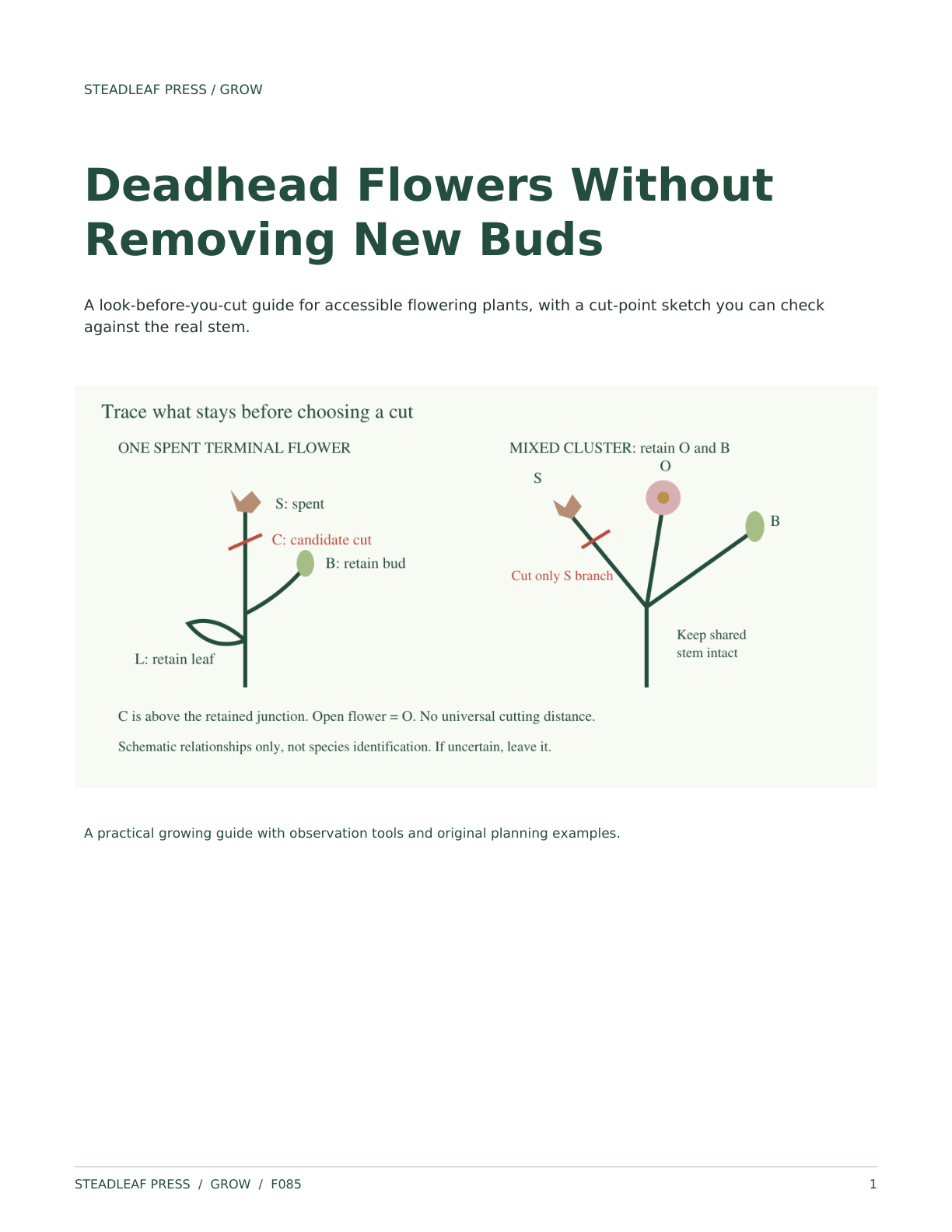
Cut-point sketch: one spent terminal flower
Use this labelled sequence for a plant whose guidance permits cutting above the retained leaf or bud:
- S is the spent flower at the end of the stalk.
- C is the proposed cut on the stalk below S but above the retained junction.
- B is a healthy bud on a side shoot connected below C.
- L is the healthy leaf or leaf junction being retained below C.
In the sketch, the section from C upwards carries S only. B and L remain connected to the plant below the cut. The actual distance above a bud, the angle and the exact structure depend on the plant's guidance; the drawing supplies no universal millimetre measurement.
Before closing the tool, say what would be removed: “This spent flower and this short stalk.” Then say what would stay: “That side bud and those leaves.” If either answer is unclear, reopen the tool and stop.
The letters describe relationships, not a prescription to manufacture this shape. Do not remove a healthy side shoot simply because the real stem differs from the diagram.
STEADLEAF PRESS / GROW / F085 4
4. Treat a mixed flower cluster differently
A cluster can carry spent flowers, open flowers and unopened buds at the same time. Iowa State describes removing individual faded flowers within a cluster, then dealing with the entire flower stem when all its flowers have finished, using the appropriate plant-specific position. [2]
Trace the tiny stalk of the individual spent flower back into the cluster. If selective removal is practical and the method is appropriate for the plant, remove only that spent part. Do not cut the shared main stalk while it still carries the flowers or buds you intend to keep.
Mixed-cluster sketch
Draw three short branches meeting at a shared junction. Label their ends S for spent, O for open and B for bud. Put the candidate cut on S's own branch, between S and the shared junction. A cut on the common stem below the junction would remove all three branches and is not the selective action shown here.
If the cluster is too dense to see the individual stalk, leave it for now. Pulling an entire handful of flowers is not a substitute for locating the correct connection.
Once a cluster has finished, look up what happens next for that plant. Some plants have leafy stems; others send flower stalks up from foliage at the base. Their removal positions differ. Do not translate “all flowers finished” into “cut everything to ground level.”
STEADLEAF PRESS / GROW / F085 5
5. Make one controlled cut, then inspect
Choose an appropriately sized, sharp, clean hand tool that can reach the selected stalk without crushing adjacent growth. Some soft spent flowers can be pinched off, but tougher or stringy stems may require a cutting tool. [1] This guide uses snips for the illustrated operation; it is not a guide to knives, tool sharpening or woody pruning.
Read the tool's instructions. Keep fingers outside the blades' path and support the plant only where your hand cannot be caught by the cut. If the stem bends away, the tool jams or you cannot see both the selected stalk and nearby buds, stop and reposition rather than tugging.
Keep the plant steady and remove the selected spent part without pulling on the retained branch. Put the removed material aside, then inspect the plant before moving to another flower. Can you still see the healthy bud and leaves that you planned to keep? Did the cut remain confined to the intended stalk?
Check any plant-specific sap or thorn precautions. Wear appropriate protection when handling an irritating or thorny plant, and avoid touching your face. Do not treat ornamental flowers as food. If you suspect disease, keep that material separate and obtain guidance on tool hygiene and disposal rather than moving immediately through the rest of your plants with the same tool.
A single cut is enough for the first rehearsal. You do not need to clear the entire container to prove that you understand the method.
STEADLEAF PRESS / GROW / F085 6
6. Record what you removed, not a promised result
Session record
Plant and date: ____
Structure: single flower / mixed cluster / other ____
Spent part identified by: ____
Retained bud, leaf or flower: ____
Removal position checked against: ____
Action: removed selected part / left uncertain / intentionally retained ____
Condition after the action: ____
Fictional example: Jo starts to place her snips below a small cluster because its largest flower has faded. Looking again, she sees an unopened bud connected above that proposed cut. She takes the snips away, identifies the faded flower's own short stalk and checks the plant's guidance. She removes only that flower. On a second cluster she cannot distinguish a green bud from a developing seed structure, so she leaves it and takes a photograph for advice. The two decisions are equally deliberate.
When you next inspect the plant, record any new flowers as an observation, not proof that the cut caused them. Weather, season, cultivar and plant condition also matter. Deadheading cannot make every species repeat-flower or repair an unsuitable growing situation.
Keep this boundary clear: removing a spent flower is the task; preserving the growth you did not intend to remove is part of completing it.
STEADLEAF PRESS / GROW / F085 7
Sources and scope
Sources directly consulted on 18 November 2026.
[1] Royal Horticultural Society. Deadheading plants. General definition, reasons to leave seedheads, many-plant cut guidance and appropriate tools. Species-specific rose, shrub, bulb and close-cutting instructions are not universalized here. https://www.rhs.org.uk/garden-jobs/deadheading-plants
[2] Iowa State University Extension and Outreach. Deadheading Herbaceous Ornamentals and Roses. Individual versus whole-cluster removal, varied responses and self-cleaning plants. Its rose leaflet counts, seasonal dates and cutting measurements are not transferred to this general guide. https://yardandgarden.extension.iastate.edu/how-to/deadheading-herbaceous-ornamentals-and-ros es
[3] RHS School Gardening. Picking and deadheading flowers. Bud and seed-pod confusion and comparison of flower stages. Its long-stem harvesting instructions are not treated as deadheading instructions for all plants. https://www.rhs.org.uk/education-learning/school-gardening/resources/ga rdening-skills/picking-and-deadheading-flowers
The labelled sketches, stop decisions, session record and fictional example are original editorial teaching tools. They are schematic, not species-identification illustrations or measured cut templates. No physical pruning, regrowth or print trial is claimed.