Grow Calendula in a Small Sunny Pot
A seed-to-flower care sheet for an identified Calendula officinalis cultivar, with room to record what actually happens.
A seed-to-flower care sheet for an identified Calendula officinalis cultivar, with room to record what actually happens.
FREE · No email or checkout
Read the complete free guide online
Read the instructional text here, or download the complete free PDF above for original diagrams, tables, worksheets and page layout. The original publication is unchanged.
STEADLEAF PRESS / GROW
Grow Calendula in a Small Sunny Pot
A seed-to-flower care sheet for an identified Calendula officinalis cultivar, with room to record what actually happens.
A practical growing guide with observation tools and original planning examples.
STEADLEAF PRESS / GROW / F086 1
A packet of calendula seed offers a colour, a name and a set of expectations. Your pot adds another set of conditions. Start by bringing those two records together, rather than trying to make a handful of seedlings fit whatever container happens to be empty.
This guide is for an accessible outdoor ornamental container. It does not cover medicinal preparations, edible-flower production, indoor forcing or structural mounting. “Small” describes a modest display, not permission to restrict a plant's roots. If your chosen cultivar needs more room than the available pot provides, change the cultivar or container before sowing.
1. Read the plant name before planning the pot
Look for Calendula officinalis and the cultivar or series on the packet. Wisconsin Extension distinguishes calendula, also called pot marigold, from Tagetes marigolds. [1] A common name alone is not enough to select instructions.
Choose a seed-propagated cultivar for this project. A plant sold under a branded name is not necessarily offered as seed. Keep the packet or photograph both sides, including the supplier's sowing and spacing instructions.
RHS lists Calendula officinalis for containers and full sun or partial shade. Its profile includes a broad size range, not the final dimensions of every cultivar. [2] For this sunny-pot plan, record the light that actually reaches the planting position. Do not infer it from a bright room seen through a window or from the direction the building faces.
Identity and place card
Botanical name: ____
Cultivar or series: ____
Seed supplier and packet date: ____
Expected mature height and spread, with source: ____
Observed outdoor sun at the intended position: ____
Local growing season and advice consulted: ____
A compact description is useful, but it is not a pot-size specification. Ask the supplier for a suitable container size and final plant count for that cultivar if the packet gives only open-ground spacing. Do not turn the stated plant height into a required pot depth, or divide the pot's area by the spacing figure and call the result a tested capacity.
STEADLEAF PRESS / GROW / F086 2
2. Make the container decision before the sowing decision
RHS explains that containers need drainage openings, that small volumes can dry rapidly and that potting compost differs from garden compost. [3] Choose a suitable container-growing medium; do not interpret the species' tolerance of relatively poor soil as an instruction to fill a pot with compacted, exhausted material.
Measure the internal opening and usable depth rather than relying on the outside decorative dimensions. Check that you can inspect the surface, reach the drainage outlet and water without leaning beyond a safe position. Keep the pot on a stable surface where drainage will not create a slip hazard or affect someone below.
Container agreement
Internal dimensions: ____
Cultivar-specific container recommendation: ____
Planned final number of plants and its basis: ____
Growing-medium product and existing feed: ____
Drainage route: ____
Person checking the pot during absences: ____
If the size recommendation is missing, mark the plan not yet confirmed. A temporary seed-starting container and the final flowering container serve different stages; label them separately if you use both. This guide's simplest route is direct sowing into a suitable final pot when local conditions permit. It does not provide a transplanting schedule for indoor-raised plants.
Make space for the record as well as the plant. Attach a weather-resistant label that will remain readable without digging around the seedlings. Put the packet somewhere dry, not underneath a wet saucer.
STEADLEAF PRESS / GROW / F086 3
3. Choose a local sowing window and record the actual depth
The RHS profile permits spring or autumn sowing in its UK context. [2] Neither season word is a universal calendar instruction. UNH's regional guide instead describes early spring sowing after heavy-frost danger has passed and soil has reached 60°F, approximately 16°C. [4] These are examples of guidance tied to conditions, not competing dates to average.
For a direct-sown pot, use the seed supplier's instructions together with local advice for your climate and growing position. An exposed container is not automatically equivalent to the garden bed described by a regional guide. Postpone if you cannot provide the required conditions or monitor the pot.
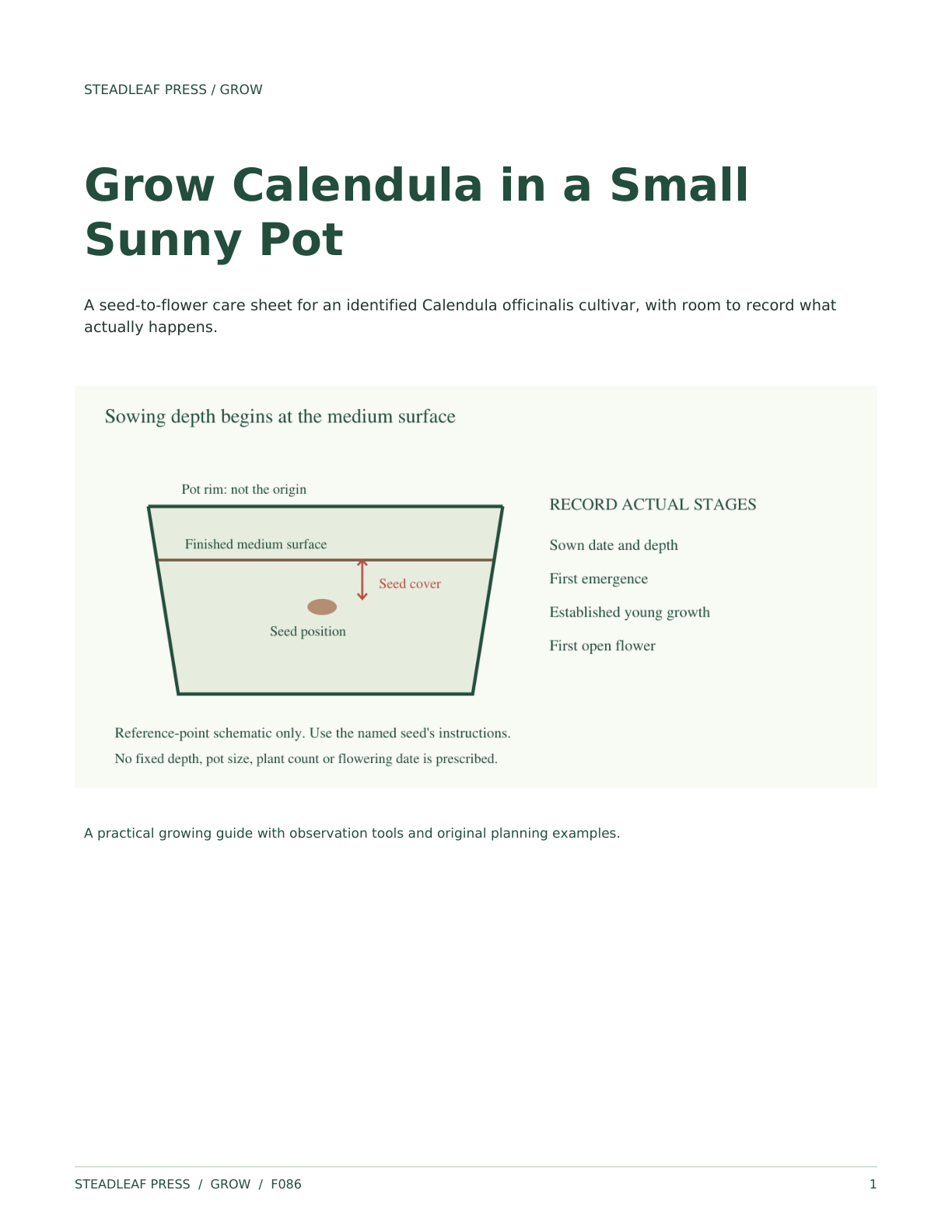
UNH gives a quarter-inch sowing depth and a 10–15-day germination estimate for its guide. [4] Record the instructions that apply to your own seed rather than copying the estimate as a deadline. A depth describes the cover above the seed, not a distance measured from the pot rim.
Sowing record
Date actually sown: ____
Depth specified for this seed: ____
Depth measured from the finished medium surface: ____
Number sown and approximate positions: ____
Expected emergence interval and its source: ____
Final thinning or spacing instruction: ____
Prepare and moisten the medium according to its instructions. Sow at the specified depth, cover gently and water in a way that does not wash the seed into one corner. Keep the medium appropriately moist for germination without leaving it saturated or standing in trapped water. Write the date after sowing, not the date you first intended to sow.
Schematic: a horizontal line marks the finished medium surface. A seed lies below it. The depth arrow runs from that surface to the seed position; the pot rim sits above the surface and is not the measuring origin. The drawing is a reference-point aid, not a universal depth template.
STEADLEAF PRESS / GROW / F086 4
4. Follow stages rather than promising a flowering date
Use three separate entries: first emergence, established young growth and first open flower. Do not fill the final box from a packet's maturity figure. The word “maturity” can be ambiguous, and an estimate is not an observation in your pot.
Checkpoint What to record Next decision
Seed is covered Actual depth, date and seed Maintain the required germination positions conditions
First seedlings appear Date and number visible Compare with the supplier's thinning instructions
Young plants occupy their planned Final retained count and any Confirm remaining plants have the places crowding intended space
Buds are visible Date and location on the plant Observe without treating unopened buds as spent flowers
First flower opens Actual date and photograph Begin a flowering-stage care record
When seedlings are ready for thinning under the chosen instructions, reduce them to the planned arrangement rather than leaving every successful seedling to compete. Avoid disturbing the retained plants' roots. If you do not know how to thin the particular arrangement safely, obtain practical guidance before pulling a tight clump apart.
If emergence is late, check seed age, depth, temperature and moisture records before sowing more into the same positions. A missing seedling does not establish which factor failed. Note the uncertainty rather than making several changes at once and losing the original record.
STEADLEAF PRESS / GROW / F086 5
5. Adjust care to the pot, not to a fixed weekly dose
Wisconsin Extension notes that calendula flowers best without heavy fertilization and may struggle during prolonged summer heat. It also identifies aphids and powdery mildew among possible problems. [1] These observations do not diagnose every pale leaf, wilted shoot or flowering pause.
Inspect the medium and plant before watering. The aim is a suitable moisture condition, not a fixed cupful every morning. After rain, check the actual medium; after hot or windy weather, check again rather than assuming yesterday's pattern still applies. Water can be needed without fertilizer being needed.
Check what feed is already in the growing medium before adding another product. Follow the relevant product and cultivar guidance rather than combining several feeds to accelerate flowering. RHS's general container advice is a reminder that limited medium needs continued attention, not a command to heavily feed calendula. [3]
For faded flowers, decide whether you want to retain seedheads or remove spent heads. RHS recommends deadheading for this species to prolong flowering. [2] Protect developing buds and use the plant-appropriate removal point. This sheet does not repeat a detailed cut-point guide or promise continuous bloom.
Observation Useful first check Avoid assuming
Flowering slows during hot Weather record, moisture and That a larger feed dose will restore weather plant condition flowers
Plant wilts Medium condition and drainage, That every wilt means dryness before adding water
White patches or insects appear Clear photographs and appropriate That a visual symptom proves one local identification help diagnosis
Pot repeatedly dries before anyone Whether the container and care That the same small pot must be can check it arrangement remain workable retained at all costs
Stop routine trimming or feeding when the plant has an unexplained serious decline. Get advice using the plant name, photographs and the record you have kept. This guide does not prescribe pesticides or a treatment for unidentified disease.
STEADLEAF PRESS / GROW / F086 6
6. Close the season with a useful record
Flowering-stage care sheet
Date / medium condition / weather: ____
Buds, open flowers and spent heads observed: ____
Water or feed actually applied, including product details: ____
Seedheads retained or spent flowers removed: ____
Concern requiring advice: ____
Next check and responsible person: ____
Fictional example: Mina chooses a compact seed cultivar but cannot find a container recommendation on its packet. She asks the supplier before buying the pot. At sowing she records the actual cover depth. Later, three seedlings appear where she planned fewer mature plants, so she follows the thinning guidance rather than treating all three as a bonus display. During a warm spell she records fewer open flowers; she does not double the fertilizer. At season's end she has dates and observations, not a claim that the pot proved a universal method.
Decide whether to keep selected seedheads, prevent unwanted self-sowing or finish the display. Wisconsin notes that unremoved flowers can lead to self-sowing. [1] Keeping seedheads is a deliberate alternative to removing them, not an overlooked task.
Before reusing the pot, record what you would change: cultivar, container size, sowing window, light position or who checks moisture. Separate an observed problem from a suspected cause. “The pot dried before the evening check” is more useful than “calendula is difficult.”
STEADLEAF PRESS / GROW / F086 7
Sources and scope
Sources directly consulted on 18 November 2026.
[1] University of Wisconsin–Madison Division of Extension. Calendula, Calendula officinalis. Identity versus Tagetes, moderate feeding, heat-related decline, possible pests and self-sowing. Culinary, medicinal, companion-pest-control and commercial propagation claims are outside this guide. https://hort.extension.wisc.edu/articles/calendula-calendula-officinalis/
[2] Royal Horticultural Society. Calendula officinalis. Container use, light, UK-context sowing seasons and flowering maintenance. Broad species dimensions and hardiness are not presented as cultivar-specific pot capacity or global winter guarantees. https://www.rhs.org.uk/plants/62350/calendula-officinalis/details
[3] Royal Horticultural Society. Growing plants in containers. Drainage, medium terminology, restricted-volume care and drying. Ballast suggestions, generic planting counts and a universal fertilizer schedule are not adopted. https://www.rhs.org.uk/container-gardening/growing-plants-in-containers
[4] University of New Hampshire Extension. How to grow calendula (Calendula officinalis). Regional sowing conditions, quarter-inch depth and germination estimate. Its open-ground spacing and maturity number are not converted into a universal pot size or promised flowering date. https://extension.unh.edu/resource/how-grow-calendula-calendula-officinalis
The container agreement, stage record, depth-reference schematic and fictional example are original editorial tools. No germination, flowering, physical planting or print trial is claimed. This ornamental guide is not food-safety or medical advice.