Keep a Shady Flower Box Interesting With Foliage
A foliage-texture composition plan that begins with the view and ends with a compatible, maintainable planting.
A foliage-texture composition plan that begins with the view and ends with a compatible, maintainable planting.
FREE · No email or checkout
Read the complete free guide online
Read the instructional text here, or download the complete free PDF above for original diagrams, tables, worksheets and page layout. The original publication is unchanged.
STEADLEAF PRESS / GROW
Keep a Shady Flower Box Interesting With Foliage
A foliage-texture composition plan that begins with the view and ends with a compatible, maintainable planting.
A practical growing guide with observation tools and original planning examples.
STEADLEAF PRESS / GROW / F087 1
Stand where you normally see the flower box, not where you normally water it. From a chair across the room, a tiny patterned leaf may disappear into the background. A broad leaf beside a finely divided one may remain distinct even when there are no flowers. That difference is the starting point for this plan.
The aim is not to make a dark place suitable by choosing brighter leaves. It is to design a foliage-led display using plants that genuinely suit the available conditions. This guide is for an accessible, already safely supported container. It does not approve window-box brackets, loads, exterior access or installation. Never lean outside to arrange a display.
1. Describe the shade before choosing the look
RHS distinguishes several kinds of shade and explains that light changes with time of day. Moderate shade may favour foliage interest over flowering; very dense shade severely limits suitable plants. [1] A box beneath an overhang is not automatically the same growing environment as one receiving moving shade through a tree.
Record what reaches the box during the intended display season. Note direct sun, open sky, reflected light and any obstruction. Describe whether rain reaches the medium rather than assuming a shaded location stays moist. If you cannot establish that the place supplies enough light for your candidates, leave the planting decision open.
Site and viewing card
Display season: ____
Observed light and time of observation: ____
What casts the shade: ____
Rain exposure and watering access: ____
Main viewing position and approximate distance: ____
Background seen behind the leaves: ____
Choose one main view for the first sketch. It might be the kitchen doorway, an outdoor seat or a safe position beside the box. Mark other important views separately. A composition that reads clearly from one direction need not look identical from every side.
STEADLEAF PRESS / GROW / F087 2
2. Make a leaf comparison before a shopping list
Illinois Extension describes texture as relative: leaf size and shape, and also surface qualities, affect the impression. Contrasting textures can create drama; similar ones can feel more harmonious. [2] Here, “coarse” is a visual description, not a criticism of a plant or a recommendation to touch it.
Compare photographs or intact nursery plants without removing leaves. Look for one contrast you can actually see from the intended distance. For example, broad simple shapes and a finer divided outline may form a useful pair. This is a design relationship, not proof that the two plants share growing requirements.
Use the following original comparison exercise:
1. Draw a broad leaf silhouette on a card and a fine divided silhouette on another.
2. Place the cards next to each other against a sketch or photograph of the box's background.
3. Look from the chosen viewing distance. Are both shapes still legible?
4. Swap their positions. Does one obscure the other or seem lost?
5. Write down the arrangement you prefer, including the option to use only one texture.
Do not add a third contrast just to make the sketch busier. Leave enough quiet visual space to notice the first relationship. A card exercise helps clarify your preference before money or roots are committed.
Visual role card
Dominant texture I want to notice: ____
Contrasting or repeating texture: ____
Reason it works from the actual view: ____
Colour relationship, if important: ____
Detail that disappears at this distance: ____
A pale leaf may look conspicuous against a dark wall, but that is a viewing judgement. Pale or variegated foliage is not evidence of shade tolerance. Verify the named plant separately.
STEADLEAF PRESS / GROW / F087 3
3. Replace the visual roles with identified candidates
For each role, find a named species and cultivar whose documented needs fit the site. Read the whole label, not just the attractive front photograph. Check expected mature dimensions, container suitability, moisture, medium, temperature and seasonal persistence.
Illinois's container guidance emphasizes compatible light, soil and watering needs, and notes that a single kind of plant is simplest to maintain. [2] Its Gazebo Containers page likewise requires compatible light and moisture. [3] A pleasing contrast is not a reason to put plants with conflicting requirements into the same root zone.
Candidate check Dominant texture Companion texture
Botanical name and cultivar ____ ____
Source of growing guidance ____ ____
Light suitability for this place ____ ____
Moisture and medium ____ ____ requirements
Expected dimensions and ____ ____ container guidance
Seasonal foliage and temperature ____ ____ limits
Access precautions for people or ____ ____ animals
Mark each unresolved entry as unknown. Do not fill it with the other plant's information. If compatibility cannot be established, keep the candidates separate or choose a different companion. Do not try to solve a genuine moisture conflict by watering one side of a shared box and hoping the boundary behaves like a separate pot.
The plan does not supply a universal list of “shade plants.” Cultivars differ, climates differ, and some attractive seasonal foliage will not persist through local winter conditions. A temporary display needs an end-of-season decision just as much as a permanent one.
STEADLEAF PRESS / GROW / F087 4
4. Draw the view and the growing space separately
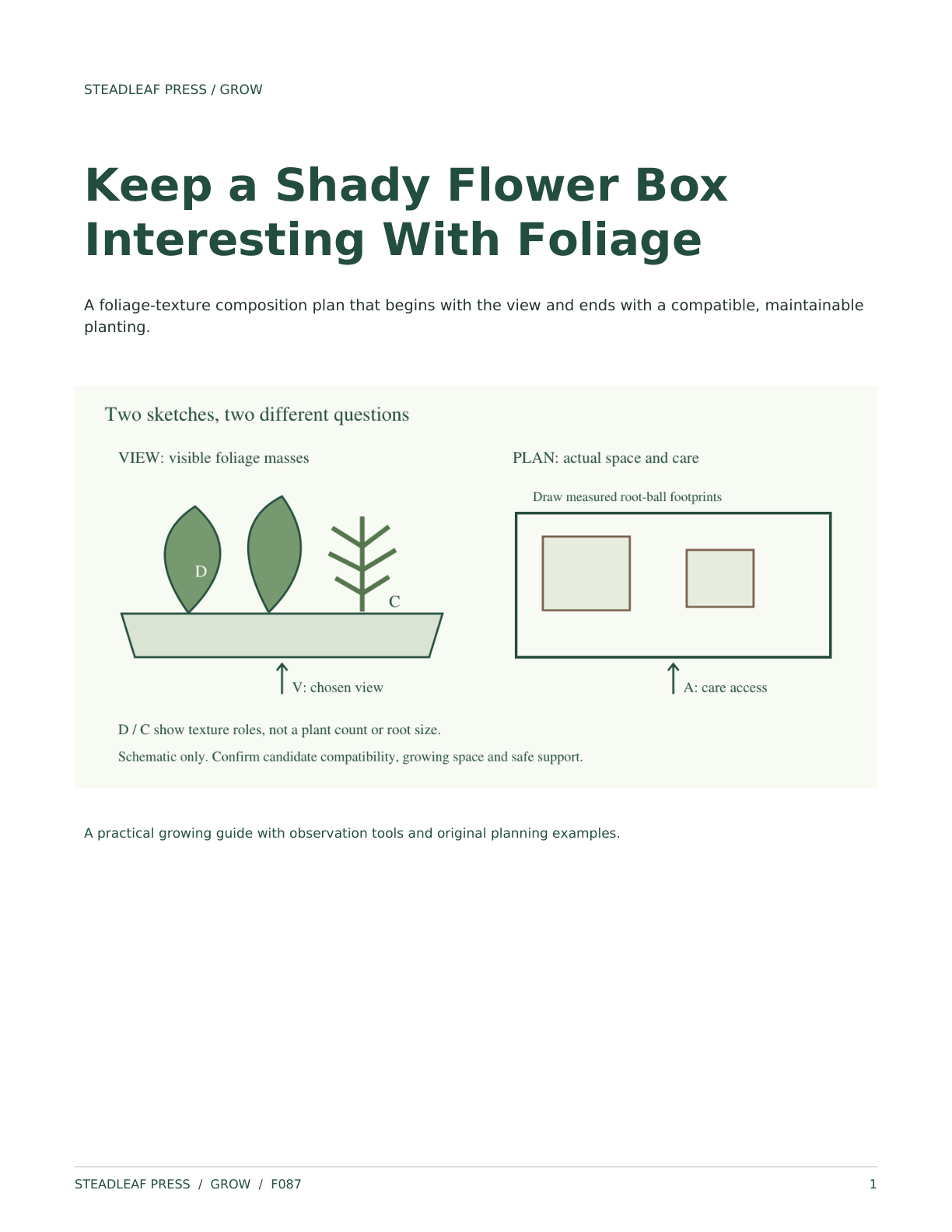
Use two sketches. The first shows what you want to see; the second checks what must physically fit. Do not let an attractive front elevation substitute for a container plan.
Sketch A: the view
Draw the visible outline of the box. Add broad leaf symbols labelled D for dominant texture and finer symbols labelled C for contrast. Leave part of each intended texture visible. Add an arrow marked V from the chosen viewing position.
These symbols show visual masses, not individual plants. Three broad-leaf symbols do not prescribe three specimens. The apparent size of the foliage is also not the size of its root system.
Sketch B: the planting and care plan
Draw the internal container footprint. Add the actual current root-ball footprints at the positions being considered, along with the space required by the selected plants' guidance. Mark the watering and inspection approach A. Note the drainage route separately.
Confirm internal dimensions, usable depth and final plant count with suitable guidance for the actual candidates. If those facts are missing, label the sketch provisional rather than planting to a decorative pattern. The number of nursery pots you can stand in the box is not, by itself, the number of plants it can support over the display period.
Before planting
- Can I identify every plant and its care requirements?
- Have I distinguished nursery size from expected growth?
- Does the physical arrangement follow the selected plants' guidance?
- Can I inspect the medium and reach the watering points safely?
- Can the required drainage remain functional?
- Is the intended viewing contrast still visible without crowding the plants?
If the answer to the last question is no, change the composition rather than reducing necessary growing space. A less elaborate display can be the more successful design.
STEADLEAF PRESS / GROW / F087 5
5. Test the composition without treating the test as a growing trial
Use paper shapes first. If you later compare real nursery plants, keep them in their pots and work on a stable, accessible surface. This is a brief visual rehearsal, not an instruction to leave small nursery pots unattended inside a box or to plant through unsuitable weather.
Look from V again. Then use A to check the care approach. A leaf arrangement that looks balanced may conceal the only place where you can inspect the medium. Move the visual masses on paper and reassess the candidate positions before disturbing roots.
Fictional example: Sam plans a box viewed from a dining chair. His first sketch includes several small patterned leaves, but the patterns vanish from that distance. He changes the concept to one broad visual mass beside a fine outline. One candidate needs conditions incompatible with the other, so he rejects the pairing despite liking its colours. The replacement pair passes the care comparison, but its mature-space guidance allows fewer plants than the drawing appeared to suggest. He redraws the symbols as masses rather than adding extra specimens.
A successful rehearsal means the arrangement is understandable and workable enough to proceed under the plants' guidance. It does not establish survival, root development, winter hardiness or structural safety.
STEADLEAF PRESS / GROW / F087 6
6. Review foliage and health as separate questions
After planting under the chosen species-specific instructions, retain the plan and photograph the display from the same main view. Record the date and conditions. Later comparisons should distinguish a design change from a health concern.
What changed Design question Care question
One texture hides the other Has the visual balance shifted? Is this expected growth or an unsuitable placement?
A leaf colour looks duller Has the background or lighting Is there a concerning change changed? requiring plant-specific advice?
The box looks sparse Is the original expectation too Are the plants developing normally dense? for the season?
Leaves decline or collapse Do not treat this as a styling Check conditions and seek problem appropriate identification or care advice
Do not remove healthy foliage merely to force the plant back into the sketch. Look up the pruning limits of the named plant before making changes. If a candidate outgrows the arrangement, reconsider the plan rather than assuming repeated cutting will make it permanently suitable.
Review record
Date and photograph reference: ____
View used: ____
Texture relationship still visible: ____
Health or care concern, kept separate from appearance: ____
Action taken or reason for leaving unchanged: ____
Next review or seasonal transition: ____
The finished plan is not a promise of flowers in shade. It is a way to make foliage worth looking at while preserving the conditions that allow the plants to grow. Sometimes the best result is one well-chosen kind of plant, repeated or simply allowed enough room to be seen.
STEADLEAF PRESS / GROW / F087 7
Sources and scope
Sources directly consulted on 18 November 2026.
[1] Royal Horticultural Society. Shade gardening. Different shade conditions, changing light, reduced flowering and limits of very dense shade. Open-ground soil amendments and its specific plant combinations are not transferred to a window-box recipe. https://www.rhs.org.uk/garden-design/shade-gardening
[2] University of Illinois Extension. Plants: Container Gardens. Relative leaf texture, contrasting versus harmonious effects, plant identity and compatible growing requirements. Odd-number and height-proportion preferences are not treated as required plant counts or structural rules. https://extension.illinois.edu/container-gardens/plants-0
[3] University of Illinois Extension. Gazebo Containers. Compatibility of light and moisture needs in mixed containers. The demonstration garden's feeding routine and named example combinations are not generalized to all shady boxes. https://extension.illinois.edu/mg/gazebo-containers
The viewing cards, two-sketch method, review table and fictional example are original editorial teaching tools. No planting, long-term shade performance, mounting, physical load or print test is claimed. The sketches are not installation drawings or horticultural guarantees.