Balance Flower Colors in a Three-Pot Display
A simple palette and placement board for three separate containers, comparing the same three plants against one background at one viewing time.
A simple palette and placement board for three separate containers, comparing the same three plants against one background at one viewing time.
FREE · No email or checkout
Read the complete free guide online
Read the instructional text here, or download the complete free PDF above for original diagrams, tables, worksheets and page layout. The original publication is unchanged.
STEADLEAF PRESS / GROW
Balance Flower Colors in a Three-Pot Display
A simple palette and placement board for three separate containers, comparing the same three plants against one background at one viewing time.
A practical growing guide with observation tools and original planning examples.
STEADLEAF PRESS / GROW / F088 1
Three pots do not have to mean three unrelated flower colours. They can repeat one colour, carry a quiet progression or set a small accent beside a larger field of another hue. The useful question is not “Which three colours must I buy?” but “What relationship do I want to see from here?”
This guide helps you make that decision on paper, then check it against real plants and a safe growing position. It is not a planting recipe, a rule about three specimens per pot or permission to put heavy containers on an unverified surface. Each pot keeps its own root space and care requirements. This is a same-view composition exercise, not an annual colour calendar, succession plan or guide to filling seasonal gaps.
1. Put the background on the board first
Photograph or sketch the intended setting from your usual viewing position. Include the wall, paving, railing or surrounding foliage rather than cropping the view to an empty rectangle. Illinois Extension explains that background and light affect how a colour appears and suggests using a photograph when coordinating plants and containers. [1]
Place three empty pot outlines over that background. Label them A, B and C. Include the containers' own colours: a vivid glazed pot is part of the display even when its flowers are absent.
Setting card
Main viewing position: ____
Usual viewing time: ____
Background colours: ____
Container colours and visible proportions: ____
Date and light of this comparison: ____
Safe standing space and care access: ____
Compare the board in the light in which you normally enjoy the display. A screen photograph is a planning reference, not a calibrated flower-colour sample. If possible, look at the actual flowers before choosing them. Keep written colour names beside the swatches so the plan does not depend on distinguishing colour alone.
STEADLEAF PRESS / GROW / F088 2
2. Choose one relationship, then test an alternative
Illinois describes monochromatic schemes as variations within one hue, analogous schemes as neighbouring colours on a colour wheel and complementary schemes as opposing colours. [1] These are useful starting points, not mandatory formulas or guarantees that everyone will prefer the same arrangement.
Choose three actual plants, or three clearly labelled proposed candidates, to represent. Note which colours repeat and which contrast. Then make two paper versions using that same set:
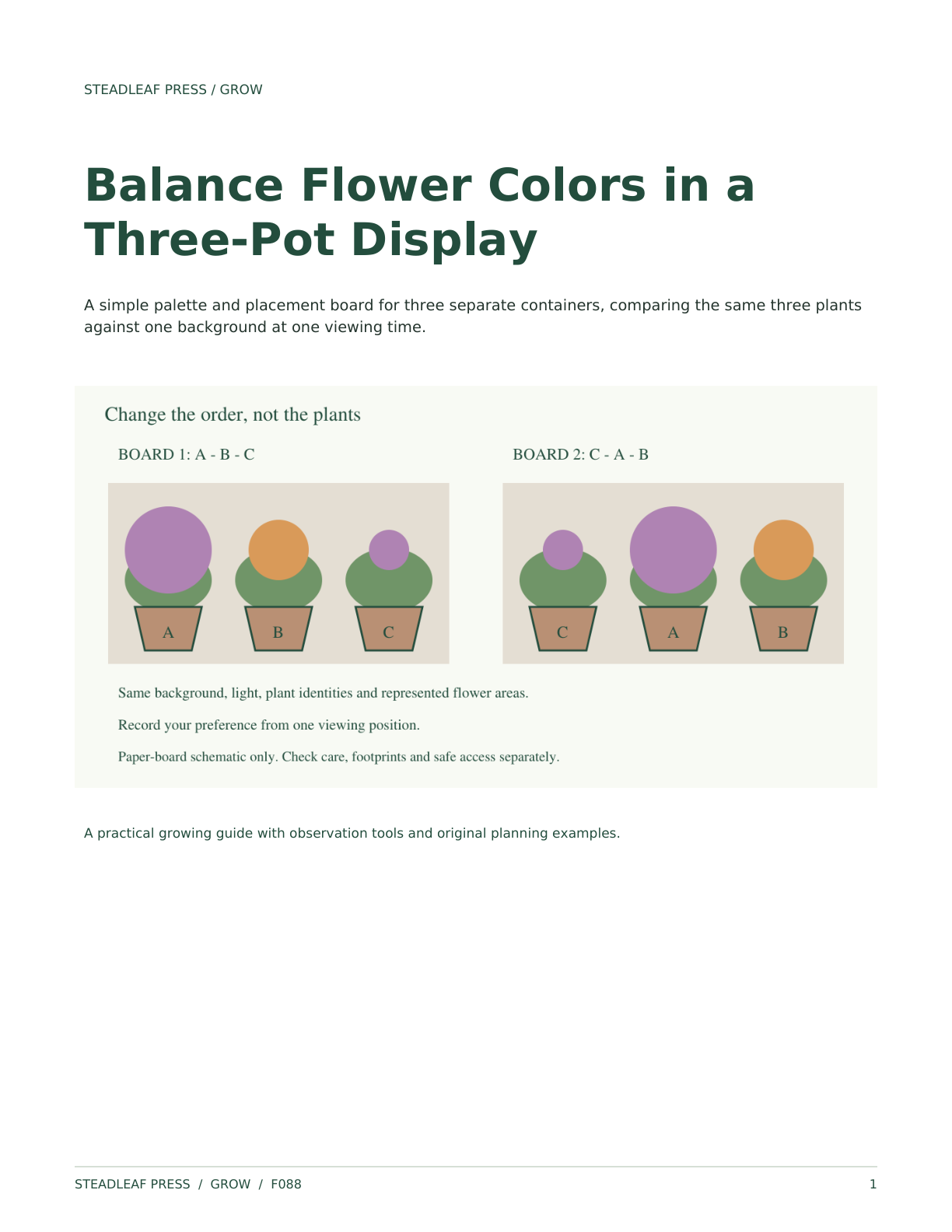
- Board 1, current or first order: place the labelled pot cut-outs A–B–C against the background.
- Board 2, reordered: move those same cut-outs to C–A–B. Keep each plant's colour and represented area unchanged.
For example, if A and C share a hue, the second order brings those related colours together rather than putting them at opposite ends. If the candidates have different relationships, describe those instead. No particular hue or arrangement is mandatory.
The boards are original exercises. They do not prescribe species, pot sizes or a number of flowers. You can keep the first order. If you prefer a new set of plants or colours, label that as a different proposal rather than silently changing the set between these two boards.
Draw the visible flower area, not just three equally sized dots. A few bright flowers and a dense mound of paler ones may have different visual effects. You do not need to measure a percentage to decide which attracts your eye first.
Palette choice
Main colour or colour family: ____
Repeated colour: ____
Accent, if any: ____
What I notice first: ____
What I want to change: ____
Chosen board and reason: ____
Keep the foliage in the drawing. The RHS notes that green can unify a planting and provide a pause between other colours. [2] Do not colour every part of a plant outline as though it will be covered in flowers all season.
STEADLEAF PRESS / GROW / F088 3
3. Keep the comparison fair
Use the same three plant images or swatches on both boards. Do not compare one version made from peak-flowering catalogue photographs with another showing the plants as they look today. That changes the evidence as well as the arrangement.
For an existing group, sketch the flowers actually visible now, including a plant with no open flowers. For a proposed purchase, label the swatches as proposed and keep any uncertainty visible. A flowerless plant is not a blank space to fill with an invented bloom colour.
Keep these items unchanged while comparing the two boards:
- The background photograph and its crop.
- The three pot identities and the represented amount of foliage.
- The approximate visible flower area for each plant.
- The viewing position and the light used to inspect the boards.
First change only the order. If you also want to consider a different colour or plant, make a separately labelled third board. This prevents a preference for a completely different plant from being mistaken for evidence about placement.
Same-view comparison card
Check Board 1 Board 2
Same three plant identities? ____ ____
Same background and light? ____ ____
Actual or proposed flower areas ____ ____ labelled?
Pot order ____ ____
What attracts my eye first? ____ ____
What seems lost against the ____ ____ background?
Preferred version and reason ____ ____
The comparison is a design exercise, not a scientific experiment or proof that a colour has a universal effect. If one arrangement hides a plant, record that rather than enlarging its drawing to make the board look balanced. You can also prefer the original order and make no change.
Flower availability still limits any future plan. Confirm that intended flowers can reasonably be present for the viewing occasion before buying. If that is unknown, keep the scheme provisional. This board does not schedule flowering or replace local seasonal planning.
STEADLEAF PRESS / GROW / F088 4
4. Keep the three care plans separate
Colour is the final selection filter, not the first qualification for growing in the position. Confirm each candidate's light, temperature, container, medium and moisture requirements. Check that all three can occupy their proposed places without one shading another beyond its tolerance.
Separate pots let you use different suitable growing media or watering decisions, but they do not make every combination manageable. If you cannot reliably provide the distinct care, simplify the selection. A palette that needs constant rescue is not a successful plan.
Per-pot care line
Pot ID: ____
Plant identity and guidance: ____
Container size and drainage confirmed: ____
Light and temperature suitability: ____
Watering decision based on: ____
Existing feed and any further product guidance: ____
Access precautions for people or animals: ____
Copy this line for A, B and C. Label the actual containers to match the board. A shared display does not justify pouring the same quantity of water or fertilizer into every pot. Nor should one pot's drainage collect around another in a way that defeats the intended care.
If you plan mixed planting within a pot, check compatibility inside that pot separately. The three-pot palette board does not resolve the root-space and shared-medium requirements of a mixed container.
STEADLEAF PRESS / GROW / F088 5
5. Rehearse placement without lifting a heavy pot
Illinois describes groups of containers as flexible arrangements that can change as they develop. [3] Use that flexibility at the planning stage first: move the paper outlines rather than repeatedly moving full pots.
Draw the actual footprints on a placement plan. Mark the viewing point V and a clear care approach A. Include door swing, walking routes and the space the plants are expected to occupy. Do not arrange a narrow passage around a drawing that shows only the pot bases.
Try A–B–C, then C–A–B on paper. Changing the order may change how the accent works without requiring a different plant. Keep written pot IDs fixed to their plants; position is the thing being changed.
Schematic board: three separate pot shapes are labelled A, B and C, each with a flower-colour swatch and a green foliage area. A background strip sits behind them. Beneath the swatches is a row recording the same-view comparison conditions. A separate footprint plan shows V and the care approach. No distances or load capacities are implied.
Place real containers only where the surface and arrangement are already suitable. Do not improvise stacked-pot stands, use an unstable support or lift beyond your capacity to achieve a height effect. This guide does not adopt elevation suggestions from general design articles as installation instructions.
STEADLEAF PRESS / GROW / F088 6
6. Record the decision, not a promise
Take a photograph from V after arranging the containers. Record the actual viewing light and date. If you revisit the decision later, make a new dated board rather than treating a changed plant as an unchanged comparison. Compare the overall effect without treating a photograph as a diagnosis of plant health.
Observation Design response to consider Boundary
Accent now dominates Revise the next board or safely Do not crowd or shade a plant to reconsider order suppress its colour
One plant is hidden behind another Reconsider order on paper with the Do not cut healthy growth solely to same plant images enforce the drawing
A flower colour differs from the Update the recorded swatch and Do not promise an exact catalogue image cultivar details screen-to-flower match
Plant health declines Investigate care and seek suitable Styling is not treatment advice
Fictional example: Noor photographs three existing flowering pots against her patterned wall. Her first board uses three equal colour circles, although one plant has only a small area of open flowers. She redraws the areas to match what she can see, then compares A–B–C with C–A–B using the same cut-outs. In the second order, the small pale patch is easier for her to distinguish from the background. She records that preference, checks the plants' care and access constraints and decides whether a safe rearrangement is worthwhile. She has not bought another plant or predicted a later season.
Final board record
Chosen palette and pot order: ____
Comparison date, light and background: ____
Actual or proposed colour areas: ____
Care differences that must remain visible: ____
Safe placement checked by: ____
Reason for changing or keeping the current order: ____
Balance is a preference you can revise. It does not require equal flower counts, equal pot sizes or three new purchases. The best board is one you can recognize in the real setting and maintain without sacrificing the plants' needs.
STEADLEAF PRESS / GROW / F088 7
Sources and scope
Sources directly consulted on 18 November 2026.
[1] University of Illinois Extension. Color Considerations. Background and lighting, colour-wheel relationships and planning with photographs. Subjective effects are starting points, not universal psychological promises. https://extension.illinois.edu/container-gardens/color-considerations
[2] Royal Horticultural Society. How to plan a border. The unifying role of foliage. Border density, ground preparation, regional aspect generalizations and planting dates are not used as container prescriptions. https://www.rhs.org.uk/garden-design/how-to-plan-a-border
[3] University of Illinois Extension. Landscaping with Containers. Grouped containers and changing arrangements. Improvised supports and elevation methods are not adopted. https://extension.illinois.edu/container-gardens/landscaping-containers
The two-board exercises, same-view comparison card, per-pot care line and fictional example are original editorial tools. No flowering synchronization, physical load, placement, colour calibration or print test is claimed. This is a planning guide, not approval of a particular installation.