Replace a Spent Annual in a Mixed Container
A selective replanting sequence with a stop point when neighbouring roots cannot be protected.
A selective replanting sequence with a stop point when neighbouring roots cannot be protected.
FREE · No email or checkout
Read the complete free guide online
Read the instructional text here, or download the complete free PDF above for original diagrams, tables, worksheets and page layout. The original publication is unchanged.
STEADLEAF PRESS / GROW
Replace a Spent Annual in a Mixed Container
A selective replanting sequence with a stop point when neighbouring roots cannot be protected.
A practical growing guide with observation tools and original planning examples.
STEADLEAF PRESS / GROW / F089 1
One tired plant does not necessarily mean the whole container needs emptying. It also does not mean that the plant can be pulled out without affecting its neighbours. Roots do not follow the neat circles in a planting sketch.
This guide helps you decide whether a small, accessible ornamental annual can be replaced individually. It is not a promise of undisturbed roots. It excludes woody plants, established perennial divisions, bulbs, edible-crop sanitation, suspected contamination and work from an unsafe window or hanging position. A plant that is merely between flowers may need no replacement at all.
1. Decide what has actually finished
Identify the plant and check its expected seasonal behaviour. Record what you can see rather than writing “dead” because the flowers have faded. A healthy plant with developing buds is a different situation from one that has completed its annual display. A tender perennial sold as bedding is not automatically a true annual.
Illinois Extension describes selective changes within a container as one option alongside replacing an entire planting or rearranging separate pots. [1] That supports considering a small change; it does not establish that every mixed root system can be separated safely.
Before-work decision card
Target plant and cultivar: ____
Why replacement is being considered: ____
Guidance checked for its seasonal behaviour: ____
Condition of neighbouring plants: ____
Known recent watering, feeding or weather problem: ____
Decision: leave / observe / investigate / consider replacement
Do not use this sequence to conceal an unexplained collapse. If several plants decline together, the shared medium, drainage or conditions may be involved. If you suspect pests, disease or chemical contamination, keep the replacement out and seek appropriate local horticultural advice. A fresh plant is not a diagnostic test.
The following stop rules are conservative editorial boundaries, not a method for identifying a disease. Unexplained soft decay, spreading symptoms, an unusual smell or uncertainty about the cause is enough to postpone this cosmetic task.
STEADLEAF PRESS / GROW / F089 2
2. Check the replacement before disturbing the planting
Keep the proposed replacement in its nursery pot while you assess it. Confirm its identity, condition, expected size and suitability for the actual light, temperature, growing medium and moisture regime. Illinois's shared-container guidance stresses compatible light and moisture requirements. [2] A matching flower colour cannot resolve conflicting care needs in one root zone.
Compare the nursery root-ball dimensions with the space you may be able to open. The visible gap between leaves is not a measured underground planting pocket. Do not buy a larger specimen on the assumption that you will carve out enough space.
Question Evidence or decision
Is this named plant suitable for the existing ____ conditions?
Does its documented container requirement fit? ____
Can its root ball fit without compressing or cutting Not yet confirmed / ____ neighbouring roots?
Is the current medium still suitable for all retained ____ plants?
Can watering and inspection remain accessible? ____
What will I do if selective removal is not possible? ____
The RHS advises choosing a container and growing medium suited to the plants. [3] Here the container is already occupied, so an unsuitable candidate must be rejected rather than making the remaining plants accommodate it.
Have a separate suitable place for the nursery plant if the task stops. Leaving it unplanted is a valid outcome. You do not have to complete the replacement on the day you begin assessing it.
STEADLEAF PRESS / GROW / F089 3
3. Prepare a small, controlled work area
Work only where the container is already safely supported and you can reach the target without leaning outside or lifting beyond your capacity. Do not use a neighbouring stem or a trailing plant as a handhold.
Gather clean gloves if needed for the plants involved, a small hand tool, a tray for removed material, appropriate fresh potting medium and a watering can. Follow the medium bag's handling instructions. Keep the plant labels available. Do not place tools across neighbouring crowns or leave loose material where people or animals can reach it.
Check moisture before starting. Avoid trying to extract a hard, dry mass or working a saturated, unstable planting. Let the container reach a manageable condition consistent with the plants' care needs. This is not an instruction to soak an already wet pot or wait a fixed number of hours.
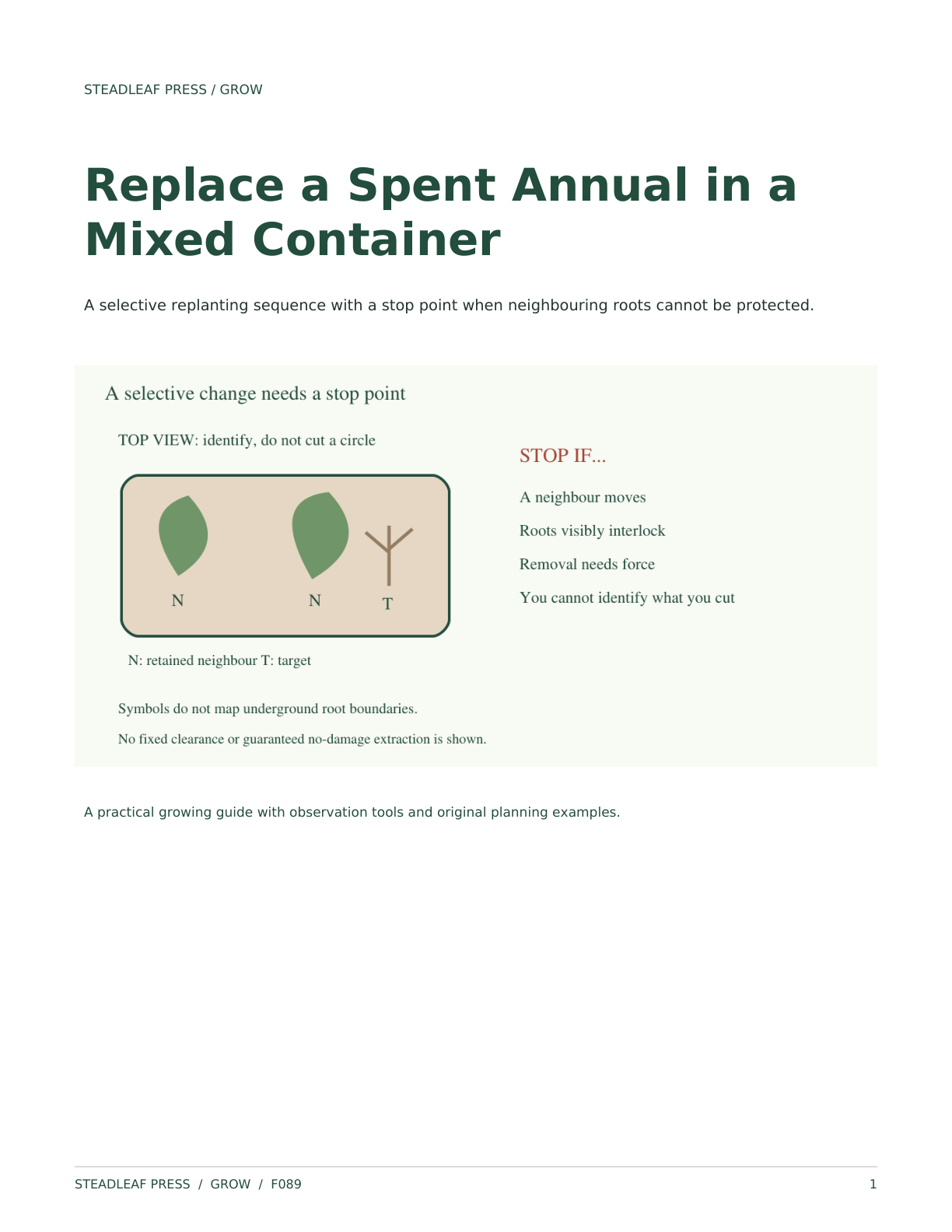
Photograph the planting and mark the target T and retained neighbours N on a simple sketch. Note each retained plant's present stem position and medium level. These are reference observations, not a map of where all roots lie.
Schematic: a top view labels one target T beside retained plants N. A second panel shows “neighbour moves or roots interlock → stop.” No cutting circle, fixed clearance or underground root boundary is drawn.
STEADLEAF PRESS / GROW / F089 4
4. Test whether the target can be removed selectively
Move loose surface decoration out of the immediate working area without scraping across crowns. Keep neighbouring foliage out of the way gently; do not bend it sharply, bind it tightly or trim healthy leaves just to improve access.
Begin at an accessible outer edge of the target's root mass. Use fingers or the small hand tool only where you can see and control what you are doing. Ease loose medium away in small amounts. Do not drive a blade vertically around the plant as though a drawn circle separates its roots from everyone else's.
Support the target's root mass as it becomes accessible. Do not yank the stem, twist the plant against its neighbours or use the container rim as a lever. The relevant test is whether the mass releases with gentle, controlled handling while the retained planting stays stable.
Stop if a neighbour tilts or rises, if roots visibly link the plants, if resistance requires force, or if you cannot tell what you would cut. Do not keep pulling to find out how much resistance the roots can tolerate. Settle any loosened retained medium gently back into place without burying crowns, then seek advice or plan a different whole-container task. This guide does not teach root pruning or division.
If the target releases cleanly enough for this limited task, place it on the tray. Inspect the resulting pocket without widening it into the neighbours. Do not chase every fine root through the shared medium. Equally, do not plant into unexplained decay or suspicious material simply because the top growth has been removed.
STEADLEAF PRESS / GROW / F089 5
5. Recheck the pocket and plant only if it fits
Now compare the actual pocket with the replacement's intact root ball. If it will not fit at the appropriate planting level without squeezing it, cutting roots or lifting neighbours, stop. The earlier estimate was provisional. Use a smaller suitable candidate or leave the space pending a new plan; do not improvise by burying the replacement deeper.
Illinois advises planting at the level used in the original pot. [1] Apply that to a suitable ordinary bedding replacement unless the named plant's instructions specify otherwise. Do not raise the surrounding medium over retained crowns to make the new plant's level look even.
Add appropriate potting medium only where needed around the replacement. Gently settle it into contact with the root ball, without stamping, tightly packing the pocket or filling the whole container to its rim. The RHS describes gentle gap filling and retaining room for watering. [3] Its whole-container setup is not a licence to rebuild the occupied planting around a reluctant root ball.
Water in carefully, using a gentle flow that does not wash medium away. Check that drainage still works and avoid leaving the container standing in accumulated water. The RHS recommends slow, thorough watering after planting and emphasizes that later watering depends on conditions. [3] Do not interpret that as repeatedly flooding an already wet shared container.
Keep any existing fertilizer information with the care record. A newly filled pocket does not justify adding an unmeasured extra dose to the entire planting. Follow the actual plants', medium's and product's guidance.
STEADLEAF PRESS / GROW / F089 6
6. Watch both the new plant and the retained neighbours
Record the work immediately. On subsequent ordinary care checks, compare the replacement and its neighbours with the baseline. The new root ball and older surrounding medium may not dry alike. Assess the relevant moisture and drainage rather than using a fixed daily watering dose.
Observation Next step
Replacement or retained plant wilts Check moisture, drainage and conditions; do not automatically add more water
A retained stem is newly loose or tilted Stop further cosmetic work and assess possible disturbance
Medium settles around the replacement Check planting level; add suitable medium only if needed without burying crowns
Unexplained decline continues or spreads Seek advice with identity, photographs and care history
Selective-change record
Date and target removed: ____
Reason and evidence: ____
Did neighbours remain stable during removal? ____
Replacement identity and original planting level: ____
Medium added and existing feed information: ____
Watering-in and drainage observation: ____
Later observation and action: ____
Fictional example: Eli plans to replace a finished bedding plant near the edge of a shared pot. At the first gentle loosening, the neighbouring plant moves too. Eli stops, settles the loosened medium and keeps the replacement in its nursery pot under appropriate care. The selective-change record says “not completed: neighbouring movement,” not “success.” A gap in the display is preferable to pretending that the root systems were independent.
Success here is an informed, limited decision. It may be a compatible replacement, a postponed task or a choice to leave a healthy plant alone. No sequence can guarantee that living neighbours remain entirely undisturbed.
STEADLEAF PRESS / GROW / F089 7
Sources and scope
Sources directly consulted on 18 November 2026.
[1] University of Illinois Extension. Designs, Container Gardens. Selective seasonal changes and ordinary planting-level guidance. Tight spacing, root-ball squeezing and regional species or winter examples are not adopted. https://extension.illinois.edu/container-gardens/designs
[2] University of Illinois Extension. Gazebo Containers. Shared light and moisture compatibility. Demonstration feeding routines and named combinations are not universal prescriptions. https://extension.illinois.edu/mg/gazebo-containers
[3] Royal Horticultural Society. How to plant up a container. Suitable medium/container, gentle gap filling, watering room and watering-in principles. This guide does not transfer its new-container construction, mulch or hole-covering directions to an occupied root system. https://www.rhs.org.uk/container-gardening/how-to-plant-up-a-container
The staged stop decisions, comparison card and fictional example are original editorial tools. The sources support the stated general planting principles; they do not validate a guaranteed no-damage extraction method. No physical removal, root examination, planting, recovery or structural trial is claimed.