Choose a Plant Stand Without Overloading It
Steadleaf Press
Choose a plant stand by its instructions, the complete wet weight of the pots and the conditions where it will be used. The finished checklist separates three questions: what the stand can support, whether the pots fit, and whether the location is suitable.
FREE · No email or checkout
Read the complete free guide online
Read the instructional text here, or download the complete free PDF above for original diagrams, tables, worksheets and page layout. The original publication is unchanged.
STEADLEAF PRESS / GROW
Choose a Plant Stand Without Overloading It
Steadleaf Press
A practical growing guide with observation tools and original planning examples.
STEADLEAF PRESS / GROW / F091 1
Choose a plant stand by its instructions, the complete wet weight of the pots and the conditions where it will be used. The finished checklist separates three questions: what the stand can support, whether the pots fit, and whether the location is suitable.
Start with the pots you intend to support
A plant stand can make a small collection easier to see and care for. It can also raise a heavy, wet object above the floor. Decide what it needs to hold before choosing the shape or finish.
List each pot, its saucer or outer container, and the plant it holds. Include anything else that would sit on the stand. A watering can, decorative stone or spare bag of mix is still a load, even if it is there only briefly.
For a first arrangement, prefer a simple design with clear instructions and accessible platforms. A stand is not a step stool, seat, climbing frame or improvised workbench. Keep it out of routes where someone is likely to catch a foot on its legs or grab it for support.
Read what the rating actually describes
Find the manufacturer's instructions for the exact model and size. A listing photograph is not a load specification. Check whether a quoted limit applies to one shelf, one pot holder, or the whole stand, and whether it depends on a specified arrangement.
Two current manufacturer examples show why wording matters. IKEA's DAKSJUS listing specifies indoor use and a maximum load per shelf. Its VISINGSÖ outdoor stand lists a maximum load for the product. These examples illustrate different descriptions, not interchangeable capacities or purchase recommendations. Read the current instructions for your own model. DAKSJUS product information · VISINGSÖ product information
Do not multiply a shelf rating by the number of shelves and call the result a total rating unless the manufacturer supports that interpretation. If a listing says only “heavy duty,” ask for a documented capacity and permitted use. If the important answer is unavailable, choose a different stand.
Specification Exact wording for this model Clear enough to decide?
Indoor or outdoor use _____ _____
Whole-stand maximum _____ _____
Individual shelf or holder _____ _____ maximum
Permitted pot dimensions _____ _____
Required assembly or restraint _____ _____
Suitable supporting surface _____ _____
Inspection and maintenance _____ _____ instructions
Keep a copy of the model number and instructions. Similar-looking versions may have different limits.
STEADLEAF PRESS / GROW / F091 2
Account for the complete wet load
A dry bag's labelled weight does not tell you the weight of the finished planted container. The load includes the pot, growing medium, plant, saucer or cachepot, retained water and any accessories. Rutgers Extension identifies wet weight as a property that varies with the components of a growing medium. A single density assumption will not suit every mix. Rutgers: Fundamentals of container media management
For a small container you can handle safely, a suitable scale can help establish its actual weight after normal watering and drainage. Use the scale on a stable surface within its own rating. Do not carry a heavy pot onto a bathroom scale, climb while holding it or balance it precariously to obtain a number.
If a reservoir is part of the planter, account for its intended full condition. If you cannot establish the loaded weight without unsafe handling, obtain suitable product information or help. Do not fill an unknown stand and see whether it bends.
Record uncertainty honestly. A measurement taken with an empty reservoir does not cover a full one. A young plant and nursery pot do not represent a much larger future container.
Item Loaded weight or reliable Condition represented Remaining uncertainty specification
Pot A with plant and _____ _____ _____ accessories
Pot B with plant and _____ _____ _____ accessories
Pot C with plant and _____ _____ _____ accessories
Other items placed on _____ _____ _____ the stand
Use one unit throughout. Do not compare kilograms with pounds without converting. Keep reasonable capacity for expected change, following the manufacturer's guidance; this guide supplies no invented universal safety percentage.
STEADLEAF PRESS / GROW / F091 3
Check each platform and the whole arrangement
Compare each proposed pot with the permitted dimensions and position. If two or more pots share one shelf, add their complete loads, including any tray or accessories on that shelf, and compare that combined load with the shelf limit. Check separate pot-holder limits where specified, then compare everything carried by the stand with its whole-stand limit. For example, two 4 kg assemblies on one shelf total 8 kg and exceed a 6 kg shelf rating even though either assembly alone is lighter than 6 kg. Passing the whole-stand check does not override an overloaded shelf or holder.
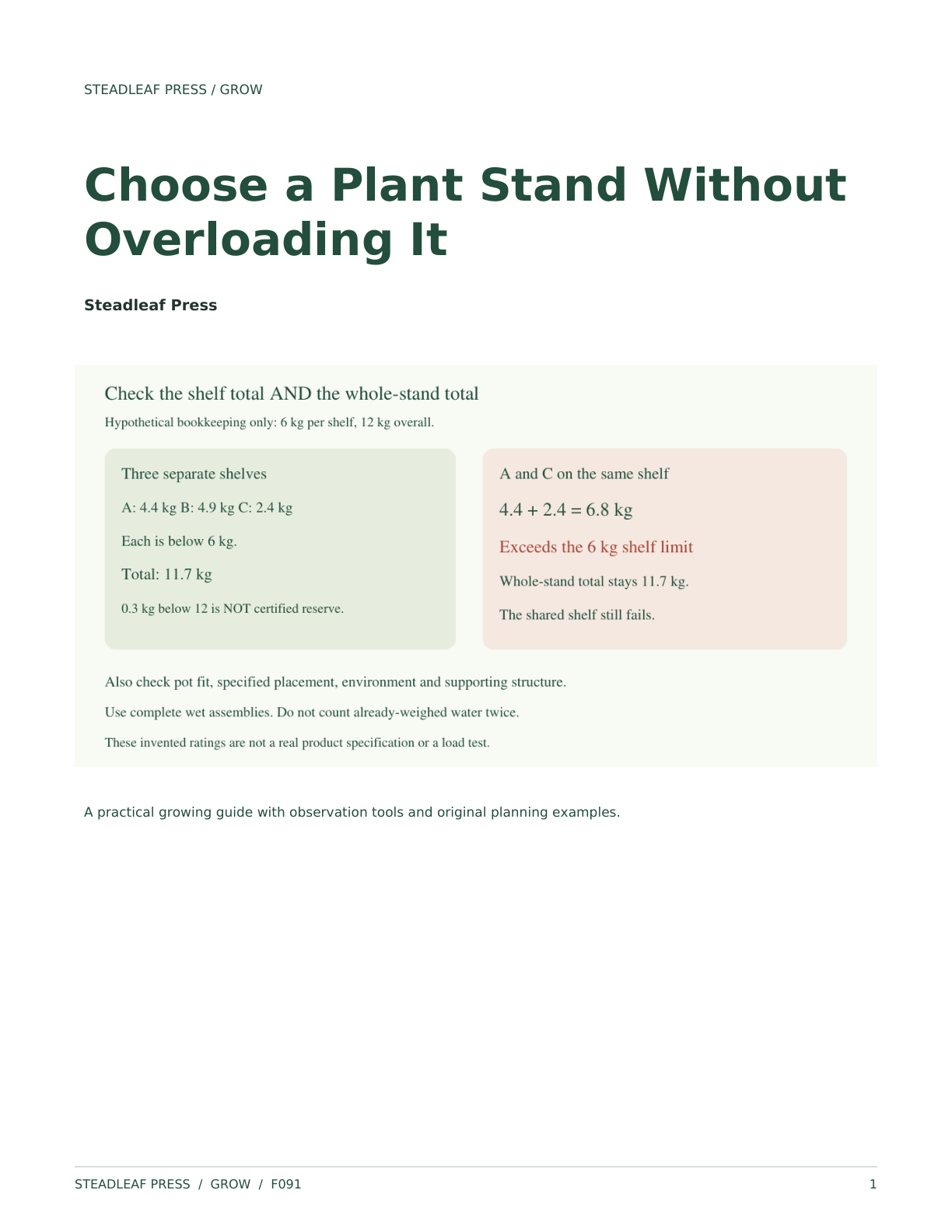
Hypothetical example: A stand is documented for 6 kg on each of three shelves and 12 kg overall. Three planted pots at 5 kg each would satisfy the individual shelf limit but total 15 kg, exceeding the whole-stand limit. The arrangement fails. These are arithmetic examples, not ratings for a real product.
Another example: A pot weighs less than a platform's limit but its base does not sit securely within the intended holder. The weight comparison alone does not make it suitable. Choose a compatible pot or stand rather than improvising an oversized bridging board.
A load limit also does not mean that any placement within it is equally stable. Follow the specified positions and assembly. Do not assume that a lower pot can safely counterbalance an unsuitable upper pot.
Match the stand to the environment
Outdoor suitability should be stated for the product. A decorative indoor stand does not become outdoor-rated because it is under a balcony overhang. Consider rain, humidity, temperature changes and exposure in the actual location, along with the maker's storage and care instructions.
For an outdoor display, consider the whole planted shape in wind. A broad or tall canopy presents a different arrangement from a low plant in the same pot. If the position is exposed or the stand becomes unstable, use a more suitable permitted location or a different arrangement. Do not add unplanned ballast or tie it to a railing as a substitute for appropriate design.
On a balcony or raised deck, the stand's rating tells you nothing about the supporting structure's allowable load. Victoria's Building and Plumbing Commission identifies people, furniture and large pots as loads a balcony must support. If structural stability is in doubt, avoid the area and arrange qualified assessment. Building and Plumbing Commission: Balconies, decks and balustrades
STEADLEAF PRESS / GROW / F091 4
Inspect before loading
Assemble the stand exactly as instructed, with the specified parts. Check for missing fasteners, cracking, distortion, corrosion, loose joints or damaged feet. A stand with an unknown history and no usable instructions may be a poor choice for a heavy planting.
Place it on a suitable level surface where every intended contact point is supported. Do not level it with loose stones, folded paper or a stack of scraps. If the instructions require a restraint, resolve permission and a suitable installation before use; do not invent an attachment method.
Keep stands away from balcony edges and situations where children or pets might climb them. A high shelf is not, by itself, a reliable way to keep an unsuitable or toxic plant inaccessible.
Do not use a loaded shake test, repeated overloading or your body weight to prove strength. Visible steadiness with empty pots is only a placement check.
Plan drainage without hiding water
Decide where water will go before loading the plants. A draining pot may need to be watered elsewhere, allowed to drain, and returned only if it is easy and safe to handle. Alternatively, use a suitable collection arrangement that can be inspected and emptied without tipping or reaching awkwardly.
Check what the stand's surface tolerates. Do not let runoff fall onto electrical equipment, a lower plant's leaves, a walkway or someone else's balcony. A saucer that cannot be reached to empty is a design problem.
Keep drainage holes functional. Do not trap a pot in a tight outer holder that prevents inspection. Include collected water in the load assessment, and avoid leaving ordinary plant roots standing in unwanted drainage water.
STEADLEAF PRESS / GROW / F091 5
Make a load ledger without counting water twice
Give each complete pot assembly a name and keep its contents together in the record. If you weigh a watered, drained pot with its plant and saucer already on the scale, that reading already includes the water retained in the mix and the saucer's weight. Do not add those same components again. Conversely, an outer decorative pot weighed separately is missing from that reading and must be added.
Use a separate line for anything not included in the measurement. For a reservoir planter, distinguish water retained in the growing medium from the reservoir's full operating contents. Do not deliberately waterlog an ordinary pot to simulate a reservoir. Follow the planter's instructions and record the condition actually measured.
Hypothetical assembly What the measurement Addition not yet included Load used for includes comparison
A Watered and drained pot, Outer holder: 0.6 kg 4.4 kg plant and saucer: 3.8 kg
B Complete planter with None 4.9 kg reservoir at its specified full level: 4.9 kg
C Watered and drained pot Saucer: 0.3 kg 2.4 kg with plant: 2.1 kg
Total carried by the Assemblies A, B and C No other accessories 11.7 kg stand assumed
These invented measurements illustrate bookkeeping only. If A, B and C occupy separate shelves, the earlier hypothetical 6 kg shelf limits are met and the combined load is 0.3 kg below the 12 kg whole-stand limit. If two assemblies share a shelf, add them before checking: A and C together weigh 6.8 kg and would exceed that shelf's 6 kg limit, even though the whole-stand total stays 11.7 kg. That small difference is not a safety margin established by this guide and does not approve the arrangement. Unmeasured retained water, a changed holder or uncertain readings could invalidate the comparison. Resolve uncertainty or choose fewer or lighter assemblies; do not round weights down to obtain a pass.
The load supported by the floor is a different total: it includes the stand itself as well as everything carried on it. Do not use the packaged shipping weight as the stand's weight without confirmation, since packaging can be included. Do not divide this combined weight by the whole balcony area to declare the location acceptable. The supporting structure and the stand's contact points require an appropriate assessment for that location.
STEADLEAF PRESS / GROW / F091 6
Give water a visible destination
For every pot, complete this sentence before loading: “Water leaves through _____, collects in _____, and I empty it by _____ without moving an unsafe load.” If the collection tray sits on another shelf, include its filled condition in that shelf's load record. If it sits on the floor, keep it out of the walking route and account for it in the location assessment.
Check access with the stand empty and the proposed containers unfilled where practical. Confirm that a saucer can be removed without lifting the shelf above it, that a tray does not bridge unsupported gaps, and that inspecting the water level does not require tipping the stand. An empty trial checks access, not strength. Do not use an improvised watertight liner to hide a drainage problem.
After the first ordinary watering, look for escaped water and record what needs changing. If a spill, inaccessible saucer or trapped water makes care unsafe, stop using that arrangement until the problem is resolved. Never leave water accumulating because removing it would be difficult.
Make the care test practical
Stand in the position where you will water and inspect the plants. Can you see the potting mix? Can you reach the back pot without pulling a trailing stem? Can a saucer be removed without disturbing the plant above it?
If care requires a stool, a long stretch over a rail, or moving a heavy wet container at shoulder height, choose a lower or simpler arrangement. Attractive display height should not make every watering session difficult.
Write a short placement record:
Model: _____
Permitted environment: _____
Pots assigned to each position: _____
Individual and total limits checked: _____
Drainage method: _____
Next condition that triggers review: _____
STEADLEAF PRESS / GROW / F091 7
Know when to stop using the arrangement
Reassess after repotting, adding a reservoir, changing a plant's size, moving the stand or noticing deterioration. If a shelf sags, a joint loosens, a leg becomes uneven or the stand starts to rock, keep people clear and unload only when that can be done safely. Seek appropriate help rather than trying to reinforce an occupied stand.
The useful outcome is a documented fit between the product, pots and place. Sometimes the best decision is to keep the pots at floor level in permitted positions, or to display fewer plants.
Sources and scope
The linked manufacturer, Rutgers and building-safety information was rechecked on 7 November 2026. The checklists, load ledger and numerical examples are original decision aids. The manufacturer pages illustrate rating language, not a recommendation or a completed assembly review. Product limits can change with model and configuration. This guide does not certify furniture, assess structural capacity or provide fastening or repair instructions.