Plan a Pollinator Friendly Water Source
Steadleaf Press
Plan one small, shallow water dish with accessible landing surfaces and a cleaning routine you can maintain. A well-kept dish may offer visiting insects a drinking place; it is an optional addition to a suitable planted space, not a substitute for flowers and habitat.
FREE · No email or checkout
Read the complete free guide online
Read the instructional text here, or download the complete free PDF above for original diagrams, tables, worksheets and page layout. The original publication is unchanged.
STEADLEAF PRESS / GROW
Plan a Pollinator Friendly Water Source
Steadleaf Press
A practical growing guide with observation tools and original planning examples.
STEADLEAF PRESS / GROW / F092 1
Plan one small, shallow water dish with accessible landing surfaces and a cleaning routine you can maintain. A well-kept dish may offer visiting insects a drinking place; it is an optional addition to a suitable planted space, not a substitute for flowers and habitat.
Decide whether you can maintain it
The simplest water feature is often the easiest to keep in good condition. Start with one small dish rather than a collection of containers. Choose something you can lift, empty and scrub without strain.
Before setting it out, answer three questions: Who will check it? Where will it be cleaned? What happens when nobody is home? If the answers are uncertain, leave the dish dry and concentrate on caring for the plants you already have.
The RHS includes a shallow saucer with pebbles and frequently changed water among its suggestions for pollinators. It does not mean that every container garden needs an artificial water source or that a dish will attract a particular species. RHS: Plants for Pollinators
Choose a simple washable dish
Use an intact shallow saucer or bowl with a stable base and a surface you can scrub. Avoid sharp edges, cracked surfaces, containers that previously held chemicals, and delicate objects likely to break during routine cleaning.
Select a few clean, stable stones or pebbles that fit securely within it. The aim is to provide exposed landing surfaces beside the water, with easy access back out. Do not make a precarious pile of stones or use loose decorative pieces that can roll away.
Choose materials appropriate for the people and animals using the space. Small loose stones may be unsuitable where children or pets can reach them. In that situation, use a safer location or omit the feature. A water dish should not create a new household hazard.
Component What I will use Practical check
Shallow dish _____ Stable, intact and easy to empty
Landing surfaces _____ Secure, clean and partly exposed
Supporting surface _____ Level and safe to reach
Cleaning brush _____ Dedicated to outdoor cleaning
Fresh water supply _____ Convenient and free of added treatments
There is no need to buy a pump, heater, elaborate ornament or automatic refill system for this project.
STEADLEAF PRESS / GROW / F092 2
Choose a location you can reach comfortably
Put the dish on a stable, permitted surface where it will not be kicked, knocked from an edge or confused with a pet's drinking bowl. Keep it away from a door threshold, narrow walking route or frequently used seat if insect activity there would be unwelcome.
On a balcony, keep the whole arrangement inside the protected area and off the top of the railing. Do not hang it outside the balcony to gain space. Make sure accidental overflow cannot fall onto people or neighbouring property.
Choose a place you will notice during ordinary plant care. A hidden dish is easy to forget. It should be possible to remove the dish without reaching over flowers occupied by insects or lifting a heavy planter first.
Look at what can fall into it. Soil, fertiliser granules, pot runoff and spray drift are reasons to choose another position. This dish is separate from the saucer used to collect drainage from a planted container.
STEADLEAF PRESS / GROW / F092 3
Assemble the first version
1. Rinse the dish and landing stones before use.
2. Set the dish securely in its chosen location.
3. Arrange the stones so they remain stable and provide exposed surfaces.
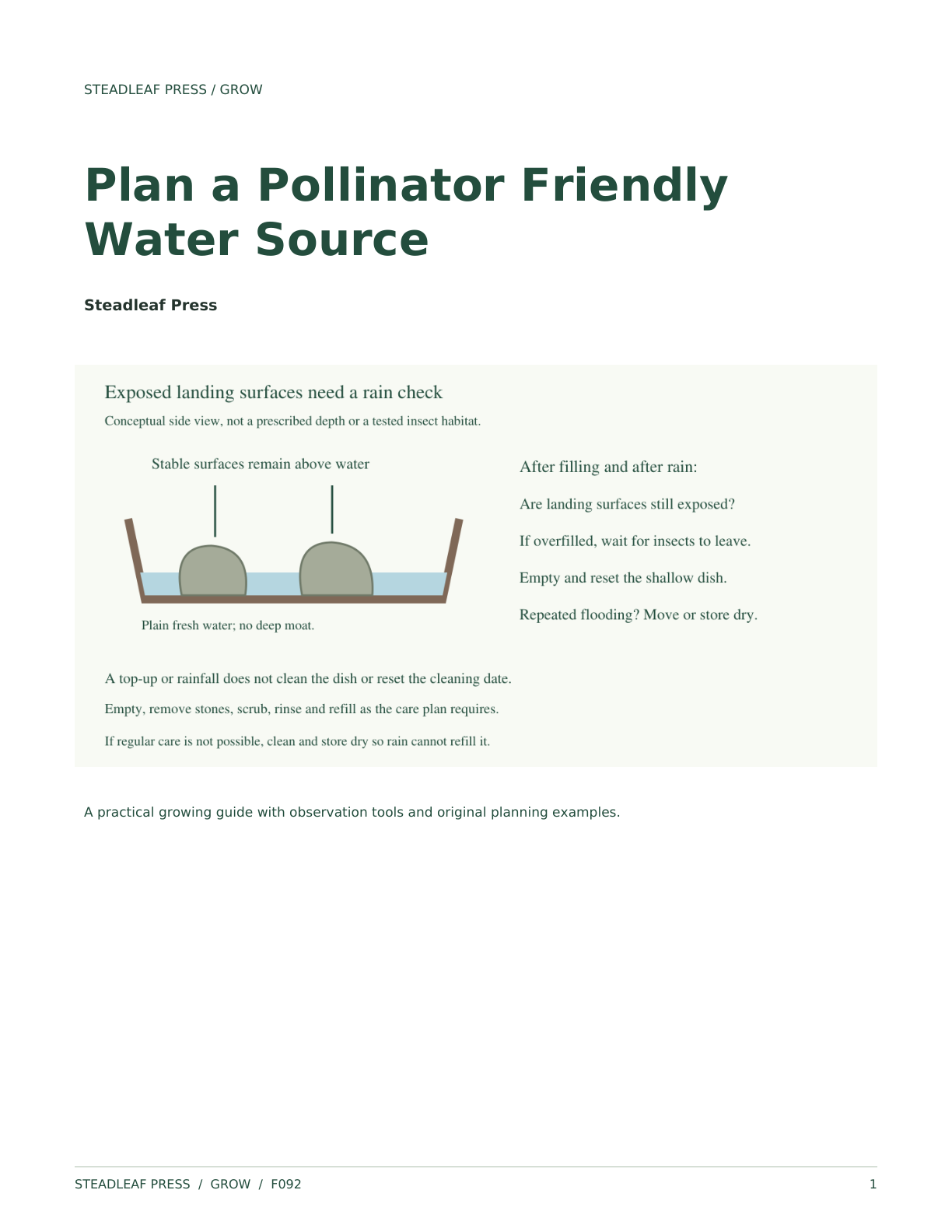
4. Add a small amount of plain fresh water, leaving landing surfaces above it.
5. Check that the water can be reached from those surfaces without surrounding them with a deep moat.
6. Confirm that you can lift and empty the dish safely.
Keep this a plain-water project. Do not add sugar, honey, fertiliser, scent, salt or pesticide. Recipes for feeders and specialised puddling habitats are separate subjects, and there is no need to improvise one here.
Do not assume that a decorative stone arrangement is suitable merely because it looks attractive. Check the water level after filling and again after rain: exposed landing surfaces must remain available. Rain can submerge stones that were exposed when you set up the dish. When insects have moved away, empty and reset an overfilled dish rather than leaving it as a deeper bowl. If the same location repeatedly floods the arrangement, choose another permitted position or store the dish dry.
STEADLEAF PRESS / GROW / F092 4
Build cleaning into the project
Cornell Cooperative Extension advises frequent cleaning of artificial pollinator water sources and refilling every two to three days. Use that as a regular maintenance prompt, with earlier attention whenever the dish becomes dirty or conditions demand it. Cornell Cooperative Extension: Water and shelter for pollinators
Check the dish during your daily garden look-round. Notice low water, fallen leaves, slime, soil, droppings or displaced stones. A visual check is not a reason to postpone a scheduled clean merely because the surface looks clear.
For a routine clean, remove the dish when no insects are using it, empty it in an appropriate place, and remove the stones. Scrub the inside surface and the washable stones, rinse thoroughly, and reassemble with fresh water. Use a brush kept for this outdoor task and wash your hands afterwards. Follow local wildlife or public-health advice if unusual contamination requires a different cleaning method.
Simply pouring fresh water into old water does not clean the container. Emptying it also gives you a chance to inspect the surfaces and reset the landing arrangement.
Prevent a forgotten container of standing water
Mosquito management is part of maintaining any small outdoor water container. CDC guidance includes flowerpot saucers and birdbaths among items that should be emptied and scrubbed weekly. The scrub matters because mosquitoes can lay eggs near the water. CDC: Mosquito control at home
For this project, the more frequent cleaning-and-refill routine above should include that scrubbing step. It is not permission to leave dirty water for several days. Follow stricter advice from your local mosquito-control or public-health service where relevant.
If you see larvae, persistent fouling or a problem you cannot resolve, empty and scrub the dish and keep it dry while you seek local guidance. A small removable saucer does not need an improvised chemical treatment. Do not add insecticide to a pollinator drinking dish.
Check neighbouring items too. An empty plant saucer, bucket or folded cover may collect rain even while the intended dish is being maintained.
STEADLEAF PRESS / GROW / F092 5
Use a short maintenance record
Date Water and landing Cleaning Refilled or stored Next check surfaces completed dry
_____ _____ _____ _____ _____
_____ _____ _____ _____ _____
_____ _____ _____ _____ _____
The record can be a few words, such as “leaf debris removed; scrubbed; refilled.” Enter the next cleaning date when you finish, rather than relying on memory. For example, a dish cleaned on Monday morning could be scheduled for Thursday morning, with daily checks and earlier cleaning if it becomes dirty. That three-day interval follows the maintenance prompt above; it does not override more frequent local advice. Topping up or rainfall does not count as cleaning and should not reset the cleaning date.
Write the absence plan now: “If I am away or cannot maintain this dish, _____ will empty, clean and store it dry.” If nobody has agreed to help, do that yourself before leaving. Turn stored containers over or keep them under cover so they cannot refill with rain.
STEADLEAF PRESS / GROW / F092 6
Observe visitors without handling them
Watch from a comfortable distance and let insects come and go. Do not catch them, move them onto the stones or disturb a nest to encourage visits. Describe only what you can see confidently.
A simple observation note might read: “Two small flying insects landed on exposed stones; water was low; warm afternoon.” That is more useful than labelling every visitor a bee or claiming that the dish improved the local population.
Observation Note
Date, time and weather _____
What landed, if anything _____
Which surface was used _____
Was water accessible? _____
One practical adjustment _____
No visible visit during a short watch is not proof of failure. Equally, one visit does not prove that the feature supplies every insect's needs. Keep the gardening aim modest.
STEADLEAF PRESS / GROW / F092 7
Make the smallest useful adjustment
A dish that dries quickly: A gardener notices that the water is gone each afternoon. They first review the location and their capacity to check it. They do not replace it with a deep unattended bowl. If the care burden is unrealistic, they remove the feature.
A dish that collects debris: Another gardener places a saucer beneath a draining pot. It repeatedly fills with soil particles. They move it away from runoff and simplify the arrangement so that cleaning becomes easy.
A dish nobody visits: A third gardener sees no insects over several brief observations. The dish remains clean and manageable, so they continue watching without adding sweeteners or buying a more complicated feature.
Finish with a care commitment
My dish is _____. Its landing surfaces are _____. Its location is _____. I will look at it during _____. I will clean and refresh it on _____ and sooner if needed. If maintenance becomes impractical, I will store it dry.
A small water source is worth keeping only while you can care for it. Removing it responsibly is a valid gardening decision.
Sources and scope
The RHS, Cornell Cooperative Extension and CDC sources linked above were rechecked on 8 November 2026. The component sheet, observation record, rain check and scheduling examples are original practical aids. This guide covers a small removable plain-water saucer, not a pond, wildlife rehabilitation, a feeder, mosquito treatment or habitat certification.