Make a Container Garden Wildlife-Conscious
Steadleaf Press
A container garden can offer flowers, foliage and sheltered places that wildlife may use. Start with plants that suit your region and your growing conditions, then make a small, manageable plan for their care. A healthy pot of appropriate plants is a sounder starting point than a crowded collection chosen only for a wildlife label.
FREE · No email or checkout
Read the complete free guide online
Read the instructional text here, or download the complete free PDF above for original diagrams, tables, worksheets and page layout. The original publication is unchanged.
STEADLEAF PRESS / GROW
Make a Container Garden Wildlife-Conscious
Steadleaf Press
A practical growing guide with observation tools and original planning examples.
STEADLEAF PRESS / GROW / F094 1
A container garden can offer flowers, foliage and sheltered places that wildlife may use. Start with plants that suit your region and your growing conditions, then make a small, manageable plan for their care. A healthy pot of appropriate plants is a sounder starting point than a crowded collection chosen only for a wildlife label.
This guide helps you build a regional shortlist, distinguish flowers for visiting adults from food for larvae, and look for gaps in flowering time. You can use it for a few pots on a patio or another permitted growing space. It does not promise a particular number of visitors or a measurable conservation result.
Begin with your place
Write down your country and region before making a plant list. Where practical, add your county, state or local ecological area. “Native” needs a place attached to it. A plant native to one part of a large country may not belong naturally in yours.
For local choices, begin with a botanic garden, extension service, government conservation body or established regional native-plant organisation. Minnesota's Board of Water and Soil Resources recommends geographically appropriate plants and a range of flowering times and forms. Its species lists are regional resources, not a worldwide shopping list. Minnesota BWSR, Selecting Plants and Seed Mixes
Check invasive status separately. A plant being sold locally is not enough to settle that question. Use your jurisdiction's current invasive-plant guidance and record the botanical name. In England and Wales, restrictions apply to specified invasive plants and can also cover viable seeds and other plant parts. Do not treat a container as an exemption. GOV.UK, Invasive non-native plant species
You need not discard a healthy, noninvasive ornamental merely because it is not native. RHS guidance recognises wildlife value in both native and non-native garden plants while encouraging locally occurring natives. Use that distinction carefully: a flower's appeal to visiting insects does not establish that it supports the same wildlife relationships as a local native plant. RHS, Wildlife in gardens
STEADLEAF PRESS / GROW / F094 2
Match the plant to the container
Record the growing conditions before comparing wildlife benefits:
- Direct sun and shade at the intended position.
- Wind exposure and reflected heat.
- Available container width and depth.
- Mature plant height, spread and growth habit.
- Watering access and the care you can reliably provide.
- Whether the plant is seasonal or will need an overwintering plan.
Illinois Extension advises choosing containers for the plants' mature size and matching their sun, moisture and drainage needs. Plants sharing a pot should tolerate the same conditions. A regional native still needs an appropriate container and regular attention. Illinois Extension, Pollinator resources in container gardens
Keep different needs in separate pots when that makes care simpler. Reject a plant that needs a much larger root space than you can provide, even if its wildlife associations are appealing. For perennial plants, get local advice about winter survival in containers; suitability in open ground does not settle your pot's winter plan.
STEADLEAF PRESS / GROW / F094 3
Separate three kinds of benefit
Use three headings on your shortlist.
Flowers for adults. Record whether a reliable source identifies nectar or pollen value, and which visitors it discusses. Prefer useful information about the actual species or cultivar over a general picture of a butterfly on the label.
Food for larvae. Look for a named relationship between a plant and an insect's young. Many butterflies have particular larval host-plant requirements. A nectar flower for an adult butterfly may not feed its caterpillars. University of Minnesota, Backyard Pollinator Practices
Shelter or seasonal structure. Consider what can safely remain when flowering finishes. Stems, foliage and other plant material can provide overwintering places for some invertebrates. The details depend on the species and setting. Keep this distinct from a promise that insects will nest in your pots. RHS, Wildlife in gardens
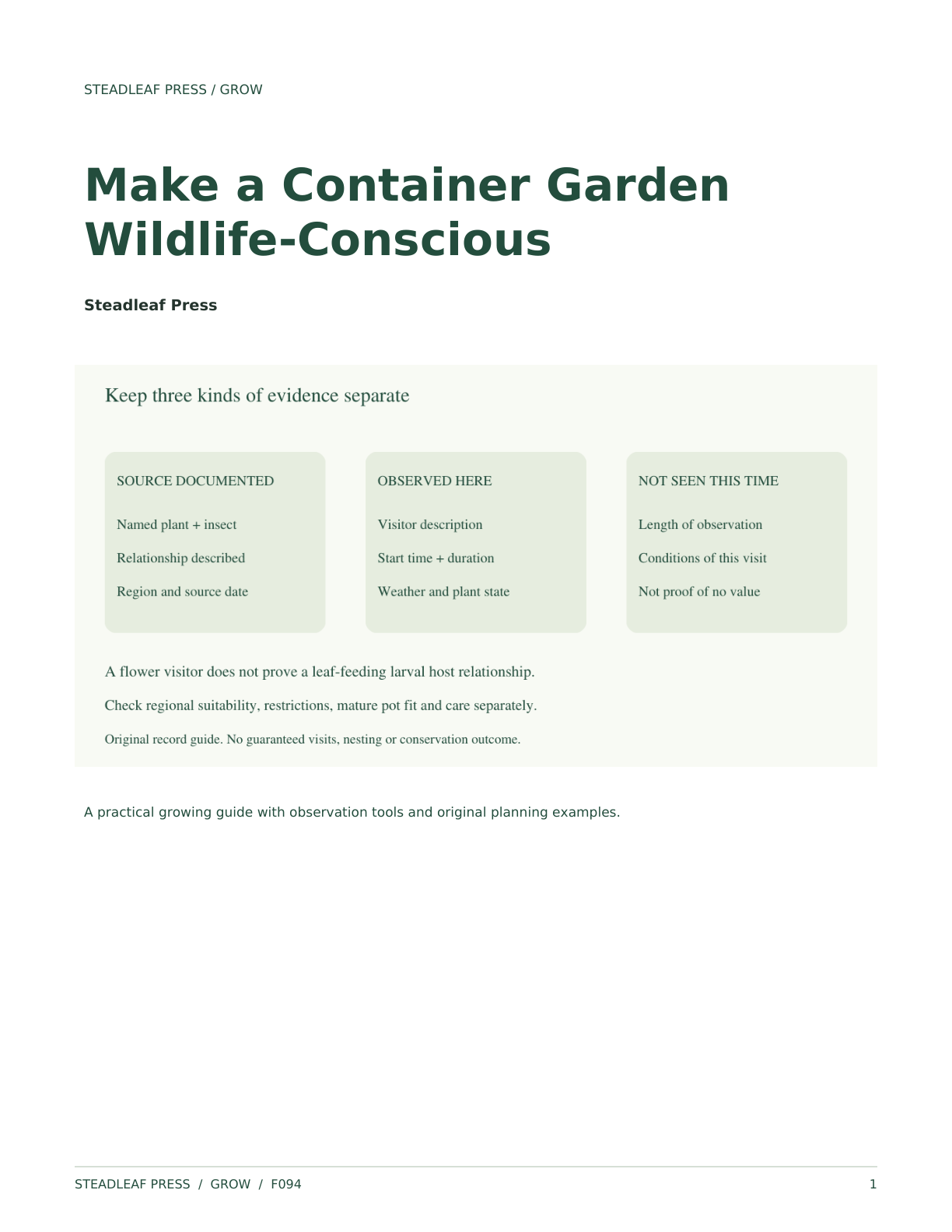
A candidate can fit more than one heading. Write “not yet checked” rather than leaving an unexplained blank when you do not know. Keep “relationship documented by a source,” “visitor observed here” and “not observed during this visit” separate in the record. None is interchangeable with the others. For a host plant, also decide whether you are comfortable allowing some leaves to be eaten. That is part of the purpose of growing it.
STEADLEAF PRESS / GROW / F094 4
Use the regional plant selection checklist
Complete one record for each candidate before buying.
Identity and source
- Common name:
- Botanical name and cultivar, if any:
- Information source and date checked:
- Nursery or other responsible plant source:
Regional fit
- Native to my region, or suitable non-native:
- Regional evidence for that description:
- Current invasive or restricted status checked with:
- Any uncertainty that needs local advice:
Growing fit
- Position and light:
- Expected mature size:
- Suitable container and potting conditions:
- Watering and overwintering plan:
Wildlife role
- Adult flower visitors or resource documented:
- Larval host relationship documented:
- Seasonal stems, seed heads or shelter worth considering:
- Expected flowering period in this region:
Decision
- Keep on shortlist, investigate further, or reject:
- Reason:
- What this plant adds that the other pots do not:
This last question helps when every attractive candidate flowers at roughly the same time. It also makes it easier to choose one well-suited plant instead of buying several that do not fit.
STEADLEAF PRESS / GROW / F094 5
Build a flowering sequence
Draw one line for each candidate and divide the growing season into locally meaningful periods. In a temperate climate, early spring, late spring, summer and autumn may be useful. In another climate, use wet and dry seasons or local flowering periods instead.
Mark the expected bloom window lightly in pencil. Leave room underneath for actual observations. Flowering dates are planning guides, not appointments.
Your worksheet can read:
- Early part of the local growing season: candidate, expected bloom, source.
- Middle part: candidate, expected bloom, source.
- Later part: candidate, expected bloom, source.
- Largest apparent gap:
- One suitable plant to investigate for that gap:
Choose a range of accessible flower forms rather than assuming every elaborate bloom offers the same resources. RHS guidance notes that many double-flowered forms make pollen and nectar difficult to reach. RHS, Wildlife in gardens
Do not force continuous bloom into too few pots by overcrowding. You can acknowledge a gap and make a better choice at the next replacement or planting opportunity.
STEADLEAF PRESS / GROW / F094 6
Work through a regional shortlist
Imagine a gardener in Manchester, England, choosing three separate pots for a partially shaded, ground-level courtyard. They want an earlier start to flowering and something continuing into summer. This is an illustrative decision process, not a tested planting combination.
The RHS's container wildflower guide suggests sweet violet (Viola odorata), red campion (Silene dioica) and common harebell (Campanula rotundifolia) among its options. It describes sweet violet flowering from late winter into early spring, red campion from late spring through summer, and harebell from midsummer into early autumn. Red campion suits partial shade; harebell can grow in sun or partial shade. Use those botanical names when checking nursery labels: a similar common name does not identify the same species. RHS, Wildflowers for containers
The gardener writes those three names on separate candidate records. Before buying, they check each plant's local suitability, exact growing needs and mature dimensions against their available pots. They also check the light at the violet's intended position rather than assuming all three need identical conditions.
On the flowering worksheet, the candidates offer a possible sequence. The gardener does not describe it as uninterrupted bloom. Weather and establishment could change the timing, and a plant may flower less well than expected in that particular spot.
The larval-host column is marked “not yet checked” until a suitable source confirms a relationship. A flower-visiting bee does not establish a leaf-feeding host relationship. The next question is specific: “Could one plant in this shortlist also support a locally occurring insect's larvae, and can I grow it well here?” Record both the plant and insect named by the source; do not transfer a claim automatically to another species or cultivar.
If a candidate fails the light or space check, the gardener replaces that candidate on paper. They do not move pots into the doorway to make the list fit.
STEADLEAF PRESS / GROW / F094 7
Care without making every visitor a problem
Look closely before treating damaged leaves. Record what you see and seek identification when needed. Avoid routine preventive insecticide use in a garden intended to support insects; University of Minnesota guidance favours pollinator-aware plant sourcing and nonchemical management. University of Minnesota, Backyard Pollinator Practices
Where appropriate, leave some seasonal plant structure undisturbed. On balconies or shared sites, follow the building's fire, maintenance and access requirements; do not accumulate dry material beside doors or use a wildlife plan to justify clutter.
Keep a simple observation record: date, start time, observation duration, weather, plant, flowering condition, visitor description and any care change. “Small dark bee, identity uncertain” is more useful than a confident guess. Record quiet visits too, without treating a short observation as proof that a plant has no value.
At the end of the season, choose one improvement you can maintain: a better-fitting plant, an earlier flowering candidate, or more careful identification before treatment. A modest garden can be thoughtful without becoming complicated.
STEADLEAF PRESS / GROW / F094 8
Sources and scope
- Minnesota BWSR, Selecting Plants and Seed Mixes: regional selection and flowering diversity.
- GOV.UK, Invasive non-native plant species: England and Wales restrictions.
- Illinois Extension, Pollinator resources in container gardens: container size and growing conditions.
- University of Minnesota, Backyard Pollinator Practices: host plants and care.
- RHS, Wildlife in gardens and Wildflowers for containers: UK garden context and the example candidates.
Sources initially checked 4 November 2026. The RHS container-wildflower guide, Illinois Extension container guidance and GOV.UK restrictions page were rechecked on 8 November 2026. Worksheets and the selection example are original. Plant choices require regional checks; no worldwide species list or conservation outcome is implied.