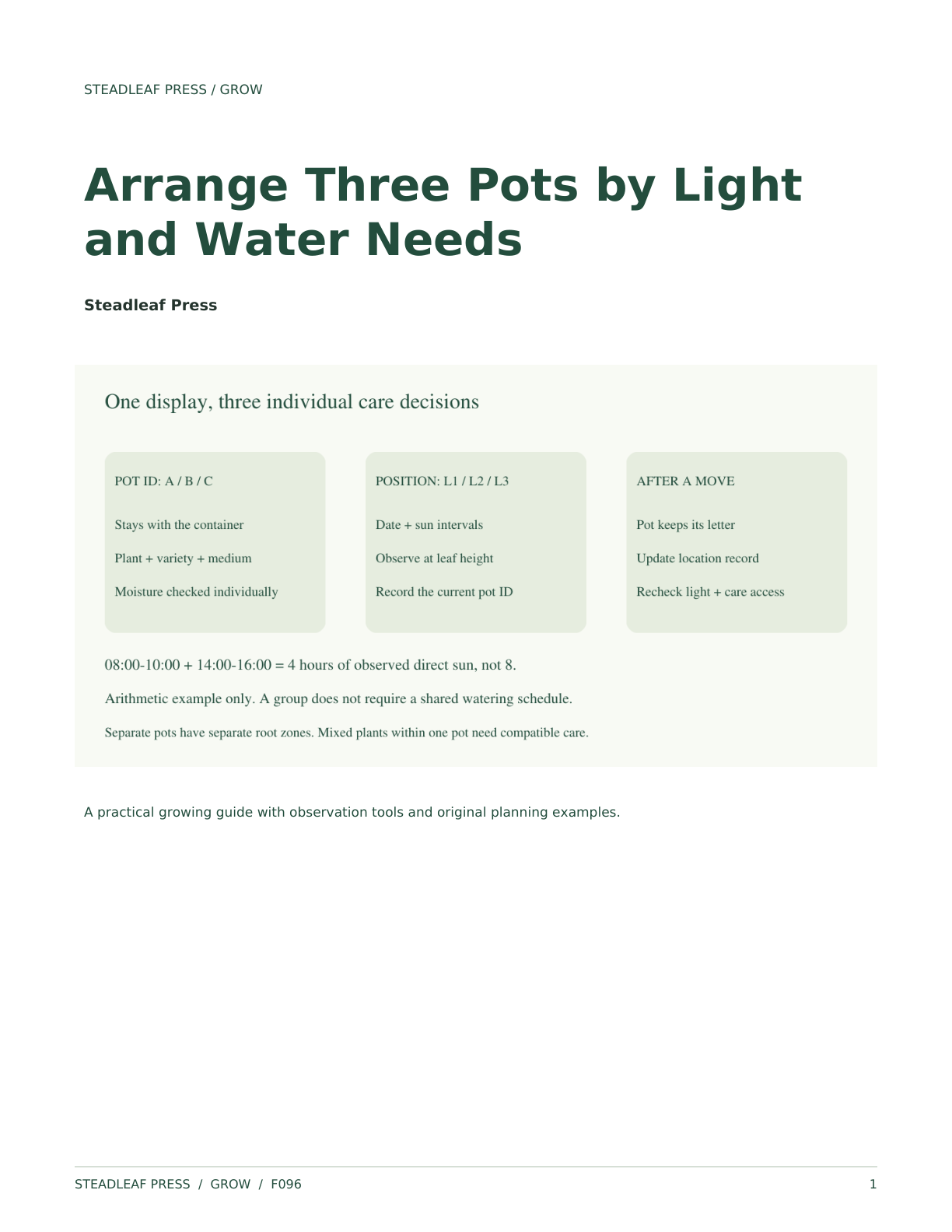
Arrange Three Pots by Light and Water Needs
Steadleaf Press
Three pots can look like one small garden while receiving different care. Start by finding a suitable place for each plant, then bring the arrangement together visually. A matching row is less useful if one plant sits in the wrong light or receives water simply because its neighbour needs a drink.
FREE · No email or checkout
Read the complete free guide online
Read the instructional text here, or download the complete free PDF above for original diagrams, tables, worksheets and page layout. The original publication is unchanged.
STEADLEAF PRESS / GROW
Arrange Three Pots by Light and Water Needs
Steadleaf Press
A practical growing guide with observation tools and original planning examples.
STEADLEAF PRESS / GROW / F096 1
Three pots can look like one small garden while receiving different care. Start by finding a suitable place for each plant, then bring the arrangement together visually. A matching row is less useful if one plant sits in the wrong light or receives water simply because its neighbour needs a drink.
This plan is for three separate containers. You will make a light record, match each pot to a position and leave yourself a short care note. Use existing plants or complete the records before buying.
Keep separate pots separate in your care plan
Plants sharing one pot also share its growing medium and watering. Different plants in neighbouring pots have separate root zones, so you can use different suitable potting mixes and water them individually. The containers do not need identical water requirements to sit near one another, provided you can care for each without repeatedly soaking the others.
For a mixed planting within any one pot, select plants with compatible moisture needs. Iowa State University Extension explains that watering becomes difficult when one plant in a shared container needs substantially more water than its companions. It also notes that pots at the edge of a group can dry more quickly. Iowa State University Extension, Watering Plants in Containers and Plug Trays
Write individual pot decisions in your notes. If you later combine plants into one container, check their compatibility again.
STEADLEAF PRESS / GROW / F096 2
Observe the light where the leaves will be
Name three possible positions L1, L2 and L3, and reserve A, B and C for the pots themselves. A pot keeps its letter when moved; its location record changes. On a simple sketch, mark the wall, door, railing and any overhead cover. Include the direction from which you usually approach with a watering can.
Observe direct sunlight at each position through a reasonably clear day. Note when it starts and stops, including breaks caused by nearby buildings. Michigan's Department of Natural Resources recommends recording sunlight on a diagram at hourly intervals and explains that this approach can be used on a porch or balcony. Your record is an estimate, so leave gaps marked as unknown rather than filling them with guesses. Michigan DNR, Make a sun map
Record the date and weather, keeping separate sun intervals separate. For example, direct sun from 08:00–10:00 and 14:00–16:00 totals four hours, not the eight hours between the first and last observation. This is an invented arithmetic example, not a plant requirement. A cloudy afternoon cannot tell you precisely when a neighbouring wall would cast shade on a clear afternoon. Repeat uncertain observations when convenient, and check again when seasonal changes noticeably alter the light.
Look at the intended leaf height as well as the floor. A railing may shade a low plant while a taller plant reaches the sun. An existing pot can also shade its neighbour. Do the final observation with the proposed containers in place if they can be moved safely.
Use this position record:
Position Direct sun Shade or cover Other concern Suitable candidate observed
L1 From ___ to ___; ___ Wind, heat, access ___ breaks ___ or rain cover ___
L2 From ___ to ___; ___ ___ ___ breaks ___
L3 From ___ to ___; ___ ___ ___ breaks ___
Choose plants whose named variety and care guidance fit the observations. Labels such as full sun and partial shade are useful starting points, but keep the actual exposure in your record. Morning sunlight and a hot, exposed afternoon deserve different notes even when the hours happen to add up similarly.
STEADLEAF PRESS / GROW / F096 3
Give every pot its own record
Before arranging the pots, complete one card for each. Keep the plant label or photograph it so you can check the name later.
- Pot identifier: A, B or C.
- Plant and variety: Include every plant if this is a mixed container.
- Light requirement: Copy the relevant label or reliable plant guide.
- Moisture guidance: Record the plant's needs in words, rather than assigning a day of the week.
- Container: Note its material, approximate size and drainage arrangement.
- Current growth: Newly planted, established, actively growing or seasonally resting.
- Placement: Current position L1, L2 or L3; date placed there; why the observed light fits this plant.
- Access: Can you reach the growing medium, water it and inspect the plant?
Container material helps explain why similar plants may need different attention. Illinois Extension notes that potting mix in porous containers can dry faster than in plastic or glazed pots. It also recommends drainage holes and checking moisture rather than relying only on appearances. Illinois Extension, 6 tips for watering container gardens
Keep sound mismatched pots if you like them. Record their differences so that each receives suitable care.
STEADLEAF PRESS / GROW / F096 4
Put care within reach
Place the pot with the narrowest acceptable range of conditions first. Then place the remaining two wherever their needs can be met. If two plants need the only sunny position, choose another location for one or change the plant selection. Do not hide the conflict behind an attractive arrangement.
Leave access to each pot's surface. A tall plant at the front may make it awkward to reach a smaller pot behind it. Instead of stretching through foliage with a full watering can, bring the smaller container forward or open a gap at one side.
Check where drainage goes. Water from one container should not repeatedly empty into another plant's pot, collect in a walkway or drip onto people below. Keep doors, required escape routes and drainage points unobstructed. If this is an elevated balcony, follow its restrictions and confirm any uncertainty about loads before adding containers.
Finally, consider the view. You might align the front edges, repeat a pot colour or leave a small gap that makes each plant easy to see. These choices can connect the group without requiring equal spacing or identical care.
STEADLEAF PRESS / GROW / F096 5
Work through one example
Imagine an enclosed patio with three existing plants in separate pots. The following observations and plant requirements are illustrative, not a recipe for named species.
The open end receives about six hours of direct sunlight on the observation day. A middle position receives a shorter morning period. A sheltered position has bright shade, and the roof prevents most rain from reaching it.
Pot Information already First placement Care note checked
A Plant needs full sun and a Open end Check the mix before drying period between watering; do not copy B's waterings; porous pot decision
B Plant accepts the Middle Keep the surface observed morning sun reachable from the front and needs more consistent moisture
C Plant suits bright shade; Sheltered end Check after rain too, container has working because this pot is under drainage cover
The owner initially puts B behind A to create a neat triangle. Once standing at the watering position, they discover that A's foliage blocks access to B. They propose bringing B forward and shifting C slightly sideways, then check the light at the new leaf positions. They keep the change only if both plants still receive suitable conditions and drainage and access remain usable. The group may be less symmetrical, but each pot needs a workable position, not merely a reachable one.
On the next check, B needs water, while A and C still have the moisture appropriate to their plants. Only B is watered. Later, a spell of warmer weather prompts more frequent checking, without committing all three pots to a new automatic schedule.
The result is three clear, individual decisions.
STEADLEAF PRESS / GROW / F096 6
Make a short observation log
Use this log while learning the arrangement.
Date and weather Pot Moisture and plant Action What to check next observations
___ ___ ___ Watered, left alone ___ or investigated ___
When watering an ordinary free-draining container, apply water to the growing medium and allow it to drain. Illinois Extension recommends watering thoroughly until water leaves the drainage holes. Self-watering and specialist containers need their own instructions. Illinois Extension, 6 tips for watering container gardens
Do not use wilting alone to decide that more water is needed. Iowa State notes that overwatered plants can wilt too. Check moisture and drainage, then investigate persistent symptoms using guidance for the particular plant. Iowa State University Extension
STEADLEAF PRESS / GROW / F096 7
Adjust when the arrangement changes
Revisit the plan after substantial growth, a change of season, a repotting or a move. Ask which leaves now receive the light, whether you can still reach every pot and whether your notes match what you observe.
Move one manageable container at a time when a change is needed. Get help with heavy pots rather than lifting them to preserve a display. If no suitable position is available, a different plant may be easier to care for than repeated rearranging.
Keep the final plan simple: a position for each pot, a reason it belongs there and a reminder to check it individually.
STEADLEAF PRESS / GROW / F096 8
Sources and scope
- Michigan Department of Natural Resources, Make a sun map: observing direct sunlight at specific locations.
- University of Illinois Extension, 6 tips for watering container gardens: container materials, drainage, moisture checks and thorough watering.
- Iowa State University Extension and Outreach, Watering Plants in Containers and Plug Trays: compatible watering needs within a shared container, variation between pots and interpreting wilt.
The worksheets and patio example are planning aids. They do not prescribe plant-specific watering intervals, certify balcony capacity or replace instructions for a particular container system. Use local growing advice and guidance for the named plants to complete them.