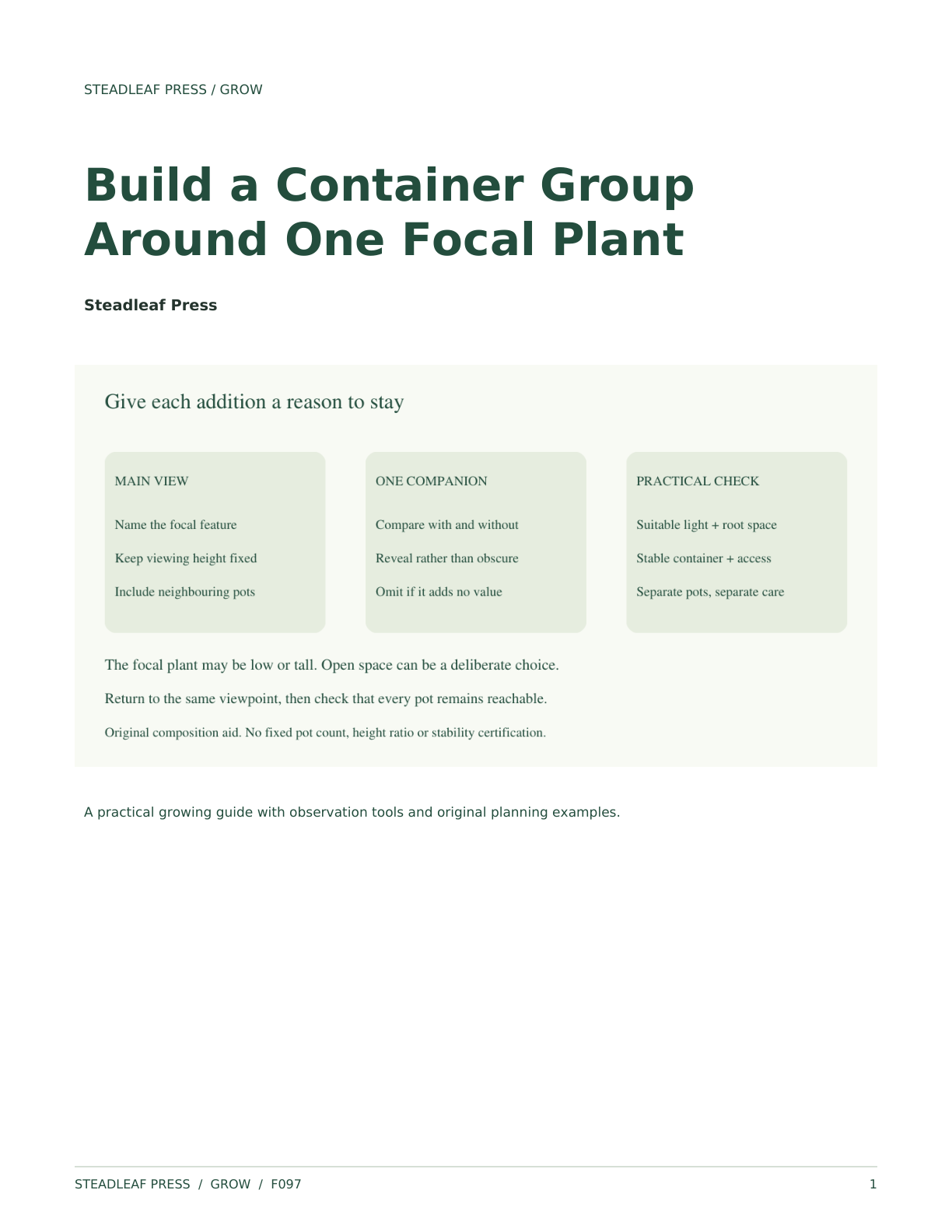
Build a Container Group Around One Focal Plant
Steadleaf Press
Begin with a plant you want to notice. It might have broad leaves, an attractive branching shape, a long flowering season or simply personal meaning. Give it a suitable place to grow, then arrange a few companions so that you can enjoy it clearly.
FREE · No email or checkout
Read the complete free guide online
Read the instructional text here, or download the complete free PDF above for original diagrams, tables, worksheets and page layout. The original publication is unchanged.
STEADLEAF PRESS / GROW
Build a Container Group Around One Focal Plant
Steadleaf Press
A practical growing guide with observation tools and original planning examples.
STEADLEAF PRESS / GROW / F097 1
Begin with a plant you want to notice. It might have broad leaves, an attractive branching shape, a long flowering season or simply personal meaning. Give it a suitable place to grow, then arrange a few companions so that you can enjoy it clearly.
A low mound of coloured foliage can be a focal plant as readily as a compact shrub. Decide what you want to notice and what can stay in the background.
Choose the view before choosing more plants
Stand or sit where you most often see the garden. A group viewed from a kitchen window may need a different arrangement from one beside an outdoor chair. Choose one main view to work on first, then check that the other views remain practical.
Write a sentence such as “From the chair, I want to see the rounded leaves against the plain wall.” Use the sentence to reject additions that hide the feature you want to enjoy.
Notice the background already present. A dark leaf can disappear against a dark fence. A fine branching shape may be difficult to see against a busy trellis. Before buying a different plant, consider a modest change of position within the conditions it can tolerate.
Use these notes:
- Main viewing place:
- Usual viewing height, seated or standing:
- Plant feature I want to notice:
- Background behind that feature:
- Other important views:
- Doors, walking space and care access that must remain clear:
Photograph the arrangement from the main viewpoint if you want a record. For a useful before-and-after comparison, keep the same seated or standing position, camera height and framing; otherwise a camera move can make a plant appear more prominent without improving the actual view. Include the neighbouring pots and access space rather than cropping them out. A quick pencil sketch works just as well if you prefer.
STEADLEAF PRESS / GROW / F097 2
Choose a plant that can stay in the role
Before calling a plant the centrepiece, check its light needs, expected mature size, growing medium, watering and seasonal care. Consider what it will look like after its current flowers fade. If the main attraction lasts briefly, decide whether you will enjoy its later foliage or want another existing pot to become prominent.
The RHS includes structural plants among useful focal choices for container displays. That supports a broad starting point, rather than a requirement to use a particular plant form. RHS, Containers summer selection
For a small space, compare two candidates using this decision sheet. Complete the practical entries before deciding which looks more dramatic.
Question Candidate one Candidate two
What makes me want to look at it? ___ ___
Does the available light suit it? ___ ___
Will its mature spread fit the ___ ___ reserved space?
Can a suitable container fit there? ___ ___
What will I see outside its flowering ___ ___ period?
Can I provide its seasonal care? ___ ___
Do I already own it or have a ___ ___ suitable pot?
A plant that fails a practical question needs a different location or should leave the shortlist. Do not plan to solve an unsuitable mature size through continual severe pruning unless that treatment is appropriate for the particular plant.
STEADLEAF PRESS / GROW / F097 3
Let the container support the plant
Choose the pot for the plant's root needs and the conditions of the site. Check drainage, stability, condition and the effort required to handle it. The display should remain manageable when the plant and growing medium are wet.
Tall, narrow pots containing tall plants are vulnerable to blowing over, as the RHS explains in its container guidance. A sheltered position and an appropriate container matter more than creating extra height. Do not use an undersized pot or a makeshift pedestal to make the focal plant seem larger. RHS, Growing plants in containers
On a balcony, do not add heavy ballast or a larger container merely to steady an unsuitable arrangement. Confirm the building's restrictions and load capacity, and choose a less exposed location or a smaller suitable plant where necessary. There is no container-to-plant height ratio that proves a display safe.
Try your existing containers first. A quiet finish can keep attention on foliage, while a patterned pot may be part of the composition you enjoy.
STEADLEAF PRESS / GROW / F097 4
Give companions a specific purpose
Start with the focal plant in place, then consider one companion at a time. Compare the view with and without that addition before changing anything else. Ask what becomes clearer and what becomes hidden. Useful contributions include a softer outline, a repeated leaf colour or a smaller shape beside a broad one. If a companion obscures the feature you named, first try a permitted position farther to one side, or omit it; adding another pot will not necessarily solve the overlap.
Several conspicuous plants may compete for attention. For this arrangement, give the most distinctive feature to the focal plant and make the surrounding choices simpler.
Use this companion list before shopping:
Space in the group Purpose Something already Conditions to confirm available
Beside the focal plant Repeat one colour or ___ ___ soften its outline
Lower or forward position Connect the group to the ___ ___ front edge
Optional additional pot Fill a specific remaining ___ ___ need
Leave the optional row empty unless it solves something. Open space may let you see an attractive stem, the container itself or the shape of a leaf. You do not need to fill every visible patch of paving.
If the plants remain in separate pots, care for each root zone individually. If you combine them in one container, choose compatible growing requirements. Similar colours tell you nothing about whether the plants should share a watering routine.
STEADLEAF PRESS / GROW / F097 5
Arrange the plants from the main viewpoint
Try the group at ground level before considering any stand. Keep pots upright on suitable, stable surfaces. Put the main feature where it can be seen, then move the companions within their acceptable growing positions.
Illinois Extension distinguishes between containers viewed from one side and those seen all around. For a front view, taller plants can sit toward the back; an all-around display needs consideration from every side. Illinois Extension, Container Garden Designs
Apply that idea flexibly across the group. A low focal plant may belong forward, with a quieter taller plant behind it. A flowering specimen may look best slightly to one side where its flowers are not hidden. Neither arrangement requires a fixed triangle, an odd number of pots or predetermined proportions.
After each change, return to the main viewing position. Then walk to the containers with an empty watering can. Check that you can reach each pot without moving another heavy container, stepping into foliage or blocking a door. Revise the composition if looking after it is awkward.
STEADLEAF PRESS / GROW / F097 6
Work through a foliage example
Imagine a small courtyard owner who already has a broad-leaved plant in a plain container. Its care needs match a sheltered position visible from the dining table. They want the leaf shape to be the first thing they notice.
They also own a low green plant, a small flowering pot and a second plant with strongly patterned foliage. All are checked against the conditions of their proposed positions before arranging.
The first attempt places the patterned plant beside the broad-leaved focal plant. From the table, both demand attention, and their overlapping leaves hide the focal plant's outline. The owner moves the patterned plant to another suitable location rather than adding still more pots to connect them.
The low green plant goes beside the focal container, where it softens the bottom of the group without covering the broad leaves. The flowering pot sits a little forward, within reach for care. A gap remains behind it so the main plant's stem is visible.
The finished record reads:
- Focal feature: Broad leaves visible from the dining table.
- Supporting choice: One low green plant with a less conspicuous outline.
- Seasonal addition: An existing flowering pot, kept separate for its own care.
- Deliberately omitted: The strongly patterned plant, now in another suitable position.
- First review: When growth begins to obscure the main leaf shape or access.
The owner improved the view without buying anything.
STEADLEAF PRESS / GROW / F097 7
Allow the focus to change
As the plants grow, compare the group with the original sentence about the view. You may still like the focal plant, or another existing plant may be at its best. A seasonal change of emphasis can be enjoyable without rebuilding the whole display.
For a flower-led group, make a simple after-flowering plan before buying companions: keep the focal plant for its foliage, move the whole pot to another appropriate position when safe, or let a neighbouring plant become more prominent. Record the trigger and the destination: “When the flowering display finishes, pot B becomes the focus; pot A remains in its suitable growing position.” A change of focus need not mean moving a plant. If a move is planned, confirm the destination's light, space and care access first. Keep healthy plants that still have a useful place and suitable care.
Finish by recording one change you would make next, if needed. “Move the flowering pot forward when it comes into bloom” is more useful than a general intention to improve the garden. Leave a settled arrangement alone while it is working for you and the plants.
STEADLEAF PRESS / GROW / F097 8
Sources and scope
- Royal Horticultural Society, Containers summer selection: structural plants as possible focal choices.
- Royal Horticultural Society, Growing plants in containers: container selection and the vulnerability of tall, narrow plantings to wind.
- University of Illinois Extension, Container Garden Designs: arranging for the viewing direction.
The worksheets and courtyard example offer a design process, not a plant recipe or a stability assessment. Complete them using the actual plants, site conditions and applicable building requirements. The focal plant can be low or tall, flowering or foliage-led, provided its practical needs are met.