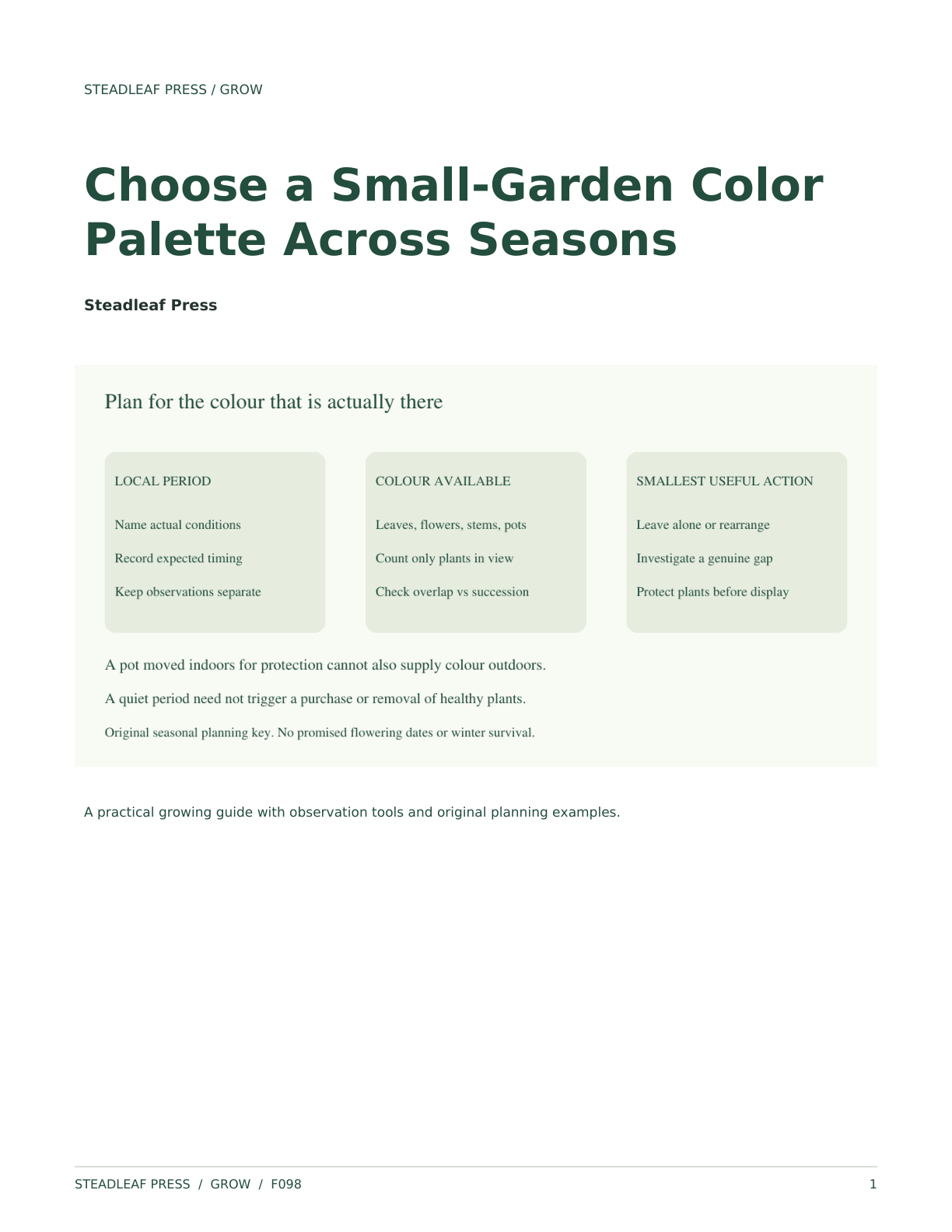
Choose a Small-Garden Color Palette Across Seasons
Steadleaf Press
A small garden changes colour even when you buy nothing new. Leaves emerge, flowers open and fade, stems become visible, and the pots themselves take a larger part in the view. Planning across seasons helps you enjoy those changes without treating every quiet period as a shopping problem.
FREE · No email or checkout
Read the complete free guide online
Read the instructional text here, or download the complete free PDF above for original diagrams, tables, worksheets and page layout. The original publication is unchanged.
STEADLEAF PRESS / GROW
Choose a Small-Garden Color Palette Across Seasons
Steadleaf Press
A practical growing guide with observation tools and original planning examples.
STEADLEAF PRESS / GROW / F098 1
A small garden changes colour even when you buy nothing new. Leaves emerge, flowers open and fade, stems become visible, and the pots themselves take a larger part in the view. Planning across seasons helps you enjoy those changes without treating every quiet period as a shopping problem.
Build a timeline around what grows well, then consider how to improve any period when you would welcome more colour.
Name the seasons your garden actually experiences
Begin with a few locally useful periods rather than fixed months. In a temperate garden these might be spring growth, summer flowering, autumn change and winter rest. Elsewhere, a cooler flowering period, hot dry stretch and wet growing season may describe the garden more accurately. Add or remove rows from the board to fit those periods; four is a worksheet example, not a requirement.
Write your own names across a page. Under each, note the conditions that affect your choices: frost, heat, rain, strong wind or the shade of nearby trees. Add when you are usually at home to enjoy the garden. A display planned for a month when you are away may deserve less of your budget.
Use local guidance for expected flowering periods, then refine the timeline with your observations. A catalogue photograph cannot promise when your plant will flower.
Keep expected and observed dates separate. “Usually flowers in late spring here” is a useful forecast. “First flowers opened on 18 May this year” is a record. Neither promises next year's exact timing.
STEADLEAF PRESS / GROW / F098 2
Record colour beyond the flowers
Walk around the garden and list what supplies colour now. Include leaf undersides, new growth, seedheads where appropriate, stems, bark, containers and the wall or fence behind them. Note whether each feature is lasting, temporary or uncertain.
The RHS describes foliage as a source of extended colour and stems or bark as potential seasonal features, especially when flowers are scarce. Use that range when planning rather than expecting a small collection of plants to bloom continuously. RHS, Three ways to bring colour into your garden
For each plant, make a short entry:
- Name and variety:
- Leaf colour when newly growing:
- Leaf colour later in the season:
- Flower colour and expected flowering period:
- What remains attractive after flowering:
- What disappears or needs seasonal protection:
- Dates or conditions observed in this garden:
Do not assume that an evergreen looks identical throughout the year, or that every plant sold for foliage keeps its leaves through your winter. Record the named variety and the local conditions alongside the colour.
STEADLEAF PRESS / GROW / F098 3
Choose a thread that can continue
Pick one colour or relationship you would like to recognise through the year. It could be deep foliage beside pale flowers, silver-grey leaves with warm pot colours, or a changing range of greens. The thread can remain while individual flowers come and go.
University of Georgia Extension encourages gardeners to choose combinations they enjoy and reduce competing colours rather than using every favourite at once. Apply that as a helpful editing choice, not a restriction on personal taste. University of Georgia Extension, Using Color in the Landscapes
Write one sentence: “The garden will keep ___ visible, with ___ appearing during ___.” For example, “The garden will keep dark foliage and warm clay pots visible, with pale flowers appearing during the main growing period.”
That sentence leaves room for seasonal change. It does not require matching every flower or removing a healthy plant because it blooms in an unexpected shade.
STEADLEAF PRESS / GROW / F098 4
Make a season by season board
Use the board below as a working page. Rename the periods to match your climate. Enter plants you already own before listing possible additions. Mark each colour as observed, expected from a named source, or uncertain. Count it as part of the outdoor view only while that plant will actually remain there; a pot moved indoors for protection cannot also supply colour in the courtyard.
Local period Colour already Temporary feature Practical condition Smallest useful available action
First active growth ___ ___ ___ ___
Main growing ___ ___ ___ ___ period
Later growth or ___ ___ ___ ___ change
Quiet or difficult ___ ___ ___ ___ period
Fill the last column with a decision, not necessarily a purchase. Options include leaving the arrangement alone, turning an existing pot toward the main view, moving a manageable container to another suitable position, or researching one plant for a genuine gap.
Under the board, keep a separate shortlist:
Possible addition Period it would Conditions it must Existing plant it Decision improve tolerate would complement
___ ___ ___ ___ Buy, investigate or leave out
Use the shortlist to avoid buying several plants for the same brief period. Check timing as well as colour: two pale-flowered plants do not form a simultaneous pair if one finishes before the other starts. They may instead repeat the colour in succession. Write which effect you want, then compare their local bloom windows. If overlap is uncertain, treat it as a possibility rather than the basis of the whole scheme. Leave out candidates whose growing needs do not match the space.
STEADLEAF PRESS / GROW / F098 5
Work through a sheltered courtyard example
Consider a fictional courtyard in a mild temperate climate. It has light shade, warm-coloured pots and a dark-leaved heuchera already growing well. The owner also has two separately potted flowering plants, one recorded as flowering earlier and the other later in the growing season.
Heucheras are useful candidates for foliage-led container plans. The RHS describes their range of leaf colours and suitability for light or dappled shade. It also cautions that some lose leaves in colder conditions, so year-round foliage depends on the variety and location. RHS, How to grow heuchera
The owner chooses dark foliage, pale flowers and the existing clay-coloured pots as the continuing relationship. Their board looks like this:
Period Continuing colour Changing feature Decision
New growth Dark and fresh green Earlier pale flowers Move the flowering pot leaves; clay pots into view when it is ready, if that position suits it
Main growth Foliage and the same Flowers overlap briefly Enjoy the fuller display pots without adding another flowering plant
Later growth Dark foliage remains the Later flowers fade Keep healthy plants and main feature let foliage carry the view
Quiet months Pots and whatever Possible leaf loss during Use a simpler display and foliage remains locally cold weather follow the plants' protection needs
The owner considered buying a plant for every row, but the earlier and later flowers already cover their favourite periods outdoors. Pots and foliage can carry the quieter view.
If the heuchera loses more foliage than expected during a cold winter, that observation goes on the board. Next year's winter plan changes accordingly. Distinguish normal seasonal change from unexplained decline by checking guidance for the actual cultivar and conditions; do not label every loss of foliage as harmless winter rest. The plant is not discarded merely because the original colour forecast was too optimistic.
STEADLEAF PRESS / GROW / F098 6
Keep healthy plants through the transitions
A change of season does not require emptying every container. Illinois Extension describes several options for seasonal displays, including changing only selected plants or rearranging pots so that those at their best are more visible. Illinois Extension, Container Garden Designs
Before replacing anything, ask:
1. Is the plant healthy and simply between attractive stages?
2. Does it have a suitable place to continue growing or rest?
3. Could a neighbouring pot become more visible while it changes?
4. Would the proposed replacement actually improve the missing period?
5. Can I provide the replacement's care, including any winter or dry-season needs?
For plants kept through cold weather, include a realistic protection plan. Illinois Extension explains that perennial roots in containers experience harsher cold than roots insulated by the ground. A plant's landscape hardiness alone does not guarantee survival in an exposed pot. Illinois Extension, Overwintering potted plants
Where protection requires moving a plant out of sight, allow the display to become smaller. Do not keep it exposed solely to preserve the colour scheme. Get help with heavy containers, and keep any temporary storage compatible with the plant's needs and building rules.
STEADLEAF PRESS / GROW / F098 7
Review the board at the end of each period
Take a photograph from the same ordinary viewing place and add three short notes: what remained colourful, what appeared earlier or later than expected, and what you would keep unchanged.
Add a fourth note only when something needs action. For example, “The pale flowers were hidden behind new leaves” suggests a placement change. “The whole garden was quiet while we were away” may suggest doing nothing at all.
After a year, your board will contain more useful local information than a generic shopping list. Keep the plants and combinations that earned their place. Change the parts that were difficult to care for or failed to bring the pleasure you expected.
STEADLEAF PRESS / GROW / F098 8
Sources and scope
- Royal Horticultural Society, Three ways to bring colour into your garden: foliage, flowers, stems and bark as sources of seasonal colour.
- University of Georgia Extension, Using Color in the Landscapes: choosing and editing colour combinations. Its seasonal examples concern north Georgia.
- Royal Horticultural Society, How to grow heuchera: foliage choices, light preferences and variable winter leaf retention.
- University of Illinois Extension, Container Garden Designs: selective seasonal changes and rearranging existing containers.
- University of Illinois Extension, Overwintering potted plants: cold exposure of container-grown perennials.
The board and courtyard example are adaptable planning tools. Flowering dates, leaf retention and overwintering needs depend on the actual plant and location. Check local noninvasive plant guidance before adding a new species, and plan for the garden you can care for through the whole year.