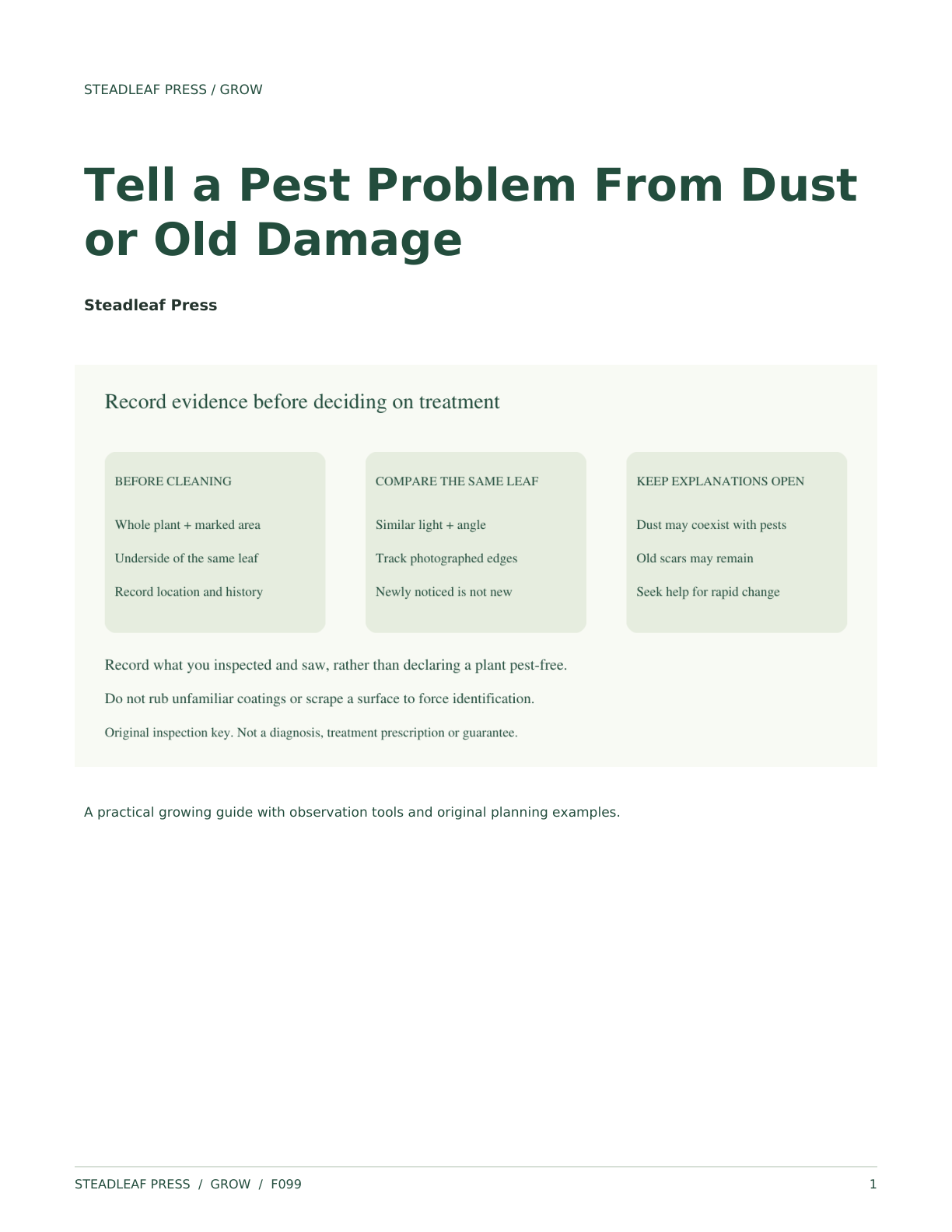
Tell a Pest Problem From Dust or Old Damage
Steadleaf Press
A pale speck, brown patch or fuzzy area deserves a closer look before treatment. Ask three questions: is it material sitting on the leaf, a normal part of the plant, or damage within the tissue? Then look for evidence that something is active now.
FREE · No email or checkout
Read the complete free guide online
Read the instructional text here, or download the complete free PDF above for original diagrams, tables, worksheets and page layout. The original publication is unchanged.
STEADLEAF PRESS / GROW
Tell a Pest Problem From Dust or Old Damage
Steadleaf Press
A practical growing guide with observation tools and original planning examples.
STEADLEAF PRESS / GROW / F099 1
A pale speck, brown patch or fuzzy area deserves a closer look before treatment. Ask three questions: is it material sitting on the leaf, a normal part of the plant, or damage within the tissue? Then look for evidence that something is active now.
Dry, dead leaf tissue will not heal back to green. Its continued presence is not evidence that a treatment has failed or a pest is still feeding. Use dated photographs and new observations to distinguish an old mark from a developing problem. Scorched areas, for example, remain damaged even when the plant survives and produces healthy growth. South Dakota State University Extension, Leaf Scorch and Sunscald
Inspect before cleaning
Choose a well-lit place and support the plant securely. Have a hand lens, plain paper and a camera or phone ready. Do not begin by polishing the whole plant; that can remove evidence before you understand it.
Take three photographs:
1. The whole plant, showing which leaves are affected.
2. A close view of one marked area.
3. The underside of that same leaf, with its position on the plant recorded.
Look at a newer leaf and an older one as well. Note whether the mark appears on exposed upper surfaces, protected undersides, leaf joints or the entire plant. Inspect stems and crevices too. A leaf surface can be dusty while a separate pest problem is present underneath it.
Record recent events: cleaning nearby, building work, splashed water, a move into stronger sun, cold exposure or a previous treatment. These are clues to investigate, not proof of a cause. RHS guidance lists several environmental causes of houseplant spots and discoloration as well as pests and disease. RHS, Leaf damage on houseplants
STEADLEAF PRESS / GROW / F099 2
Use the leaf inspection comparison chart
Use the chart to decide what to inspect next. A visual resemblance should remain a working possibility until supported by further evidence.
What you see Possibility to consider Useful next check What not to assume
A loose dull film over Ordinary dust Photograph first, then Dust on top does not exposed leaves gently clean a small exclude pests suitable area with plain underneath. water. Iowa State
White crystalline material Mineral or fertiliser Review the water and Every white patch is not on leaves, mix or pot residue fertiliser history and an insect or fungus; compare deposits on appearance alone does different surfaces. not identify the Maryland Extension substance.
A dry brown patch, tear Old physical or Compare its boundaries A persistent scar does or scar that is part of the physiological damage with a dated photograph not prove continued leaf and inspect nearby feeding. healthy tissue.
Fine pale stippling, Spider-mite feeding Use magnification One web or a few pale sometimes with fine beneath leaves to look dots do not establish webbing for the mites themselves. mites. Maryland Extension
Silvery scarring with tiny Possible thrips feeding Search for slender Scratches and silvery dark spots insects and compare marks alone do not them with an confirm thrips. identification guide. RHS
Cottony wax gathered Possible mealybugs Look for the insect bodies A loose fibre or every near joints or on stems and inspect sheltered fuzzy patch is not a parts of the plant. mealybug. Maryland Extension
Raised shell-like bumps Possible scale insects Compare shapes and A stationary bump is not on stems or leaf positions with a reliable automatically a pest. undersides reference for scale and for the plant itself. RHS
Brown spore-bearing Normal reproductive Identify the fern and Normal spore structures clusters on a fern structures, called sori compare its normal do not exclude a fertile fronds. Iowa State separate infestation elsewhere.
A white or grey surface Possible fungal growth or Keep photographs and Material that wipes away growth that is unfamiliar another coating seek identification, is not necessarily especially if it spreads. harmless dust. Powdery mildew grows on the surface. UC IPM
Natural hairs and patterned leaf colouring also need to be recognised before cleaning or treatment. Check the exact species and cultivar against a reliable plant reference. Do not rub an unfamiliar coating off simply to see what happens.
STEADLEAF PRESS / GROW / F099 3
Clean only when cleaning is appropriate
For an identified plant with sturdy, smooth leaves, support a leaf from underneath and use a soft cloth lightly dampened with plain water on a small area. Stop if the surface seems delicate or is being damaged. Use clean materials so you do not carry debris from one plant to another.
Iowa State recommends damp, soft materials for cleaning large-leaved houseplants and warns that household detergents can damage leaf surfaces. Its guidance also distinguishes the care of fuzzy-leaved plants. Iowa State University Extension, Cleaning houseplants
For fuzzy, unusually coated or fragile leaves, check plant-specific guidance first. Skip improvised soap, alcohol, oil or leaf-shine mixtures. Do not use forceful scraping as an identification method.
Write down what happened: “Loose grey material transferred to the cloth; the green surface below remained intact.” That supports a surface-deposit explanation. It does not establish the identity of every remaining speck or replace inspection of the underside.
If you have already cleaned the plant, say so when asking for help. A photograph taken afterwards may show something different from the original concern.
STEADLEAF PRESS / GROW / F099 4
Track change on the same leaf
Give the leaf a simple description such as “third mature leaf on the left-hand stem,” and mark its position on the whole-plant photograph. Use that photograph to find it again; counting from the top can select a different leaf after new growth appears. Label the photograph rather than writing on the leaf. Include a familiar size reference beside the leaf without pressing it against the tissue.
At the next check, use similar lighting and angle. Compare the same boundaries. A shadow, brighter exposure or a closer photograph can make an unchanged patch look larger or darker.
Use this record:
- Plant and leaf location:
- Date first noticed:
- Surface material, normal structure, tissue damage or uncertain:
- Size and position of the marked area:
- Insects, mites, eggs, wax or webbing actually observed:
- Underside and leaf joints checked:
- Cleaning or care changes made:
- Photo names and dates:
- What is genuinely new at the next check:
- Next inspection date, action and reason; signs that would prompt earlier help:
Separate “newly noticed” from “new since the last check.” A spot on an underside you did not inspect before has an unknown starting date. A patch extending beyond its photographed boundary or a mark appearing on a previously clear, photographed leaf is stronger evidence of change. Record clearly observed pests even if you cannot tell when they arrived. The same old dry edge looking untidy is not new damage.
Check developing leaves as well, without demanding immediate growth from a slow or resting plant. A quiet inspection is reassuring evidence, not a guarantee that no pest is present.
STEADLEAF PRESS / GROW / F099 5
Work through a mixed finding
Imagine a smooth-leaved houseplant with a pale surface film and one brown patch. This is an illustrative inspection, not a report of a plant we have tested.
The owner photographs both features separately. After a small, gentle clean, the loose film lifts away. The brown patch stays because it is part of the leaf. They record the cleaning and keep a photograph that clearly shows the patch boundary.
They inspect the underside, joints and nearby leaves. If they see no pest, they record which parts were checked and whether a hand lens was used, rather than writing “pest-free.” They review recent care and set a follow-up date, rather than spraying because the old patch remains visible. Rapid spreading damage, wilting or softening calls for earlier assessment.
At a later check, there are several possible paths:
- If the patch is unchanged and no new signs appear, continue appropriate care and ordinary observation.
- If the patch enlarges or new leaves develop similar damage, investigate the ongoing cause.
- If identifiable insects or mites appear, use pest-specific guidance.
- If unfamiliar powdery growth develops, seek identification rather than calling it dust because the first film wiped away.
More than one explanation may be correct. Cleaning dust does not explain a scar, and identifying a scar does not settle the condition of every other leaf.
STEADLEAF PRESS / GROW / F099 6
Know when a closer assessment is worthwhile
Seek help when damage spreads quickly, the plant wilts despite apparently suitable care, a stem or crown softens, or the evidence remains ambiguous. Send the whole-plant view as well as the close-up, the plant's identity if known, and the record of recent changes.
Keep a plant with a suspected transmissible problem apart while the cause is assessed. Do not diagnose a particular pathogen from colour, a halo or a soft spot alone. Likewise, do not assume that a plant without visible insects needs a fungicide.
The next useful step may be identification, a care adjustment, careful cleaning or simply documenting an old mark. Treatment follows the evidence; it does not replace it.
STEADLEAF PRESS / GROW / F099 7
Sources and scope
- South Dakota State University Extension, Leaf Scorch and Sunscald: permanent injury to scorched tissue.
- RHS, Leaf damage on houseplants, Thrips and Scale insects: alternative causes and pest clues.
- Iowa State, Cleaning houseplants and Growing Ferns from Spores: surface care and natural fern structures.
- Maryland Extension, Mineral deposits, Mealybugs and Indoor plant problems: residue and pest comparisons.
- UC IPM, Houseplant Problems: surface fungal growth.
Sources checked 4 November 2026. The comparison chart, observation record and scenario are original. They are inspection aids, not an image-based diagnosis, pesticide prescription or guarantee of pest absence.