Check for Fungus Gnats Without Overreacting
Steadleaf Press
A small fly near a houseplant is a reason to look more closely, not a reason to empty every pot. Start by finding where the flies appear, checking the condition of the plants and looking for evidence that points to fungus gnats. A few clear observations will help you choose a proportionate next step.
FREE · No email or checkout
Read the complete free guide online
Read the instructional text here, or download the complete free PDF above for original diagrams, tables, worksheets and page layout. The original publication is unchanged.
STEADLEAF PRESS / GROW
Check for Fungus Gnats Without Overreacting
Steadleaf Press
A practical growing guide with observation tools and original planning examples.
STEADLEAF PRESS / GROW / F100 1
A small fly near a houseplant is a reason to look more closely, not a reason to empty every pot. Start by finding where the flies appear, checking the condition of the plants and looking for evidence that points to fungus gnats. A few clear observations will help you choose a proportionate next step.
This guide covers inspection, monitoring and gentle changes to everyday care. Its aim is a short record of what you found and what needs attention, without turning an uncertain sighting into an emergency.
Separate the flying adults from the soil stage
Adult fungus gnats are small, dark, delicate flies with long legs and antennae. They often stay around potting media or nearby windows. Their larvae live in the growing medium and look very different: slender, pale to translucent bodies with dark heads. The larvae feed on fungi and decaying material and can also feed on roots. University of California IPM, Fungus Gnats
The flying adults are generally a nuisance. The condition of the roots and the vulnerability of the plant matter when judging the potential plant problem. University of Georgia Extension notes that larvae can affect young plants and seedlings, and that generations can overlap indoors. Seeing another adult after your first care adjustment does not by itself establish that the adjustment failed. University of Georgia Extension, Fungus Gnats A Tiny Nuisance of Houseplants
Avoid diagnosing the plant from a fly alone. Equally, do not assume every small indoor fly is a fungus gnat. A clear close photograph, a magnifying lens and the place where you repeatedly find the insects are more useful than a hurried guess.
STEADLEAF PRESS / GROW / F100 2
Record the first sighting
Begin with the pot nearest the repeated activity. Give it a simple name, such as “desk plant,” so that later notes refer to the same container.
- Date and location: Where were the flies noticed?
- Activity: Resting on the growing medium, walking on the pot, flying near a window or elsewhere?
- Appearance: Colour, general shape and anything visible through a lens.
- Plant: Name, approximate age and whether it is a seedling or established specimen.
- Recent change: New plant, repotting, changed watering, or a move indoors?
- Plant condition: Normal growth, new yellowing, persistent wilt or another change?
Photograph the whole plant and the pot before making changes. If you can photograph an insect clearly, retain that image separately. Do not add water or disturb roots merely to make something appear for the camera.
Look at nearby pots as well. Adults may move between locations, so the closest pot is a starting point rather than a proven source. If activity is concentrated away from plants, broaden the identification question instead of treating the entire plant collection.
STEADLEAF PRESS / GROW / F100 3
Inspect the pot without dismantling it
Look over the growing-medium surface, the pot rim, its saucer and any decorative outer pot. Notice fallen leaves, old flowers and standing water. Check the moisture using the usual method appropriate for that plant and medium. Record what you actually find, not what you expected from the last watering date.
If larvae are visible near the surface, note their appearance and location. Their absence during a brief inspection does not establish that there are none. Cornell IPM describes larvae occurring near the surface of damp potting soil and recommends magnification when examining these small insects. Cornell IPM, Fungus Gnats
Leave the root ball in place during this first check unless a separate plant-health concern calls for examination. Repeatedly uprooting a healthy plant to search for larvae can make the investigation more disruptive than the initial problem.
Use this record across the plants you inspect:
Pot and inspection Repeated adult Moisture or Plant condition Next step and date activity drainage review date observation
___ ___ ___ ___ ___
___ ___ ___ ___ ___
___ ___ ___ ___ ___
One row may say “No adults seen; growing medium still moist; plant looks normal; leave care unchanged.” Recording an uneventful check helps prevent treating every pot just because one is troublesome.
STEADLEAF PRESS / GROW / F100 4
Use a sticky card as a record of adult activity
A commercially made yellow sticky card can catch flying adults and make repeated activity easier to observe. It does not remove larvae already in the pot. University of California IPM includes sticky traps among monitoring and trapping methods, while emphasising moisture and debris management. University of California IPM, Fungus Gnats
Follow the card's placement instructions. Keep the sticky surface clear of leaves and out of reach of children and pets. Avoid placing exposed cards where they could contact wildlife. Do not substitute an open bowl of a homemade mixture.
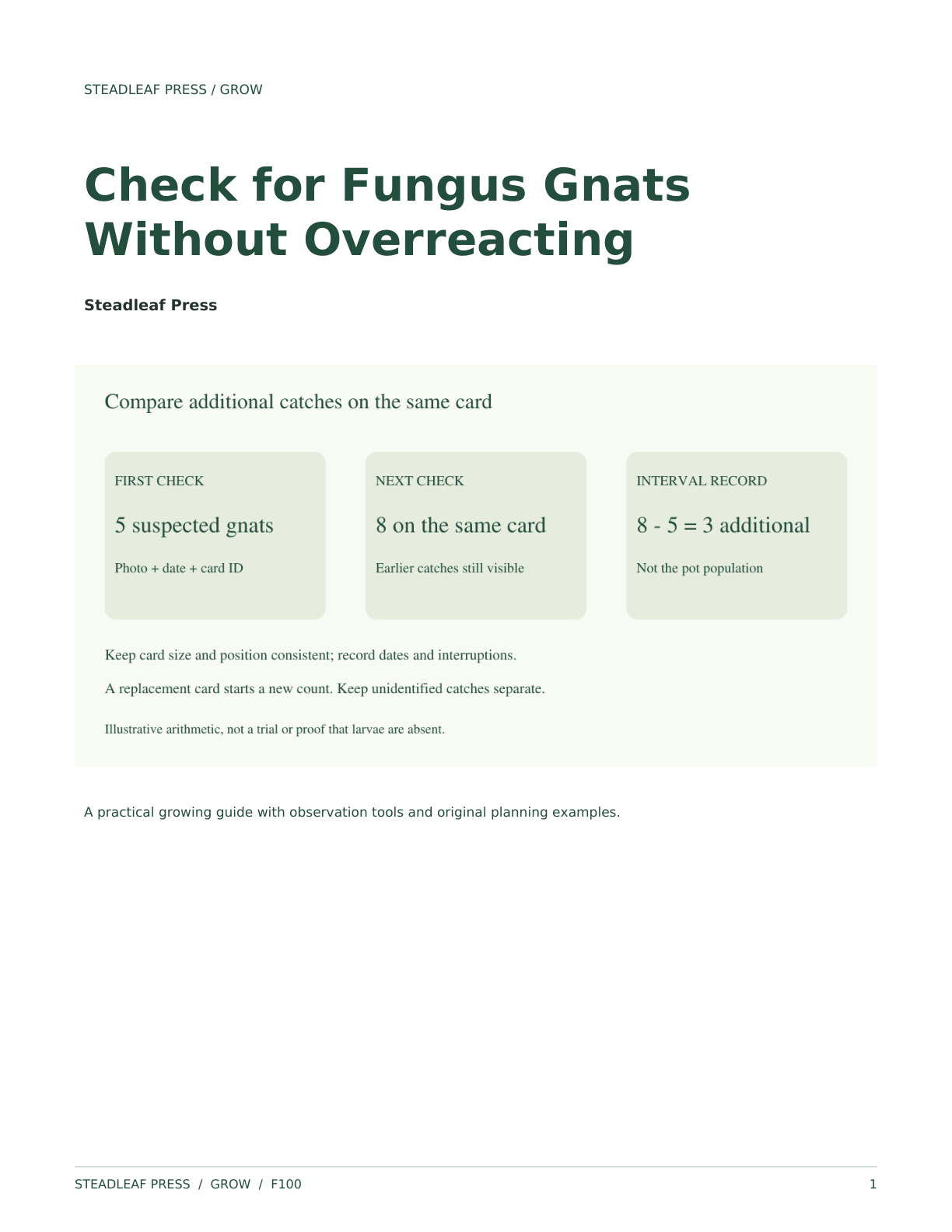
Label each card with its pot, card identifier and starting date. Keep its size and position consistent while comparing observations, and record the dates of both checks in each comparison. When replacing it, begin a new count and record the replacement. A card exposed for a fortnight cannot be compared directly with one exposed for an afternoon. If a card falls, becomes obscured or is moved, note the interruption rather than treating that interval as directly comparable.
Record “new suspected fungus gnats since the last check” rather than counting every insect on the card again. For example, if the same intact card holds 5 suspected gnats at one check and 8 at the next, with the earlier catches still visible, record 3 additional catches during that interval. Photograph the card at each check to support the comparison. Keep unidentified catches separate; a full card does not mean every mark is the insect you are investigating. Card counts describe catches, not the total population in the pot.
STEADLEAF PRESS / GROW / F100 5
Correct excess moisture without drying the plant out
Fungus gnats favour moist conditions, so reducing unnecessary wetness can help. University of Georgia Extension, Fungus Gnats A Tiny Nuisance of Houseplants. Keep drainage working and remove loose decaying debris, as described in UC IPM's cultural management guidance.
Make the adjustment fit the plant:
1. Remove loose, fallen plant debris from the surface without digging into roots.
2. Check that an ordinary draining pot is not standing in accumulated runoff.
3. Confirm the plant's moisture needs before changing when you water.
4. Allow the degree of drying appropriate to that species and growing system.
5. Keep observing both insect activity and plant condition.
A moisture-loving plant should not be forced into the drying routine of a succulent. The RHS explicitly limits drying advice to what preserves plant health. Seedlings and newly rooted plants also need particular care. If you cannot reduce surface wetness without harming the plant, ask for advice specific to the plant and growing system.
Do not add a thick covering to hide the surface, change every potting mix or strip roots as an automatic first response. These changes make it harder to see what is happening and may create a new care problem. Specialist systems, including self-watering pots and water culture, need their own guidance.
STEADLEAF PRESS / GROW / F100 6
Work through an example
Imagine a desk plant with a few small flies around it. The plant is established and growing normally. Its owner has been adding a little water every morning without checking the medium.
Inspection finds damp mix, fallen leaves and water sitting in the outer pot. The owner photographs a fly, removes the loose debris and empties the excess runoff. They check the plant's care guidance and replace the automatic top-up with a moisture-based decision. A labelled sticky card provides a consistent place to observe adult activity.
Their first note reads:
“Suspected fungus gnats near the desk pot. Plant otherwise normal. Changed unnecessary watering and removed standing runoff. Identification still needs a clearer insect photo.”
At a later check, another adult appears. The owner records it and compares additional catches over similar observation periods rather than immediately repotting. Fewer catches alongside a healthy plant support continuing the improved routine, but do not show that all larvae are gone. If activity rises or the plant deteriorates, the dated notes and photographs are ready for a plant clinic.
The same plan would need more urgent advice for a tray of vulnerable seedlings showing poor growth. The plant's condition changes the response, even if the flying insects look similar.
STEADLEAF PRESS / GROW / F100 7
Decide what the evidence calls for
Choose the statement that fits the current picture:
- Identification uncertain: Improve the photograph or request help before treating.
- Likely fungus gnats and a healthy plant: Correct avoidable wetness and debris, then monitor.
- Persistent activity despite suitable care: Request plant-specific management advice with the record.
- Declining plant or affected seedlings: Seek prompt diagnostic advice rather than assuming flies explain every symptom.
Your useful outcome is a clearer source, a care adjustment that the plant can tolerate and a record showing whether the situation is changing. A promise that one card or one dry day will eliminate every life stage is not needed.
STEADLEAF PRESS / GROW / F100 8
Sources and scope
- University of California Statewide IPM Program, Fungus Gnats: adult and larval identification, monitoring and cultural management.
- University of Georgia Extension, Fungus Gnats A Tiny Nuisance of Houseplants: life stages, overlapping generations and vulnerable young plants.
- Cornell Integrated Pest Management, Fungus Gnats: inspection and the relationship between larvae and damp growing media.
- Royal Horticultural Society, Fungus gnats: keeping plant health central when adjusting moisture.
The log and example are observation aids, not a diagnosis from a single symptom. This guide contains no pesticide recipes. A local extension service or qualified plant adviser can help with identification, persistent problems and species-appropriate care.