Inspect Leaf Undersides for Spider Mites
Steadleaf Press
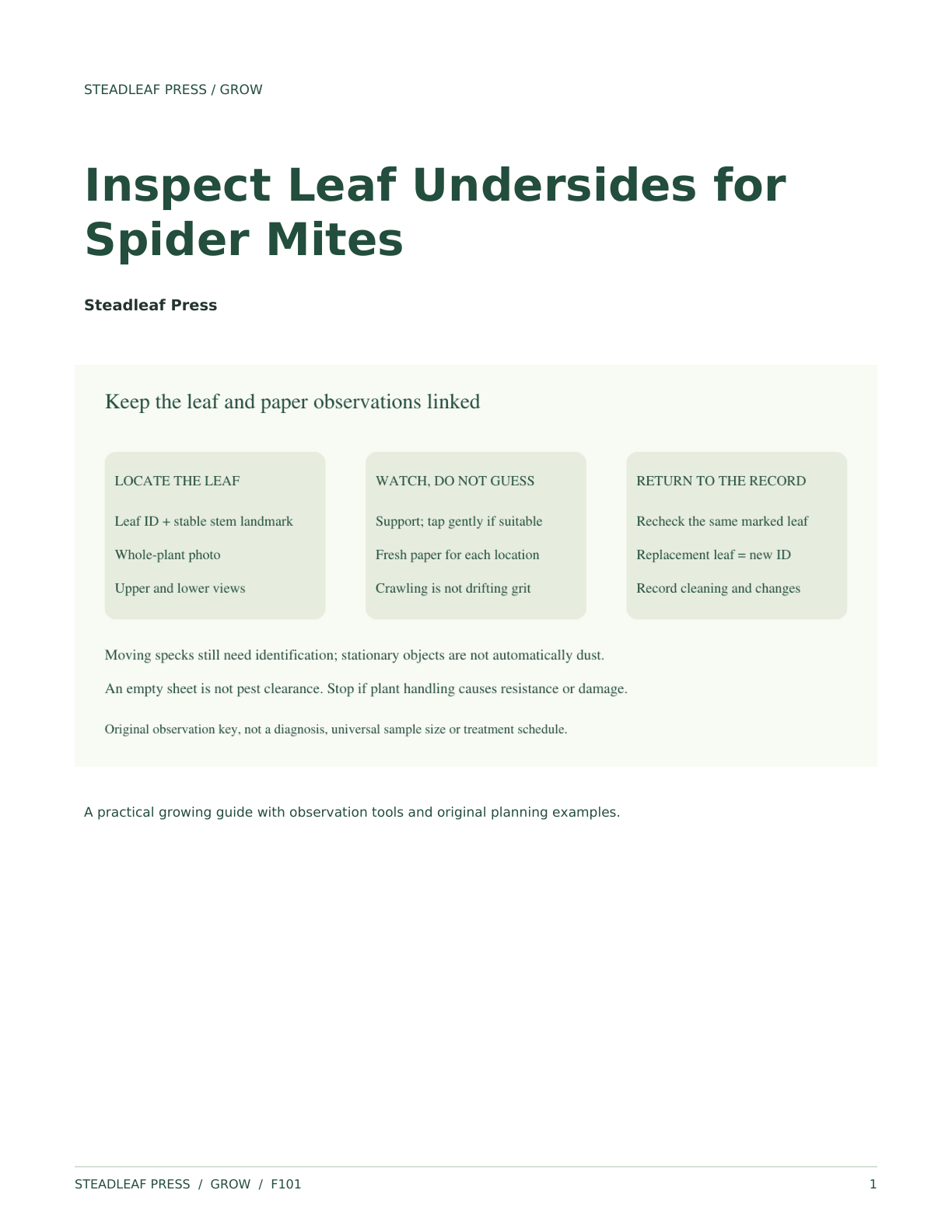
Fine speckling or a thread of webbing deserves a closer look, but neither is enough to identify spider mites on its own. Turn over several leaves, use magnification and record whether you can see moving organisms. A calm inspection can separate an active pest concern from dust, old damage or an ordinary spider's web.
FREE · No email or checkout
Read the complete free guide online
Read the instructional text here, or download the complete free PDF above for original diagrams, tables, worksheets and page layout. The original publication is unchanged.
STEADLEAF PRESS / GROW
Inspect Leaf Undersides for Spider Mites
Steadleaf Press
A practical growing guide with observation tools and original planning examples.
STEADLEAF PRESS / GROW / F101 1
Fine speckling or a thread of webbing deserves a closer look, but neither is enough to identify spider mites on its own. Turn over several leaves, use magnification and record whether you can see moving organisms. A calm inspection can separate an active pest concern from dust, old damage or an ordinary spider's web.
You will need good light, a hand lens if available, plain white paper and somewhere to make notes. This is an observation routine with a gentle first response for suitable plants, not a chemical treatment plan.
Know what you are looking for
Spider mites are tiny arachnids. Their feeding can leave numerous pale flecks and, with greater injury, a dull or bronzed appearance. Their colour varies, so looking only for red specks can miss them. Colorado State University Extension also warns that spider webs and plant fluff can be mistaken for mite webbing. Colorado State University Extension, Spider Mites
Treat those signs as directions for inspection. Write “fine flecking on two leaves” before writing “spider mites.” This keeps an observation separate from its possible explanation.
Look closely at the lower leaf surface, including around veins and where the leaf joins its stalk. Utah State University recommends inspecting leaf undersides with a hand lens for mites and debris. Its guide covers crops and ornamentals; the magnified inspection is useful here without importing a crop-treatment program. Utah State University, Two-Spotted Spider Mite
You do not need to identify every tiny object immediately. The first goal is to find repeatable evidence and preserve a useful view of it.
STEADLEAF PRESS / GROW / F101 2
Set up without spreading the work across the room
If you suspect an active pest, move the plant away from touching neighbours when this can be done safely and the new place meets its care needs. Check those neighbouring plants too. Separation is a precaution, not proof that the rest of the collection is unaffected.
Put down a clean working surface. Keep other plants away from the inspection area. Wash your hands afterward and clean reusable equipment before examining another plant. If the container is heavy, leave it in place and bring the light, lens and paper to it.
Begin with a whole-plant photograph. Include its position relative to a window or heat source. Then photograph one affected leaf from above and below. Keep the images labelled with the plant name and date so that a later adviser can understand what they show.
Avoid turning a delicate plant upside down or repeatedly bending its leaves. Support a leaf gently while looking underneath, and stop if the stalk resists.
STEADLEAF PRESS / GROW / F101 3
Follow a short leaf route
Choose an affected leaf, a nearby leaf and a leaf elsewhere on the plant. Add more locations if the plant is large or damage is scattered. This is a practical starting route, not a sample size that can certify the plant pest-free.
For each location, record the following:
Leaf location Upper surface Underside under a Webbing or debris Photo reference lens
Affected leaf ___ ___ ___ ___
Nearby leaf ___ ___ ___ ___
Elsewhere on plant ___ ___ ___ ___
Use concrete descriptions. “Tiny pale objects beside the main vein, movement not seen” is more useful than “looks infected.” Stationary objects are not automatically dust: mite eggs do not crawl, and a still image may not resolve what you found. Note whether you used a lens, the leaf's age, and whether dated observations show that the marks are new. If you did not inspect that location previously, record when you first noticed them rather than assigning an age to the damage.
Inspect the gaps between stems and leaves as well as the most obvious web. A single strand crossing a large space tells you less than close observation of the leaf surface and any organisms present.
STEADLEAF PRESS / GROW / F101 4
Use white paper to make movement easier to see
Hold a clean sheet of white paper beneath one leaf or small shoot. Tap the supported plant part lightly enough not to damage it, then hold the paper still and watch through the lens. Look for independent crawling rather than particles sliding as the sheet tilts or moving in a draught. Photograph the findings before tapping another location onto the paper.
Purdue Extension describes tapping foliage over white paper to reveal tiny crawling mites. Movement helps distinguish living organisms from loose grit. It does not, by itself, identify every moving speck as a plant-feeding spider mite. Purdue Extension, Spider Mites on Ornamentals
Keep a separate note for the paper observation:
- Plant and leaf location:
- Moving specks seen, not seen or uncertain:
- Appearance under magnification:
- Stationary debris also present:
- Photograph obtained:
- Identification question still open:
Repeat at another suspect location if the first result is unclear and the plant tolerates handling. Use a fresh sheet for each separately recorded location so an earlier catch is not assigned to the next leaf. Always use clean paper for the next plant. Do not force a brittle shoot to produce a sample, and do not interpret an empty sheet as a complete clearance.
If you cannot resolve the tiny objects, keep a close photograph and ask a plant diagnostic service what image or sample would help. Follow its collection instructions before mailing or carrying plant material.
STEADLEAF PRESS / GROW / F101 5
Choose a first response that suits the leaves
When evidence supports a mite problem, plain-water cleaning may reduce mites on a plant that tolerates washing. Colorado State University Extension describes rinsing manageable houseplants and wiping larger leaves with a soft, damp cloth. Purdue also describes water dislodging mites. Colorado State University Extension, Purdue Extension
Choose the method around the plant rather than convenience:
1. Confirm that its leaves tolerate rinsing or wiping. Seek plant-specific guidance for delicate, fuzzy or easily damaged foliage.
2. Work away from electrical equipment and other plants.
3. Support the container and stems. Use gentle water pressure appropriate to the leaves.
4. Include the undersides you inspected without forcing leaves backward.
5. Avoid repeatedly saturating the growing medium during leaf cleaning, and let normal drainage occur.
6. Stop if leaves bruise, tear or react badly.
Do not compensate for suspected mites by leaving the roots constantly wet. Keep the plant's normal moisture and light needs in view. A humidity change or routine misting should not replace checking whether mites remain.
STEADLEAF PRESS / GROW / F101 6
Work through two different outcomes
In the first example, an owner notices one web strand on a plant beside a window. The leaves look as they did before. A careful underside inspection finds no moving organisms, and a paper observation reveals stationary particles with no crawling observed. The particles remain unidentified unless their appearance can be resolved.
The record reads: “Web strand present, no mites found during this inspection, no new leaf damage.” The owner keeps an eye on the plant and checks again if signs change. They do not treat the whole shelf or claim that the plant has been definitively cleared.
In the second example, several leaves have new pale flecking. The owner sees tiny moving organisms on the undersides and on the paper, with fine webbing around affected leaf joints. They photograph these findings, separate touching plants and seek identification help if the organisms remain uncertain.
For a confirmed problem on washable foliage, they begin a gentle physical response and record the areas cleaned. The follow-up question is whether live mites and new damage are continuing. Old flecks alone are not a useful measure of current pest activity.
These examples lead to different actions because the evidence differs. Neither depends on webbing alone.
STEADLEAF PRESS / GROW / F101 7
Recheck the same places and know when to ask
Keep your leaf-location record so later inspections return to the same leaves. Give each recorded leaf an identifier and locate it on the whole-plant photograph using a stable stem landmark; “affected leaf” alone may refer to a different leaf next time. If a recorded leaf falls or is removed, note that and give any replacement its own identifier. Add developing leaves as the plant grows. Record new findings separately from old marks and note any cleaning between observations.
Seek help when identification is uncertain, the plant is declining, webbing and live mites remain widespread, or the foliage cannot safely be cleaned. Include the whole-plant view, close images, plant name and your observation notes. Describe any products already used rather than adding another remedy before advice arrives.
The useful outcome is a supported identification or a clear unresolved question, followed by care that does not damage the plant. Continue monitoring after improvement rather than declaring success from one empty piece of paper.
STEADLEAF PRESS / GROW / F101 8
Sources and scope
- Colorado State University Extension, Spider Mites: feeding signs, variable appearance, webbing lookalikes and physical cleaning of houseplants.
- Purdue Extension, Spider Mites on Ornamentals: observing crawling organisms after tapping foliage over white paper and physical removal with water.
- Utah State University, Two-Spotted Spider Mite: hand-lens inspection of leaf undersides.
The inspection route and examples are planning aids. They do not establish a universal diagnosis, treatment interval or quarantine period. This guide does not prescribe pesticides or homemade sprays; use qualified, plant-specific advice for persistent or uncertain problems.