Identify Scale Insects on Indoor Stems
Steadleaf Press
A row of brown bumps on a houseplant stem can be easy to overlook. It can also be easy to misread. Before rubbing, scraping or spraying anything, record where the bumps sit and look closely enough to decide whether you have a likely insect problem or an unanswered identification question.
FREE · No email or checkout
Read the complete free guide online
Read the instructional text here, or download the complete free PDF above for original diagrams, tables, worksheets and page layout. The original publication is unchanged.
STEADLEAF PRESS / GROW
Identify Scale Insects on Indoor Stems
Steadleaf Press
A practical growing guide with observation tools and original planning examples.
STEADLEAF PRESS / GROW / F102 1
A row of brown bumps on a houseplant stem can be easy to overlook. It can also be easy to misread. Before rubbing, scraping or spraying anything, record where the bumps sit and look closely enough to decide whether you have a likely insect problem or an unanswered identification question.
This guide ends with a useful record and a proportionate next step. You do not need to name every scale species at home, and you do not need to injure a stem to find out what is attached to it.
Start with appearance, not a removal attempt
Many scale insects look unlike familiar insects. Their settled stages can resemble small oval, round or elongated bumps, with no obvious head or legs. The mobile young are often called crawlers. Appearance varies between groups and life stages, so a single photograph of one brown scale is not a universal identification key. University of California IPM describes these differences.
Find a comfortable place with good light. Use a hand lens or a clear, close photograph if available. Support the pot and turn it rather than twisting a branch toward the light. Leave tight leaf sheaths, tender folds and inaccessible crevices intact.
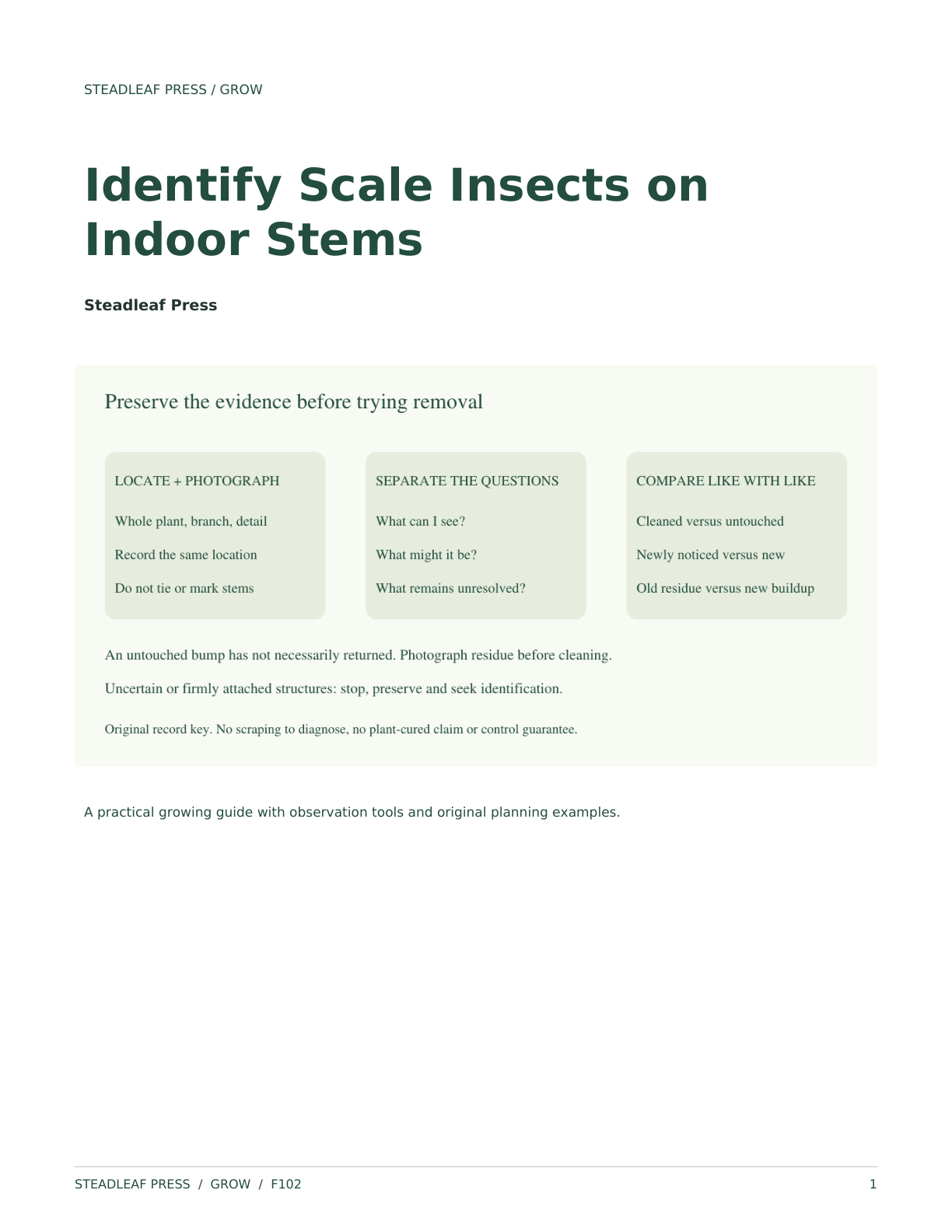
Start by taking a whole-plant photograph. Then take one image showing the affected branch in context and another showing the suspect structures. Put a familiar size reference near the plant without pressing it against the stem. Keep the original images rather than only a heavily enlarged, blurry version.
Give each observation an ordinary location name: “main stem below the lowest leaf,” for example, and mark that location on the whole-plant photograph. If a leaf drops or a branch is removed, note the change rather than assigning its old record to a different location. That makes later comparisons more reliable than repeatedly inspecting “the bad bit.”
STEADLEAF PRESS / GROW / F102 2
Read the surrounding clues carefully
Soft scales can produce sticky honeydew; armored scales do not. Stickiness therefore helps frame the question, but its absence does not rule out scale. Honeydew also occurs with other sap-feeding pests. Use this distinction alongside the structures you can see, rather than as a stand-alone diagnosis. UC IPM explains the scale groups and their honeydew differences.
Inspect more than the obvious stem. Brown soft scale may occur along leaf veins, on leaf undersides, on leaf stalks and on young branches. Some can be concealed around emerging growth. The University of Maryland's indoor-scale guide illustrates these locations and notes that prolonged or heavy infestations may reduce vigor and cause leaf loss.
You are collecting a combination of clues:
- Are similar structures present on more than one plant part?
- Do they have distinct outlines that you can photograph?
- Is there sticky residue below the affected area?
- Are there signs of fresh growth, declining growth or leaf loss?
- Has anyone already applied a product or cleaned the plant?
None of those questions requires scraping. A plant's own surface features also deserve consideration. Compare the suspect area with another part of the same plant and with a reliable description of that plant. Repeated bumps are not automatically pests, and regular spacing is not proof of harmlessness.
If you cannot distinguish an attached organism from plant tissue, stop at “uncertain structure.” Preserve the area for a clearer photograph or professional identification.
STEADLEAF PRESS / GROW / F102 3
Make a stem-and-leaf record
Use the following worksheet for one plant. Choose a few places that you can find again without marking or tying its stems. This is a practical record, not a prescribed scientific sampling method.
Plant name, if known: Date and usual location: First reason for inspection: Recent purchases, moves or treatments:
Location Shape and color Surface residue Plant condition Photo reference observed nearby
Main stem below a named leaf
Leaf stalk at the next junction
Underside of an accessible leaf
Another branch for comparison
Finish with three short statements:
What I can see: Describe the structures without naming them first. What this may be: Record the likely identification and the source used. What remains unresolved: State the missing detail or conflicting evidence.
For example: “Several tan oval structures sit along a leaf stalk. The shelf below is sticky. Soft scale seems possible. I cannot yet tell whether every stem bump is the same thing.”
That note gives an adviser more to work with than “my plant has scale everywhere.” It also prevents uncertainty from becoming a reason to scrub the entire plant.
STEADLEAF PRESS / GROW / F102 4
Keep the first response gentle
While investigating, prevent the suspect plant's leaves from touching neighboring plants where practical. Choose a separate position that still suits its light and temperature needs. Check nearby plants as well. Separation is a precaution, not a promise that no insects have moved or that a fixed number of days will clear the problem.
For a small, confirmed infestation on suitable robust foliage, individual physical removal may be feasible. Iowa State University Extension describes picking or gently rubbing scales loose, while emphasizing the limits and effort involved.
Keep that option narrow. If the plant has a sturdy, smooth, accessible surface and you are confident the object is scale, a soft cloth lightly moistened with plain water may help lift an easily loosened insect. Support the plant part, use a clean section of cloth and stop if the surface resists, flexes excessively or appears to tear.
Do not use a blade, abrasive pad or sharp tool. Do not scrape bark to prove that a bump is an insect, force apart new leaves or rub a delicate growing point. A structure that remains firmly attached is a reason to pause, not to increase pressure.
This limited removal is not a complete control program. Leave uncertain or inaccessible structures alone and seek plant-specific advice. Keep used wiping materials away from other plants, clean the work area and wash your hands before handling the rest of the collection.
STEADLEAF PRESS / GROW / F102 5
Work through two plausible outcomes
A smooth-leaved plant with sticky residue
You notice stickiness on a shelf and find several oval structures along two leaf stalks. Close photographs resemble soft scale in an extension guide, so you record a provisional identification. You move the plant so its foliage no longer touches its neighbor, photograph both affected stalks and inspect the neighboring plant. A plant adviser then confirms scale from the clear photographs and advises that limited physical removal is suitable for this plant.
The accessible leaf surfaces are sturdy enough for careful handling. A few confirmed insects loosen with a gentle wipe. Others sit near tender growth, so you leave those in place and request advice. Your next record distinguishes the cleaned areas from the untouched ones. “Some removed” is an accurate outcome; “plant cured” is not established.
An old stem with unexplained bumps
A second plant has roughened patches on an older stem. There is no clear matching structure on its leaves, and close photographs do not show enough detail to distinguish an insect covering from the plant surface.
You record the location, compare it with another stem and seek identification. You do not strip the surface or remove healthy leaves. The useful result is a preserved plant and a precise question. Lack of a diagnosis is not a failure to act responsibly.
STEADLEAF PRESS / GROW / F102 6
Revisit the evidence and choose a stopping point
At later checks, return to the same photographed locations. Compare structures in areas you cleaned with those deliberately left untouched; a bump that was never removed is not evidence that it has returned. Record newly noticed structures separately from ones shown to be new by earlier photographs. Photograph shelf residue before cleaning the shelf, and note the cleaning date so later accumulation can be distinguished from old stickiness. Observe new growth and record any cleaning or treatment of the plant.
Ask an extension service, plant clinic or other qualified adviser for help when identification remains uncertain, affected areas are widespread, the plant is declining, or gentle removal is impractical. Send the whole-plant image, detailed photographs and the worksheet. Ask how to submit a sample before cutting or mailing plant material.
If management becomes too demanding for the plant's value to you, discuss realistic options rather than repeatedly injuring it in pursuit of a perfect inspection. You can make that decision after understanding what is present and what follow-up would involve.
The aim is to replace a vague worry with visible evidence, protect the plant during inspection and choose an action you can carry out safely.
STEADLEAF PRESS / GROW / F102 7
Sources and scope
- UC Statewide IPM Program, Scales: appearance, life-stage distinctions and differences between soft and armored scales.
- University of Maryland Extension, Scale Insects on Indoor Plants: indoor inspection locations and possible plant effects.
- Iowa State University Extension and Outreach, Scale Insects on Houseplants: the limited role of careful individual physical removal.
The worksheet and examples are original observation aids, not an identification key or a guarantee of control. Only the identification and nonchemical handling information identified above is used here. This guide does not prescribe the chemical or homemade treatments discussed in some source pages.