Respond to Aphids on Tender Growth
Steadleaf Press
The first curled shoot on a plant can make you want to remove every imperfect leaf. Pause long enough to inspect the growth itself. A useful aphid response begins with finding the insects, seeing how much of the plant is involved and choosing a method the tender tissue can tolerate.
FREE · No email or checkout
Read the complete free guide online
Read the instructional text here, or download the complete free PDF above for original diagrams, tables, worksheets and page layout. The original publication is unchanged.
STEADLEAF PRESS / GROW
Respond to Aphids on Tender Growth
Steadleaf Press
A practical growing guide with observation tools and original planning examples.
STEADLEAF PRESS / GROW / F103 1
The first curled shoot on a plant can make you want to remove every imperfect leaf. Pause long enough to inspect the growth itself. A useful aphid response begins with finding the insects, seeing how much of the plant is involved and choosing a method the tender tissue can tolerate.
You will make a small map of affected shoots, carry out a gentle first response where appropriate and record what happens afterward. Keep the plant's condition in view throughout. A clean-looking tip is not a success if the inspection or cleaning has broken it.
Look for the insects on the growth
Aphids are small, soft-bodied insects, often with a pear-shaped outline, visible legs and antennae. They can be green, yellow, brown, red or black; color alone is not enough to identify them. Most species have two small tubes, called cornicles, projecting from the rear of the body. Some adults have wings. UC IPM's aphid guide illustrates these features.
Start at the shoot that caught your attention. Look around the growing tip, below developing buds and under accessible young leaves. Use a hand lens or a close photograph if the details are hard to see. Do not pull open a tight bud or straighten a curled leaf by force.
White flecks among a colony may be shed skins rather than live insects. Aphids on houseplants often gather on new growth and leaf undersides, and heavy infestations can cause distorted growth. Mississippi State University Extension describes these signs and the shed skins.
Write down what you actually find. “Several soft-bodied insects beneath the newest leaf” is useful. “The leaf is curled, therefore aphids” skips the identification step. If insects are not visible or the view is unclear, photograph the symptom and keep the cause open.
STEADLEAF PRESS / GROW / F103 2
Separate a local patch from a wider problem
After the first shoot, look at other accessible growing points around the plant. Inspect neighboring plants too, especially foliage that touches. On an indoor collection, separate the suspect plant where practical, while preserving suitable light and temperature. Oregon State University recommends isolating affected houseplants.
Separation helps you organize care. It does not prove that the rest of the collection is unaffected, and it does not create a fixed quarantine period after which inspection is unnecessary.
Give growing points short identifiers on a dated photograph or sketch, with descriptions such as “side shoot above the pot handle.” Keep those identifiers after rotating or moving the pot; “window-facing tip” can otherwise refer to a different shoot at the next check. Mark the photograph rather than tying labels around tender stems.
Record live insects separately from old leaf distortion, white cast skins and sticky residue. These observations answer different questions. A damaged leaf can remain in your record without being evidence that a live colony is still present there.
STEADLEAF PRESS / GROW / F103 3
Make a growing-tip map
Use this worksheet on one plant at a time. The number of rows is a convenience for note-taking, not a sampling rule or a treatment threshold. Add rows if needed.
Plant name: Date and indoor or outdoor location: First sign noticed: Plant's general condition: Previous cleaning or products used:
Named growing Live aphids seen? Other observations Handling access Next action point
A: fixed landmark ___
B: fixed landmark ___
C: fixed landmark ___
Additional ID and fixed landmark ___
For handling access, write something concrete: “sturdy leaf can be supported,” “new shoot is brittle” or “insects hidden inside folded leaf.” In the live-aphid column, distinguish “seen,” “not seen in the area inspected” and “view obstructed.” An inaccessible folded leaf is not a negative finding. That distinction also prevents a practical obstacle from becoming a reason to use more force.
Summarize the map in one sentence: “Live insects are visible at two named tips; the other inspected tips have no insects visible today.” Avoid turning a limited inspection into “the rest of the plant is pest-free.”
STEADLEAF PRESS / GROW / F103 4
Choose the least disruptive useful response
Context matters. Outdoors, aphids are part of food webs, and natural enemies may already be present. The Royal Horticultural Society recommends tolerating aphids where practical and recognizing predators such as ladybirds and hoverflies. Inspect before disturbing an outdoor colony, and seek help identifying unfamiliar insects rather than assuming everything beside an aphid is another pest.
An outdoor plant growing well with a small visible colony may justify continued observation. A struggling indoor plant, a very young plant or spreading colonies may need closer attention. Those are contextual decisions, not a universal number of aphids that separates harmless from harmful.
Where the plant can safely tolerate washing, plain water can remove exposed aphids. Mississippi State advises using enough force to dislodge them without damaging the plant. Its houseplant guidance makes that limit explicit.
Before rinsing, answer three questions:
1. Can I move and support this pot safely?
2. Do these leaves and shoots tolerate washing?
3. Can I reach the insects without tearing, bending or opening tender growth?
If any answer is uncertain, pause for plant-specific advice. A delicate seedling, an awkward heavy container or insects hidden inside tight growth may need a different approach than a sturdy, easily moved houseplant.
STEADLEAF PRESS / GROW / F103 5
Rinse carefully, then stop and inspect
UC IPM also describes water removal, specifically for sturdy plants. The following handling sequence applies that limit conservatively. UC IPM, Aphids
Work in a suitable washing area away from other plants and electrical items. Support the pot securely. Keep the growing point visible and begin with a gentle stream directed at the accessible insects. Support the foliage without pinching the tender tip.
Use only the pressure the plant tolerates. If the insects remain and the shoot is flexing or leaves are tearing, do not keep increasing the force. Stop and record the part you could not clean safely.
Avoid repeatedly soaking the root zone while washing the foliage. Let drainage finish and return the plant to a suitable growing position. Leaf cleaning is not a reason to abandon its normal watering needs or leave water standing around its roots.
Inspect the cleaned areas again. Record whether visible insects remain, whether any growth was difficult to reach and whether the plant tolerated the handling. Clean the work area and your hands before handling other plants.
Do not add a household spray mixture because water failed to reach a sheltered colony. Keep the unresolved problem specific: “insects remain inside one folded leaf” is a useful request for advice.
STEADLEAF PRESS / GROW / F103 6
Work through an indoor example
You find insects around two tips of a small flowering houseplant. Magnified photographs show features consistent with aphids. A few white flecks lie on a lower leaf, but you record those separately from the living insects.
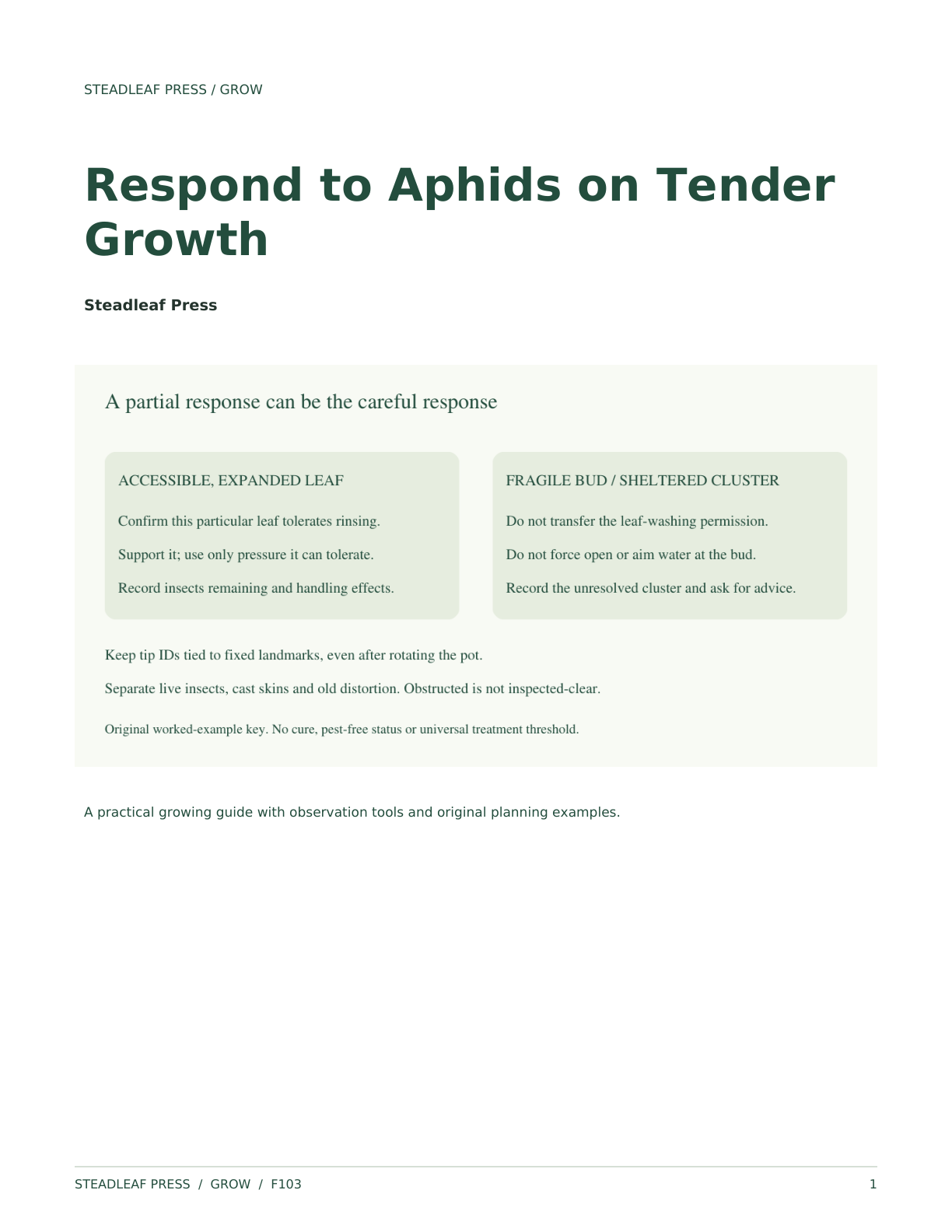
Your map shows one exposed cluster on an accessible, expanded leaf below a tip and another tucked near a fragile developing bud. The remaining inspected tips have no live insects visible. You separate touching foliage and confirm that the particular leaf bearing the exposed cluster tolerates rinsing. That does not establish that the tender bud can tolerate the same handling.
Gentle washing removes the exposed insects from that leaf without damaging it. You do not direct the stream at the fragile bud or force it open to reach the second cluster. Your action note reads: “Expanded leaf below first tip rinsed; sheltered bud cluster still present; advice needed for tender growth.”
At the next inspection, use the same tip names and add any newly affected growth. If another tip now has insects, that is a meaningful change. If an old curled leaf still looks curled but no insects are visible there, record the appearance without counting it as a new colony.
This example has a partial result, not a promised cure. It also creates a clear handoff to a qualified adviser if the remaining colony cannot be managed without harming the plant.
STEADLEAF PRESS / GROW / F103 7
Follow the change in live activity
Continue checking at intervals that fit the plant's condition and how quickly the problem is changing. Do not wait for the next routine watering if new colonies or declining growth appear sooner. Record dates so “still there” and “returned after cleaning” do not get confused.
Ask for help when identification is uncertain, colonies remain widespread or keep expanding, the plant is losing vigor, or tender growth cannot be cleaned safely. Provide the whole-plant photograph, close images, growing-tip map and any previous treatment details. Follow the adviser’s sample instructions before cutting or sending material.
The useful outcome is a manageable sequence: identify what you can, locate the affected growth, make a gentle response where suitable and check the result. You do not need to strip a plant of every marked leaf to make progress.
STEADLEAF PRESS / GROW / F103 8
Sources and scope
- UC Statewide IPM Program, Aphids: body form, variable colors, cornicles, winged forms and water removal on sturdy plants.
- Mississippi State University Extension Service, Insect Pests of Houseplants: aphid inspection locations, shed skins and plant-safe water removal.
- Royal Horticultural Society, Aphids: outdoor ecological context and proportionate responses.
- Oregon State University Extension, Keep aphids under control with low-risk, natural strategies: separation of affected houseplants and nonchemical management context.
The map and worked example are original planning aids. This guide covers inspection and a limited nonchemical first response. It does not establish a pest-free quarantine period, guarantee control or prescribe pesticide products or homemade mixtures.