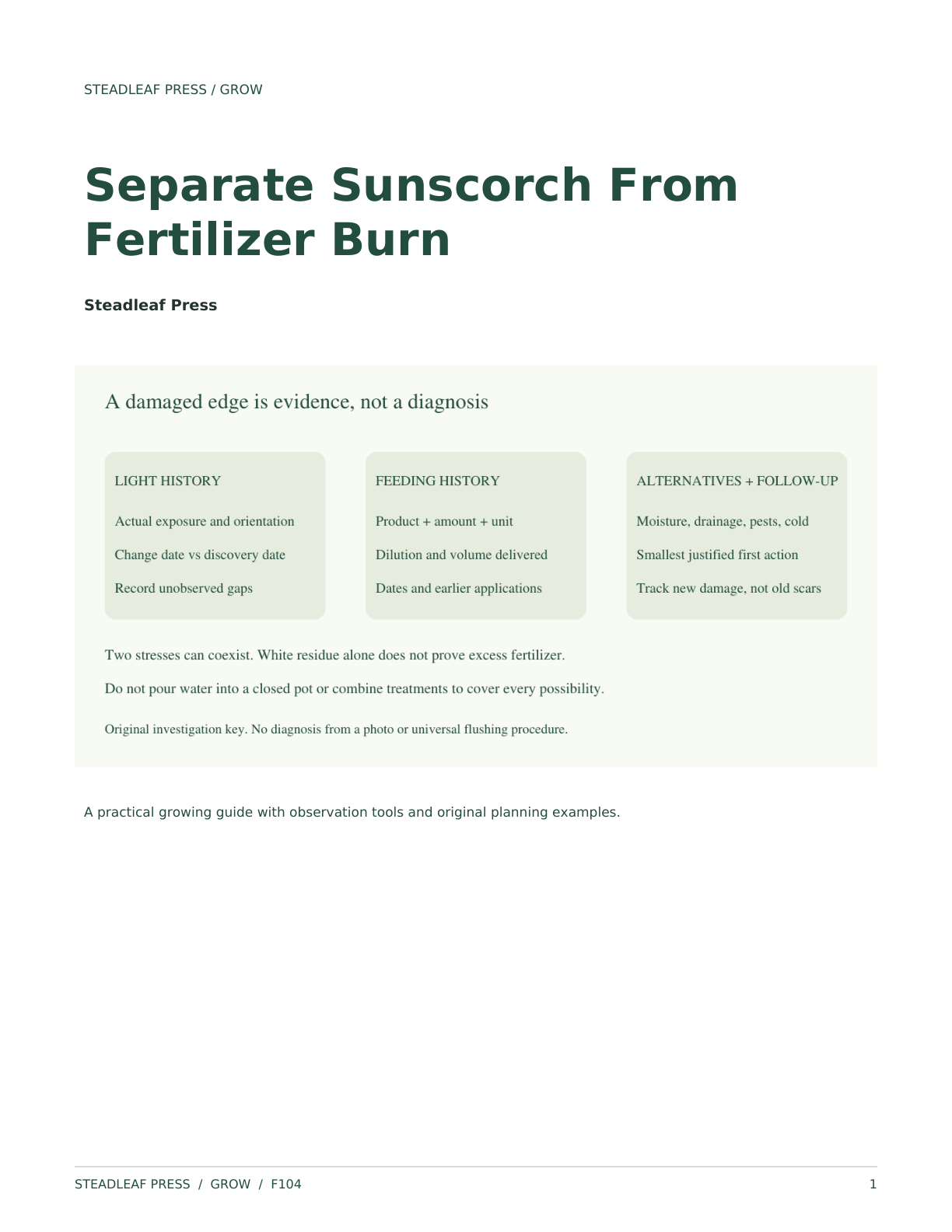
Separate Sunscorch From Fertilizer Burn
Steadleaf Press
A brown leaf edge tells you that tissue has been damaged. It does not tell you why. A plant moved into stronger sunshine and a plant exposed to excess fertilizer salts can both develop unattractive leaves. Dry roots, persistently wet roots, cold and pests can complicate the picture.
FREE · No email or checkout
Read the complete free guide online
Read the instructional text here, or download the complete free PDF above for original diagrams, tables, worksheets and page layout. The original publication is unchanged.
STEADLEAF PRESS / GROW
Separate Sunscorch From Fertilizer Burn
Steadleaf Press
A practical growing guide with observation tools and original planning examples.
STEADLEAF PRESS / GROW / F104 1
A brown leaf edge tells you that tissue has been damaged. It does not tell you why. A plant moved into stronger sunshine and a plant exposed to excess fertilizer salts can both develop unattractive leaves. Dry roots, persistently wet roots, cold and pests can complicate the picture.
Use this guide to compare the location of damage with the plant's recent care. You will finish with a short evidence record and a sensible first response, rather than a diagnosis based on one photograph.
Record the damage before changing the care
Keep the plant in its current orientation long enough to photograph it, unless that would leave it exposed to an obvious hazard. Take one photograph of the whole plant and another of a representative damaged leaf. Include a healthier leaf in the frame when possible.
Mark the window-facing side on your sketch. Note the date, the room and the plant's name. Photograph the potting surface and container too. Do not remove every damaged leaf before recording where the problem appears.
Choose ordinary descriptions: pale patch, crisp edge, brown tip, soft area or yellow lower leaf. Avoid writing “burn” as the observation. That word already assumes a cause.
If you cannot identify the plant, preserve its label and ask the seller or a local horticultural service for help. Its normal light, moisture and seasonal needs matter to the next decision.
STEADLEAF PRESS / GROW / F104 2
Compare two possibilities without forcing a choice
University of Maryland Extension describes excessive-light damage as pale or bleached areas that may later become brown and brittle. A sudden move from a lower-light position to strong sunlight is relevant history. University of Maryland Extension, Excess Light on Indoor Plants
Its separate guide to high soluble salts lists damaged leaf tips or margins, reduced growth, wilting and other symptoms associated with excessive or incorrectly applied fertilizer. Those signs overlap other problems, so they need a care history. University of Maryland Extension, Fertilizer Toxicity or High Soluble Salts in Indoor Plants
Use this comparison as an investigation aid:
Observation Question about light Question about fertilizer or salts
Pale patch on an exposed leaf Did direct sun newly reach this Was anything spilled or sprayed surface? there?
Several brown tips or edges Did exposure, heat or drying Was the product, dose or change? frequency changed?
Damage mainly on one side Was that side facing the window or Was there a local spill rather than outdoors? a root-zone application?
Decline throughout the plant Are the whole plant's conditions Is there a credible history of unsuitable? excessive feeding or accumulated salts?
White residue on pot or mix Does it have any clear relationship Could water minerals, fertilizer, or to exposure? both explain it?
The table does not award points. One strong piece of history can be more useful than several vague symptoms. It is also possible for two stresses to occur together.
STEADLEAF PRESS / GROW / F104 3
Rebuild the light history
Start with changes, not compass directions alone. Write down whether the plant moved, a curtain came down, a nearby obstruction changed, or outdoor exposure began. Record the date of the change and the date damage was first noticed separately. If the plant was not checked in between, give that observation gap rather than assuming the damage began on the day you noticed it.
Observe the actual position through the day when you can. A bright-looking room does not tell you how long direct sun touches particular leaves. A single photograph of the window is not a complete exposure record.
Answer these questions:
- Where was the plant before this position?
- Which leaves faced the strongest new light?
- Did the plant go straight from indoors into direct outdoor sun?
- Did the growing medium become unusually dry during the same period?
- Are sheltered leaves affected in the same way?
- Have new damaged areas appeared since the exposure was reduced?
Treat an exposed-side pattern as supporting evidence, not proof. A spray, physical contact or another local event can also affect one side. Conversely, an uneven pattern may be difficult to see on a plant that was rotated repeatedly.
STEADLEAF PRESS / GROW / F104 4
Rebuild the feeding history
Find the actual package or a photograph of its directions. Record the product name and formulation, application dates, measured amount with its unit, and amount of water used if diluted. Also record how much of that prepared solution went into this pot. Mixture strength, volume delivered and frequency are separate parts of the feeding history; a correctly diluted feed can still be applied too often. Do not treat a scoop, capful, millilitre and gram as interchangeable measures. Write “unknown” wherever you cannot reconstruct the information.
Check whether another person fed the plant, whether the potting mix already contained fertilizer, or whether a slow-release product was added as well as liquid feed. Do not assume all products with similar names have the same concentration.
If several plants received the same mixture, record the approximate volume each received and which were affected. Include pot size, drainage and any differences in previous feeding. Equal mixture strength does not mean equal exposure when application volumes or earlier doses differ. These comparisons can help an adviser investigate, but an unaffected plant does not by itself rule out a feeding error in another pot.
White crust is useful to record, but it does not by itself prove overfertilization. Maryland Extension explains that deposits can come from dissolved minerals in irrigation water as well as fertilizer. University of Maryland Extension, Mineral and Fertilizer Salt Deposits on Indoor Plants
STEADLEAF PRESS / GROW / F104 5
Check the alternatives you could easily miss
Feel the growing medium using a method suitable for the plant and pot, and inspect the drainage arrangement. A decorative outer pot may conceal standing water. Do not add water simply because leaves look dry at their edges.
Look at leaf undersides and stem joints for visible pests or fresh changes. Record what you find without naming a pest from damage alone. Also note cold exposure, proximity to a heater and any recent household spray or leaf treatment.
Maryland's diagnostic guide places leaf scorching among several possible environmental problems, including insufficient water and high salts. It also distinguishes these from other causes of leaf spots and blotches. That overlap is why this check comes before choosing a treatment. University of Maryland Extension, Diagnose Indoor Plant Problems
STEADLEAF PRESS / GROW / F104 6
Choose the smallest justified first response
If abrupt strong sun is the clearest change: move the plant to light appropriate for its species and previous conditions. Avoid replacing excessive sun with a permanently dark corner. Any later increase in exposure should be gradual and plant-specific.
If an excessive fertilizer application is documented: stop further feeding while you assess the root zone. Keep the product label and your record. Extension guidance describes leaching or replacing affected potting medium, but the suitable choice depends on drainage, plant condition and the product involved. Ask for plant-specific guidance if the pot is already saturated, drainage is poor or the dose was substantial. Do not keep pouring water into a closed container.
If the evidence is mixed: correct an obvious care fault, such as standing drainage water, and seek advice before combining several treatments. Do not add fertilizer to “strengthen” a stressed plant or apply pesticides for an unconfirmed environmental problem.
In each case, write what you changed and why. Avoid moving, feeding, repotting and spraying at once just to cover every possibility.
STEADLEAF PRESS / GROW / F104 7
Work through an example
A fictional owner notices pale patches on a trailing foliage plant three days after moving it from a shelf to a bright window. The patches are on the window-facing leaves. The plant has not been fed recently, its pot drains, and the owner finds no visible pests during inspection.
The useful conclusion is: “The timing and exposure support investigating excessive light first.” It is not: “Every pale patch is sunburn.”
The owner photographs the pattern, moves the plant to an appropriate gentler exposure and records future changes. They do not add a fertilizer flush without evidence of excess feeding. If new damage continues, they revisit moisture, roots and other possible causes rather than defending their first guess.
STEADLEAF PRESS / GROW / F104 8
Review new damage rather than expecting old marks to vanish
Repeat photographs from the same direction. Note whether previously unaffected leaves develop damage, whether new growth looks healthier and whether the plant remains stable between checks. Brown, dead leaf tissue will not become sound green tissue again. Maryland Extension's diagnostic response uses healthier subsequent growth, rather than disappearance of old injury, as evidence of improvement. Ask Extension, response from University of Maryland HGIC
Use this final record:
- Main observation and location:
- Most relevant recent change:
- Evidence against my first explanation:
- First action and date:
- Next check date and the photographed leaves or growing points I will compare:
- Reason to seek help sooner:
Rapid collapse, a soft stem base, continuing widespread damage or an uncertain major fertilizer error deserves prompt advice. Send the whole-plant view, leaf details, product information and care history. A useful diagnosis needs the context that a close-up of a brown edge leaves out.
Sources and scope
The linked university extension sources support the symptom distinctions, salt sources and recovery cautions. The comparison table, investigation sequence and example are original practical aids. This guide covers observation and initial care decisions for potted houseplants, not laboratory diagnosis, pesticide selection or a universal fertilizer-removal procedure.