Investigate Yellow Leaves From Bottom to Top
Steadleaf Press
A yellow leaf is a place to begin looking. It is not an instruction to water, feed or repot immediately. The useful questions are which leaves changed first, how quickly the change is spreading and what else is happening around the plant.
FREE · No email or checkout
Read the complete free guide online
Read the instructional text here, or download the complete free PDF above for original diagrams, tables, worksheets and page layout. The original publication is unchanged.
STEADLEAF PRESS / GROW
Investigate Yellow Leaves From Bottom to Top
Steadleaf Press
A practical growing guide with observation tools and original planning examples.
STEADLEAF PRESS / GROW / F105 1
A yellow leaf is a place to begin looking. It is not an instruction to water, feed or repot immediately. The useful questions are which leaves changed first, how quickly the change is spreading and what else is happening around the plant.
This inspection moves from the pot and lower leaves to the newest growth. It helps you assemble a clear record, choose a justified first action and explain the problem if you need help.
Establish what has actually changed
Identify the plant as accurately as possible. Keep its botanical name or nursery label with the record, including the variety when known. Normal variegation, seasonal changes and the plant's growth habit can otherwise be mistaken for trouble.
Take a whole-plant photograph in useful light. Avoid filters that change colour. Take a close-up of one affected leaf and one comparable healthy leaf. Record the date and when you first noticed the change.
Yellowing is often called chlorosis, but the term describes a symptom rather than a diagnosis. The RHS identifies several broad possibilities, including natural leaf turnover, growing conditions, nutrition, pests and disease. The position and pattern of yellowing can help an investigation, especially alongside other symptoms. RHS, Chlorosis
Write “three older leaves yellowing” rather than “nitrogen deficiency.” You can refine the explanation later without losing the original observation.
STEADLEAF PRESS / GROW / F105 2
Begin below the leaves
Check the container before reaching for the watering can. Is the plant in a nursery pot inside an outer cover? Can excess water leave the inner pot? Is water standing underneath? Has decorative wrapping blocked drainage?
Inspect the potting medium at an appropriate accessible depth, rather than judging only its surface. A light-coloured top layer does not describe every part of the root ball. If the pot is small enough to lift comfortably, compare its weight with your own experience after watering. Do not lift a heavy container to perform this test.
Record the last watering and what happened afterward. Was the entire medium wetted? Did water drain? Did it remain wet longer than usual? Was watering repeated because the foliage looked unhappy?
Persistently wet conditions can damage roots by reducing their oxygen supply. Affected plants may wilt or show yellowing despite having plenty of water in the pot. Maryland Extension therefore advises checking the root-zone situation rather than interpreting wilt as a simple request for more water. University of Maryland Extension, Overwatered Indoor Plants
A root inspection is not the first step for every yellow leaf. If a small root ball can be slid out intact and there is a reason to examine it, handle it gently. Do not pull the plant out by its stem, repeatedly disturb it or dismantle healthy roots merely to complete a checklist. Seek help with an unwieldy plant or one that is collapsing.
STEADLEAF PRESS / GROW / F105 3
Map the leaves in three groups
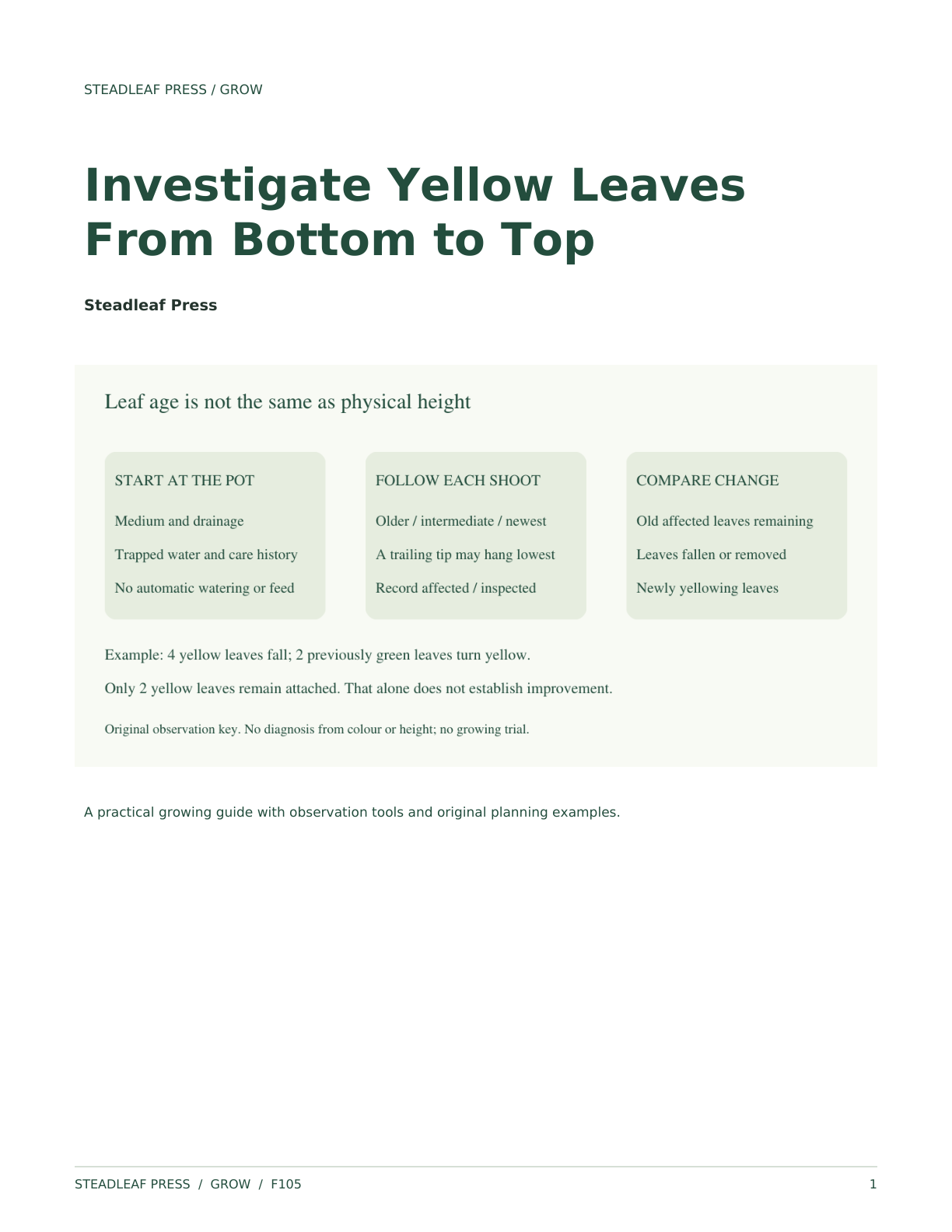
Group leaves by their place in the plant's growth as well as their physical height. On an upright shoot, lower leaves may be older, but the newest leaves on a trailing stem can hang below older ones. Follow each shoot toward its growing tip rather than assuming “lowest” means “oldest.” On a rosette plant, distinguish older outer leaves from young central ones. Mark the groups on a photograph so the same areas can be compared later.
Leaf group and location What changed? Affected out of leaves Other observation inspected
Older leaves on named Uniform yellow, patches, ___ of ___ Firm, limp, dry, falling or shoot edges or none other ___
Intermediate-age foliage ___ ___ of ___ ___
Newest growth on named ___ ___ of ___ ___ shoot
Then note whether the change appears on all sides or mainly toward a window, wall or heater. Include the undersides, without twisting delicate leaves. Look for visible insects, webbing, sticky deposits or raised structures, and photograph uncertain findings before disturbing them.
An occasional older leaf can yellow and fall as a healthy houseplant matures. A large or continuing change needs a broader check. The RHS specifically cautions that widespread yellowing can reflect several different growing problems. RHS, Leaf damage on houseplants
Do not turn the chart into a rigid rule that lower leaves mean one deficiency and upper leaves mean another. Record leaf age because it is useful evidence, not because it supplies a diagnosis on its own.
STEADLEAF PRESS / GROW / F105 4
Reconstruct the last changes in care
Use a short timeline. Begin before the first affected leaf, not just with what you did yesterday.
- Move, purchase or return from outdoors:
- Change in direct sun, shading or room position:
- Recent watering pattern or absence from home:
- Repotting, fertilizer application or other product use:
- Cold transport, open window, heater or air-conditioning exposure:
- Newly introduced plant or visible pest concern:
If nothing changed deliberately, record that too. The light at a stationary window and the rate at which a pot dries can still change with conditions.
Iowa State Extension notes that yellowing and leaf drop may have several contributing causes. Its guidance includes moisture problems, temperature exposure and both unsuitable light levels and abrupt light changes. Iowa State University Extension, Yellow or brown leaves and leaf drop
The timeline is especially useful when two events occurred together. If you repotted and moved the plant in the same week, do not report only the event that matches your preferred explanation.
STEADLEAF PRESS / GROW / F105 5
Compare water, light and roots before adding nutrients
Check a reliable care guide for the identified plant. Compare its needs with what you observed, not with the generic instructions attached to another houseplant.
For watering, write down the condition that should prompt watering for this plant. Do not replace the old calendar with a different calendar. Illinois Extension explains that species, container, medium and growing conditions affect water needs, and that a wilted plant may be overwatered rather than thirsty. Illinois Extension, Watering houseplants
For light, record actual exposure where the foliage sits. If the position is unsuitable, plan an appropriate change without abruptly placing a previously shaded plant in strong sun. Avoid changing locations daily in search of instant colour recovery.
Check the fertilizer history only after considering these basics. Iowa State Extension advises identifying and correcting the growing conditions that do not meet the plant's needs; it also warns that salts from excess fertilizer can damage roots and cause yellowing, wilting or leaf drop. Adding fertilizer is therefore not a substitute for investigating unsuitable conditions. Iowa State University Extension, Diagnosing Houseplant Problems Related to Poor Culture
If nutrient deficiency remains a credible possibility, ask what evidence is needed to distinguish inadequate supply from poor root function or unsuitable growing-medium conditions. More fertilizer is not automatically the answer to yellow between leaf veins.
STEADLEAF PRESS / GROW / F105 6
Choose one of four next steps
Observe a limited, explainable change. If an older leaf is affected while the rest of the plant appears sound, keep a dated record and continue suitable care. Reassess if the pattern changes.
Correct an identified care problem. For example, empty water trapped in an outer pot and review why it accumulated. Record the correction. Do not assume that emptying the water has already resolved any root damage.
Separate and investigate a possible pest problem. If you see suspicious living organisms or new deposits, keep the plant apart where its growing needs can still be met. Identify what is present before choosing a response.
Ask for diagnostic help. Rapid decline, multiple newly affected leaves, a soft base, unusual lesions or a valuable plant with an unclear problem merits advice sooner. Contact a local extension service or qualified horticultural adviser with the record.
You can take more than one necessary action when the evidence calls for it. The aim is to avoid a bundle of unrelated treatments that makes the next observation harder to interpret.
STEADLEAF PRESS / GROW / F105 7
Use a worked record
A fictional owner finds four yellow lower leaves on a plant recently moved into a cooler room. The middle and new leaves are still firm. The owner has continued watering on the previous weekly schedule and discovers water retained in the decorative cover.
The record says: “Older leaves affected; medium remains wet; water trapped outside the nursery pot; recent room change.” It does not say the plant certainly has a named root disease.
The owner empties the trapped water, checks the plant's actual care requirements and replaces scheduled watering with checks of the medium. This does not mean withholding water indefinitely: watering resumes when the plant-specific moisture condition calls for it. They monitor the remaining leaves and seek advice if decline continues, rather than adding fertilizer because the lower leaves are yellow.
STEADLEAF PRESS / GROW / F105 8
Compare progression, not just colour
Return to the same leaf groups and photographs. Count newly yellowing leaves separately from previously affected leaves still attached, and record leaves that fell or were removed. For example, if four yellow leaves fall and two previously green leaves turn yellow, seeing only two attached yellow leaves does not establish improvement. Note changes in firmness, emerging growth and how the medium behaves between waterings.
Maryland Extension emphasizes the pattern and progression of symptoms when investigating yellow leaves. A record of change is more useful than repeatedly counting the same damaged leaves as fresh evidence. University of Maryland Extension, Yellowing Leaves on Indoor Plants
Finish each check with one sentence: “Since the last record, ___ changed, so I will ___.” If the answer is that nothing meaningful changed, continue the justified plan rather than inventing another treatment.
Sources and scope
The linked RHS and university extension guidance supports the possible causes and care cautions. The observation chart, decision sequence and worked example are original. This guide does not diagnose nutrient deficiencies, viruses or root pathogens from leaf colour, and it does not replace plant-specific advice when deterioration is rapid or unexplained.