Isolate a New Houseplant Before Joining the Group
Steadleaf Press
A new houseplant needs a suitable place to grow while you get to know it. Keeping it apart from established plants gives you time to notice pests or other problems that were not obvious at purchase.
FREE · No email or checkout
Read the complete free guide online
Read the instructional text here, or download the complete free PDF above for original diagrams, tables, worksheets and page layout. The original publication is unchanged.
STEADLEAF PRESS / GROW
Isolate a New Houseplant Before Joining the Group
Steadleaf Press
A practical growing guide with observation tools and original planning examples.
STEADLEAF PRESS / GROW / F106 1
A new houseplant needs a suitable place to grow while you get to know it. Keeping it apart from established plants gives you time to notice pests or other problems that were not obvious at purchase.
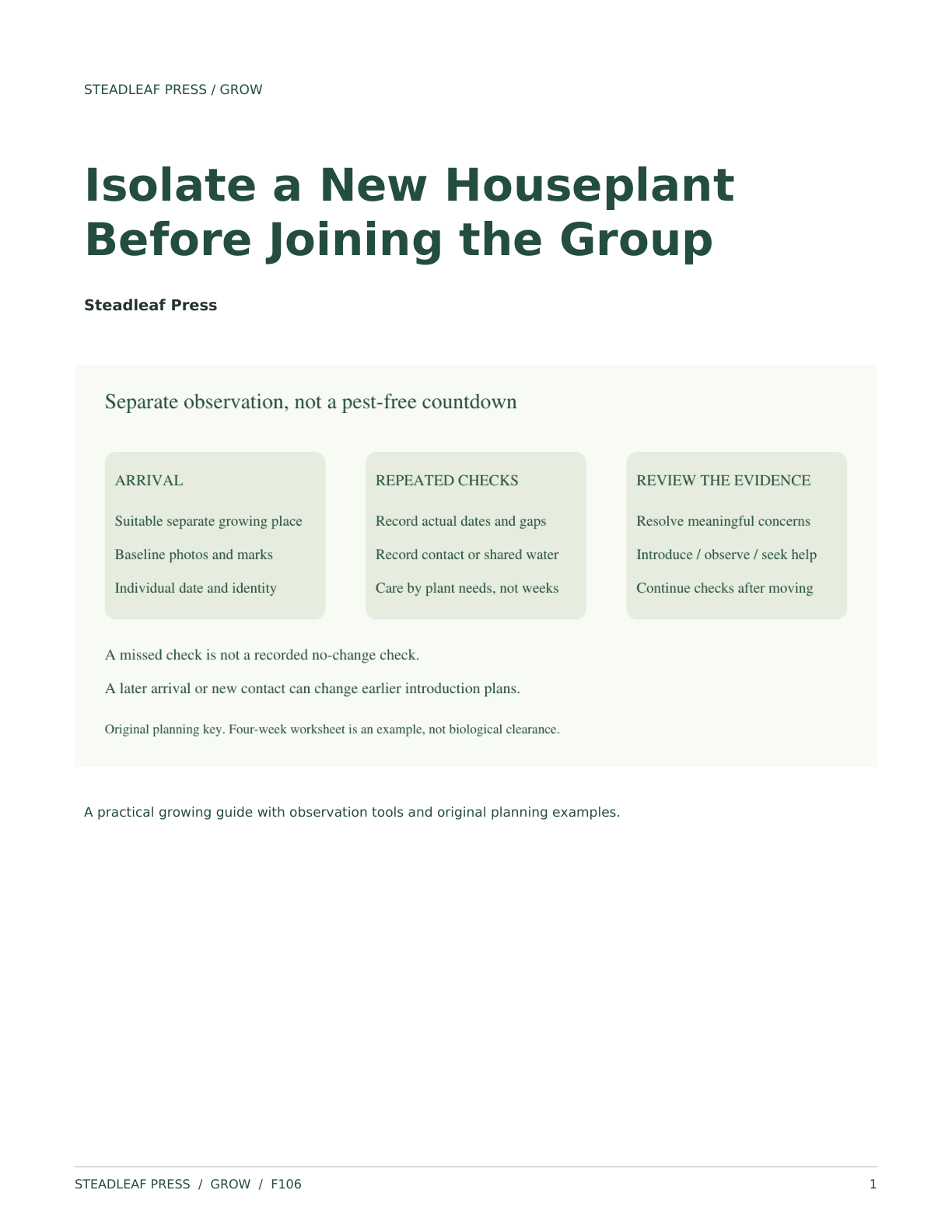
Isolation is an observation routine, not a guarantee that a plant becomes pest-free on a particular day. Plan the place, the care and the checks before deciding when it can join the collection.
Choose the holding place before bringing a plant home
Find a location apart from your established plants where the newcomer can receive suitable light and temperature. A separate room is useful when available. A dark cupboard or cold porch is not a good substitute just because it is empty.
Virginia Cooperative Extension recommends separating new plants at risk of hidden pests and warns that handling can transfer pests between plants. Its guidance supports physical separation and attention to the order in which plants are handled. Virginia Cooperative Extension, Indoor Plant Culture
If you have only one growing area, create as much practical separation as conditions allow and prevent foliage from touching. Treat this as a limited arrangement, not equivalent protection to a separate room. If you cannot provide reasonable growing conditions away from the collection, postponing a purchase may be the simplest choice.
The place must also be safe for people and animals. Keep unfamiliar plants out of reach of children and pets until you have checked their identity and suitability. Do not put a pot where it blocks a doorway, falls from a narrow ledge or leaks onto an electrical item.
STEADLEAF PRESS / GROW / F106 2
Prepare a small, ordinary kit
You do not need a treatment cupboard. Gather:
- The plant label or purchase information.
- A clean tray or saucer reserved for this plant.
- A hand lens if available.
- A phone camera or notebook.
- A watering container that lets you avoid splashing neighbouring pots.
- A place to record checks and any changes in care.
Choose a tray that lets you see and remove drainage water. Keep it with the new plant rather than exchanging it among pots. Avoid sharing a basin of bottom-watering water between the newcomer and the established collection.
Cornell's houseplant pest-management guidance identifies handling and drainage water as possible routes of spread for some plant problems. Separate water and equipment routines are practical ways to reduce that opportunity. Cornell Cooperative Extension, Houseplant Pest Management
STEADLEAF PRESS / GROW / F106 3
Make an arrival record
Unpack the plant where dropped leaves or growing medium can be collected. Photograph it before making cosmetic changes. Keep packaging and labels only as long as useful, then clear the area.
Record:
- Plant name and variety, if known:
- Date received and source:
- Condition on arrival:
- Existing marks or damaged leaves:
- Current container and drainage arrangement:
- Known care or treatment information from the seller:
- Observation location and any contact with other plants or shared drainage water:
Inspect the upper and lower leaf surfaces, stem joints, growing tips, pot rim and visible growing-medium surface. Look carefully rather than assuming that an attractive top view is enough. Illinois Extension advises examining leaves and stems for insect or disease signs when selecting plants. Illinois Extension, Get Started with Houseplants
Separate what you see from what you think it means. “Small white clumps at two leaf joints” is a useful entry. “Definitely mealybugs” needs closer examination. Preserve clear photographs of unfamiliar structures; normal plant features and residue can be misleading.
Do not uproot a healthy-looking plant or strip every leaf as a routine arrival procedure. If the plant arrives severely damaged or with an evident problem, keep it separate and contact the seller or a horticultural adviser before undertaking extensive rescue work.
STEADLEAF PRESS / GROW / F106 4
Keep care steady while you observe
Check moisture rather than automatically watering on arrival. Transport, packaging and the nursery's last watering all affect what the pot needs now. Follow guidance for the identified plant and make sure excess water can leave the growing container.
Avoid repotting, moving between several windows, feeding and applying a preventive spray all at once. A stable starting point makes it easier to notice whether a problem was already present or developed after a change.
Illinois Extension notes that newly moved plants can yellow or drop some leaves while adjusting. That possibility belongs in the record, but it should not be used to dismiss continuing decline or visible pests. The same guidance recommends checking moisture during adjustment rather than feeding immediately. Illinois Extension, Get Started with Houseplants
Keep isolation care as visible and convenient as you can. A plant hidden in a spare room is easy to forget. Put the check on an existing routine, such as your normal plant inspection, while continuing to decide watering from the pot's condition.
STEADLEAF PRESS / GROW / F106 5
Use a schedule with an observation goal
Published recommendations vary. Illinois Extension suggests keeping new plants apart for two to three weeks; Cornell's guide describes about a month. These are observation periods, not proof that every pest or disease will reveal itself within that time.
For this worksheet, plan an initial four-week observation window with a fuller check on arrival and roughly weekly afterward. Enter the actual date of each check. If a review is missed, mark it missed rather than filling in “no change” later; inspect when you return and reconsider the introduction date from the evidence available. This is an organisational example, not a universal biological threshold. Look sooner whenever you notice a change, and adjust the plan to plant-specific or pest-specific advice.
Check What to compare What to record
Arrival Whole plant, both leaf surfaces, Baseline photographs and existing stems, pot and drainage marks
First weekly review Same parts, including previously New signs, unchanged marks and suspicious areas care given
Second review Earlier findings and any emerging Evidence becoming clearer or growth remaining uncertain
Third review Whole plant and holding area Fresh damage, visible organisms or continuing stability
Fourth review Full record and current condition Introduce, continue separate observation or obtain advice
Between reviews, check moisture as often as the plant needs. The inspection timetable is not a watering timetable.
STEADLEAF PRESS / GROW / F106 6
Avoid carrying the problem between plants
Care for the established collection before handling a suspicious newcomer when practical. Wash your hands after handling the isolated plant, and clean any reusable equipment before it is used elsewhere. Follow an appropriate cleaning method for the item rather than mixing household chemicals.
Do not move drainage water, fallen leaves or used growing medium into another pot. Clear debris from the holding area. Keep the new plant's tray separate, and avoid letting its foliage brush against established plants when moving it.
If several new plants arrive together, label them individually. Sharing one holding area does not make them independent of each other. A problem found on one means the others deserve renewed inspection, and the affected plant should be separated further where feasible.
A later arrival needs its own arrival date and checks. Also record whether it touched earlier arrivals, shared drainage water or otherwise created a new exposure. An older plant's clean record from before that contact cannot establish its condition afterward. Inspect the potentially exposed plants and reconsider their introduction plans according to what is found; do not automatically give every plant the room's earliest release date.
STEADLEAF PRESS / GROW / F106 7
Decide what a finding means for the plan
No concerning change: continue suitable care and complete the planned observations. Record what you checked rather than writing only “fine.”
An uncertain structure or mark: photograph it with context and magnification if possible. Compare it with reliable guidance for the plant or ask for identification. Continue separation while a meaningful concern remains unresolved.
A visible pest or progressing problem: keep the plant apart and choose a response based on identification and plant suitability. Do not treat every newcomer with an indiscriminate spray, and do not regard a treatment date as automatic permission to join the group.
Rapid deterioration: seek prompt advice or discuss return options with the seller. A failing plant needs an assessment, not simply a longer stay in the same conditions.
For a confirmed problem, use its specific follow-up guidance. Different organisms and plant conditions require different checks. There is no single extra number of days that makes all treated plants safe.
STEADLEAF PRESS / GROW / F106 8
Introduce the plant deliberately
Before moving it, review the record and inspect again. Have concerning findings been resolved? Is the plant stable in suitable care? Is the destination appropriate for its light, space and watering needs?
Move it without pressing its foliage through the rest of the collection. Keep its label and arrival notes. Continue ordinary inspection after introduction; isolation reduces opportunities for spread but does not remove the need to watch established plants.
A useful final note is: “Introduced on ___ after checks dated ___; previous concerns resolved by ___; next routine check ___.” Write “no concerning findings observed” when that is what the record supports, rather than claiming pest absence. If a meaningful concern remains unresolved or the record lacks the planned observations, continue the separate assessment and set the next review date.
Sources and scope
The linked Illinois, Virginia and Cornell extension guidance supports inspecting arrivals, keeping them apart and reducing spread through handling or water. The four-week worksheet and decision record are original organisational tools. This guide covers ordinary houseplant observation, not regulated plant quarantine, import compliance, pest eradication or a promise of disease-free plants.