Protect Pots During a Sudden Cold Night
Steadleaf Press
The forecast has changed, darkness is approaching and several pots are still outside. Start with the plants you can move safely. A short list of destinations and a completed count will help more than hurriedly covering everything you own.
FREE · No email or checkout
Read the complete free guide online
Read the instructional text here, or download the complete free PDF above for original diagrams, tables, worksheets and page layout. The original publication is unchanged.
STEADLEAF PRESS / GROW
Protect Pots During a Sudden Cold Night
Steadleaf Press
A practical growing guide with observation tools and original planning examples.
STEADLEAF PRESS / GROW / F107 1
The forecast has changed, darkness is approaching and several pots are still outside. Start with the plants you can move safely. A short list of destinations and a completed count will help more than hurriedly covering everything you own.
This guide is for a brief cold event affecting movable containers. It does not replace a winter-storage plan, identify a plant's cold tolerance or promise that a cover will prevent damage. Your task tonight is to match each vulnerable plant to protection that is suitable and available.
Read the overnight forecast before lifting anything
Check the forecast for your location, including the overnight low, the hours of cold, wind and any frost or freeze advisory. Use the hourly forecast to plan completion before temperatures become unsuitable for the plants, not just before the night's lowest reading. Allow time for safe moves before darkness or worsening weather. Look again before your final evening check and record when you read it.
A forecast just above freezing does not rule out frost on exposed surfaces. The National Weather Service explains that the temperature at a plant or ground surface can fall below the temperature recorded higher above ground, particularly on clear, calm nights. A weather-app number is not a measurement of every leaf. National Weather Service, Dew and Frost Development
Nor does the absence of an alert prove that tender plants are safe. Local frost-warning programs have seasonal operating periods. Check the actual forecast rather than relying only on notifications. The NWS Atlanta cold-weather page illustrates a regional program; its alert criteria and season are not universal instructions for gardens elsewhere.
Write a one-line summary: “Forecast checked at ___; lowest predicted temperature ___; coldest period ___; warning or uncertainty ___.” Use one temperature scale throughout your notes.
STEADLEAF PRESS / GROW / F107 2
Give each plant a decision, not the whole patio
Identify the plant as closely as possible, including the cultivar when relevant. Find its cold guidance from a reliable horticultural source. Distinguish a comfortable growing temperature, a chilling limit and survival through a brief freeze. They answer different questions.
If the identity or tolerance is uncertain, do not conduct a cold experiment with a valued plant. Use a suitable protected location while you seek identification. A tropical foliage plant and a dormant hardy shrub need separate decisions even when their containers look alike.
Container roots deserve attention independently of leaves and stems. Texas A&M AgriLife describes exposed pots as vulnerable to root injury because the surrounding ground does not provide the same insulation. Root injury may become apparent later, rather than showing as immediate blackened foliage. An in-ground hardiness description alone is therefore insufficient for tonight's pot. Texas A&M AgriLife Extension, Frosts and Freezes
Make three groups:
- Move now: known tender plants or uncertain plants with a suitable safe destination.
- Assess separately: hardy or dormant plants whose container protection needs checking.
- Cannot move safely: large, awkward or inaccessible pots requiring another plan.
A heavy pot belongs in the third group even if you desperately want it indoors. Get appropriate help before conditions deteriorate; do not drag it down stairs or lean over an edge.
STEADLEAF PRESS / GROW / F107 3
Check the refuge before filling it
For each proposed location, answer: is it warm enough for this plant, accessible, clear of hazards and available for the full cold period? A garage, porch or shed is not automatically frost-free. A warm reading when the door first closes does not establish its overnight minimum; use known overnight performance or suitable temperature monitoring, and choose a more dependable refuge if warmth is uncertain. A frost-free location can still be too cold for a tropical plant.
Iowa State recommends bringing movable tropical and annual containers into a sufficiently warm protected structure during a frost event. Its advice supports relocation; it does not establish that every enclosed space is warm enough. Iowa State Extension, How to Protect Plants from Frost and Freeze
Prepare a stable surface and a tray where needed. Leave room for doors, access and people. Keep unfamiliar or toxic plants away from children and pets. Never use a cooking surface, obstruct a heater or position wet pots beside electrical equipment. Do not run a vehicle to warm a garage.
Keep outdoor arrivals apart from established indoor plants when practical. Look for obvious pests without delaying urgent protection. The next day's inspection can be more thorough. Avoid forcing a large crown through another plant's foliage just to make the last pot fit.
STEADLEAF PRESS / GROW / F107 4
Complete the movable-pot response sheet
Use one row per container. “Done” means the pot has reached its checked destination, not merely that you intend to move it.
Pot and identity Why tonight Suitable Safe mover or Moved and counted matters destination equipment
___ Plant guidance or ___ ___ Time: ___ uncertainty: ___
___ ___ ___ ___ ___
___ ___ ___ ___ ___
Before starting, count the pots on the list. Clear the route and open necessary doors. Move the easiest high-priority plants first so a difficult container does not consume the whole preparation window. Lift by the container, never by stems or foliage. Use equipment only as designed and within its rated load.
For each pot, check whether its normal moisture assessment calls for water. Do not give every plant an emergency soaking. Record any watering so tomorrow's inspection does not lead to an accidental second application. Empty unwanted standing water from outer containers where safe.
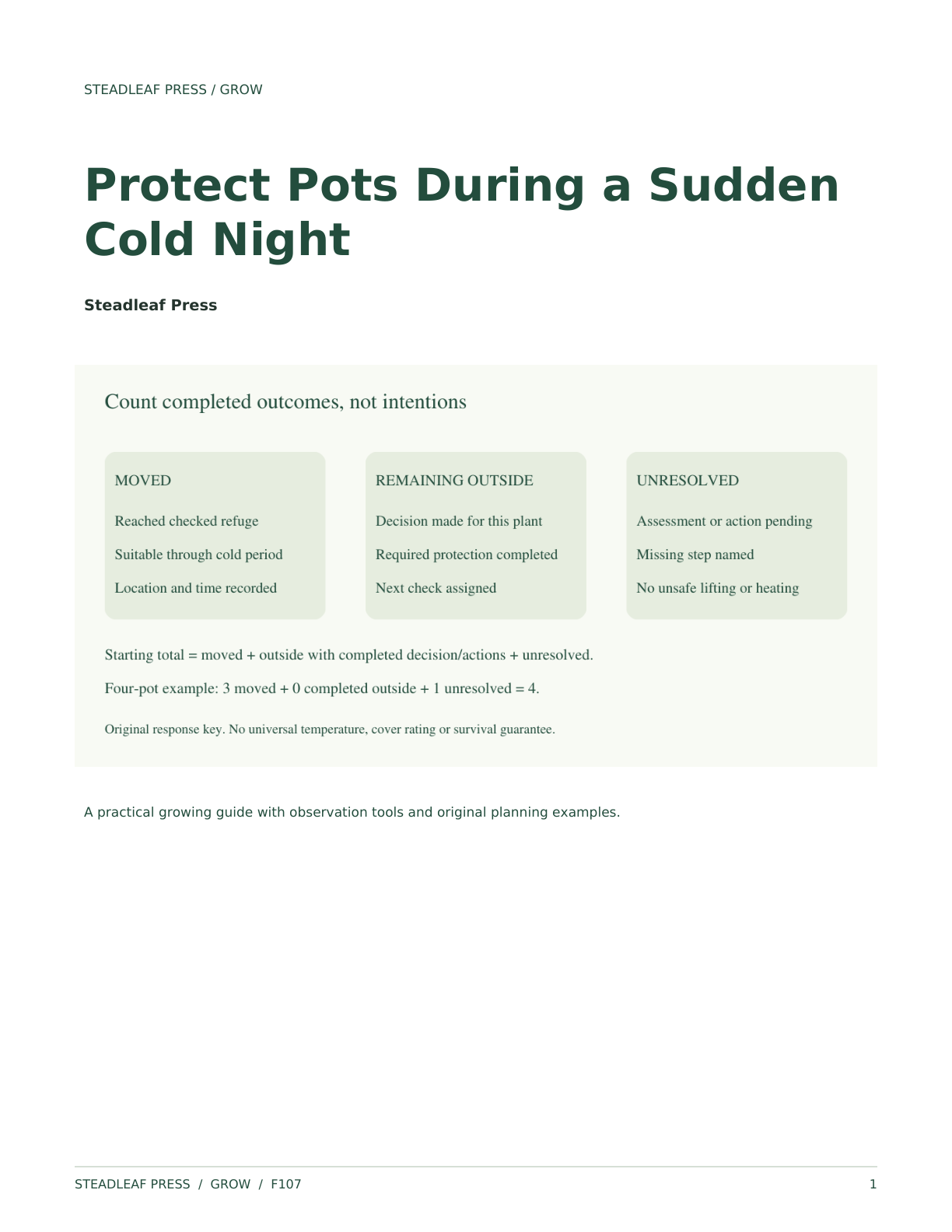
Finish with a physical walk-through and assign each listed pot exactly one current outcome: moved to a checked refuge; remaining outside with its decision and any required protection completed; or unresolved. Those three counts should add up to the starting total. A pot assessed but still awaiting necessary action remains unresolved. Record what is missing and investigate mismatches while there is still time to act safely.
STEADLEAF PRESS / GROW / F107 5
Use a cover only when the arrangement is suitable
A cover is a limited option for a plant that can appropriately remain outside during the predicted event. Choose purpose-made horticultural material and follow its instructions. Ensure the arrangement cannot crush foliage, topple the pot, obstruct an exit or blow into a neighbouring property.
University of Florida guidance explains that covers help more against frost than extreme cold and that covers extending to the ground retain heat. Its landscape advice should not be treated as a tested protection rating for a pot on an exposed balcony. Keep the material clear of fragile foliage and arrange a daytime removal check. UF/IFAS, Winter Plant Protection
Do not wrap a canopy and assume the roots are protected. Do not seal a plant into a plastic bag. If safe support and installation are unavailable, a suitable relocation is preferable to an improvised cover.
Never add candles, flames, improvised heaters or strings of lights beneath a cover. This checklist does not provide a heating system design. Likewise, continuous sprinkler frost protection is not a casual substitute for moving a few pots.
Record the person and time responsible for removing or adjusting the cover. An overnight arrangement is unfinished until that next check is assigned.
STEADLEAF PRESS / GROW / F107 6
Work through one example
You have four small pots on a terrace. Two are identified tender plants, one is an unidentified gift and one is a hardy shrub. The forecast has become colder, but the shrub's label describes only garden hardiness.
The first three receive checked indoor spaces, each with a tray and room for inspection. You photograph the gift's label for later identification. The shrub receives a separate container-cold assessment rather than automatically sharing the warm living room. If that assessment remains uncertain, you seek plant-specific advice and use only a refuge appropriate to its condition.
If the shrub's assessment is still pending, the note reads: “Four listed; three moved at 17:20; one shrub unresolved; indoor floor dry; doorway clear.” Once a suitable plan for the shrub has actually been carried out, replace its pending entry with the location, action and time. Record the forecast recheck separately. The useful result is completed protection or an explicit remaining gap, not four boxes marked assessed.
STEADLEAF PRESS / GROW / F107 7
Review before returning plants outside
In the morning, check the current temperature and the coming night before moving anything back. Open or remove temporary covers as conditions and product instructions require so they do not become an unintended daytime enclosure.
Photograph concerning changes and note which plant parts are affected. Avoid declaring success from one apparently healthy morning, particularly when roots may have been exposed. Keep care suitable and seek identification of substantial or progressing damage before making drastic cuts.
Return each plant only when its own conditions are suitable. If another cold night is approaching, arrange appropriate temporary care rather than repeated rushed moves. End the record with the actual destination, remaining concern and next check.
Sources and scope
The NWS sources explain frost observations and regional warning practice. Texas A&M supports the distinction between exposed container roots and in-ground protection. Iowa State supports moving suitable containers; UF/IFAS explains the limitations of covers. The response sheet, count procedure and example are original planning tools for one cold event, not a universal temperature threshold or a guarantee of survival.