Plan Shade for a Summer Heatwave
Steadleaf Press
Shade moves during the day. A comfortable corner at breakfast may expose every leaf and the side of a dark pot by afternoon. Before a heatwave, work out when protection is needed and whether the place you have chosen still provides it then.
FREE · No email or checkout
Read the complete free guide online
Read the instructional text here, or download the complete free PDF above for original diagrams, tables, worksheets and page layout. The original publication is unchanged.
STEADLEAF PRESS / GROW
Plan Shade for a Summer Heatwave
Steadleaf Press
A practical growing guide with observation tools and original planning examples.
STEADLEAF PRESS / GROW / F108 1
Shade moves during the day. A comfortable corner at breakfast may expose every leaf and the side of a dark pot by afternoon. Before a heatwave, work out when protection is needed and whether the place you have chosen still provides it then.
This guide helps you make a timed shade plan for a few containers. It pairs simple observations with decisions you can carry out safely. It does not prescribe a single temperature at which every plant needs covering, or a shade percentage suitable for every species.
Choose a small group to observe
Start with the containers you are most concerned about: plants with a history of scorching, recent arrivals, or pots whose afternoon conditions you have never checked. Give each one a short label that will remain readable when the pots move.
Write down the plant's usual light requirement and where that information came from. Include its present condition. A record that begins with already-brown leaf edges will be more useful than a later assumption that every mark appeared during the heatwave.
Check the container as well as the crown. Illinois Extension notes that dark containers can absorb substantial heat in summer sun, transferring heat to the growing medium. Small pots and some materials are also subject to larger temperature fluctuations. Shading the leaves while leaving the pot wall exposed may leave part of the problem unchanged. Illinois Extension, Container Material Choices
Choose one or two possible refuge positions. Reject any place that blocks access, requires an unsafe lift, exposes people below to falling objects or crowds the plants against equipment. Mark a safe route before the hottest weather arrives.
STEADLEAF PRESS / GROW / F108 2
Watch the shade before relying on it
On a safe preparation day, inspect candidate positions through the period when protection will be needed, including the expected hottest afternoon hours and low evening sun. Record when you actually observe a shadow crossing the plants. If a position is shaded at 11:00 but sunny at 12:30, the change happened somewhere in that interval; 12:30 is not a verified start time. Plan the move before the uncertain interval rather than waiting for the later observation.
You are looking for the actual shadow, not the label “covered patio.” Does the roof shade the foliage but miss the pot? Does low afternoon sun enter beneath the overhang? Does a neighbouring wall reflect light into the sheltered area? Take photographs from the same place if that helps you compare.
Use ordinary clock times rather than “morning” and “later.” Someone helping you should be able to act without reconstructing what you meant. If you cannot observe a critical period, mark it unverified and choose a more dependable refuge until you can check.
Do not put yourself at risk to complete a perfect record. Prepare in cooler conditions, follow local heat advice and shorten outdoor work when necessary. A remote sensor may reduce trips if you already have one, but a new purchase is not essential to make a basic shade plan.
STEADLEAF PRESS / GROW / F108 3
Know which temperature you are writing down
A forecast air temperature, the temperature of a leaf and the temperature within a pot are different measurements. University of Missouri Extension explains that leaves can become warmer than surrounding air in strong sunlight; its article concerns grain crops, so its crop-specific growth thresholds should not be transferred to houseplants or patio flowers. MU Extension, Plants Respond to Heat Differently Than Humans
For a repeatable local air reading, use an appropriate outdoor thermometer according to its instructions, protected from direct radiation and with air able to circulate. The National Weather Service describes air-temperature measurement as shielded from radiation and moisture. A thermometer lying on hot paving is measuring a different exposure. National Weather Service, Dry Bulb Temperature
Label readings explicitly: forecast air, local shaded air, or another genuinely measured quantity. Do not rename a pot-wall surface reading “root temperature.” If you have no instrument, write “not measured” and record the sun pattern and plant condition. Those observations still support a practical plan.
Avoid using a human “feels like” figure as a plant-damage threshold. It serves a different purpose. Keep human heat warnings central to your own safety while using plant-specific advice for the collection.
STEADLEAF PRESS / GROW / F108 4
Make a timed observation sheet
Use the same observation positions each day where practical. Record a location change immediately, because a lower reading after moving the thermometer cannot be compared as though the instrument stayed still.
Date: ___ Plant or group: ___ Forecast source and check time: ___
Instrument and measurement position, or “none”: ___
Check time Direct sun on Direct sun on Local air Moisture check Plant change or leaves? pot? reading and result action units
Early check: ___ ___ ___ ___ ___ ___
Before exposed ___ ___ ___ ___ ___ period: ___
Afternoon ___ ___ ___ ___ ___ check: ___
Evening review: ___ ___ ___ ___ ___ ___
Add a sentence after each day's entries: “Tomorrow I will change ___ because I observed ___.” A useful change is specific enough to test, such as moving two pots before the earliest unverified interval in which their current position may become exposed.
Record watering only after assessing the individual pot. A shade plan does not replace that assessment, and a hot forecast does not tell you whether a particular root ball is wet or dry. Keep the normal species-appropriate drainage arrangement functioning after a move.
STEADLEAF PRESS / GROW / F108 5
Select protection you can use safely
Existing shade is usually the simplest option to evaluate: a suitable covered area, a building shadow or a safe position beneath established overhead shelter. Choose it by the observed coverage window and the plant's needs, not by how cool it looks in a photograph.
Where existing shelter is insufficient, use only properly designed shade equipment in a permitted installation, following its instructions and weather limits. On balconies, do not tie sails to railings, add improvised ballast or assemble a frame whose loads and attachments have not been assessed. Obtain building approval or suitable professional advice where required.
Shade cloth and frost-protection fabric are not interchangeable. Maryland Extension describes shade cloth for reducing excessive sunlight and heat in vegetable growing, while noting that row covers can increase heat. Its discussion of 30 percent shade cloth is specific to vegetable production, not a universal specification for a mixed container collection. University of Maryland Extension, Vegetable Garden Weather and Pest Protection
Do not drape an improvised blanket tightly over foliage or enclose pots in plastic. Keep air movement and access for inspection. If a safe installation is unavailable, move manageable pots to suitable existing shelter rather than constructing a makeshift sail during the warning period.
STEADLEAF PRESS / GROW / F108 6
Turn the observations into an action card
Complete these lines before the heatwave:
- Containers receiving temporary shade: ___
- Location, observed shade times and any unobserved intervals: ___
- Time to move or deploy approved equipment: ___
- Who can do it safely: ___
- Watering access and drainage check: ___
- What happens if nobody is home at that time: ___
- Conditions that make the arrangement unsafe: ___
- Evening review time: ___
The unattended question matters. A plan requiring a daily midday move will fail if nobody is available. Choose a position with a longer verified shade window, or arrange help that does not require lifting beyond the helper's ability.
Keep separate instructions for equipment and plants. A person should not have to infer whether “take it down if windy” refers to the shade structure or the container display.
STEADLEAF PRESS / GROW / F108 7
Read one worked example
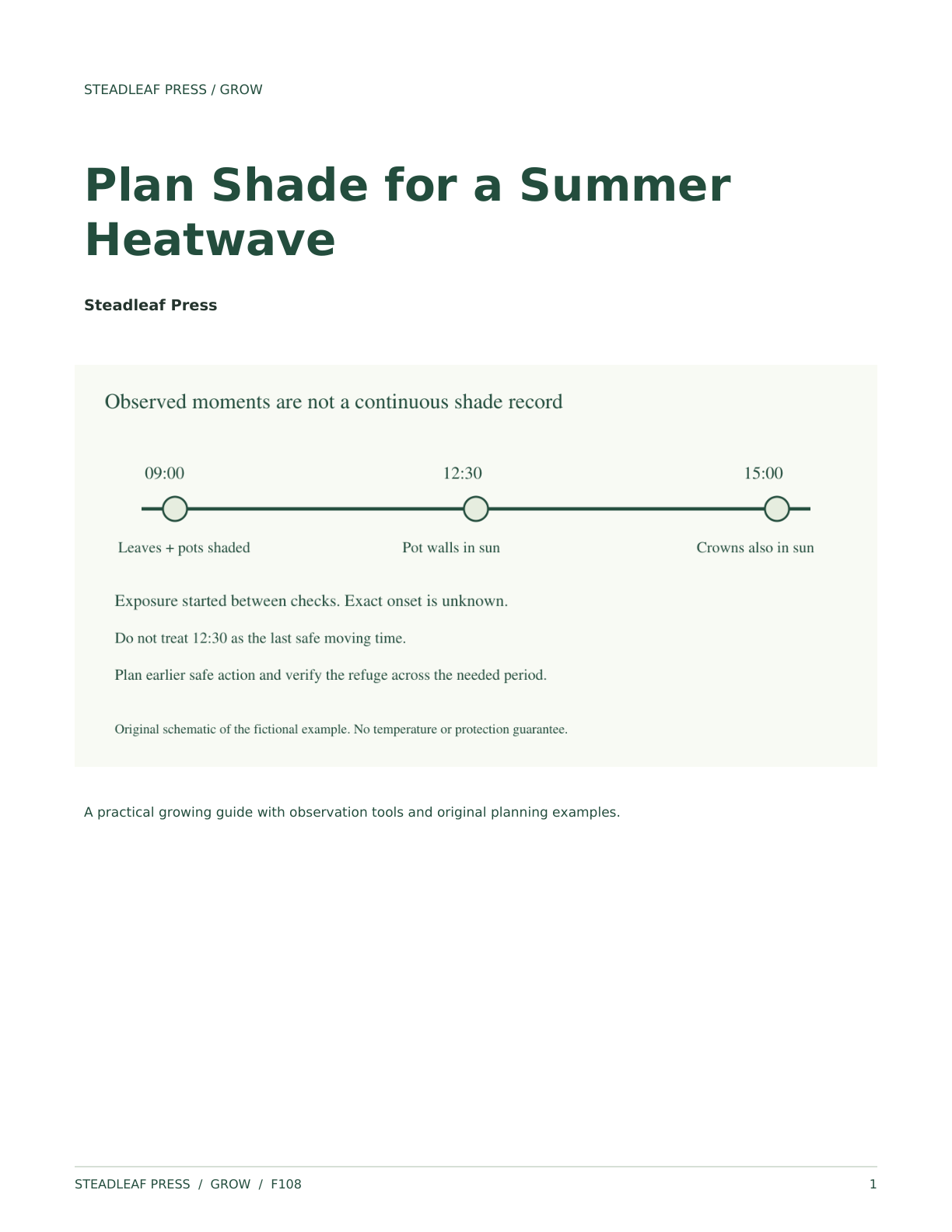
A gardener observes two pots beside a west-facing wall. At 09:00, both foliage and containers are shaded. At 12:30, the pot walls receive direct sun. At 15:00, the crowns are exposed too. These checks establish the conditions at three times, not the exact onset of either exposure. The gardener therefore does not set 12:30 as the last safe moment to move them.
A second location stays shaded through the observed afternoon. The gardener can move both pots comfortably before work, so the action card assigns that location for the event. The actual air readings, if taken, remain observations rather than proof of a universal safe temperature.
After the first day, the gardener writes: “Moved at 07:40; foliage and pot walls shaded when checked at 15:00; moisture assessed individually; retain the refuge and review this evening.” The 15:00 check confirms that moment, not uninterrupted protection all day. If one plant changes, it gets its own assessment instead of an automatic change for the whole group.
STEADLEAF PRESS / GROW / F108 8
Return gradually after the wave
Recheck the forecast and the plants before removing temporary protection. A cooler single afternoon may be followed by another hot day. Restore the ordinary arrangement in manageable stages, especially after an extended stay in substantially lower light.
Start with suitable gentler exposure and observe before increasing it. Keep shade-loving plants in their appropriate long-term light. Postpone an increase if fresh damage appears, and investigate rather than forcing the original schedule.
Save the sheet with one conclusion: which position worked, during which hours, and what remains uncertain. Next time, begin with that evidence and verify the shadows again as the season changes.
Sources and scope
Illinois supports the container-heating distinction; Missouri supports separating leaf and air temperature; NWS supports air-measurement practice; Maryland supports distinguishing shade cloth from heat-retaining covers. The timed sheet, action card and example are original planning aids. No source establishes a guaranteed safe temperature, structure or shade percentage for every container garden.