Choose When a Plant Can Go Outdoors in Spring
Steadleaf Press
A warm spring afternoon is a chance to assess the outdoor growing space, not automatic permission to leave a houseplant there overnight. Established tender plants have spent months in relatively steady conditions. Their next location needs suitable nights as well as suitable daytime light.
FREE · No email or checkout
Read the complete free guide online
Read the instructional text here, or download the complete free PDF above for original diagrams, tables, worksheets and page layout. The original publication is unchanged.
STEADLEAF PRESS / GROW
Choose When a Plant Can Go Outdoors in Spring
Steadleaf Press
A practical growing guide with observation tools and original planning examples.
STEADLEAF PRESS / GROW / F109 1
A warm spring afternoon is a chance to assess the outdoor growing space, not automatic permission to leave a houseplant there overnight. Established tender plants have spent months in relatively steady conditions. Their next location needs suitable nights as well as suitable daytime light.
Make the decision plant by plant. This worksheet is for established houseplants and tender container plants returning outdoors, rather than seedling production or a general garden planting calendar. A successful plan can include some plants staying inside all summer.
Decide whether an outdoor season suits this plant
Start with the identity on the label, including a cultivar when it affects care. “Palm,” “succulent” or “hibiscus” may be too broad. Similar-looking plants can have different needs, and a hardy garden relative is not evidence that a tender houseplant can tolerate the same conditions.
Write down your reason for moving it. You may want more growing space, an appropriate summer position or a practical care arrangement. Then check whether the proposed location actually supplies the light, temperature and shelter the plant needs.
North Carolina Extension describes African violet, Streptocarpus ionanthus, as primarily an indoor plant requiring filtered light and steady warmth. Its species profile warns about night temperatures below 60°F. This is a useful reason to question an outdoor move, rather than assuming every houseplant needs a summer holiday. NC State Extension Gardener Plant Toolbox, African Violet
If the plant is unidentified, unstable after recent damage or recovering from a major care problem, leave the move undecided while you resolve that issue. There is no need to create another change merely because other pots are going out.
STEADLEAF PRESS / GROW / F109 2
Find a temperature instruction with the right meaning
A source may give a preferred growing range, an overwintering minimum, a frost-hardiness description or a temperature for moving indoors. Copy the meaning alongside the number. Do not treat these as interchangeable.
For tropical hibiscus, Hibiscus rosa-sinensis, the RHS distinguishes protected overwintering from the decision to bring summer plants indoors. However, its outdoor-return line currently pairs Celsius and Fahrenheit figures that do not agree. Do not silently choose the more permissive number. Obtain consistent plant-specific advice before using that line as a threshold; the lower protected-overwintering minimum is not a substitute. RHS, Hibiscus rosa-sinensis
For jade plant, Wisconsin Extension recommends gradual adjustment to outdoor light and returning it indoors before frost. Its description does not supply one universal spring night-temperature threshold. Do not invent a numerical limit from the words “before frost” or test the coldest survival claim. Seek more specific advice for the plant and conditions if your decision depends on that missing number. Wisconsin Horticulture, Jade Plant
Broad houseplant guidance is a useful starting point, but it should not override more restrictive species advice. Keep the source's context, including whether it concerns a protected greenhouse or an exposed pot, visible in your notes.
STEADLEAF PRESS / GROW / F109 3
Fill in a plant-specific night-temperature worksheet
Complete this before choosing a moving date:
- Plant and cultivar: ___
- Reliable plant-specific source and link: ___
- Temperature value and units given: ___
- What that value describes: preferred growth / protected overwintering / outdoor exposure / bring indoors / other ___
- What the source does not answer: ___
- Working minimum night condition for this move: ___
- Why I chose that condition, including any precautionary margin: ___
- Forecast or observed condition that sends the plant back inside: ___
- Indoor return location: ___
A precautionary margin is your planning choice, not a newly discovered biological limit. Explain it honestly. For example, after obtaining a clear species-specific recommendation, someone might wait for a comfortably warm pattern rather than scheduling a move at its stated lower boundary. Record that reasoning instead of presenting a new precise number as scientific fact. Resolve contradictory source values before adding your own margin.
If a key field is blank, choose “wait” or obtain advice. Filling a worksheet is meant to expose missing information, not pressure you into guessing.
STEADLEAF PRESS / GROW / F109 4
Compare the coming nights with your decision
Read the forecast for the actual location, including the nighttime lows and any approaching cold front. Check several coming nights, then update the record daily while the plant is transitioning. A short forecast review window is a planning tool, not proof that cold weather has finished.
Night Forecast low and Forecast checked Meets this plant's Planned overnight units at working condition? location
___ ___ ___ Yes / no / uncertain ___
___ ___ ___ Yes / no / uncertain ___
___ ___ ___ Yes / no / uncertain ___
___ ___ ___ Yes / no / uncertain ___
Use the same temperature scale as the plant worksheet. When converting, °F = (°C × 9/5) + 32; keep the source value beside the conversion. For example, 12°C equals 53.6°F, while 59°F equals 15°C. This arithmetic identifies the mismatch in the RHS hibiscus line; it does not establish which biological recommendation the author intended. Keep local thermometer readings separate from forecasts: a sunny afternoon reading cannot establish the minimum before dawn.
If a predicted low is close to the plant's chosen condition, allow for forecast uncertainty and differences between the reporting location and the pot. Bringing a manageable plant inside is a reasonable conservative decision. Do not wait until bedtime to discover that its return space has been filled.
STEADLEAF PRESS / GROW / F109 5
Prepare the first outdoor position
Find a sheltered place with appropriate shade and a stable, accessible surface. Watch the area over the day so a patch of morning shade does not become unexpected afternoon sun. Keep the pot clear of exits and places where it could fall or drip onto people below.
University of Minnesota Extension recommends beginning houseplant transitions away from wind and direct sun. It also notes that even succulents can scorch when moved straight from indoors into outdoor sun. The plant's eventual light preference does not remove its need for an introduction to stronger conditions. UMN Extension, Moving Houseplants Outdoors
Check drainage before the first visit. Rain will not follow your indoor watering routine, and a decorative outer container must not become an unnoticed reservoir. Make sure the plant remains easy to inspect and move. A destination that requires a difficult lift every evening may be unsuitable for a day-only transition.
STEADLEAF PRESS / GROW / F109 6
Build exposure gradually and record the response
Begin with a short, supervised visit in the prepared sheltered position during suitable weather. One possible first appointment is an hour while you are home; this is an organisational example, not a prescribed exposure dose for every species.
Afterward, record the actual start and finish times, location, light, wind and any visible change. On later suitable days, lengthen time outside in manageable steps. An hour in bright afternoon sun is not equivalent to an hour in sheltered morning shade, so record exposure as well as duration. Change one main exposure at a time where practical, and compare the plant before the next increase rather than extending the visit solely because another day has passed.
Maryland Extension suggests introducing sun-preferring indoor plants to stronger outdoor light gradually over about two weeks. Use that as a reminder to allow time, not a deadline to reach full sun. Shade-loving plants should retain suitable shade throughout their outdoor season. University of Maryland Extension, Moving Indoor Plants Outside
Visit Actual time Position and Wind exposure Plant and Next step outside light moisture observations
___ ___ ___ ___ ___ Repeat / extend / step back
___ ___ ___ ___ ___ ___
___ ___ ___ ___ ___ ___
Assess water needs individually. Do not use deliberate drying, cold exposure or strong wind to make a tender plant “tough.” If new damage appears, return to suitable conditions and investigate before increasing exposure. Acclimation does not convert a tropical plant into a frost-hardy one.
STEADLEAF PRESS / GROW / F109 7
Keep daytime readiness separate from overnight readiness
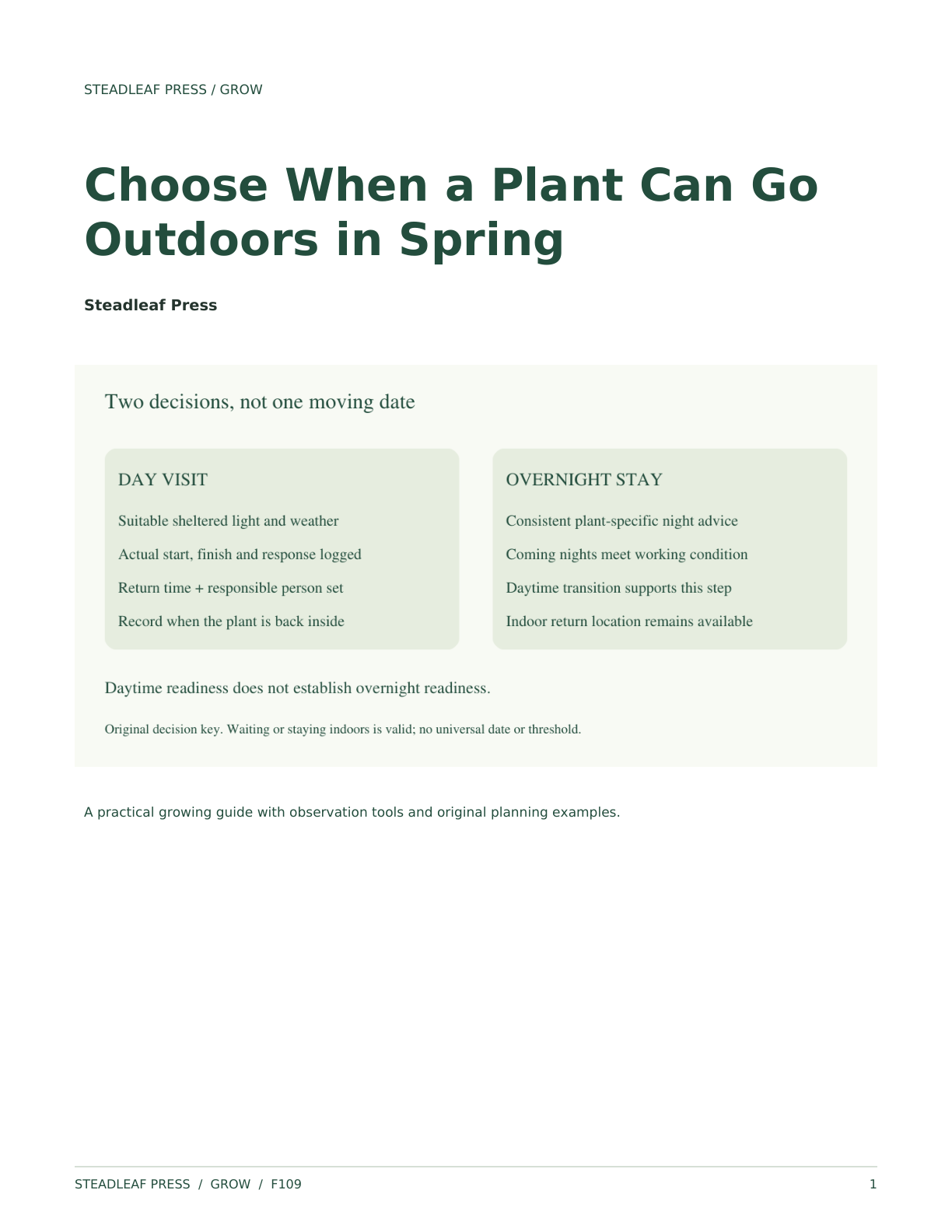
A plant can be ready for another sheltered afternoon while the nights remain unsuitable. Mark that stage clearly: “Day visits only; inside by ___.” Choose the return time from the hourly conditions and the plant's needs, with time to complete the move before conditions deteriorate; sunset or bedtime is not automatically the right deadline. Assign the return to a person and record when the pot is actually back inside.
Choose the first overnight stay only when the plant-specific temperature decision, forecast and daytime transition all support it. If you cannot reliably bring the pot back during a reversal, postpone the outdoor arrangement or choose one you can manage.
Consider a gardener with a tropical hibiscus, a jade and an African violet. The hibiscus waits indoors until the gardener has resolved conflicting temperature advice and recorded a sheltered transition plan. The jade has a light-adjustment plan but still needs a suitable night decision. The violet remains in its successful indoor position. These are three complete decisions, even though they do not share a moving date.
STEADLEAF PRESS / GROW / F109 8
Finish with a reversible summer plan
Record the date and conditions of the first overnight stay, then check the plant and forecast the next day. Keep the return space available during unsettled weather. Do not discard the worksheet just because the first night went well.
Your final note should answer: where does the plant live now, what sends it back indoors, and who can move it? That small record is more useful than a calendar reminder that simply says “plants outside.”
Sources and scope
NC State, RHS and Wisconsin provide plant-specific examples whose temperature statements have different purposes. Minnesota and Maryland support gradual exposure to outdoor conditions. The night worksheet and visit log are original decision tools. They establish neither a universal spring date nor a minimum temperature suitable for every tender plant.