Prepare a Balcony Garden for Heavy Rain
Steadleaf Press
Heavy-rain preparation begins with the balcony, not with watering the plants. Keep drainage routes visible, put away loose gardening items and preserve safe access. Then decide which plants need a manageable change of position.
FREE · No email or checkout
Read the complete free guide online
Read the instructional text here, or download the complete free PDF above for original diagrams, tables, worksheets and page layout. The original publication is unchanged.
STEADLEAF PRESS / GROW
Prepare a Balcony Garden for Heavy Rain
Steadleaf Press
A practical growing guide with observation tools and original planning examples.
STEADLEAF PRESS / GROW / F111 1
Heavy-rain preparation begins with the balcony, not with watering the plants. Keep drainage routes visible, put away loose gardening items and preserve safe access. Then decide which plants need a manageable change of position.
Do this work before dangerous weather arrives. A pot is not worth stepping onto a balcony during a thunderstorm or trying to lift a wet, unstable load in strong wind.
Learn what the forecast actually covers
Check the official forecast and warnings for your location. Heavy rain may arrive with wind, hail or lightning, which changes what you can safely do outdoors. Follow instructions from local emergency services and your building manager.
Write down the expected timing, your latest safe preparation opportunity and any building-specific instruction. When recording rainfall, include its units and forecast period: a total for the whole day is not an hourly rate, and an area forecast is not a measurement at your balcony. Do not translate either into a claim that your balcony will cope. Its drainage and construction matter, and a gardening checklist cannot assess either.
The City of Sydney's storm-preparation guidance includes putting away loose items such as pot plants and reporting blocked stormwater drains. Those are useful preparation principles; local warnings and responsibilities must still come from your own area. City of Sydney, How to prepare for storms
STEADLEAF PRESS / GROW / F111 2
Look at two separate drainage systems
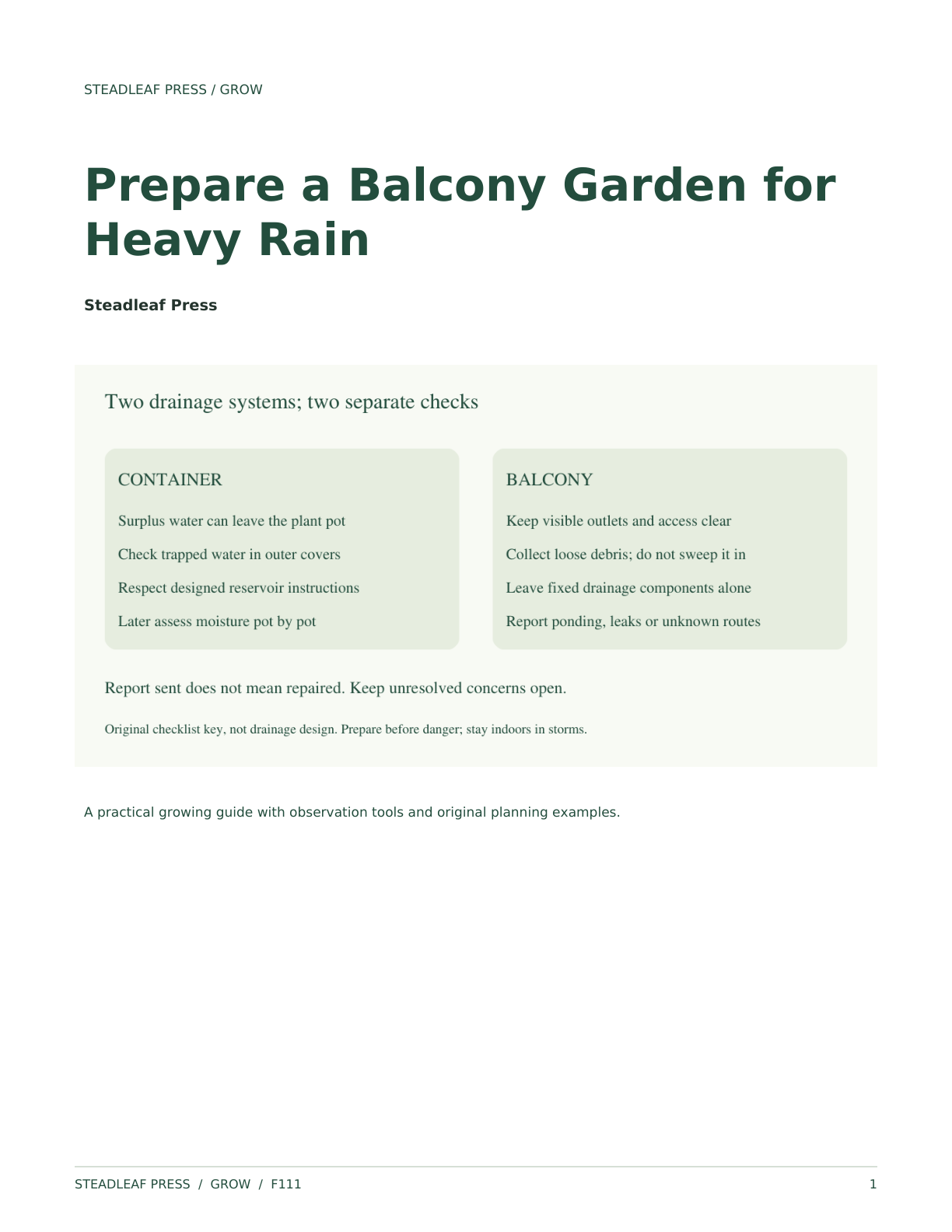
Plant drainage lets surplus water leave a container. Balcony drainage carries water away from the building surface. A plant pot can drain normally while water collects beneath it because a balcony outlet is blocked. Conversely, the balcony can drain while a plant sits in water trapped inside a decorative cover.
In dry, safe conditions, locate the visible balcony outlet or outlets. Identify the route water normally takes without pouring extra water across the floor as a test. If you do not know how the drainage works, ask the building manager rather than guessing.
Remove ordinary loose leaves and fallen potting mix from accessible surfaces where routine cleaning is permitted. Collect debris for disposal; do not sweep it into a drain. Leave fixed grates, waterproofing, pipework and drainage fittings alone.
Victoria's Building and Plumbing Commission explains that blocked outlets, inadequate overflow provision and other design problems can contribute to ponding and water entering a building. This is a reason to report trouble, not an invitation to redesign the drainage yourself. BPC, Balcony Design and Stormwater Drainage
STEADLEAF PRESS / GROW / F111 3
Keep the drain accessible after moving pots
Make a small sketch showing the door, walking route, outlets and current containers. Mark any pot, tray, mat or storage box that hides an outlet or obstructs the route to it.
Use this check:
- Can I see the accessible drain area without shifting a heavy pot?
- Is loose debris likely to collect there?
- Does a mat cover the outlet or become a movable obstruction?
- Will the planned shelter position block drainage or the door?
- Is there a drainage concern that needs reporting now?
Do not plug an overflow, stuff a drain with cloth, build a barrier across it or seal around a pot to prevent runoff. Do not drill the balcony, alter thresholds or remove building components. A repeated puddle or leak belongs in a maintenance report with photographs taken safely.
Keep building access clear even when that means moving fewer plants. There is no useful plant shelter arrangement that prevents the door opening or obstructs an escape route.
STEADLEAF PRESS / GROW / F111 4
Put away the loose gardening items
Collect empty nursery pots, plant labels that have worked loose, lightweight saucers, unused stakes, bags and tools. Store them in an appropriate indoor or enclosed place before the weather worsens. Do not simply pile them behind the largest pot.
NSW State Emergency Service recommends clearing garden and balcony debris and bringing loose items inside where possible because they can become hazards in wind or floodwater. NSW SES, Prepare your home and property
Review temporary covers and shade materials according to their instructions. Remove or put them away beforehand when required. Avoid improvising a plastic-sheet roof tied to a railing: a covering can collect water, catch wind and introduce another hazard.
Check existing supports from a safe standing position. If something is damaged or insecure, do not lean out to repair it. Arrange appropriate help and keep away from a hazardous area.
STEADLEAF PRESS / GROW / F111 5
Decide which pots need attention
List plants that are unusually exposed, recently planted or especially sensitive to prolonged wet conditions. Check their actual needs rather than assuming every plant should be brought inside.
For each movable pot, choose a safe destination before lifting it. Consider light, temperature, household access and separation from indoor plants if pests are a concern. Keep unfamiliar or unsuitable plants away from pets and children.
Do not move an awkward pot alone, lift by the plant or stand on furniture to reach a container. Wet potting medium makes a container heavier. Leave large, fixed or inaccessible planters to an appropriately planned response with the building manager or a professional where necessary.
Check ordinary draining pots for trapped water in saucers or outer covers. Follow the plant system's instructions: a designed self-watering reservoir is different from an accidental pool around a nursery pot. Avoid dismantling or modifying either system in a rush.
Rainfall does not create one watering rule for the whole collection. Roof cover and foliage can affect what reaches a pot. RHS guidance recommends checking each container and notes that light rain may wet only a shallow layer. Use the actual medium condition when care resumes. RHS, How to water containers
STEADLEAF PRESS / GROW / F111 6
Complete a before-rain record
Area or item Action needed Who can do it safely? Done or unresolved
Door and walking route ___ ___ ___
Accessible drain ___ ___ ___ surrounds
Loose pots, tools and ___ ___ ___ materials
Temporary cover or ___ ___ ___ shade equipment
Small movable ___ ___ ___ containers
Heavy or fixed containers ___ ___ ___
Known leak, ponding or Report to ___ ___ ___ damage
Add the official forecast source and time checked. For each action, record completion or the unresolved next step. Separate “report sent” from “problem repaired”: include the report date, recipient and any response, and keep the physical concern open until its resolution is confirmed. The list is a preparation record, not evidence that the balcony is waterproof or that every object is secure.
STEADLEAF PRESS / GROW / F111 7
Stop outdoor work when conditions become unsafe
If thunder is heard or lightning is nearby, go indoors and stay off the balcony. The US National Weather Service explicitly includes balconies and porches among places to avoid during lightning, and warns against touching electrical equipment or unplugging it during the storm. National Weather Service, Lightning Indoors
Do not go back out to empty a saucer, retrieve a loose label or save a plant. Follow local safety advice and remain away from hazardous windows, water or electrical equipment. If water is entering the building or something threatens people below, use the appropriate building or emergency contact from a safe location.
This guide does not provide electrical, flood-rescue or structural instructions. Personal safety takes priority over finishing the checklist.
STEADLEAF PRESS / GROW / F111 8
Inspect after conditions are safe
Look for damage before stepping into the growing area. If there are loose building parts, unstable objects, broken glass, water near electricity or another significant hazard, keep away and report it.
When normal access is safe, photograph any ponding, leak or shifted object before routine cleanup. Record the observation time and location. If you first see a puddle at 10 a.m., that establishes when you saw it, not when it formed; record an earlier photograph separately if one exists. Clear ordinary debris without pushing it into outlets. Check which pots contain trapped drainage water and which growing media are actually wet.
Do not water everything because the sun has returned. Equally, do not assume every sheltered pot received enough rain. Resume decisions pot by pot. Record broken stems and continuing plant decline separately from old marks.
If floodwater, sewage or unknown contaminated water reached edible plants or potting medium, pause harvesting and obtain local public-health or extension advice. Ordinary rain and contaminated flooding require different responses.
STEADLEAF PRESS / GROW / F111 9
Learn from one event
A fictional balcony gardener discovers that a small storage box repeatedly hides fallen leaves beside an outlet. Before the next forecast, they move the box to an appropriate storage place and keep that area visible. They report previous ponding rather than assuming the box was the only cause.
Another pot was sheltered so thoroughly that its growing medium remained dry. That plant goes into the separate moisture-check record. The gardener does not change every pot's watering to match it.
Finish with one improvement you can maintain: clearer drain access, fewer loose items, an earlier moving plan or a maintenance report. Preparation becomes more useful when it responds to the actual balcony instead of growing into a longer list of improvised fixes.
Sources and scope
The linked emergency and building authorities support advance preparation, clear drainage and safe storm behaviour. RHS guidance supports individual moisture checks. The worksheet and examples are original. Local building requirements and emergency directions take precedence; this is not a drainage design, structural assessment or assurance against storm damage.