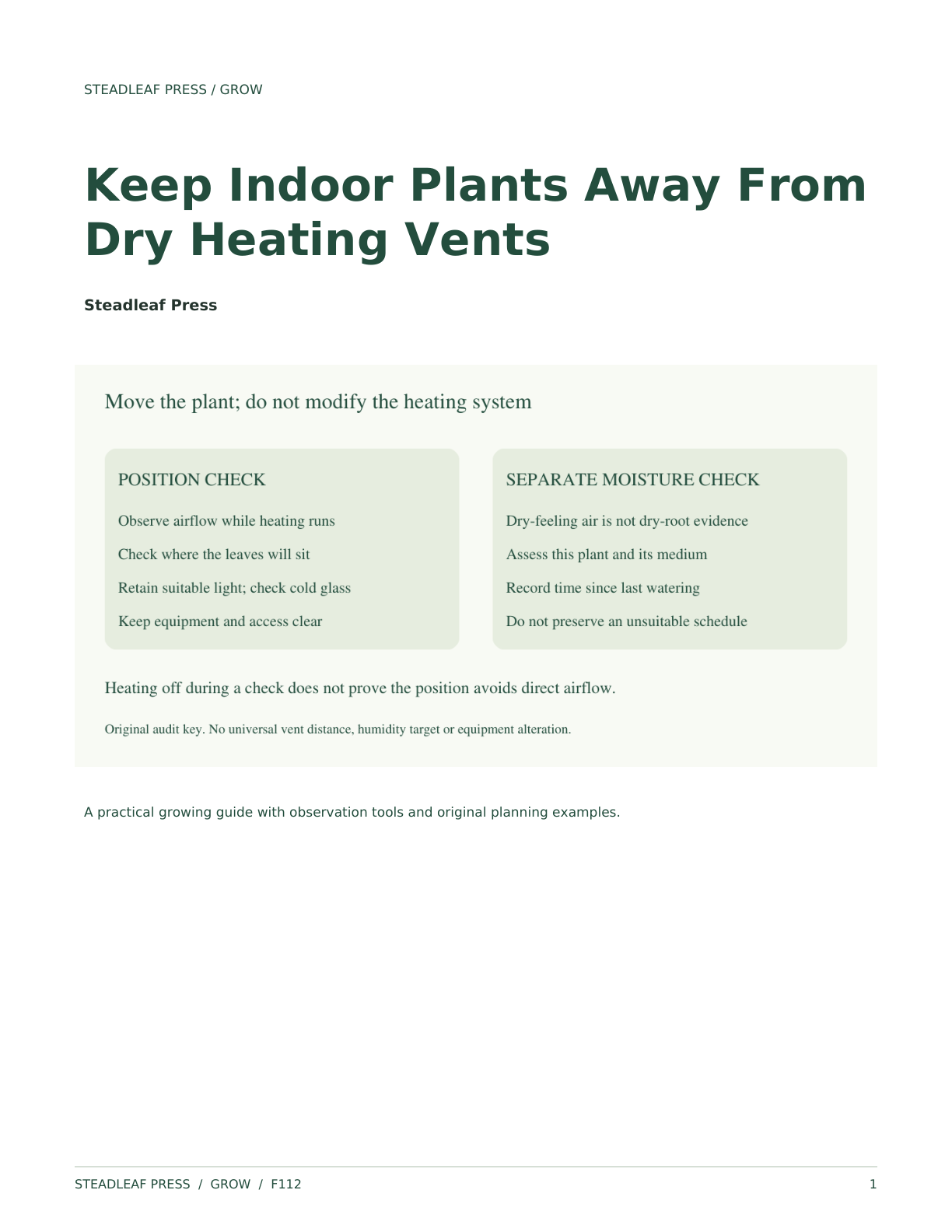
Keep Indoor Plants Away From Dry Heating Vents
Steadleaf Press
When the heating comes on, a familiar plant position can become a different growing environment. Warm air may blow across leaves, a radiator may heat the space beside a pot, and a window may be cold after dark. Moving the plant can help, but the new place must still provide suitable light.
FREE · No email or checkout
Read the complete free guide online
Read the instructional text here, or download the complete free PDF above for original diagrams, tables, worksheets and page layout. The original publication is unchanged.
STEADLEAF PRESS / GROW
Keep Indoor Plants Away From Dry Heating Vents
Steadleaf Press
A practical growing guide with observation tools and original planning examples.
STEADLEAF PRESS / GROW / F112 1
When the heating comes on, a familiar plant position can become a different growing environment. Warm air may blow across leaves, a radiator may heat the space beside a pot, and a window may be cold after dark. Moving the plant can help, but the new place must still provide suitable light.
Use this room audit to find direct exposure, compare possible positions and check the result. It does not require changing the heating system or buying humidity equipment.
Identify the plant before choosing its winter place
Find the plant's name and a reliable care guide. Record its light, moisture and temperature needs. Keep uncertain identification visible rather than applying the needs of another plant nearby.
Houseplants differ in the conditions they tolerate. University of Connecticut guidance recommends learning the requirements of the plant and keeping plants away from direct heat sources, cold drafts and cold window glass. University of Connecticut, Growing Houseplants
Make one brief card:
- Plant and variety, if known:
- Current position:
- Suitable light:
- Plant-specific temperature guidance and source:
- Usual moisture trigger:
- Recent change in leaves or growth:
The card prevents one quick fix from creating another problem. A plant moved away from a vent but into a dark hallway may still be poorly placed.
STEADLEAF PRESS / GROW / F112 2
Map heat sources and the route of the air
Sketch the room with windows, doors and the usual plant positions. Mark supply vents, radiators, baseboard heaters, fireplaces and portable heaters where present. Do not touch equipment to find out whether it is hot.
Observe normal heating operation from a safe position. Note where you can feel moving warm air and whether foliage is directly in its path. Record whether the heating was running during the check: no airflow felt while the system is off does not establish that a position avoids the supply stream. A vent above a plant can matter as much as one beneath it. Keep hands, paper and instruments away from hot surfaces and moving equipment.
University of Arkansas Extension specifically advises avoiding positions where heating or air-conditioning vents blow directly onto plants. That is a useful location check, not a universal distance rule for every vent and room. University of Arkansas Extension, Care of Houseplants
Write “warm airflow reaches the upper leaves when heating runs” rather than “this corner is too dry.” The first is something you observed. The second needs more information.
STEADLEAF PRESS / GROW / F112 3
Do not alter the heating system for the plants
Move the plant or choose another suitable growing place. Do not cover a vent with a pot, tray or cloth, block a return grille, drape foliage over a heater or modify equipment to redirect air. Keep all clearances required by the appliance instructions and building guidance.
Do not put a water tray on a radiator or balance a humidifier above electrical equipment. Cords, water and crowded growing displays need a safe arrangement independently of plant care.
If no usable position remains, reduce the number of plants in that room or choose a species better suited to the available conditions. The room does not have to be redesigned around a plant that cannot grow comfortably there.
Any concern about the heating equipment itself belongs with the building manager or an appropriate technician. A gardening audit does not assess ventilation, appliance safety or building performance.
STEADLEAF PRESS / GROW / F112 4
Compare the actual plant positions
Choose two or three realistic alternatives. Look at the location where leaves will sit, not just where the pot will stand. A tall plant may reach the warm airflow even when its container appears well away from the vent.
If you already have a suitable room thermometer or humidity meter, use it according to its instructions. Place it safely at a representative location, away from water and direct contact with a heater. Allow it time to settle and note when the heating is running. One reading does not describe the whole day.
Illinois Extension recommends checking temperatures near plants and considering the daily fluctuations around windows and heat sources. It also notes that winter light can change as sun angles and outdoor foliage change. Illinois Extension, How to overwinter house plants
Use this comparison:
Position Light observed Direct airflow or Night-time concern Practical access nearby heat
Current place ___ ___ ___ ___
Alternative A ___ ___ ___ ___
Alternative B ___ ___ ___ ___
Add any instrument reading with its time, units and conditions. Label it as air temperature or relative humidity, not leaf or root temperature. For a comparison, use the same instrument and allow it to settle at each position according to its instructions. If the heating switches off between readings, record that change rather than attributing the difference entirely to location. Mark unmeasured conditions as unknown. The table is meant to reveal trade-offs, not create false precision.
STEADLEAF PRESS / GROW / F112 5
Check moisture separately from room dryness
Dry-feeling air does not tell you whether the root ball needs water. Check the growing medium in the way appropriate for the plant and container. Inspect any outer pot for water left from the previous watering.
Winter can bring competing changes. Direct warm air may increase drying in one place, while reduced light and slower growth may reduce water use elsewhere. Illinois Extension describes lower winter demand for many houseplants and cautions against continuing unsuitable watering practices. Illinois Extension, How to overwinter house plants
After relocation, record how the pot behaves rather than retaining its previous schedule automatically. Note when it was last watered and the medium condition at each check. A dry check six days after watering cannot be compared directly with a moist check two days after watering to decide which position dries faster. Write a reminder to check it, then decide whether to water from what you find.
Do not soak the roots to compensate for a heating vent. Root moisture and air humidity are different conditions. Likewise, misting a leaf is not a substitute for removing a plant from direct hot airflow.
STEADLEAF PRESS / GROW / F112 6
Move one plant with a clear reason
Before lifting, clear the route and confirm the destination is stable and suitable. Get help with a heavy or awkward container. Keep the plant away from household traffic, and account for children and pets when choosing the new place.
Take a photograph and write a short moving note:
“On ___, I moved ___ from ___ to ___ because ___. The new place appears suitable for ___, but I still need to check ___.”
For example, the reason might be direct warm air on the upper leaves. The remaining question might be the light available on cloudy days. That is more informative than moving every plant in the room without recording why.
Avoid repeatedly changing positions in search of an immediate cosmetic improvement. Give the justified arrangement a chance to be observed, while responding promptly if it creates an obvious new problem.
STEADLEAF PRESS / GROW / F112 7
Treat brown edges as a question, not a verdict
Photograph existing marks before moving the plant. At later checks, distinguish old damage from new changes. A damaged edge still being visible does not establish that the relocation failed.
If leaves continue changing, revisit the whole care picture. Check moisture, actual light, temperature exposure and visible pest signs. Do not assume that every brown tip in winter comes from central heating.
If the plant declines rapidly, the base softens or the cause remains unclear, seek plant-specific advice. Include the whole-plant photograph, the position comparison and any readings. Avoid adding fertilizer or a spray merely because relocation has not produced immediate new growth.
STEADLEAF PRESS / GROW / F112 8
Work through a winter relocation example
A fictional owner keeps a small foliage plant on a stand beside a window. Once the heating starts, warm air reaches the leaves above the stand. The owner considers moving it deeper into the room, but that place has much less useful daylight.
The audit identifies a second stable position beside a different part of the window, outside the direct airflow and with the foliage clear of cold glass. The owner checks the plant's care guide, confirms a safe arrangement and moves it there.
They record existing brown edges and check moisture without changing to an automatic daily watering routine. At later inspections, they compare new changes rather than expecting old edges to disappear. If the alternative proves too cold after dark, the temperature record prompts another considered decision.
The example does not depend on an invented minimum distance from a vent. It depends on observing the room and matching the plant to a suitable position.
STEADLEAF PRESS / GROW / F112 9
Finish the audit with a manageable plan
- Direct warm airflow removed from foliage where possible.
- Suitable light retained or an unresolved shortage recorded.
- Cold glass and draft exposure checked.
- Heater, vent and household access kept clear.
- Moisture checked independently of air conditions.
- Existing marks photographed.
- Next observation chosen and reason recorded.
Keep the audit with the plant's care note. Repeat it when heating use or furniture placement changes. The best winter position is one that meets the plant's needs and remains convenient and safe for the people using the room.
Sources and scope
The linked Arkansas, Connecticut and Illinois extension guidance supports avoiding direct heating airflow and assessing light, temperature and water together. The room map, comparison table and example are original practical tools. This guide does not prescribe HVAC modifications, appliance clearances or a single humidity target for all houseplants.