Flush a Salt-Crusted Potting Mix Safely
A symptom guide with clear limits for flushing
Compare four symptom clues, apply six eligibility checks, use a bounded two-pass method only when appropriate, and record drainage and subsequent observations.
FREE · No email or checkout
Free practical guide. No email or payment required. Photo is contextual, not proof of measured salt levels or a flushing trial.
Read the complete free guide online
Read the instructional text here, or download the complete free PDF above for original diagrams, tables, worksheets and page layout. The original publication is unchanged.
STEADLEAF PRESS / GROW Flush a Salt-Crusted Potting Mix Safely
A symptom guide with clear limits for flushing
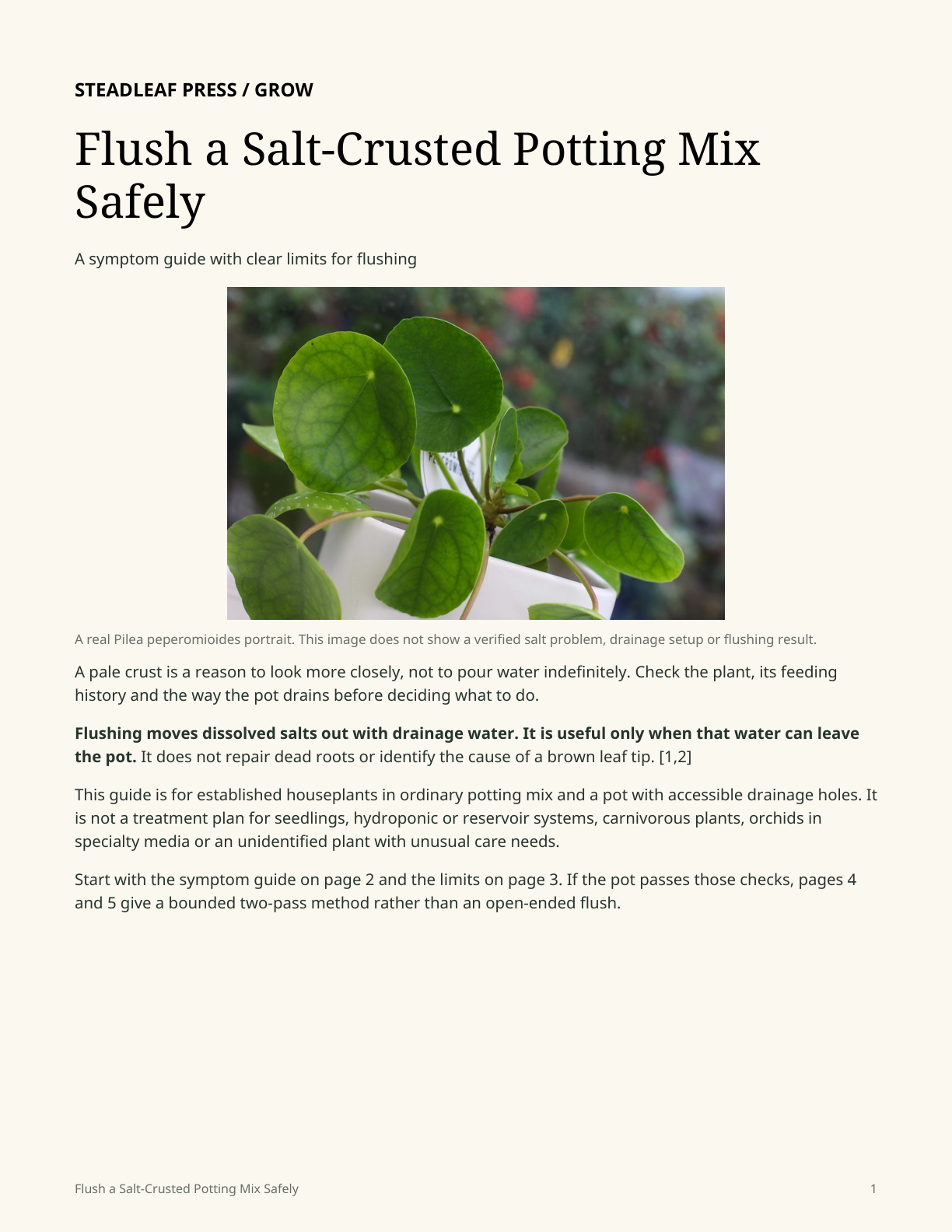
A real Pilea peperomioides portrait. This image does not show a verified salt problem, drainage setup or flushing result.
A pale crust is a reason to look more closely, not to pour water indefinitely. Check the plant, its feeding history and the way the pot drains before deciding what to do.
Flushing moves dissolved salts out with drainage water. It is useful only when that water can leave the pot. It does not repair dead roots or identify the cause of a brown leaf tip. [1,2]
This guide is for established houseplants in ordinary potting mix and a pot with accessible drainage holes. It is not a treatment plan for seedlings, hydroponic or reservoir systems, carnivorous plants, orchids in specialty media or an unidentified plant with unusual care needs.
Start with the symptom guide on page 2 and the limits on page 3. If the pot passes those checks, pages 4 and 5 give a bounded two-pass method rather than an open-ended flush.
Flush a Salt-Crusted Potting Mix Safely 1
STEADLEAF PRESS / GROW Read the clues together
Water can leave minerals behind, and fertilizer can add soluble salts. A deposit may contain either or both. Its appearance cannot tell you the root-zone salt concentration or the amount of fertilizer used. [1]
What you notice What it may suggest What to check next
Dry white or pale crust on Mineral or fertilizer residue is Check the water source, fertilizer record and the mix or pot rim possible pot drainage. A crust is not proof of injury.
Brown leaf tips or edges Excess salts are one possible cause Compare moisture, light, humidity and with slower growth feeding history. Do not diagnose from tips alone.
Wilting while the mix Salt stress or damaged roots may Treat persistent wetness and worsening wilt remains wet be involved as a reason to pause flushing and seek help.
A verified concentrate or Fertilizer injury is a credible Record the product, dilution, amount and dosing error concern time applied. Seek prompt case-specific advice.
Salt-related signs: [1,3]. Overlapping care problems: [2,4]. This comparison is not a diagnostic test.
Do not turn every white mark into a salt problem
If a deposit is fuzzy, moving, attached to insects or otherwise unclear, photograph it and ask for identification. This guide does not identify mold, pests, perlite or fertilizer pellets by color. Do not dissolve an unknown substance with household chemicals.
A useful observation is specific
Write “dry pale ring on the pot rim; last fertilizer amount unknown; mix still wet below the surface,” rather than “salt burn.” The first description gives you three things to investigate without deciding the answer in advance.
A white crust and healthy-looking leaves can coexist. Equally, no obvious crust does not rule out a problem. Use the whole care history.
Flush a Salt-Crusted Potting Mix Safely 2
STEADLEAF PRESS / GROW Decide whether flushing fits
Use these checks before adding water. An unknown answer is a reason to verify, not an automatic pass. The limits below are a conservative synthesis of drainage, root-health and leaching guidance. [1-5]
A reasonable candidate
[ ] The plant is identified and fits this guide's ordinary houseplant scope.
[ ] The pot has open, accessible outlets and a clear route for runoff to leave.
[ ] The mix accepts water across its surface and drains normally; it is not persistently waterlogged.
[ ] There is no rapid collapse, soft stem base or worsening wilt in wet mix.
[ ] You can handle the pot securely and catch runoff without leaving the base submerged.
[ ] You have suitable low-mineral water, and no known major fertilizer overdose needing an individual plan.
If all apply, the method on pages 4 and 5 can be considered for suspected ordinary salt accumulation. It is not confirmation of the diagnosis or a promise of recovery.
Hold the flush and change the plan
No holes, blocked drainage or a saturated root zone: Do not pour extra water in. Empty standing water from an accessible cover pot. A different container, fresh mix or root assessment may be needed; drainage comes before leaching. [2,5]
Dry mix that has shrunk from the pot walls: Water may bypass the root ball. Rehydrate according to the plant's needs first, then reassess. Fast runoff from a dry channel is not evidence that the mix has been rinsed. Do not keep pouring to compensate. [2,9]
Severe decline, a known overdose or a heavily encrusted pot: Pause additional fertilizer and ask an extension service or qualified plant adviser about repotting or another response. Keep the product packaging and photos. Repeated flushing is not a substitute for assessment. [1,3,5]
Special systems or sensitive plants: Use plant- and system-specific guidance rather than adapting this procedure by guesswork.
Flush a Salt-Crusted Potting Mix Safely 3
STEADLEAF PRESS / GROW Use a bounded two pass rinse
Only proceed after the checks on page 3. This method adapts UC Cooperative Extension's two-waterings approach for an eligible, freely draining houseplant. It is not a universal salt-removal dose. [5]
Prepare
Move the growing pot out of its decorative cover. Set it securely above a sink or catchment so the drainage holes stay open and the base cannot sit in runoff. Protect work surfaces and keep children and pets away from fertilizer-containing drainage water.
Choose room-temperature water low in dissolved minerals, with no fertilizer added. Avoid salt-softened water. If your usual water leaves heavy residue, verify a lower-mineral source; a “filtered” label alone does not tell you what it removes. [1,6]
Gently lift off a loose surface crust with a clean spoon, taking only material that comes away without exposing or pulling roots. Do not dig to a prescribed depth. If it is interwoven with roots or stems, stop and ask about a suitable refresh or repot instead. [5,7]
The path must stay open
Low-mineral water enters from above.
Water moves through evenly wetted mix.
Runoff leaves without being reabsorbed.
Conceptual flow only, not a measured drainage test. A pot sitting in collected runoff breaks this path.
Flush a Salt-Crusted Potting Mix Safely 4
STEADLEAF PRESS / GROW Rinse and observe
Begin only if preparation is complete and all page 3 checks still pass. Do not use bottom soaking for this task: dissolved salts need a route out, not a bath to be reabsorbed. [5]
1 First pass: Slowly distribute water over the mix, avoiding the crown. Wet the root ball thoroughly until water runs from the bottom. Pause if water pools rather than entering the mix. Stop if it drains poorly or rushes down a side gap while the interior stays dry. [5,9]
2 Drain before repeating: Let runoff leave freely. UC's example waits about five minutes before the second watering; do not use that clock to override poor drainage. If the pot is not draining normally, do not begin the second pass. [5]
3 Second pass: If drainage remains normal, repeat the slow top watering, letting excess water flow out. Then stop this session and allow the pot to finish draining. Do not add pass after pass until the water “looks clean.” [5]
4 Return and record: Empty the catchment. Replace any safely removed surface mix with suitable fresh mix without burying the stem more deeply. Record what you did on page 8. Keep the pot out of standing water. [5,7]
Runoff is not a test result. Clear water, faster drainage or a vanished crust does not establish a safe salt level. If the concern persists, investigate rather than automatically repeating this session.
Flush a Salt-Crusted Potting Mix Safely 5
STEADLEAF PRESS / GROW Know what flushing cannot fix
It cannot restore dead tissue
Browned tissue and damaged roots are not made healthy by a rinse. Judge subsequent care by the plant's overall condition and new changes, not by expecting an old brown tip to turn green. Persistent or worsening symptoms deserve reassessment. [3,4]
It cannot correct the source by itself
Review the fertilizer product, dilution, quantity and frequency. Account for slow-release pellets, spikes and fertilizer already present in the mix. Holding liquid feed does not remove those existing inputs. Follow directions rather than immediately replacing nutrients “lost in the flush.” [8]
Check whether water is coming through a salt-based softener. If mineral deposits recur, investigate water quality as well as fertilizer use. Do not add vinegar, baking soda, dish soap or a household descaler to planted mix as a shortcut.
It cannot make a poorly draining mix suitable
If water repeatedly stands on top, the root ball stays wet unusually long or the plant declines, stop treating the problem as cosmetic crust. Seek advice on the container, roots and mix. In severe salt accumulation, replacing the mix and using a clean suitable pot may be more appropriate than more rinsing. [1,2,3]
Do not scrape, wash or prune roots routinely just because a crust is visible. Repotting is a separate decision based on the plant and the extent of the problem.
It does not create a fixed watering calendar
After draining, return to moisture checks suited to the species. Do not water again merely because a certain number of days has passed, and do not deliberately leave a thirsty plant dry to “rest” after flushing. [6]
There is no universal volume or repeat interval. Extension sources describe different leaching methods. This guide uses one bounded example, not a guarantee of complete removal. For repeated symptoms or a salt-sensitive plant, ask whether a potting-medium or irrigation-water test would be useful and how to interpret it for that species. Do not apply a random meter threshold from a different growing system.
Flush a Salt-Crusted Potting Mix Safely 6
STEADLEAF PRESS / GROW Choose the response that fits
These are hypothetical situations, not tested recovery stories. Use them to practice the limits, not to identify a disease.
A thin crust and an otherwise stable plant
A known foliage houseplant has a pale deposit on the rim. The mix wets evenly and drains freely. There is no dosing error in the record, but the usual water leaves residue on the watering can.
Next step: Check the water source and feeding record. If the page 3 checks pass, a bounded rinse is an option. Record the result and prevent recurrence by addressing the likely input, rather than starting a weekly flushing routine.
Brown tips and a pot that stays wet
The plant droops, the mix remains wet, and water collects inside the decorative pot.
Next step: Do not flush to chase the brown tips. Empty accessible standing water, check drainage and seek help for worsening wet wilt. The symptom is not enough to distinguish salt injury from a root problem. [2,4]
Water races down a dry side gap
The mix has pulled away from the wall. Water exits immediately, but an accessible moisture check shows that the root ball is still dry.
Next step: Stop the flushing attempt. Restore appropriate moisture using guidance for the plant and mix, then check whether even wetting is possible. More runoff alone is not a successful rinse. [9]
A concentrate was added without dilution
The label shows that the product required dilution. The plant has begun to wilt.
Next step: Save the label and record the amount and time applied. Contact a qualified adviser promptly for a case-specific response. Do not wait for a scheduled rinse, add another product, or assume the two-pass method will correct a major overdose. [3]
The useful outcome may be “do not flush this pot today.” You have still made progress if you identify what needs checking first.
Flush a Salt-Crusted Potting Mix Safely 7
STEADLEAF PRESS / GROW My salt and drainage record
Use this sheet for one plant. Photographs from the same angle help comparisons. Plant and pot ______________________________________________________ Date and photo reference ____________________________________________ Before deciding
Deposit location and appearance _____________________________________ _______________________________________________________________________ Leaf changes and when they began ____________________________________ Moisture and drainage observations ___________________________________ _______________________________________________________________________ Water source and softener status _____________________________________ Fertilizer and mix details including last dose ___________________________ _______________________________________________________________________ Page 3 checks All pass / Hold / Need more information Reason for this choice ______________________________________________ If a rinse is appropriate
Water used and what was removed from the surface ______________________ First pass drainage and wetting observations ___________________________ Second pass completed or stopped and why _____________________________ Catchment emptied and pot draining freely Yes / No At the next care check
Date or care checkpoint _____________________________________________ Plant and mix now Improving / Unchanged / Worsening / Unclear New observations and next action ____________________________________ _______________________________________________________________________ Advice or test requested if needed ____________________________________ This record tracks observations. It does not measure salt concentration or prove recovery.
Flush a Salt-Crusted Potting Mix Safely 8
STEADLEAF PRESS / GROW Sources and photo credit
Primary extension guidance checked on November 2, 2026. The comparison, eligibility checklist and record are original Steadleaf Press tools, not validated diagnostic tests. The two-pass method is a bounded adaptation of source 5; other sources use different volumes or intervals.
1. University of Maryland Extension. Mineral and Fertilizer Salt Deposits on Indoor Plants. Residue sources and management limits.
2. University of Maryland Extension. Overwatered Indoor Plants. Wet-wilt overlap, oxygen loss and shrunken dry mix.
3. University of Maryland Extension. Fertilizer Toxicity or High Soluble Salts in Indoor Plants. Injury signs, dosing errors and replacement of affected mix.
4. Iowa State University Extension and Outreach. Diagnosing Houseplant Problems. Multiple causes and species care needs.
5. University of California Agriculture and Natural Resources. Leach Your Houseplants to Avoid Salt Problems. Two waterings, drainage, salt crust and clean pots.
6. University of Maryland Extension. Watering Indoor Plants. Moisture-based watering and salt-softened water cautions.
7. Colorado State University PlantTalk Colorado. 1339 Leaching Salts From Potting Mixes. Gentle crust removal, free drainage and replacement surface mix.
8. University of Connecticut Home and Garden Education Center. Houseplant Fertilization. Nutrient products and directions-based feeding.
9. Virginia Cooperative Extension. Properly Watering Container Houseplants. SPES-804P, May 2026. Dry peat or bark, water bypass and moisture checks.
Photo credit
Kevin Walsh, “Potted plant.” (Pilea peperomioides), image 38252, via NC State Extension Gardener Plant Toolbox. Licensed under Creative Commons Attribution 2.0 Generic. Full frame proportionally resized and JPEG encoded; no crop, retouching or generated alteration.