Grow Chives in a Small Container
A sowing, light and snipping chart for a manageable culinary clump
Follow a stage-based sowing, light and snipping chart, plan one manageable container and record growth before taking a small harvest.
FREE · No email or checkout
Free practical guide. No email or payment required. The photograph shows mature outdoor chives, not a pot-size, seedling or cutting-height demonstration; no endorsement.
Read the complete free guide online
Read the instructional text here, or download the complete free PDF above for original diagrams, tables, worksheets and page layout. The original publication is unchanged.
STEADLEAF PRESS / GROW Grow Chives in a Small Container
A sowing, light and snipping chart for a manageable culinary clump
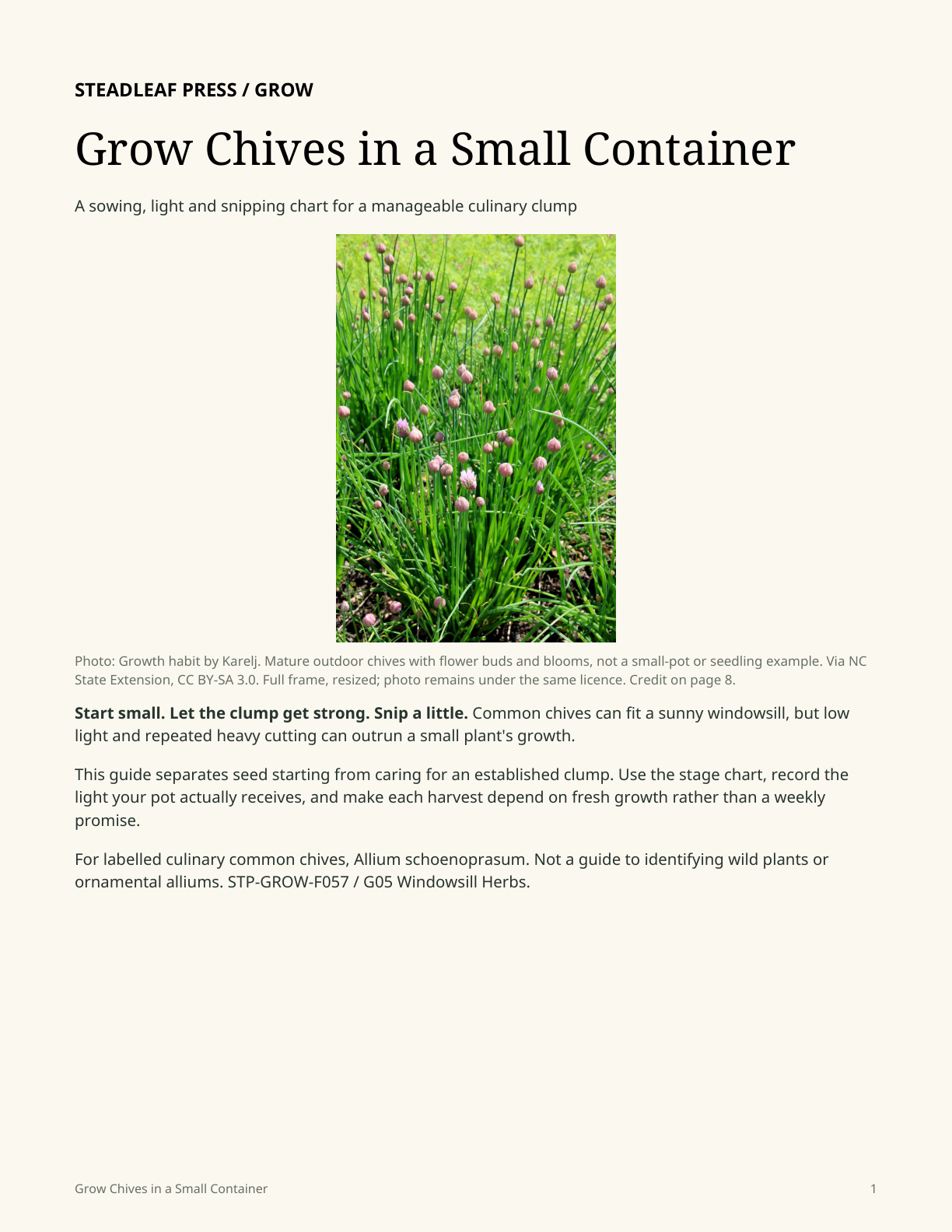
Photo: Growth habit by Karelj. Mature outdoor chives with flower buds and blooms, not a small-pot or seedling example. Via NC State Extension, CC BY-SA 3.0. Full frame, resized; photo remains under the same licence. Credit on page 8.
Start small. Let the clump get strong. Snip a little. Common chives can fit a sunny windowsill, but low light and repeated heavy cutting can outrun a small plant's growth.
This guide separates seed starting from caring for an established clump. Use the stage chart, record the light your pot actually receives, and make each harvest depend on fresh growth rather than a weekly promise.
For labelled culinary common chives, Allium schoenoprasum. Not a guide to identifying wild plants or ornamental alliums. STP-GROW-F057 / G05 Windowsill Herbs.
Grow Chives in a Small Container 1
STEADLEAF PRESS / GROW Sowing, light and snipping chart
Read across the row that matches your plant now. Moving to the next row depends on the plant, not a fixed number of days. Details and source notes follow.
Stage Sowing / growing action Light check Snipping decision
Before Choose labelled Observe the intended No harvest from an starting common-chive seed or a window at several times of unidentified plant. healthy rooted culinary day. clump. Provide drainage.
Sown, not Follow packet depth; keep Use a warm, bright place; Do not dig up seeds to check emerged seed mix lightly moist, not avoid overheating a covered or clip emerging shoots. saturated. Label and date. pot.
Young Let roots and leaves develop; Look for stronger new Wait: a few thin seedlings are seedlings move a rooted small group growth, not just long leaning not a harvestable clump. when it outgrows its starter. leaves.
Established, Maintain moisture with free A sunny position supports Take a few healthy leaves, actively drainage; check the mix growth; investigate weak, leaving most of the clump. growing before watering. sparse leaves.
After a Keep normal care; record Low winter light may slow or Wait for recovery; do not cut picking what remains and any new stop replacement growth. the entire pot repeatedly. leaves.
Three checks to repeat
Sowing: is the mix still suitable for the current stage? Light: is this spot supporting new leaves? Snipping: can the plant spare this picking and retain plenty of foliage?
A garden's cold-hardiness label does not guarantee that a tiny exposed pot will survive winter. This guide focuses on a protected small-container setup, not outdoor overwintering instructions.
Grow Chives in a Small Container 2
STEADLEAF PRESS / GROW Start with seed or a rooted clump
Choose the slower or quicker route deliberately
Seed is a patient route to a small group of plants. A healthy rooted clump gives you a head start, but still needs time to settle after planting. Do not confuse a transplant-ready age with a first-harvest date. Illinois: common chives.
1. Choose a starter with drainage. For seed, use a clean small pot or cell and fresh seed-starting mix. Illinois gives a container about 4 in (10 cm) deep as a general herb-seed starting option. Premoisten the mix so it is damp, not dripping. Illinois: starting herb seeds.
2. Read the packet first. Record its depth and expected emergence range. Utah State gives 1/4 in (about 6 mm) as a chive sowing depth; use your packet's cultivar-specific directions. Sow a small group rather than emptying the packet into one pot. Cover gently, water without washing the seed away, and label. Utah State: chives.
3. Keep the seed zone lightly moist. Check it regularly. If using a clear cover, keep it out of hot direct sun and remove it when shoots appear. Do not leave seedlings sealed in a wet, stagnant mini-greenhouse. Emergence varies; assess conditions against the packet before deciding that seed failed.
4. Grow on, then move up. Chives naturally form clumps; you do not need to reduce every small group to one lone plant. Once roots hold the mix together and the starter is crowded, transfer the group gently into a suitable growing pot without burying its base deeper.
A small starter is not the final growing pot
For an established clump, RHS recommends a container at least 20 cm (8 in) wide and deep. Use a draining container potting mix, not compacted garden soil. Keep the planting level the same as before. This is a growing-on target, not an instruction to put a few tiny seeds in a very large wet pot. RHS: chives in containers.
Grow Chives in a Small Container 3
STEADLEAF PRESS / GROW Give light and water separate checks
Measure the window, not its name
A window that looks bright to you may provide little direct sun. Record when sun actually reaches the leaves, accounting for buildings, trees, screens and the season. UMN describes 6-8 hours of direct light as best for chives; treat this as a useful light target, not proof that every south-facing window is sufficient. UMN: growing chives.
If new leaves are consistently weak and leaning, review light before expecting more harvest. A suitable grow light can help when a window is inadequate. Follow that fixture's distance and duration guidance; leave a daily dark period and keep electrical equipment away from water. Different lamps do not share one safe distance. Illinois: indoor kitchen gardens.
Moist, with somewhere for extra water to go
Check the surface and the mix just beneath it. For an established plant, water as the surface starts drying, before the root zone becomes thoroughly dry. Water gently through the mix and let excess escape; empty collected water from the saucer. Do not leave the pot standing in water. Seed-starting mix needs more even moisture at seed depth than a mature plant's surface.
Smaller pots may dry quickly, while cool, dim conditions can keep them wet longer. A fixed daily or weekly pour ignores that difference. Illinois emphasizes uniform moisture and drainage for potted chives. Illinois: indoor chive culture.
Do not feed poor light
Check whether the mix already contains fertilizer. During active growth, use a product suitable for edible container plants according to its label; avoid stacking feeds. Do not treat every yellow leaf as a nutrient shortage. UMN cautions against excess fertilizer and advises no winter feeding of indoor chives during their low-growth period.
Grow Chives in a Small Container 4
STEADLEAF PRESS / GROW Snip leaves, not the growing base
Make the first picking small
Wait for a well-rooted, healthy clump with several vigorous leaves, not just one long seedling. Wisconsin describes harvesting when leaves are about 6 in (15 cm) long. Length is a useful cue, not the only readiness test: leave most of the foliage to support the plant. Wisconsin: common chives.
Use washed hands, clean sharp scissors and a clean bowl. Select a few green leaves and snip them about 1-2 in (2.5-5 cm) above the soil, keeping blades clear of the rooted base and your fingers. Do not tug leaves or bulbs out. This range is Utah State's chive guidance, not a rule for other herbs. Utah State: chive harvest.
Leave the rest of the clump. Wait for healthy new leaves before taking more from a small plant. Whole-clump cutting is a different operation and can leave a gap of several weeks; it is not the default method here. Rinse harvested leaves under running water before use, without soap or bleach. Check any pesticide label's harvest restrictions. Maryland: clean herb harvests.
Respond to what changes
What you notice A useful next decision
New leaves slow in winter Reduce or stop picking; review light. Seasonal slowdown is not automatically plant death.
Mix stays soggy; leaves yellow or collapse Pause harvest. Check drainage and moisture before adding water or fertilizer; seek help if decline continues.
Pot fills with a crowded, weakening clump Plan division or a suitable larger pot during active growth; do not keep packing in more seed.
Flowers finish and seed heads form Remove spent flower stalks if you do not want self-sown seedlings. Use the leaf harvest method for leaves, not a basil-style pinch.
Common chives and garlic chives are different plants. Use reliable labels, not leaf shape or the cover photo alone, to establish culinary identity.
Grow Chives in a Small Container 5
STEADLEAF PRESS / GROW My small-container setup
Make a plan for the plant you have, not the biggest harvest you would like. A small sowing and a reachable, well-lit pot are easier to monitor than several neglected containers.
Decision to record My setup and next check
Starting material Common-chive cultivar; seed date or rooted-clump source
Starter and growing pot Drainage, mix, current root space and next pot
Seed instructions Packet depth and emergence range; date sown
Actual light Direct-sun times; lamp guidance if used
Harvest readiness Current leaves, recent stress and what I will leave
Decide before adding more
What would make this setup too difficult to keep watered, lit or inspected? Write one limit: one pot, one sowing group or one small picking at a time. My next action: SOW / GROW ON / IMPROVE CONDITIONS / SNIP LIGHTLY / WAIT.
Grow Chives in a Small Container 6
STEADLEAF PRESS / GROW Light, moisture and snipping log
Use observations rather than automatic watering or harvest dates. You may record several checks without watering or taking a single leaf.
Date and time Growth stage Light / mix check and action Leaves taken; retained growth and next decision
Look for a sustainable pattern
Are new leaves replacing what you take? Is the mix drying at a different rate as the season changes? If the plant becomes progressively thinner, pause harvest and address the conditions before sowing more into the same crowded pot. A useful success: one healthy, manageable clump with an occasional small picking. A constant weekly supply is not guaranteed, especially on a dim winter windowsill.
Grow Chives in a Small Container 7
STEADLEAF PRESS / GROW Sources and photo credit
Practical foundations
1. RHS: How to grow chives. Seed groups, established-clump container dimensions, planting level and spent flowers.
2. Utah State University: Chives in the garden. Chive sowing depth and 1-2 in harvest height. Garden fertilizer rates and field water quantities are not converted into pot recipes here.
3. University of Minnesota Extension: Growing chives. Light, drainage, winter slowdown and restraint with fertilizer.
4. Illinois Extension: Chives. Seed versus clump route; prepared potting mix, drainage and even moisture indoors.
5. Illinois Extension: Start herb seeds indoors. Clean seed-starting setup, premoistened mix and cover removal. Generic thinning and pinching rules are not applied to chive clumps.
6. Illinois Extension: Indoor kitchen gardens. Light intensity, duration, dark periods and condition-based care.
7. Wisconsin Horticulture: Chives. Selective leaf harvest, readiness cue and recovery after whole-clump cutting.
8. University of Maryland Extension: Harvesting herbs. Clean hands, tools and bowls; running-water rinsing. Real photograph; separate from the instructions
Karelj, Growth habit, Allium schoenoprasum, via NC State Extension Gardener Plant Toolbox, image 28070. Creative Commons Attribution-ShareAlike 3.0 Unported. Full frame, resized and JPEG encoded for print; the photograph and any image adaptation remain under CC BY-SA 3.0. No endorsement implied or additional restriction on the image.
The photo shows mature outdoor chives, including flower stems. It does not demonstrate pot size, seedling readiness or a cutting height. The guide's chart and worksheets are original Steadleaf Press work.
Sources checked 2 November 2026. Match packet directions and current growing conditions; no guaranteed germination, winter survival or harvest timetable.