Grow Mint Without Letting It Take Over
Container and propagation controls for a small space
Choose an inspectable above-ground draining pot, check rim/base/neighbors, respond to rooted escapes and control renewal, extra plants and viable debris.
FREE · No email or checkout
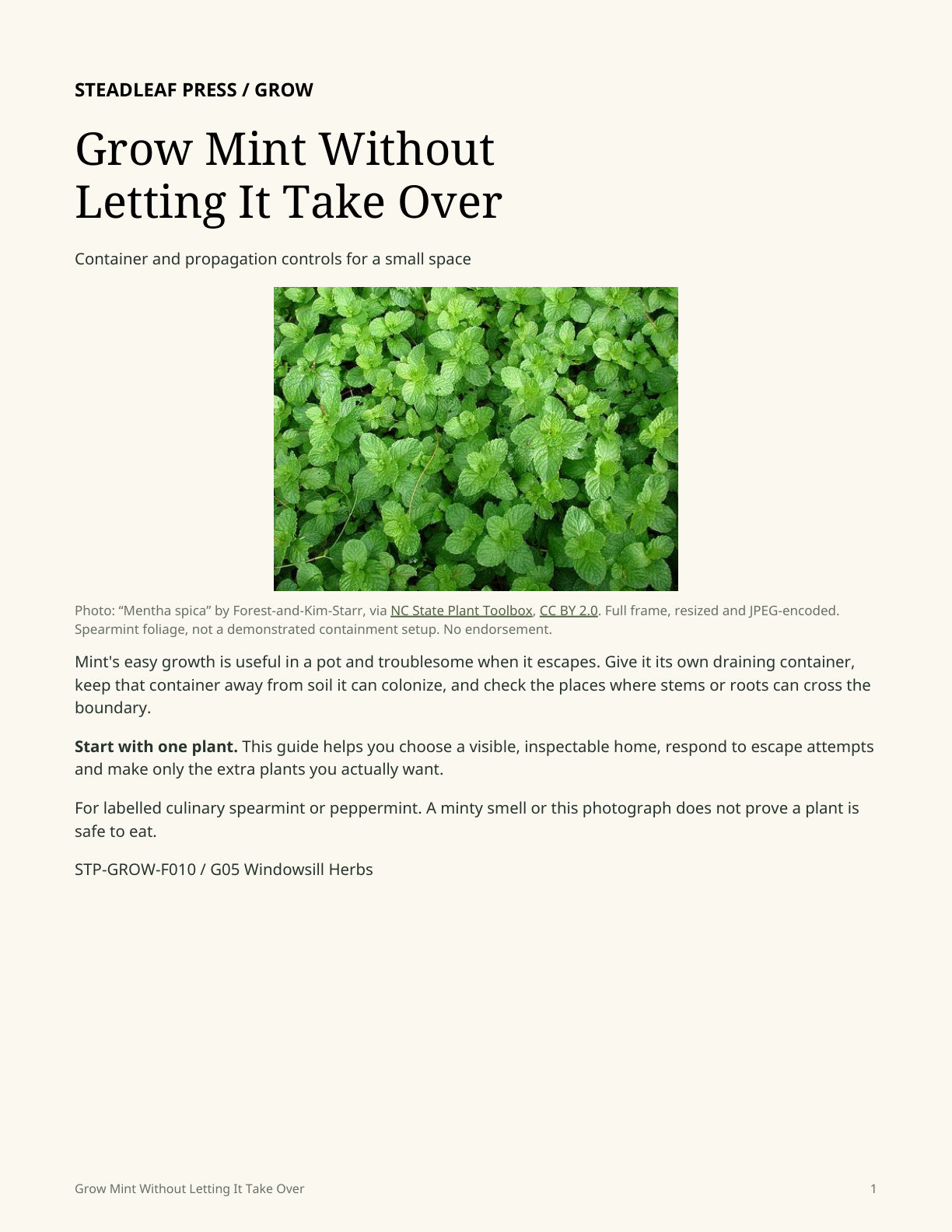
Free practical guide. No email or payment required. The photograph shows spearmint foliage, not a demonstrated containment barrier or identification guarantee; no endorsement.
Read the complete free guide online
Read the instructional text here, or download the complete free PDF above for original diagrams, tables, worksheets and page layout. The original publication is unchanged.
STEADLEAF PRESS / GROW Grow Mint Without Letting It Take Over
Container and propagation controls for a small space
Photo: “Mentha spica” by Forest-and-Kim-Starr, via NC State Plant Toolbox, CC BY 2.0. Full frame, resized and JPEG-encoded. Spearmint foliage, not a demonstrated containment setup. No endorsement.
Mint's easy growth is useful in a pot and troublesome when it escapes. Give it its own draining container, keep that container away from soil it can colonize, and check the places where stems or roots can cross the boundary.
Start with one plant. This guide helps you choose a visible, inspectable home, respond to escape attempts and make only the extra plants you actually want.
For labelled culinary spearmint or peppermint. A minty smell or this photograph does not prove a plant is safe to eat.
STP-GROW-F010 / G05 Windowsill Herbs
Grow Mint Without Letting It Take Over 1
STEADLEAF PRESS / GROW Know the escape routes
Mint does not spread only by seed. Underground stems called rhizomes extend into new space. Above-ground creeping stems can root where they touch moist soil. Small viable pieces left behind may grow again. [1, 2]
Route to watch Control you can see
Stems cross the pot rim Keep them from touching garden soil, mulch or another pot's mix. Trim crossing stems before they root.
Growth leaves a drainage hole Keep holes open, but place the pot over a clean, hard surface rather than bare soil. Inspect underneath.
Root pieces travel with old mix Collect repotting debris on a tray. Do not tip root-filled mix into a bed.
Cuttings become unplanned plants Set a limit and a destination before taking them. Collect scraps rather than dropping them outdoors.
Choose the easiest boundary to inspect
For a beginner, an above-ground pot on a suitable hard surface is easier to monitor than a buried pot. CSU Extension specifically warns that rhizomes can escape through drainage holes into soil beneath. Clay soil is not dependable containment. [3]
Some gardening guides describe buried or bottomless containers. Those approaches still need monitoring. This guide uses a visible, above-ground pot, not a promise that a buried barrier will stop every escape. [1, 3, 4]
Cutting flowers or harvesting leaves does not replace checking the rim, base and surrounding area.
Grow Mint Without Letting It Take Over 2
STEADLEAF PRESS / GROW Set up one healthy pot
Choose the plant and the container
Buy a correctly named culinary mint from a reputable supplier. Not every plant called “mint” is culinary; RHS identifies pennyroyal as harmful if eaten. Keep the original label. [1]
Give mint its own sturdy container with real drainage holes and container potting mix. Do not seal holes to stop escape. Choose a pot suited to the root ball and available space, with room to grow but not a huge volume of wet mix around a tiny plant. [5, 6]
Maryland suggests 12-16 inches (30-40 cm) diameter for containing garden mint. That is a useful established-plant example, not a requirement to put a small cutting straight into a large pot. A small sill may require a smaller plant and more frequent root-space checks. [4, 6]
Arrange the space so you can check it
Set the pot on a stable, clean hard surface or an intact catch tray, away from garden soil and neighboring containers. Empty collected water after drainage. Do not let a tray become a permanent bath. Keep the rim and base accessible; no pile of mulch or spilled mix should bridge the gap. [3, 7]
Mint likes moist, well-drained conditions and sun to partial shade outdoors. “Tolerates shade” does not mean a dark indoor corner is enough: choose strong window light or suitable supplemental light, and assess new growth. [2, 5, 6]
Check moisture regularly. Water when the mix is beginning to dry, then let excess drain. Do not deliberately starve or dry out mint to control its spread. If growth weakens, check light, drainage and root crowding before adding fertilizer. [5]
Grow Mint Without Letting It Take Over 3
STEADLEAF PRESS / GROW Inspect and respond
Build the check into watering and harvesting. During fast growth, look more often; inspect again after repotting, moving the pot or returning from a trip. This is an observation routine, not a fixed watering schedule.
What you find What to do next
A stem hangs over the rim but has not rooted Trim it with clean scissors, collect the piece and clear contact with nearby soil or pots.
Growth protrudes from a drainage hole Lift the pot safely onto a clean tray. Remove escaped growth carefully and check whether it has rooted underneath. Keep drainage open.
A shoot is rooted outside the pot Remove the new shoot with as much connected rhizome and root as practical, without damaging neighboring plants. Recheck for regrowth.
Dense roots, rapid drying or tired growth Consider renewing the root ball rather than endlessly buying a bigger pot. Check care conditions first.
Already escaped? Contain the source pot, mark the affected area and remove new shoots promptly. RHS notes that mint can return from small pieces, so one pull is not proof of eradication. An established patch may need repeated work and local advice. Do not cultivate or scatter pieces through the bed. [1]
Possible disease? Rust-like spots, unusual leaf damage or decline need diagnosis. Keep suspect plants apart and do not propagate or share them. No herbicide or home pesticide recipe is included here. [5]
Grow Mint Without Letting It Take Over 4
STEADLEAF PRESS / GROW Make new plants deliberately
Decide the limit before you divide
Cuttings and divisions preserve a known plant's characteristics more reliably than seed from mixed mints. Seeds can produce variable plants. Start with healthy, correctly labelled material, not an unidentified garden escape. [8]
Choose one: keep one pot only; replace an old pot with one healthy division; or make one extra pot for an identified recipient. Write the destination first. “It rooted” is not a reason to keep every piece.
A controlled renewal
When a healthy established clump becomes crowded, work over a tray. Ease out the root ball, separate a manageable healthy section with roots and shoots, and replant it in fresh potting mix in a clean draining pot. Remove dead central material. Use clean tools, protect your hands from the cutting path, and do not force a blade through a hard root ball. [1]
Water the replanted section, allow drainage and give it suitable light. Let healthy growth resume before a substantial harvest. Keep the same rim-and-base checks: division reduces crowding, not mint's ability to spread.
Mint stems can also root in water or moist potting medium. If you choose cuttings, prepare only the number of receiving pots you can manage; keep them labelled and contained. This is a propagation-control plan, not a full cutting-method tutorial. [5]
Close the debris loop
Collect live stems, rhizomes, roots and root-filled mix. As a containment precaution, keep viable scraps out of beds and a casual cool compost pile where they might regrow. Follow local accepted plant-waste disposal guidance; do not dump material in parks, drains or waterways. Do not share diseased material. [1, 2]
Grow Mint Without Letting It Take Over 5
STEADLEAF PRESS / GROW Your containment plan
Mint name ____________________ Pot location ____________________ Choose a setup you can maintain, not simply the biggest pot you can fit.
Decision to record My setup or action
Plant identity and source Keep the culinary label
Pot and drainage Root space; holes stay open
Boundary around the pot Hard base; no stem or soil bridges
Propagation limit How many pots; named destination
Debris and renewal plan Collection tray; accepted disposal
A small harvest: use clean hands and scissors on a healthy, established culinary plant with known treatment history. Leave enough foliage for regrowth. Rinse picked herbs under running water, without soap. Harvesting keeps growth compact but is not containment by itself. [4, 9]
Grow Mint Without Letting It Take Over 6
STEADLEAF PRESS / GROW Rim base and regrowth log
Pot ____________________ Planned maximum number of pots __________ Check all three places: over the rim, under the base and outside the pot. Record actions, not just the date.
Date and time Rim / neighbors Base / nearby soil Action / recheck
Example, not a schedule: “Stem touching another pot; trimmed and collected it; checked that pot for rooting; moved pots farther apart.” Next check or renewal decision: ____________________________________________________________________ ____________________________________________________________________ Mint may slow or die back seasonally. A quiet winter pot is not proof that rhizomes are gone. Protect container plants appropriately for your climate rather than assuming garden hardiness guarantees pot survival. [1, 7]
Grow Mint Without Letting It Take Over 7
STEADLEAF PRESS / GROW Sources & photograph
Checked 2 November 2026. Above-ground containment, propagation limits and record sheets are an original practical synthesis. Inspection and debris precautions reduce escape risk; no pot is described as maintenance-free.
1. RHS: How to Grow Mint. Plant identity, division, seasonal growth and regrowth from fragments.
2. NC State Plant Toolbox: Mentha spicata. Rhizomes, stems rooting on contact, moist draining conditions and exact photograph.
3. CSU Extension via Ask Extension: Planting peppermint and/or spearmint. Drainage-hole escape, hard-surface placement and limits of soil barriers.
4. University of Maryland: Growing Mint in a Home Garden. Container-size example, runners and culinary mint care.
5. Iowa State University: Growing Mint in the Home Garden. Moisture, propagation, crowding and leaf-disease cautions.
6. Iowa State University: Growing Herbs Indoors. Light, individual pots, drainage and avoiding overpotting.
7. RHS: Herbs in containers. Moist but not soggy mix, renewal and seasonal container protection.
8. Utah State University: How to Grow Mint in Your Garden. Known-source plants, variable seedlings and vegetative propagation. Field rates and medicinal-use suggestions are not adopted.
9. University of Maryland: Harvesting and Preserving Herbs. Clean harvesting and running-water rinsing.
Photo: “Mentha spica,” Forest-and-Kim-Starr, NC State image 5049, CC BY 2.0. Commercial reuse allowed with attribution. Full-frame resizing and JPEG encoding only; no AI or compositing. Dense spearmint foliage illustrates the plant, not a tested container barrier or identification guarantee. No endorsement.