Grow Parsley With Realistic Germination Expectations
A patient sowing plan and seedling timeline for one manageable pot
Use a realistic emergence window, choose seeds or a young plant, record conditions and separate seedling progress from harvest readiness.
FREE · No email or checkout
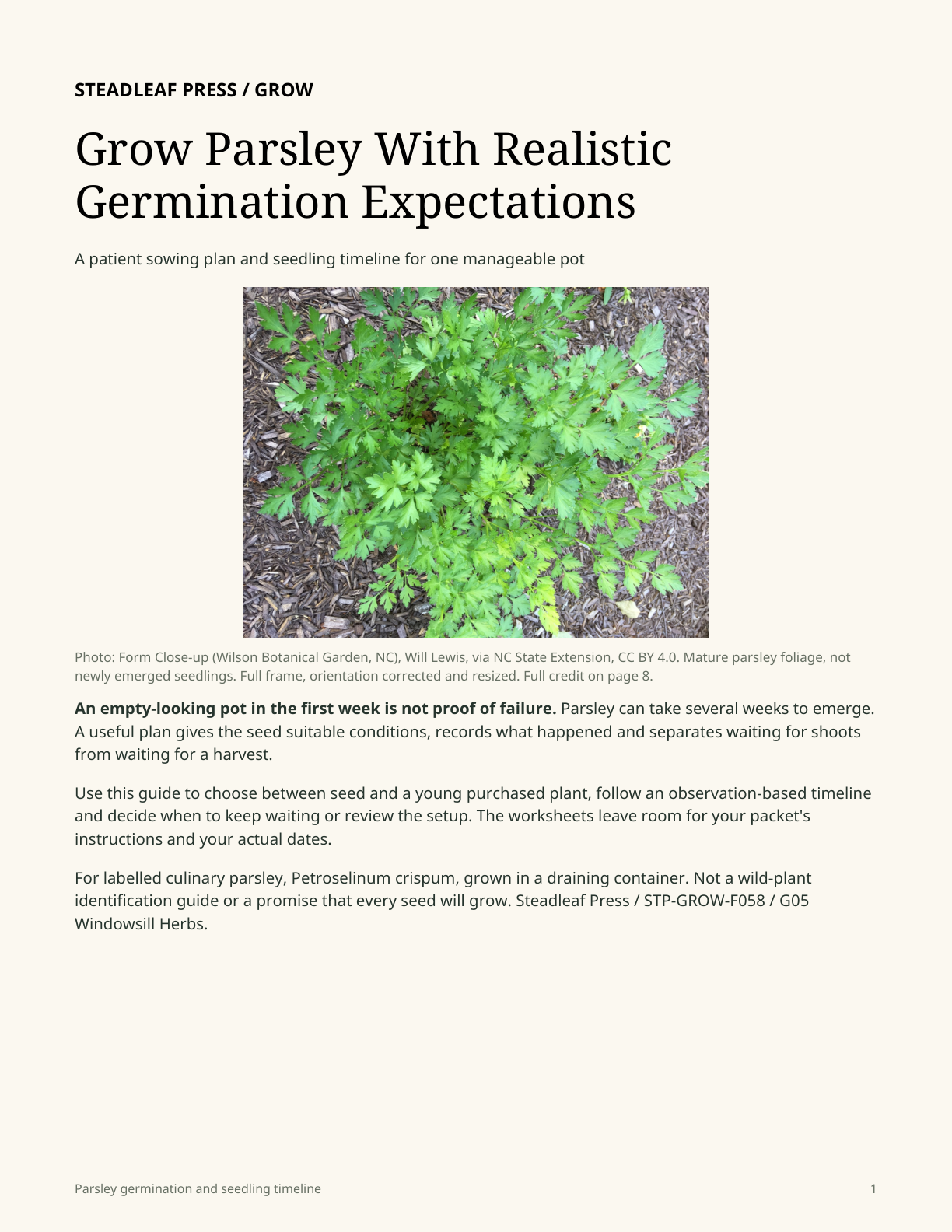
Free practical guide. No email or payment required. The photograph shows established parsley foliage, not newly emerged seedlings or a measured germination timeline; no endorsement.
Read the complete free guide online
Read the instructional text here, or download the complete free PDF above for original diagrams, tables, worksheets and page layout. The original publication is unchanged.
STEADLEAF PRESS / GROW Grow Parsley With Realistic Germination Expectations
A patient sowing plan and seedling timeline for one manageable pot
Photo: Form Close-up (Wilson Botanical Garden, NC), Will Lewis, via NC State Extension, CC BY 4.0. Mature parsley foliage, not newly emerged seedlings. Full frame, orientation corrected and resized. Full credit on page 8.
An empty-looking pot in the first week is not proof of failure. Parsley can take several weeks to emerge. A useful plan gives the seed suitable conditions, records what happened and separates waiting for shoots from waiting for a harvest.
Use this guide to choose between seed and a young purchased plant, follow an observation-based timeline and decide when to keep waiting or review the setup. The worksheets leave room for your packet's instructions and your actual dates.
For labelled culinary parsley, Petroselinum crispum, grown in a draining container. Not a wild-plant identification guide or a promise that every seed will grow. Steadleaf Press / STP-GROW-F058 / G05 Windowsill Herbs.
Parsley germination and seedling timeline 1
STEADLEAF PRESS / GROW A timeline with room for variation
Start the clock on your recorded sowing date. The windows below are planning aids, not deadlines that make a plant ready. Your seed packet and growing conditions matter.
Stage What the calendar can tell you What to look for and do
Sowing day Record the date, seed packet and its Prepare a draining pot, follow packet depth and emergence range. moisten gently. Label the pot.
First week No shoots yet can still be normal. Keep the seed zone moist without making it soggy. Do not repeatedly disturb the sowing to look for roots.
Following weeks UMN describes 2-5 weeks to Watch for narrow paired seed leaves. Record the first germination, influenced by seed emergence; do not assume every seed will emerge freshness. together.
After emergence A shoot is the beginning, not a Give adequate light and space. Watch for true leaves, harvest date. healthy growth and roots establishing in the mix.
Growing on A transplanting estimate does not Move or thin carefully when needed; harvest only predict picking day. after a plant is strong enough to retain substantial foliage.
University of Minnesota: growing parsley.
What if the packet gives another range
Write that range in your record. Published guidance varies: Iowa State lists about 20-25 days to emergence under its stated conditions, while UMN gives a broader 2-5-week window. These are compatible reasons to allow time, not a guarantee for your packet or room. Iowa State: germination requirements.
If the expected window passes, review conditions before adding more water or seed. A date alone cannot tell you whether buried seed is viable.
Parsley germination and seedling timeline 2
STEADLEAF PRESS / GROW Choose seed or a young plant
Seed gives you the whole process
Use seed when you can keep checking a labelled sowing for several weeks. Buy a packet intended for culinary parsley and note its packed-for date or other freshness information. Older seed can be less dependable; buying seed does not guarantee that every one will germinate.
Sowing directly into the growing container avoids lifting individual roots later. Choose drainage holes and a suitable container growing mix. Do not bury a small sowing in a large volume of constantly wet mix. If using starter cells instead, plan to transfer young plants with their root balls intact. Parsley's taproot benefits from careful handling. NC State: parsley profile.
A purchased plant skips the seed wait
A healthy young, labelled plant is a useful choice if you need to begin with visible growth. Look for sound leaves and an intact root ball rather than a crowded pot promising an instant large harvest. It still needs appropriate light, drainage and time to settle after moving.
Keep it at its former planting level. Water the mix gently and let excess drain. Avoid pulling apart roots simply to make several pots. Seed-starting and transplanting are different decisions; neither route removes the need to observe the plant before picking.
Make one choice you can maintain
Choose seed when Choose a young plant when
You want to observe emergence and can maintain You prefer to start with leaves already present. steady moisture.
You have a packet and a place suitable for a monitored You can obtain a correctly labelled, healthy culinary sowing. plant.
You can accept a variable wait and possible uneven You accept that settling in and reaching harvest size emergence. still take time.
Growing from seed is not a test you must pass before you may grow parsley. Choose the route that fits your time and space.
Parsley germination and seedling timeline 3
STEADLEAF PRESS / GROW Give the sowing a fair start
Record the instructions before watering
Read the packet for depth, temperature and expected emergence. UMN gives about 1/8 in (3 mm) of cover for parsley seed. Treat that as an attributed example, with your packet's directions first, rather than using a deep finger hole. Mark the position and date so later watering does not become guesswork.
Use a clean draining container and appropriate seed-starting or container mix. Moisten the mix evenly before sowing, then water gently enough not to wash the seed into a heap. Let excess escape. Consistently moist does not mean a pot standing in water.
Temperature is a condition to record
Iowa State lists 70-75 F (about 21-24 C) air temperature for its parsley germination guidance and indicates darkness during germination. This is a planning reference, not an instruction to heat wet mix without control or to put emerged seedlings in a dark cupboard. The thin covering and your packet directions guide the sowing; light is needed once seedlings emerge.
Keep a covered seed container out of hot direct sun. If using a transparent cover to reduce drying, remove it as seedlings emerge. Follow equipment instructions if using a propagation mat; do not place electrical connections where watering can reach them. Illinois: starting herb seeds indoors.
Wait with observations rather than extra treatments
Check the seed zone gently and keep a short record. Avoid repeatedly digging up seeds, soaking the pot because it looks empty or applying unlabelled germination treatments. These are practical precautions to reduce disturbance, not evidence that a particular seed is alive.
If emergence is substantially later than the packet's range, review seed age, sowing depth, temperature and any drying or saturation. Seek advice from the seed supplier when needed. A small separately labelled resowing can be easier to evaluate than mixing new seed into the original pot.
Parsley germination and seedling timeline 4
STEADLEAF PRESS / GROW Move from shoots to a useful plant
Learn what the first leaves mean
UMN describes parsley's first seed leaves as two narrow leaves opposite one another, rather like grass. Later true leaves become more recognizable. Do not use these descriptions or a photograph to identify unknown seedlings for eating; keep the original culinary-plant label.
UMN suggests thinning or transplanting when seedlings are about 2-3 in (5-8 cm) tall. Also consider crowding, root development and the packet's spacing. Lift a root ball carefully if moving a plant, avoiding unnecessary taproot disturbance. This size cue is not a first-harvest instruction.
Check light and water as the plant grows
UMN recommends about 6-8 hours of direct sun, while noting some tolerance of light shade. Observe how much light reaches your actual window or growing space. A bright-looking room alone does not assure strong growth. If using a grow light, follow its distance and duration instructions and provide a daily dark period.
Check the mix before watering. Keep it moist but not soggy, let water drain and empty the catch tray. A small pot, a larger pot and a cool room do not dry at the same rate. Do not copy a garden's weekly water allowance into an indoor container. UMN: watering container plants.
Harvest follows strength rather than a date
Wait until the plant is large and vigorous enough to lose a few outer stalks while keeping plenty of leaves and its developing centre. Cut selected outer stalks near their base with clean scissors; avoid taking only all the tips or stripping the whole plant. Illinois: parsley.
Use clean hands and tools, obey any pesticide label's harvest restrictions and rinse harvested leaves under running water, not soap. Parsley is biennial and commonly grown as an annual; flowering in its later life is not a promise of endless leaf regrowth. FDA: safe produce handling.
Parsley germination and seedling timeline 5
STEADLEAF PRESS / GROW My parsley sowing plan
Complete the first three rows before you sow. If you choose a young plant, record its source and arrival date instead of inventing a sowing date.
Decision My record
Starting material Label, variety, packet freshness or young-plant source
Sowing or arrival date Container, drainage and mix
Packet instructions Depth, temperature and expected emergence range
Growing position Observed direct light or lamp instructions
Review point When I will compare observations with the packet
Make the plan realistic
What will you do if you are away while the sowing needs attention? Choose one manageable pot or arrange suitable care before starting several batches. My route: SEED / YOUNG PLANT. My next decision: PREPARE / SOW / KEEP OBSERVING / REVIEW CONDITIONS / GROW ON.
Parsley germination and seedling timeline 6
STEADLEAF PRESS / GROW Record emergence without rushing it
Record what you can see and what you did. An entry saying no shoots yet is useful when it is paired with the sowing date and conditions.
Date and days since Moisture and temperature Shoots or true leaves Action and next check sowing observations seen
Keep the milestones separate
First emergence: when the first shoot appears. Growing on: when roots and leaves can support the next stage. Harvest readiness: when a strong plant can spare a small picking. These are three different observations. If you resow, use a new label and date. That makes the next result easier to interpret without erasing what you learned from the first batch.
Parsley germination and seedling timeline 7
STEADLEAF PRESS / GROW Sources and photo credit
Practical foundations
1. University of Minnesota Extension: Growing parsley. Variable 2-5-week emergence, seed freshness, shallow covering, early leaves, growing-on cue, light and life cycle.
2. Iowa State University Extension: Germination requirements. Parsley air-temperature guidance and approximate emergence window. Outdoor planting estimates are not harvest dates.
3. NC State Extension Gardener Plant Toolbox: Petroselinum crispum. Seed versus seedling route and careful handling of the taproot.
4. Illinois Extension: Start herb seeds indoors. Clean setup, moisture and cover removal; generic herb pinching is not applied to parsley.
5. Illinois Extension: Parsley. Growing and harvesting a sufficiently developed culinary plant.
6. UMN Extension: Fertilizing and watering container plants. Moist rather than soggy mix and drained catch trays. Outdoor watering frequency is not an indoor timetable.
7. FDA: Selecting and serving produce safely. Running-water rinsing and clean handling, not soap or produce wash. Real photograph
Form Close-up (Wilson Botanical Garden, NC), Will Lewis, Petroselinum crispum, via NC State Extension Gardener Plant Toolbox, image 24709. Creative Commons Attribution 4.0 International. Full frame, orientation corrected, resized and JPEG encoded; no endorsement implied. The image remains available under its original licence.
The photo shows established garden foliage, not emerging seed leaves or a measured timeline. The stage chart and worksheets are original Steadleaf Press work.
Sources checked 3 November 2026. Follow your packet and current conditions; no guaranteed emergence date, harvest date or perpetual regrowth.