Grow Thyme in a Fast-Draining Pot
A light and watering care card for a small culinary plant
Separate light from watering decisions and use a care card, drainage checks and observation log for one culinary thyme plant.
FREE · No email or checkout
Free practical guide. No email or payment required. Exact real photograph credited under CC BY2.0; no endorsement. Follow culinary plant labels and local growing conditions.
Read the complete free guide online
Read the instructional text here, or download the complete free PDF above for original diagrams, tables, worksheets and page layout. The original publication is unchanged.
STEADLEAF PRESS / GROW Grow Thyme in a Fast-Draining Pot
A light and watering care card for a small culinary plant
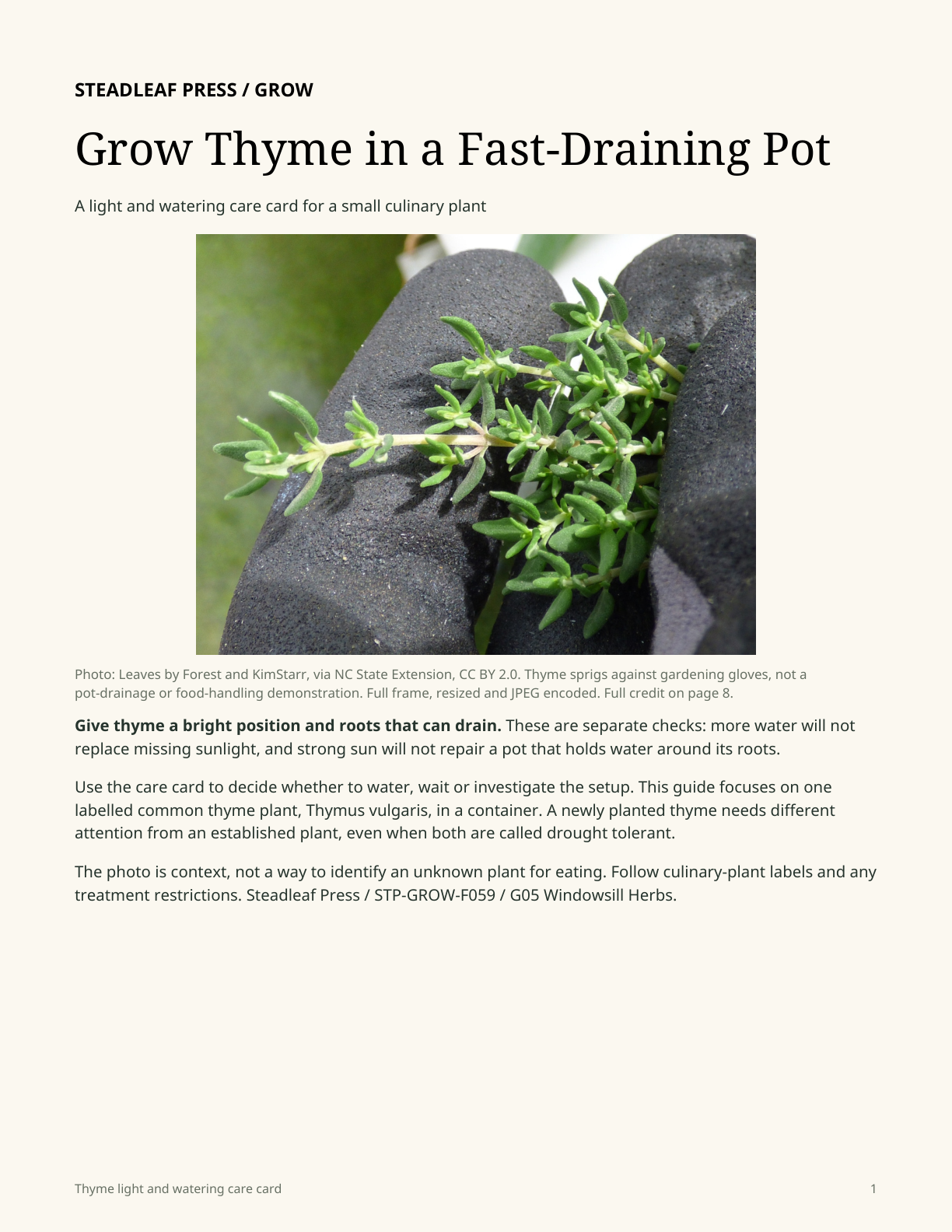
Photo: Leaves by Forest and KimStarr, via NC State Extension, CC BY 2.0. Thyme sprigs against gardening gloves, not a pot-drainage or food-handling demonstration. Full frame, resized and JPEG encoded. Full credit on page 8.
Give thyme a bright position and roots that can drain. These are separate checks: more water will not replace missing sunlight, and strong sun will not repair a pot that holds water around its roots.
Use the care card to decide whether to water, wait or investigate the setup. This guide focuses on one labelled common thyme plant, Thymus vulgaris, in a container. A newly planted thyme needs different attention from an established plant, even when both are called drought tolerant.
The photo is context, not a way to identify an unknown plant for eating. Follow culinary-plant labels and any treatment restrictions. Steadleaf Press / STP-GROW-F059 / G05 Windowsill Herbs.
Thyme light and watering care card 1
STEADLEAF PRESS / GROW The light and watering care card
Use both columns before deciding. Feel the growing mix gently below the surface where practical, notice the pot's weight and look at the whole plant. A dry surface alone can hide wetter mix beneath it.
Situation Light check Watering decision
Newly planted or Give an appropriate bright position; Check frequently and keep the developing root young make outdoor changes gradually. ball from drying out. Do not leave it soggy.
Established and Look for actual direct light reaching Water when the mix is drying and the pot is growing the plant, not just a bright room. lighter; first confirm that it is not still wet below.
Cool or low-light Reassess the available light and Expect slower drying. Check before watering period slow growth. instead of keeping a summer schedule.
Hot or windy exposure Notice stronger sun, heat and wind Small pots can dry faster. Inspect more often together. without automatically watering every time.
Wilt or yellowing with Do not assume the plant simply Pause added water, check outlets and empty wet mix needs a bigger drink. trapped water. Persistent decline needs further assessment.
Three rules for the next decision
Water: when the root zone needs it, then let excess leave. Wait: when the mix is still adequately moist. Investigate: when symptoms and moisture do not match your assumption.
Drought tolerance helps established thyme cope with dry conditions. It is not a reason to leave a container's entire root ball repeatedly bone dry. This card combines thyme-specific guidance with general container principles. Illinois: thyme and NC State: container plants.
Thyme light and watering care card 2
STEADLEAF PRESS / GROW Start with a draining container
Make the outlet visible
Choose a pot with drainage holes and a size suited to the current root ball. RHS gives at least 15 cm (6 in) across and 10 cm (4 in) deep as a starting container for a thyme plant. This is a starting reference, not a lifetime size or a reason to put tiny seedlings in a large wet pot. RHS: growing thyme.
If a nursery pot sits inside a decorative outer pot, lift it out to inspect and drain it. Water collected where you cannot see it still surrounds the roots. Keep the pot stable and protect the surface below without blocking its outlets.
Improve the mix rather than hide it
Use a prepared, free-draining container mix appropriate for herbs. RHS describes adding horticultural grit throughout a soil-based potting compost; the important distinction here is that an amendment is mixed into the medium, not piled under it as a supposed drainage layer.
Do not add a bed of gravel beneath ordinary potting mix to fix poor drainage. NC State explains that layers of different texture do not provide the expected drainage benefit. Clear holes and a suitable growing medium matter more than an invisible layer of stones. Do not use contaminated roadside sand or assume garden soil will behave well in a small pot.
Settle the plant without burying its base
Keep the plant at its former planting level and avoid damaging the root ball. Water gently after planting and let surplus escape. Then observe how this particular pot dries. A transplant that has not established roots is not ready for the same dry intervals as a settled plant.
If starting from seed, follow the packet and maintain suitable seed moisture. Thyme can germinate unevenly, and a seed-raised plant may take much longer to reach harvest size than a purchased rooted plant. NC State: common thyme.
Thyme light and watering care card 3
STEADLEAF PRESS / GROW Check light without guessing at water
Record sun that reaches the leaves
NC State lists common thyme as a full-sun plant and defines that exposure as at least six hours of direct light each day. Use this as a target to assess your location, not proof that a south-facing window is always enough. Buildings, foliage, screens and seasonal changes can shorten the usable light.
Write down when direct sun begins and ends at the plant. Look for the pattern of new growth over time. A plant leaning toward the glass or producing weak, stretched shoots may need a better position, but those signs alone are not a complete diagnosis.
A suitable grow light can help when the available window is inadequate. Follow the lamp's instructions for distance and duration and allow a daily dark period. Keep electrical connections away from watering. Do not use a universal lamp distance taken from a different fixture.
Light changes can also change drying
Moving a plant into a warmer or sunnier place may make its pot dry more quickly. Moving it into a cool room may do the opposite. Recheck the mix after a change rather than carrying the old watering timetable with it.
Introduce indoor-raised plants gradually to outdoor sun and wind. Stronger exposure should not be confused with an instruction to dry a young root ball. RHS recommends hardening off young plants before outdoor planting.
Do not fertilize a light problem
Review the plant's position and the condition of its mix before adding feed to weak growth. Check whether the mix already contains fertilizer. Use any fertilizer only according to its edible-container-plant label; adding extra does not create sunlight or unblock drainage.
Illinois: thyme indoors supports a sunny position, good drainage and watering as needed, with the medium kept relatively dry. Relative dryness is a care comparison, not a requirement to desiccate roots.
Thyme light and watering care card 4
STEADLEAF PRESS / GROW Water through and harvest lightly
Water the mix when it needs water
When the root zone is drying enough to need water, apply it slowly to the mix so the root ball is wetted and surplus begins to drain. Empty the saucer or outer pot afterward. A small daily splash can leave part of the root ball dry while making the surface look watered.
If water immediately runs around a very dry root ball, or the pot stays wet much longer than expected, review the mix, root space and drainage. Do not keep adding water merely to satisfy a calendar. General container guidance warns against complete drying because fine roots can be damaged.
Respond to stress before taking leaves
A wilted plant with wet mix needs investigation, not an automatic extra drink. Check blocked outlets and trapped water, pause harvest and seek suitable horticultural advice if decline continues. Do not diagnose root rot from a leaf symptom alone.
For a healthy established plant, take only a few leafy tips using clean scissors. Leave plenty of green growth and avoid cutting into bare old wood. A large garden-plant cutting allowance is not a safe default for a tiny pot. RHS cautions that old woody growth may not reshoot after hard cutting.
Use washed hands and clean tools. Follow any pesticide label's harvest restrictions and rinse picked sprigs under running water, not soap. Gardening gloves shown in a photograph are not a substitute for clean food handling. FDA: safe produce handling.
Plan for the season you actually have
Reduce picking when replacement growth slows. Winter wet is a risk for thyme, and container roots do not have the same insulation as roots in the ground. A perennial or hardiness label does not guarantee that a small exposed pot will survive your winter. Choose locally appropriate protection rather than relying on this guide as an overwintering prescription. Illinois: perennial patio containers.
Thyme light and watering care card 5
STEADLEAF PRESS / GROW My thyme care card
Fill in this card for one plant. Keep observations specific enough that you can repeat them after the weather, window position or pot changes.
Check My setup and observation
Plant and stage Culinary label; seedling, new transplant or established plant
Container and drainage Pot size, visible outlets and where surplus water goes
Growing mix Mix label, existing feed and root-ball condition
Actual light Direct-sun times or grow-light instructions
Next watering decision Mix below surface, pot weight and planned recheck
One practical improvement
Choose one change you can evaluate: empty hidden water, improve the light position, check the mix more carefully or pause picking while the plant settles. Record the result before changing everything at once. Today I will: WATER AND DRAIN / WAIT AND RECHECK / IMPROVE THE SETUP / SEEK ADVICE.
Thyme light and watering care card 6
STEADLEAF PRESS / GROW Track drying and growth together
Use a row whenever you check, even if no watering is needed. The aim is to learn this container's pattern rather than fill every row with a watering event.
Date and Mix and pot-weight check Water or other action New growth and next conditions decision
Compare like with like
A hot windy day and a cool indoor day do not tell the same story. Note a move, prolonged rain, a repot or a recent harvest so that the next observation has context. A useful result: a healthy manageable thyme plant that drains, receives suitable light and can spare occasional leafy tips. Constant harvesting and identical watering intervals are not the goal.
Thyme light and watering care card 7
STEADLEAF PRESS / GROW Sources and photo credit
Practical foundations
1. NC State Extension Gardener Plant Toolbox: Thymus vulgaris. Common culinary thyme, light, drainage and uneven seed germination. Fixed garden-plant harvest lengths are not applied to small pots.
2. RHS: How to grow thyme. Container starting size, free-draining mix, young-plant care, leafy trimming and winter-wet caution. UK seasonal guidance is not a universal winter guarantee.
3. NC State Extension Gardener Handbook: Plants grown in containers. Moisture checks, drainage, emptying catch trays, root drying and why gravel layers do not fix drainage. No universal daily watering rule is imported.
4. Illinois Extension: Thyme. Indoor light, drainage and watering as needed. This guide uses conservative leafy-tip harvest rather than severe rejuvenation pruning.
5. Illinois Extension: Overwintering perennial patio containers. Container-root exposure differs from plants in the ground.
6. FDA: Selecting and serving produce safely. Clean handling and running-water rinsing; washing is not sterilization. Real photograph
Leaves, Forest and KimStarr, Thymus vulgaris, via NC State Extension Gardener Plant Toolbox, image 21232. Creative Commons Attribution 2.0 Generic (CC BY 2.0). Changes made: full-frame resizing and JPEG encoding. No endorsement implied; no additional restriction on reuse of the photograph.
The photo shows sprigs held against gardening gloves. It does not demonstrate pot drainage, a cut position or ready-to-eat handling. The care card and records are original Steadleaf Press work.
Sources checked 3 November 2026. Follow plant and product labels and local conditions; no guaranteed winter survival or harvest schedule.