Harden Off Seedlings Before Outdoor Planting
Gradual Exposure Schedule
Plan crop-safe exposure, use a flexible staged schedule, record actual conditions and plant response, and decide when to advance, repeat, retreat or plant.
FREE · No email or checkout
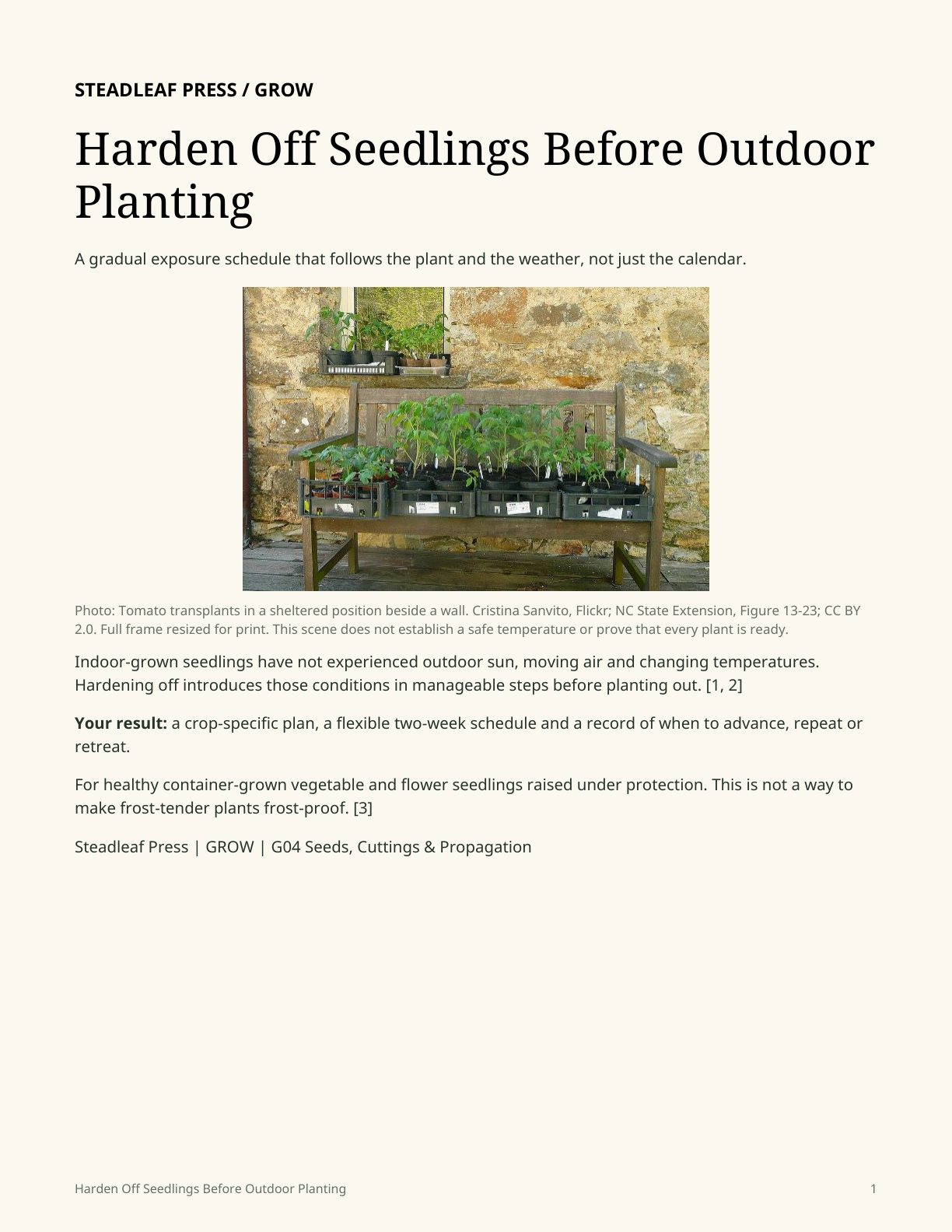
Free practical guide. No email or payment required. The photograph shows tomato transplants in a sheltered wall-side location; not evidence of safe weather or completed hardening, and not an endorsement.
Read the complete free guide online
Read the instructional text here, or download the complete free PDF above for original diagrams, tables, worksheets and page layout. The original publication is unchanged.
STEADLEAF PRESS / GROW Harden Off Seedlings Before Outdoor Planting
A gradual exposure schedule that follows the plant and the weather, not just the calendar.
Photo: Tomato transplants in a sheltered position beside a wall. Cristina Sanvito, Flickr; NC State Extension, Figure 13-23; CC BY 2.0. Full frame resized for print. This scene does not establish a safe temperature or prove that every plant is ready.
Indoor-grown seedlings have not experienced outdoor sun, moving air and changing temperatures. Hardening off introduces those conditions in manageable steps before planting out. [1, 2]
Your result: a crop-specific plan, a flexible two-week schedule and a record of when to advance, repeat or retreat.
For healthy container-grown vegetable and flower seedlings raised under protection. This is not a way to make frost-tender plants frost-proof. [3]
Steadleaf Press | GROW | G04 Seeds, Cuttings & Propagation
Harden Off Seedlings Before Outdoor Planting 1
STEADLEAF PRESS / GROW Make a safe starting plan
Check the crop before choosing dates
Read the packet or a reliable local growing guide for the crop's planting season, light needs and temperature limits. Separate warm-season crops from cool-season crops if their safe conditions differ. An average last-frost date is a planning clue, not a forecast. [2, 4]
Start with actively growing, healthy seedlings. Hardening off is not a cure for disease, severe wilting or damaged stems. If recently potted on, allow plants to settle before adding outdoor stress. [2, 3]
Checkpoint Write your plan
Crop / cultivar and intended outdoor light __________________________
Planting guidance and local source __________________________
Safe daytime and overnight conditions for __________________________ this crop
Sheltered starting spot / return spot __________________________
Choose shade protected from strong wind, with a stable place for trays. Keep a suitable indoor return space available. Do not assume an unheated shed or greenhouse will stay warm enough. [1, 5]
Prepare: labelled plants, a tray you can carry safely, water, a forecast and a reminder to bring plants back. Check the actual conditions where the trays will sit. [5]
Harden Off Seedlings Before Outdoor Planting 2
STEADLEAF PRESS / GROW A flexible exposure schedule
This is a planning example, not a required hourly prescription. Allow about one to two weeks; tender plants or difficult weather may need longer. RHS guidance allows two to three weeks. Advance only while plants remain healthy and the weather suits the crop. [1-5]
Stage / example days Exposure to try Before advancing
Start / days 1-2 About 1 hour in sheltered shade on Leaves stay firm; pots have not a mild day. Bring back inside dried out. afterwards.
Extend / days 3-4 Repeat the safe exposure, then add No fresh scorch or persistent wilt. time gradually. Introduce a short spell of gentle morning sun if appropriate.
Build / days 5-7 Longer daytime sessions; increase Plants cope with the previous step light toward this crop's final site, and forecast stays suitable. with shelter from strong wind.
Practise / days 8-10 Work toward a full day in suitable Full daytime exposure causes no outdoor conditions. Keep checking continuing stress. moisture.
Finish / days 11-14 or later Continue full days. Try an overnight Weather, plant condition and stay only after daytime adjustment planting-site readiness all pass. and only within crop-safe conditions.
Do not force a shade-preferring flower into full sun. Do not increase sun, wind and time sharply together. A repeated stage is useful progress; a cold or stormy day may be an indoor day. [2, 3, 5]
Harden Off Seedlings Before Outdoor Planting 3
STEADLEAF PRESS / GROW Run each outing deliberately
Before carrying plants out
Check the forecast, wind and temperature at the sheltered spot. Check the mix and water if needed. Support containers in a tray rather than lifting plants by their stems. Set a return reminder. [1, 5]
While they are outside
Check early in a new exposure and again later. Sun and moving air can dry small pots quickly. Water according to the mix, not a fixed timer, and let excess water drain. Never use repeated wilting as a hardening technique. [2, 4, 5]
A cold frame can provide adjustable shelter, but it needs ventilation. A closed transparent cover can overheat in sunshine. Do not leave seedlings sealed in a propagator or assume a cover makes all weather safe. [1, 3, 6]
Before the return or overnight decision
Look for drooping, bleached or browned areas, and damaged growth. Note the conditions and any change from the start of the outing. Return plants to suitable protected conditions before temperatures become unsuitable. [1-4]
Avoid a universal temperature rule. Maryland cautions against putting tender seedlings outside below 45°F (about 7°C), yet specifically advises that cucumbers and melons should not stay out overnight below 50°F (10°C). These are cautions, not safe targets for every crop. Use crop-specific advice and the forecast. [4]
Harden Off Seedlings Before Outdoor Planting 4
STEADLEAF PRESS / GROW Change the plan when needed
What you notice What to do now Next decision
Strong wind, storm, frost Move to suitable protection; skip Resume a tolerated stage when conditions risk or a crop-unsafe the outing if necessary. improve. temperature
Leaves wilt and mix is dry Move out of harsh exposure; water Reassess after recovery, not by the clock. the root zone and let it drain.
Leaves wilt but mix is Reduce exposure; do not Pause if wilting persists; seek local plant already wet automatically add more water. advice. Check drainage and plant condition.
New pale, bleached or Reduce sun exposure and examine Do not count damaged leaves as proof of brown patches after the damage. successful hardening. stronger sun
Seedlings cope with one Record time, light, wind and Make the next increase small rather than stage moisture. jumping to a full day.
Hardening off should not stop growth through severe stress. Cucumbers and melons are particularly vulnerable to over-hardening; prolonged stress can also disrupt cauliflower development. [4]
If illness, collapse or continuing decline appears, separate that concern from the exposure schedule. A photograph and notes can help a local extension or gardening adviser assess it. This chart is a response guide, not a diagnosis. [2, 3]
Harden Off Seedlings Before Outdoor Planting 5
STEADLEAF PRESS / GROW Keep an exposure record
Use one sheet per crop group. Record actual exposure, not only the plan. Copy this page for additional days. Crop / cultivar: ____________________ Starting date: ____________________
Day / date Actual time, light and wind Moisture / plant response Next step: advance, repeat or retreat
1
2
3
4
5
6
7
Indoor or protected days count in your record. There is no need to compensate for a missed outing with a longer, harsher one.
Harden Off Seedlings Before Outdoor Planting 6
STEADLEAF PRESS / GROW Decide when to plant out
Complete the conditions, not merely the schedule. A seedling that has finished two weeks still needs a crop-suitable forecast and planting site. [1-4]
Decision to record Your observation / action
Has this crop coped with full daytime exposure appropriate to its final site?
Are the forecast, frost risk and soil conditions suitable for this crop?
Are plants healthy, with no continuing stress needing attention?
Plant now, continue a stage, or postpone? Why?
Planting date and first follow-up check
When ready, transplant on a cloudy day or in late afternoon. Follow the crop's spacing and planting-depth guidance, water in, and continue checking soil moisture and exposure afterwards. Hardening off reduces a sudden transition; it does not guarantee survival. [1, 2, 7] If weather delays planting, maintain suitable light, moisture and space while keeping the plants protected from unsafe conditions. Do not leave trays forgotten outside because the schedule is complete. [1-3]
Harden Off Seedlings Before Outdoor Planting 7
STEADLEAF PRESS / GROW Sources and photo credit
Checked 2 November 2026. The schedule, forms and decision prompts are Steadleaf's synthesis; no source prescribes this exact day-by-day sequence.
1. University of Minnesota Extension: Starting seeds indoors. Gradual shade-to-outdoor exposure, return indoors, cold-frame adjustment and planting.
2. Iowa State University: Selecting, Hardening, and Planting Bedding Plants. Healthy plants, monitoring, weather protection and planting timing.
3. Royal Horticultural Society: Hardening off tender plants. Flexible duration and the limits of frost hardiness.
4. University of Maryland Extension: Hardening Off Vegetable Seedlings. Crop differences, temperature cautions and avoiding extreme stress.
5. University of Saskatchewan: Hardening off seedlings. Sheltered starts, short first outings, portable trays and moisture checks.
6. RHS: Greenhouse ventilation and shading. Overheating risk under transparent cover.
7. University of Maine Cooperative Extension: Starting Seeds at Home. Crop-dependent conditions, transplanting and record keeping.
Photo: Cristina Sanvito, Flickr, “Tomatoes hardening off under cover and near the wall of a building,” Figure 13-23 in NC State Extension's Propagation chapter. CC BY 2.0. Resized and JPEG-encoded for print; no crop or AI alteration. Attribution does not imply endorsement.