Harvest Herbs Without Damaging Regrowth
A cut-point guide for small, established culinary herb plants
Choose one of four crop-specific cut patterns, preserve the correct growing parts, take a light picking and observe recovery before harvesting again.
FREE · No email or checkout
Free practical guide. No email or payment required. The photograph shows garden parsley foliage, not a cutting demonstration or identification guarantee; no endorsement.
Read the complete free guide online
Read the instructional text here, or download the complete free PDF above for original diagrams, tables, worksheets and page layout. The original publication is unchanged.
STEADLEAF PRESS / GROW Harvest Herbs Without Damaging Regrowth
A cut-point guide for small, established culinary herb plants
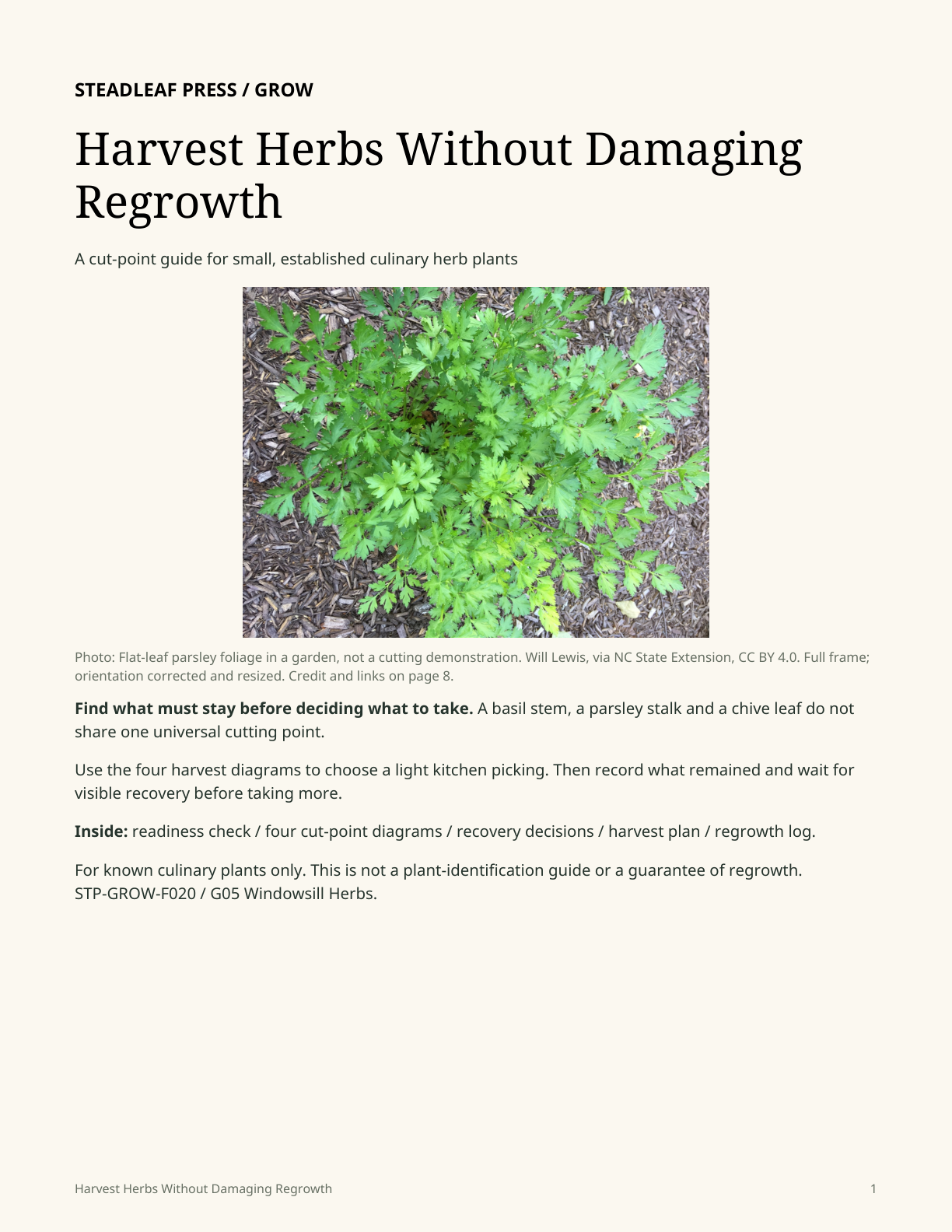
Photo: Flat-leaf parsley foliage in a garden, not a cutting demonstration. Will Lewis, via NC State Extension, CC BY 4.0. Full frame; orientation corrected and resized. Credit and links on page 8.
Find what must stay before deciding what to take. A basil stem, a parsley stalk and a chive leaf do not share one universal cutting point.
Use the four harvest diagrams to choose a light kitchen picking. Then record what remained and wait for visible recovery before taking more.
Inside: readiness check / four cut-point diagrams / recovery decisions / harvest plan / regrowth log.
For known culinary plants only. This is not a plant-identification guide or a guarantee of regrowth. STP-GROW-F020 / G05 Windowsill Herbs.
Harvest Herbs Without Damaging Regrowth 1
STEADLEAF PRESS / GROW Before the first cut
Start with identity and plant condition
Use a reliably labelled culinary plant: sweet basil, parsley, common chives, culinary thyme or rosemary. Do not identify an unknown plant by this photo, a diagram, a scent or a taste. Check any pesticide label and harvest restriction before using treated plants for food.
Choose an actively growing plant with enough healthy foliage to leave behind. Wait on tiny seedlings, newly rooted cuttings, plants recovering from repotting, and plants that are wilting, yellowing or losing leaves. A calendar date alone does not establish readiness.
Choose the method, not a universal haircut
Plant in this guide Find before cutting Leave in place
Sweet basil A healthy pair of leaves on the stem That leaf pair, its small side buds and lower foliage
Parsley An outer leaf stalk traced down The centre with its small emerging toward the base leaves
Common chives A few full-length leaves in a rooted The rooted base and most of the clump clump
Thyme or rosemary A young leafy shoot above older Leafy growth below the cut; the wood woody framework
Prepare a small, clean harvest
Wash hands, scissors or snips, and the collection bowl. Use sharp tools that cut without tearing. Place the pot securely and keep fingers out of the blades' path. Separate the intended stem gently so nearby growth is not cut by accident. Clean-harvest guidance: University of Maryland Extension.
Stop rule: if you cannot see the intended cut and the growth you will retain, do not cut yet. Move foliage gently or choose a clearer shoot.
Harvest Herbs Without Damaging Regrowth 2
STEADLEAF PRESS / GROW Two plants, two different cuts
Diagrams are simplified side views, not identification drawings. A black slash marked CUT is the cutting point. Dashed leaders are labels, not extra cuts.
A / Basil: keep the leaf pair
TAKE: the top portion
CUT KEEP: leaf pair and small side buds
KEEP: lower leaves on the rooted stem
Diagram A in words: follow a basil stem down from its tip to a healthy pair of leaves. Cut the stem just above that pair, leaving the leaves, their small side buds and lower foliage attached. Take the top portion; do not strip the retained stem bare. UMN: basil harvesting.
B / Parsley: choose an outer stalk
TAKE: one outer leaf and its stalk
KEEP: small leaves in the centre
CUT KEEP: crown; do not cut into it
Diagram B in words: trace one mature outer leaf stalk toward the base. Snip that stalk close to the soil without cutting into the central crown or emerging leaves. Leave the centre and other healthy stalks. Do not just shave off every leaf tip. UMN: parsley harvesting.
Harvest Herbs Without Damaging Regrowth 3
STEADLEAF PRESS / GROW Leaves versus woody shoots
These are light harvests, not whole-plant renovation. Choose a few leaves or tips; the diagrams do not show how much a particular plant can spare.
C / Chives: snip leaves, keep the base
TAKE: a few selected full-length leaves
KEEP: most of the growing clump
CUT KEEP: rooted base; never pull out bulbs
Diagram C in words: select a few long leaves and cut them near the base, above the soil and clear of the rooted growing base. Do not pull the leaves or bulbs out. Leave the rest of the clump growing. This is not a whole-pot haircut for a small or weak plant. UMN: chive harvesting.
D / Thyme and rosemary: stay in leafy growth
TAKE: a short young shoot CUT
KEEP: leafy growth below the cut
DO NOT CUT into bare old wood
Diagram D in words: take a short young shoot while leaving healthy leafy growth below the cut. Do not cut back into a bare, woody section to obtain a larger sprig. Hard cutting can fail to produce new shoots. Use crop-specific pruning advice for renovating an old plant. RHS: thyme and rosemary.
Harvest Herbs Without Damaging Regrowth 4
STEADLEAF PRESS / GROW Make the next harvest conditional
Take less than the plant can replace
For a small windowsill plant, begin with a few leaves or a short shoot, not a full bowl. Look at the whole plant after each cut. Keep most of its healthy foliage and its crop-specific growing points. Stop if the next cut would leave a thin, bare or unbalanced plant. This conservative starting method is not a universal percentage or yield promise.
Do not combine a large harvest with repotting, division or a rescue from drought. If you need more for a recipe, use another established plant or a different supply rather than stripping this one.
Observe before repeating
What you notice What to do next
Healthy retained leaves and new leaves or shoots Continue normal care; consider another light harvest expanding only when the plant has enough foliage again.
Little growth in a dim season Reduce or pause harvesting. Check light and the herb's normal seasonal behaviour; do not force a weekly picking schedule.
Wilting, yellowing, darkened stems or continuing leaf Stop harvesting. Check moisture, drainage, light and loss signs of pests or disease before choosing a remedy.
A bare woody plant, or parsley sending up a seed stalk Do not expect repeated leaf harvests to reset its life cycle. Seek crop-specific advice; replacement may be more practical.
Chives may grow very little in poor winter light. Parsley eventually flowers and finishes its biennial life cycle. Basil is also not an indefinitely renewable plant. See the crop sources on pages 3-4.
Handle the picking separately from plant care
Use a clean bowl. Discard damaged or contaminated material rather than mixing it with the picking. Rinse culinary herbs under running water before use; do not add soap or bleach. Do not make a watering or fertilizer change merely because you harvested: assess that plant's conditions first. This guide does not provide preservation recipes.
Harvest Herbs Without Damaging Regrowth 5
STEADLEAF PRESS / GROW My next light harvest
Fill this in while looking at the actual plant. If a cut point is hidden, write WAIT rather than guessing. A quick phone photo before picking can help you compare later.
Decision to record My plant and intended action
Identity and readiness Known culinary plant; current growth and recent stress
Cut pattern A basil / B parsley / C chives / D woody herb
What will remain Retained leaves, buds, centre or rooted base
A small picking The few leaves or shoot I intend to take; my stopping point
What I will check next Retained foliage, moisture, light and visible new growth
Practice before cutting
Point to the part that will remain. Trace the intended stalk or shoot with your eyes, then place closed scissors beside the proposed cut. Open and cut only when the correct plant part is isolated and fingers are clear. My decision today: HARVEST LIGHTLY / WAIT / INVESTIGATE A PROBLEM.
Harvest Herbs Without Damaging Regrowth 6
STEADLEAF PRESS / GROW Regrowth observation log
A log is a record, not a harvesting timetable. Check the plant as part of normal care; do not take more simply because a row is empty or a week has passed.
Date and time Plant / pattern What I took and what remained New growth or stress; next decision
Read the pattern
If harvests get smaller while the plant gets thinner, pause. Review light, drainage, moisture and the amount removed. If symptoms persist or spread, get a local extension service or knowledgeable nursery to help identify the problem before treating it. Ready for another picking? I can point to healthy retained foliage, current growth and the correct cut point. If not, I wait.
Harvest Herbs Without Damaging Regrowth 7
STEADLEAF PRESS / GROW Sources, photo and use notes
Crop-specific foundations
1. University of Minnesota Extension: Growing basil in home gardens. Whole-stem cuts above a leaf pair; flowering and annual life-cycle limits.
2. University of Minnesota Extension: Growing parsley in home gardens. Outer stalks cut near the ground; avoiding tip-only harvests; biennial life cycle.
3. University of Minnesota Extension: Growing chives in home gardens. Leaves cut near the base; reduced growth in low winter light.
4. Royal Horticultural Society: How to grow thyme. Young shoots for harvest; risks of cutting into old wood.
5. Royal Horticultural Society: How to grow rosemary. Light clipping and harvests; avoid heavy cutting into old wood.
6. University of Maryland Extension: Harvesting and preserving herbs. Clean hands, tools and bowls; running-water rinsing. Its large-harvest allowance is not used as a target for small windowsill plants here. Photo credit and diagram note
Photo: Will Lewis, Form Close-up(Wilson Botanical Garden,NC), Petroselinum crispum, via NC State Extension Gardener Plant Toolbox, image 24709. Licensed Creative Commons Attribution 4.0 International. Full-frame photo; orientation corrected, resized and encoded for print. No endorsement implied.
The photo shows garden parsley foliage; it does not expose every stalk base or prove the pictured plant's harvest readiness. Diagrams and worksheets are original Steadleaf Press work, simplified from the cited crop-specific guidance, not traced from the photo. Text descriptions accompany every diagram.
Sources checked 2 November 2026. Plant vigour, cultivar, season and growing conditions affect recovery. This guide supports careful small harvests; it does not identify plants, diagnose disease or promise a regrowth deadline.