Know When to Fertilize a Container Plant
Match the moment to the plant.
Combine plant activity, existing nutrient-supply records and actual product directions to plan a feed, wait or clarify; keep an eight-row readiness card.
FREE · No email or checkout
Free practical guide. No email or payment required. Photos are contextual illustrations, not proof of measured conditions or physical trials.
Read the complete free guide online
Read the instructional text here, or download the complete free PDF above for original diagrams, tables, worksheets and page layout. The original publication is unchanged.
STEADLEAF PRESS / GROW Know When to Fertilize a Container Plant
Match the moment to the plant.
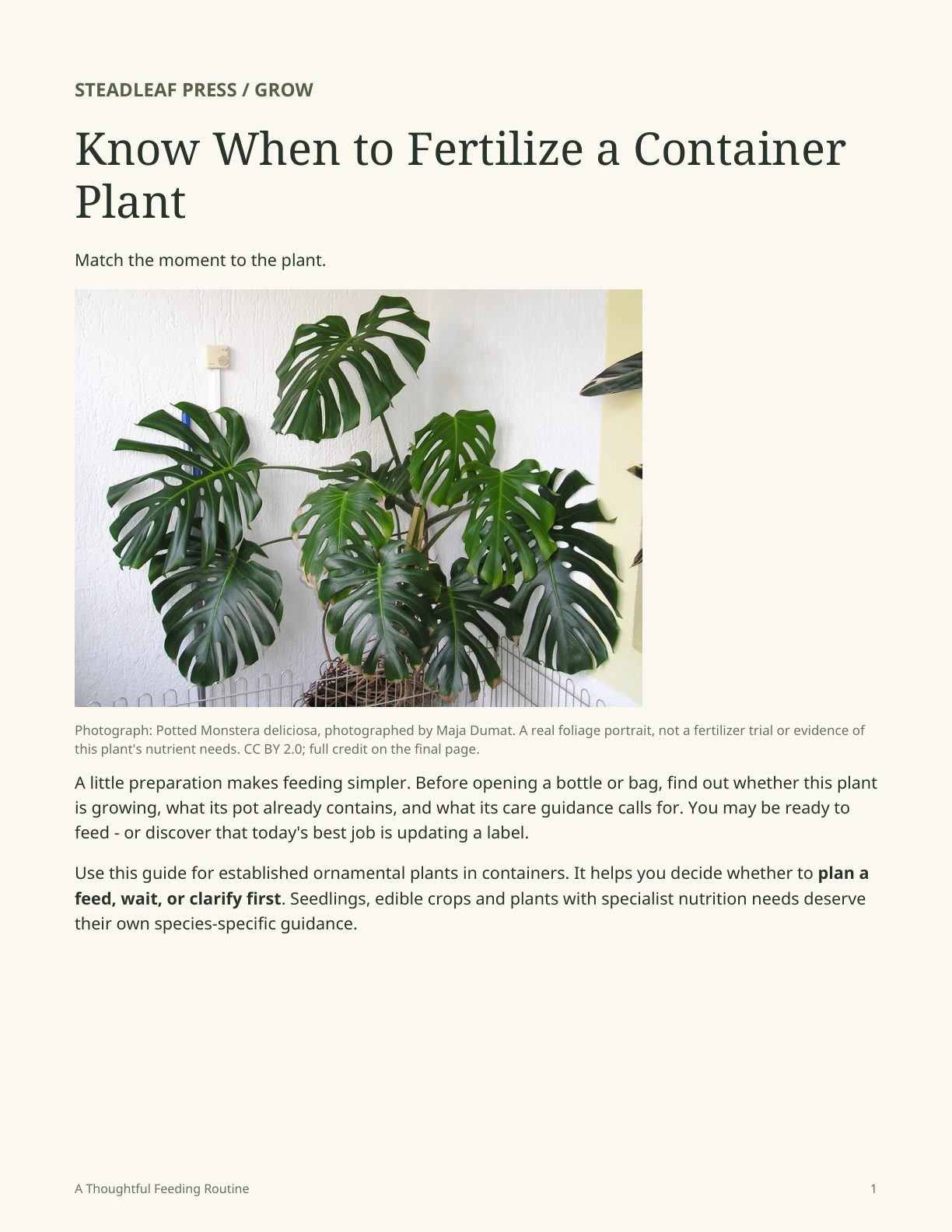
Photograph: Potted Monstera deliciosa, photographed by Maja Dumat. A real foliage portrait, not a fertilizer trial or evidence of this plant's nutrient needs. CC BY 2.0; full credit on the final page.
A little preparation makes feeding simpler. Before opening a bottle or bag, find out whether this plant is growing, what its pot already contains, and what its care guidance calls for. You may be ready to feed - or discover that today's best job is updating a label.
Use this guide for established ornamental plants in containers. It helps you decide whether to plan a feed, wait, or clarify first. Seedlings, edible crops and plants with specialist nutrition needs deserve their own species-specific guidance.
A Thoughtful Feeding Routine 1
STEADLEAF PRESS / GROW Start with the plant, not the month
Fertilizer supplies mineral nutrients, not energy. Plants obtain the energy for growth through photosynthesis; extra fertilizer cannot substitute for suitable light or solve every care problem. Feeding makes sense when the plant's needs, growing conditions and existing nutrient supply fit together. [1, 2]
Look for a pattern of activity
Notice a shoot lengthening, leaves developing or other normal growth for your identified plant over time. One bright leaf, flower or photograph is not enough to establish a need for more nutrients. Record what changed and when you noticed it.
For many indoor foliage plants, lower light slows growth during the local winter. Use that as a reason to reassess, not an automatic date-based rule for every plant, hemisphere or indoor setup. Follow the growth cycle and feeding guidance for the actual species. [1, 2]
Match the kind of container
An actively growing outdoor annual display and a slowly growing indoor foliage plant need not share a feeding schedule. In annual containers, nutrient uptake and losses during watering can reduce the mix's supply. That context does not justify giving every houseplant the same frequent feed. [3]
Your first note: Plant identity: __________ Setting: __________
Growth noticed, with date: __________________________________
Species-specific care source to check: _________________________
A Thoughtful Feeding Routine 2
STEADLEAF PRESS / GROW Find what is already in the pot
Start with the potting-mix bag, the plant's care label and your last care notes. If someone else planted the container, ask what was added. A newly bought or recently repotted plant may already have a nutrient supply. [2, 3]
Supply clue Useful question What to do with the answer
Mix says fertilizer is included What kind, and what does its label Keep the bag details with the plant say about later feeding? record. Do not add a second product automatically.
Slow- or controlled-release product Which product, on what date, at Read its own duration and was added what amount? reapplication directions alongside the plant's needs.
A soluble feed was used What product, amount and Check the stated interval before application date were recorded? planning another application.
History is missing Can the grower, previous carer or Mark it unknown. Ask before mix label clarify it? stacking products.
A duration is context, not a countdown alarm
For coated controlled-release fertilizers, release depends on the product and growing temperature. A stated duration does not measure exactly what remains in your particular pot. Treat it as one piece of planning information, not proof that the supply disappeared overnight. [4]
Leave granules intact. Their appearance is not a reliable household inventory of remaining nutrients. Record the actual product instead of guessing from bead colour or size.
A Thoughtful Feeding Routine 3
STEADLEAF PRESS / GROW Choose today's next step
Work down these questions in order. This is a practical planning aid, not a deficiency test. A yellowing leaf or slow growth can have several causes, including unsuitable light, watering problems and pests. [5]
Check If the answer is yes If no or unknown
Do I know this plant's feeding Check its current growth and Clarify identity and species-specific needs? conditions. care first.
Is it growing under suitable Review the pot's existing nutrient Wait on extra fertilizer; address the conditions, without an unresolved supply. care problem or ask for help. decline?
Does the existing-supply record Check the intended product label. Keep the current plan, or clarify the support another feed now? missing history.
Does this product cover the plant Plan the application exactly as Find the correct instructions before and setting, with clear directions I directed. applying anything. can follow?
Three worthwhile outcomes
Plan a feed: The plant's guidance, activity, supply history and product directions agree. Record the planned date and follow the label, including any moisture or application conditions. A planning decision is not a licence to increase the dose.
Wait: Current supply is still part of the care plan, growth is resting, or a care problem needs attention first. Note what would prompt a review.
Clarify first: Identity, existing supply or directions are missing. Write one specific question and who can answer it. Unknown does not mean empty.
A Thoughtful Feeding Routine 4
STEADLEAF PRESS / GROW See the decision in ordinary life
These are invented examples, not observations from the photograph or tested feeding programmes. They show how to use the questions without a universal calendar.
A new plant, with a new leaf
A recently purchased foliage plant is opening a leaf. Its owner has no record of fertilizer in the nursery mix. Clarify first: ask the grower about incorporated feed and the recommended next application. New growth alone does not justify adding another product.
A familiar annual container
An established outdoor annual display is actively growing. The owner has its species guidance, mix information and previous feeding record. Those records and the suitable product's directions indicate another application is appropriate. Plan a feed: use those directions and record the application. Do not borrow this schedule for a slow-growing indoor plant.
A quieter indoor season
A foliage plant is making little new growth as light at its usual spot decreases. The owner notices one yellow leaf. Wait and investigate: review the setting and watering history rather than treating the leaf as proof of hunger. Revisit feeding when the care picture and plant-specific guidance support it.
Keep the routine comfortable and safe
Read the actual product's handling, protective-equipment, application and storage directions. Keep fertilizer in its labelled original container, secured away from children and pets; avoid contact and wash hands after handling. Follow its spill and disposal instructions. Lawn-product rates and uses do not transfer to an indoor pot. [6]
If a plant is rapidly declining or you suspect an accidental excess, seek timely plant-specific advice rather than experimenting with extra feed or improvised flushing.
A Thoughtful Feeding Routine 5
STEADLEAF PRESS / GROW Your feeding-readiness card
Use one card per plant or container with a shared care history. A review date is a reminder to look again, not an automatic feeding appointment.
Plant / container: ______________________ Date: ______________
Record Your notes
Plant identity and care source __________________________________
Recent growth and current setting __________________________________
Mix name; included fertilizer details __________________________________
Other feed added: product, amount, date __________________________________
Relevant label interval / duration and conditions __________________________________
Missing information; person or source to ask __________________________________
Today's choice: plan a feed / wait / clarify __________________________________
Next review date or change to watch for __________________________________
If you apply fertilizer: Record the actual date, product and label-directed amount here or in your usual care notes. Keep that record for the next decision.
___________________________________________________________
A Thoughtful Feeding Routine 6
STEADLEAF PRESS / GROW Sources and photograph
Primary horticultural and safety guidance checked 2 November 2026. The decision aid and blank card are original editorial synthesis. Regional schedules, universal strengths and commercial nursery application techniques have deliberately not been turned into household rules.
1. Illinois Extension, Houseplants: Care. Active growth, excess-fertilizer risk and label directions. https://extension.illinois.edu/houseplants/care
2. N.C. Cooperative Extension, Union County, How to Fertilize House Plants. Growing conditions, existing nursery supply and fertilizer's role. https://union.ces.ncsu.edu/news/how-to-fertilize-house-plants/
3. Iowa State University Extension, Is it necessary to fertilize annuals growing in containers? Annual-container context and included feed. https://yardandgarden.extension.iastate.edu/faq/it-necessary-fertilize-annuals-growing-containers
4. UC Nursery and Floriculture Alliance, The Use and Storage of Controlled Release Fertilizers in Nursery Production. Product and temperature effects on release; used only for that principle. https://ucnfa.ucdavis.edu/news/use-and-storage-controlled-release-fertilizers-nursery-production
5. UC IPM, Houseplant Problems. Overlapping causes of yellow foliage and slow growth. https://ipm.ucanr.edu/home-and-landscape/houseplant-problems/
6. University of Nebraska-Lincoln, Fertilization in Home Lawns, safety section only. Label handling and secure original-container storage, not lawn rates. https://turf.unl.edu/turf-advice/turf-fact-sheets-nebguides/fertilization-home-lawns/
Photo credit: Original photograph by Maja Dumat, Monstera deliciosa, "Potted form", CC BY 2.0. Source: NC State Extension Gardener Plant Toolbox, image 16285. https://plants.ces.ncsu.edu/plants/monstera-deliciosa/
Licence: CC BY 2.0. https://creativecommons.org/licenses/by/2.0/ Full frame resized for layout; original retained, no generated or retouched plant details. The photograph illustrates foliage context, not a measured nutrient response or an endorsed household placement.