Learn What Fertilizer Labels Actually Tell You
Read the analysis, then read the directions.
Decode N, P2O5 and K2O, distinguish analysis from directions, and record a real label and its dilution calculation without inventing missing instructions.
FREE · No email or checkout
Free practical guide. No email or payment required. Photos are contextual illustrations, not proof of measured conditions or physical trials.
Read the complete free guide online
Read the instructional text here, or download the complete free PDF above for original diagrams, tables, worksheets and page layout. The original publication is unchanged.
STEADLEAF PRESS / GROW Learn What Fertilizer Labels Actually Tell You
Read the analysis, then read the directions.
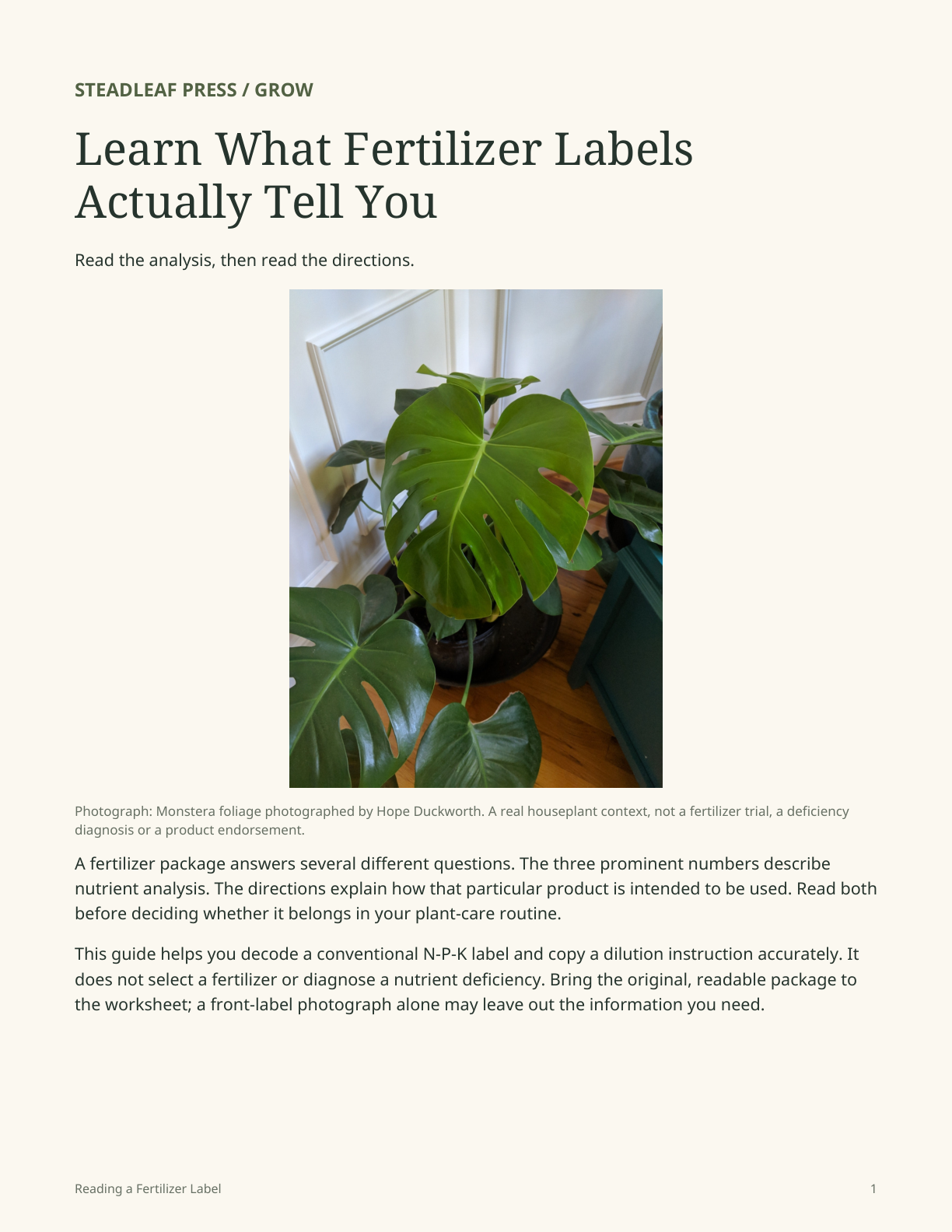
Photograph: Monstera foliage photographed by Hope Duckworth. A real houseplant context, not a fertilizer trial, a deficiency diagnosis or a product endorsement.
A fertilizer package answers several different questions. The three prominent numbers describe nutrient analysis. The directions explain how that particular product is intended to be used. Read both before deciding whether it belongs in your plant-care routine.
This guide helps you decode a conventional N-P-K label and copy a dilution instruction accurately. It does not select a fertilizer or diagnose a nutrient deficiency. Bring the original, readable package to the worksheet; a front-label photograph alone may leave out the information you need.
Reading a Fertilizer Label 1
STEADLEAF PRESS / GROW Decode the three numbers
On conventional Canadian and US labels, N-P-K is shorthand for nitrogen, phosphorus and potassium. The reporting basis matters: the second and third guarantees are commonly expressed as P2O5 and K2O, not as elemental phosphorus and potassium. Canadian labels may call these available phosphoric acid and soluble potash. [1, 2]
Position Read the guarantee as Do not mistake it for
First number Total nitrogen, expressed as N A mixing ratio with water
Second number Phosphate or available phosphoric The same percentage of elemental acid, expressed as P2O5 P
Third number Soluble potash, expressed as K2O The same percentage of elemental K
Invented analysis example: For a dry product with a 6-3-6 weight-percent analysis, 100 g of product corresponds to guarantees of 6 g N, 3 g P2O5 equivalent and 6 g K2O equivalent. This is label arithmetic, not an application amount or a real product label. The oxide expressions are reporting conventions; they do not tell you which chemical compounds are inside. [2]
A 12-6-12 analysis has the same 2:1:2 numerical ratio as 6-3-6, but twice each stated percentage. The products are not automatically interchangeable by scoop or by millilitre. Their formulations, densities and directions may differ.
The three numbers also do not describe every possible nutrient or establish that a plant needs feeding today. Read the rest of the guaranteed analysis and the product directions.
Reading a Fertilizer Label 2
STEADLEAF PRESS / GROW Find the directions that match your use
Begin with the product name and formulation. Identify whether it is ready to use, a concentrate to dilute, a soluble powder, or a product applied directly to growing media. Liquid and controlled-release products can have quite different application instructions. [3]
Label detail What to copy
Intended plants and setting The named plant group and indoor, outdoor or other use
Product form Ready to use, dilute first, dissolve first, or apply directly
Application route Soil or growing media, foliage, or another stated method
Rate Product amount, its unit, and the water volume or other basis
Timing and frequency The complete instruction and any seasonal or growth condition
Precautions Required handling, storage, protective equipment and disposal wording
Do not convert a soil application into a foliar spray, or turn a granule into a liquid feed, because another product is used that way. Ask the manufacturer if the label does not cover your intended use.
Canadian consumer labels commonly pair analysis with directions and precautions. This sheet is a reading aid, not a legal compliance assessment; special product categories and other countries can use different wording. [1]
Keep the whole instruction: “Amount per litre” tells you concentration. It does not, by itself, tell you how much finished solution to give one pot or how often to apply it.
Reading a Fertilizer Label 3
STEADLEAF PRESS / GROW Work through dilution on paper
Use this calculation only when the actual label specifies a product amount per stated volume of water and permits the batch size you plan to make. Keep the same units throughout. Copy any mixing order and other directions separately.
Product amount needed = label product amount x planned water volume / label water volume
Invented practice instruction: Suppose a fictional label said “4 mL product per 2 L water.” This made-up instruction is for arithmetic practice only; do not use it to feed a plant.
Planned water volume Calculation Product amount in this invented exercise
1 L 4 mL x 1 L / 2 L 2 mL
3 L 4 mL x 3 L / 2 L 6 mL
The concentration stays 2 mL per litre in both rows. Making a larger batch does not make it stronger.
For a real product, use its actual instruction, not these numbers. A direction expressed per final solution volume is different from one expressed per water volume; preserve the label's wording. If the basis is unclear, pause and ask the manufacturer.
Keep grams and millilitres distinct. A scoop measures volume unless its label specifies an associated mass for that product. Do not assume 1 g equals 1 mL, substitute a different brand's scoop, or estimate a tiny amount that your measuring tool cannot resolve.
Reading a Fertilizer Label 4
STEADLEAF PRESS / GROW Your label reading sheet
Product name and date checked: __________________________________
Plant and intended use: _________________________________________
Keep the package beside this sheet. Write “not stated” or “unclear” rather than filling gaps from memory.
Field Copy from your actual label
N-P-K grade and exact guarantee names
Product form and application route
Intended plant group and setting
Product amount and unit
Water volume or other rate basis and unit
Mixing order and preparation instructions
Amount to apply per plant, pot or area if stated
Timing, frequency and conditions
Precautions, storage and disposal
Question to resolve before use: __________________________________
________________________________________________________________
Reading a Fertilizer Label 5
STEADLEAF PRESS / GROW Check the calculation before mixing
Fill this in only for a label that instructs dilution in water. For a ready-to-use or directly applied product, write “not applicable” and follow that product's instructions instead.
Calculation field Your record
Label product amount, including unit
Label water volume, including unit
Planned water volume in the same unit
Calculation with units written out
Result and measuring tool
Label checked again by / date
Before mixing, confirm that you have the correct product, the correct use, compatible units and a way to measure the result accurately. If one of these is uncertain, leave the product closed while you get clarification.
A stronger mix is not a shortcut to healthier growth. Illinois Extension cautions that excess fertilizer can damage roots, particularly when growth is slowed in dim light, and advises following the label rather than strengthening the mixture. [4]
Keep handling precautions with your working notes. Follow the actual product's storage and disposal instructions, and keep it in its labelled container away from children and animals. This worksheet does not replace the package's safety information. [1]
My decision: Ready to follow the label / wait / ask a question
Reason or next step: ___________________________________________
Reading a Fertilizer Label 6
STEADLEAF PRESS / GROW Sources and photograph
Primary sources checked 2 November 2026. Worksheets, comparisons and numerical exercises are original editorial teaching tools. No physical application, plant trial or commercial product recommendation is claimed.
1. Canadian Food Inspection Agency. T-4-130, Labelling requirements for fertilizers and supplements. Canadian analysis names, directions and product-specific precautions; no compliance opinion offered. https://inspection.canada.ca/en/plant-health/fertilizers/trade-memoranda/t-4-130
2. Purdue Extension. Fertilizing Woody Plants, HO-140. Only the conventional weight-percent analysis and P2O5/K2O reporting explanation are used here; landscape application rates are not transferred to houseplants. https://ag.purdue.edu/department/hla/extension/extension-publications-library/ext-pubs/ho-140-w.html
3. Illinois Extension. Container Gardens, Fertilizing. Different product forms and label-based application; no universal feeding interval, ratio or flushing procedure adopted. https://extension.illinois.edu/container-gardens/fertilizing
4. Illinois Extension. Houseplants, Care. Label directions and excess-fertilizer cautions; regional calendar and general ratio suggestions are not treated as universal. https://extension.illinois.edu/houseplants/care
Photograph credit: Hope Duckworth, “Leaves Close-Up (Cabarrus County,NC),” Monstera deliciosa, image 23709 in the NC State Extension Gardener Plant Toolbox. CC BY 4.0. Full frame proportionally resized and JPEG-encoded for the PDF; no crop, retouching or generated alteration. No endorsement implied.
Source: https://plants.ces.ncsu.edu/plants/monstera-deliciosa/
License: https://creativecommons.org/licenses/by/4.0/