Measure Light Through a Window Screen
A two-position comparison for plant keepers—not a screen-transmission test.
Record two positions and matched sensor orientation, perform short A-B-A sets with drift notes, interpret a descriptive relative reading or acknowledge inconclusive evidence.
FREE · No email or checkout
Free practical guide. No email or payment required. Photos are contextual illustrations, not proof of measured conditions or physical trials.
Read the complete free guide online
Read the instructional text here, or download the complete free PDF above for original diagrams, tables, worksheets and page layout. The original publication is unchanged.
STEADLEAF PRESS / GROW Measure Light Through a Window Screen
A two-position comparison for plant keepers-not a screen-transmission test.
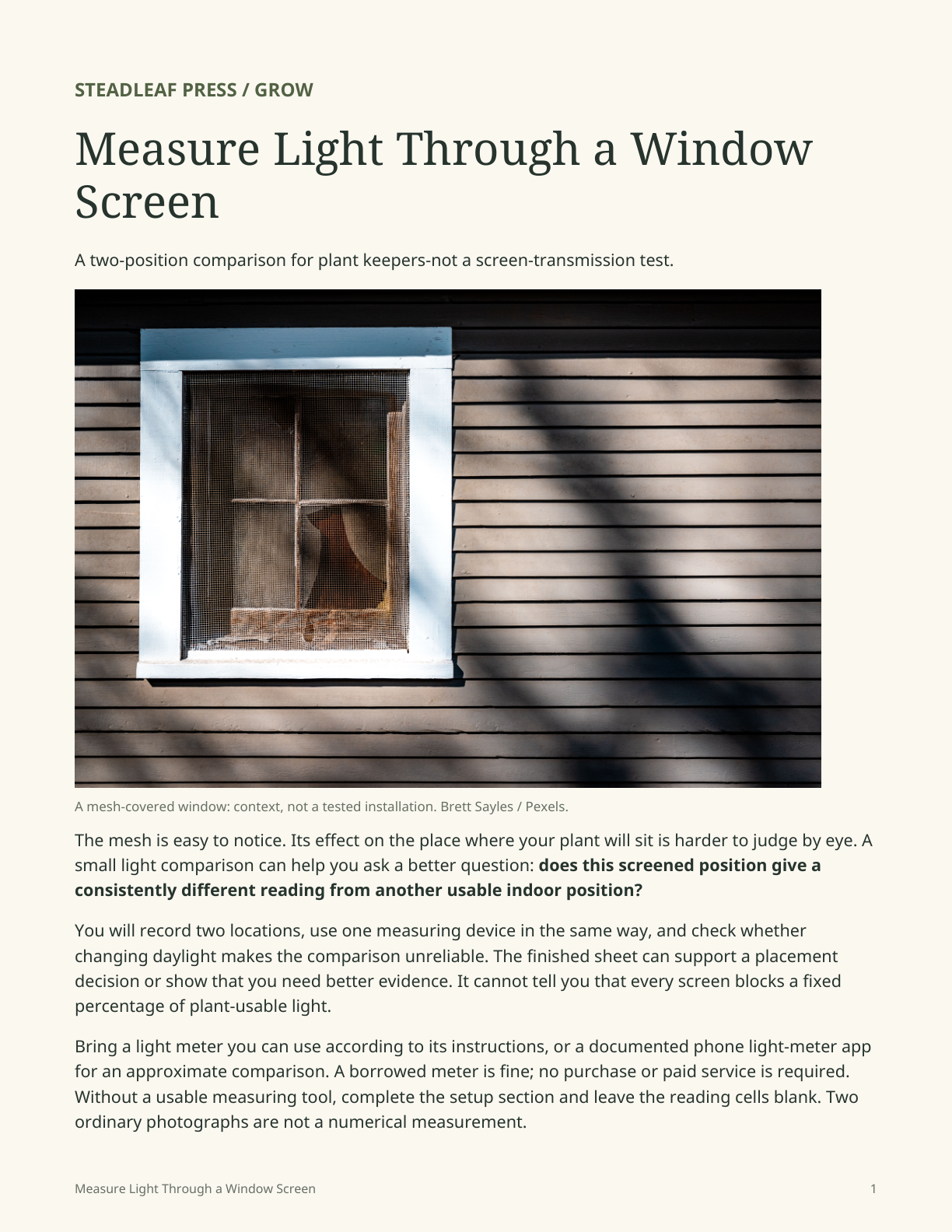
A mesh-covered window: context, not a tested installation. Brett Sayles / Pexels.
The mesh is easy to notice. Its effect on the place where your plant will sit is harder to judge by eye. A small light comparison can help you ask a better question: does this screened position give a consistently different reading from another usable indoor position?
You will record two locations, use one measuring device in the same way, and check whether changing daylight makes the comparison unreliable. The finished sheet can support a placement decision or show that you need better evidence. It cannot tell you that every screen blocks a fixed percentage of plant-usable light.
Bring a light meter you can use according to its instructions, or a documented phone light-meter app for an approximate comparison. A borrowed meter is fine; no purchase or paid service is required. Without a usable measuring tool, complete the setup section and leave the reading cells blank. Two ordinary photographs are not a numerical measurement.
Measure Light Through a Window Screen 1
STEADLEAF PRESS / GROW First separate two different questions
Question 1: How much illuminance reaches these two positions now? This is the question the worksheet helps answer. Illuminance is the light falling on a surface, weighted to human visual sensitivity; lux and foot-candles are common units. It is not the same quantity as photosynthetic photon flux density, or PPFD. [1]
Question 2: How much light does this screen material transmit? That requires controlling the light, geometry and other layers so that the material is the meaningful difference. Two household positions usually differ in several ways. A frame, different glass, a tree, distance or viewing angle can affect the result too.
Research on horticultural screens and nets finds material-dependent differences in both attenuation and spectrum. Those findings explain why a universal household “screen blocks X percent” rule is not justified; they do not supply a measurement for your window. [2]
For this guide, call the result a position comparison with the screen in place. Even when the reference is behind an unscreened pane, do not relabel the difference as the screen's transmission or as the percentage of photosynthesis lost.
Window Screen - daryl_mitchell, CC BY-SA 2.0. Visible mesh does not reveal transmission. This is not an instruction to look at the sun.
Measure Light Through a Window Screen 2
STEADLEAF PRESS / GROW Choose A and B without changing the window
A is the screened position: the indoor place where you are considering keeping foliage, with the existing insect screen in its normal position. Describe the visible layers between it and outdoors: glass, mesh, film, curtain, frame or anything uncertain. Fine mesh is not the same as a blind, decorative grille or tinted glass.
B is the reference position: a second safely reachable indoor spot near the same window. If a nearby pane is already unscreened and otherwise similar, it can be a useful reference. If the whole window is screened, B can be another plausible plant position behind the same screen. Label it honestly; it compares placements, not screen versus no screen.
Keep the observation height and distance from the window as similar as practical when comparing adjacent panes. If you deliberately compare a near-window spot with a farther-back spot, record the distance difference as part of the question. A comparison between opposite sides of a room is not a clean test of mesh.
Both positions must be reachable while standing or sitting securely inside. Keep the window closed and the screen installed. Do not unclip, cut or remove a screen, reach outside, lean on it, stand on furniture or balance a device on an edge. A screen is not fall protection. Never look directly at the sun while positioning a sensor. If a second safe position is unavailable, stop at a single-position record; do not invent a reference.
Keep the ordinary curtain/blind arrangement unchanged during a set. For a daylight-only comparison, switch off nearby optional room lights if doing so does not compromise safe movement. Otherwise leave the lighting unchanged and label it “daylight plus room light.” Do not compare an indoor reading with an outdoor reading and attribute all the difference to mesh.
Window size, distance, coverings, overhangs and outside obstructions can all change indoor light. The location description is part of the evidence, not paperwork to skip. [3]
Measure Light Through a Window Screen 3
STEADLEAF PRESS / GROW Set up one device, one unit and one angle
Use the same physical device, app mode and unit for A and B. Do not take A with a phone and B with a handheld meter. If your display uses a multiplier, record the actual value after applying it. Follow the instrument's instructions for range, settling time and any required preparation; an over-range symbol is not a high but usable number.
Find the actual sensing surface. It may not be the screen of your phone. Read the app/device documentation to learn whether it uses an ambient sensor or camera, which face must receive light and whether it needs a specified accessory. If that is unclear, do not treat its display as a dependable reading. Do not improvise a paper diffuser and assume the app is calibrated for it.
Phone apps can be helpful for approximations, but results depend on the device and calculation method. Repeating the same method reduces some inconsistencies; it does not turn an unvalidated phone into a calibrated PAR instrument. [4]
Put the sensing surface at the intended foliage height, not on the floor merely because it is convenient. For a plant not yet chosen, write down the assumed height. Keep the sensing surface in the same plane and facing the same direction at both positions, following the device's guidance. For example, if you use a horizontal, upward-facing plane, keep it horizontal at A and B. Do not rotate toward whichever direction gives the largest number. Record the plane so you can repeat it. [1, 5]
Keep hands, your body, a case or other equipment from shading the sensor. Avoid touching the mesh or glass with the sensing surface. Take a moment to notice whether the instrument itself is partly in a moving sun patch. A consistent setup matters more than collecting extra decimal places.
SCHEMATIC ONLY / example sensor plane: horizontal, upward-facing
A - screened position B - reference position
sensor at leaf height sensor at leaf height
closed glass same plane at both positions closed glass same plane at both positions Setup sketch - original schematic, not a tested window
Draw A and B on the room side of a closed window. Label screen coverage and the glass layers above the drawing. At both positions draw the sensor at the chosen height with an arrow showing its facing direction. The matching arrows are the important part: they mean same measurement plane, not “point toward the sun.” Record any unmatched distance, pane, frame or shade conditions beside B.
Measure Light Through a Window Screen 4
STEADLEAF PRESS / GROW Make a short A-B-A set
Choose a period when daylight seems relatively steady. Rapidly moving clouds or a sun patch crossing a frame can overwhelm a small location difference. You can still record that instability; you do not need to force a result.
1. A first: place the device at A in the recorded orientation. Let the reading settle as its instructions require. Write the actual time, value and unit.
2. B: move safely to B, restore the same orientation and height, and record time and value. Note any shadow, cloud or light-source change.
3. A return: go back to the original A position and orientation. Record another time and value.
Keep the set reasonably short without rushing or skipping the device's settling time. There is no universal number of seconds that makes changing daylight “controlled.” The return to A is a check for change, not a correction that can reconstruct what the light was at B's exact moment. Similar A readings do not prove the daylight stayed unchanged during B.
Repeat the set twice more if conditions remain usable. Record a new row every time; do not overwrite awkward readings. You may repeat on a different day or time, but keep that as a separate session rather than averaging unrelated conditions together.
Pause a set if a cloud passes, the sensor slips, someone changes a blind, a reading exceeds the device range, or a strong shadow moves across either point. Mark what happened and leave that set out of a numerical summary. Keep it visible on the sheet. A result you cannot interpret is not a failed gardening session-it tells you what to control next time.
Measure Light Through a Window Screen 5
STEADLEAF PRESS / GROW Read the pattern before calculating
Compare A first with A return. If they differ substantially relative to the A-B difference you hoped to interpret, daylight or setup drift may explain the apparent advantage. There is no validated pass/fail tolerance for this homemade comparison. A tiny difference within device uncertainty or ordinary reading variation is not a firm placement result.
Across usable repeated sets, ask whether B is consistently above or below both neighboring A readings. If the ordering switches, the ranges overlap, or you cannot rule out a changing setup, report “no clear difference established in this session.” Do not average unstable sets until they look convincing.
If the readings are sufficiently stable for a modest descriptive summary, you may calculate:
A reference = (A first + A return) ÷ 2
B relative to A = (B ÷ A reference) × 100%
Use the same unit throughout. If A reference is zero, near the device's lower usable limit, or either reading is invalid, leave the ratio blank. Round the result sensibly-extra decimal places do not improve the instrument.
A result of 150% means B's reading was about one and a half times A's reference reading in that set. It means about 50% higher, not 150% higher. It does not mean that moving a plant there will increase growth by 50%, or that the screen blocked a corresponding percentage.
Two invented records
Steady-looking example, not a real test: A first is 1,180 lux, B is 1,800 lux, and A return is 1,220 lux. A reference is 1,200 lux; B relative to A is 150%. If repeat sets show the same clear ordering with an unchanged setup, a cautious summary is “B gave higher illuminance readings during this session.” The cause is still not isolated to mesh.
Unstable example, not a real test: A first is 900 lux, B is 1,600 lux, and A return is 1,800 lux after a cloud clears. The large change at A makes the comparison unreliable. Do not publish a screen-loss percentage from the average. Record the cloud and repeat under steadier conditions.
Measure Light Through a Window Screen 6
STEADLEAF PRESS / GROW Two-position comparison sheet
Part 1 - keep the setup repeatable
Date: ____________________ Session time span: ____________________
Window nickname / room: ____________________ Weather: ____________________
Device and app, if used: ____________________ Unit and mode: ____________________
Sensor location on device / required preparation: __________________________________
Sensor plane and facing direction: ______________________________________________
Detail A - screened position B - reference position
Exact location ____________________ ____________________
Foliage height / reference ____________________ ____________________ surface
Distance from window ____________________ ____________________
Glass, mesh and other layers ____________________ ____________________
Frame, outside shade or ____________________ ____________________ reflection
Curtain/blind and room-light setting: _____________________________________________
Sketch box: mark the closed window, screen coverage, A/B, distances and matching sensor-facing arrows. Keep both positions on the safe room side.
YOUR SETUP / A and B on the safe room side
Known differences other than screen coverage: _____________________________________
Measure Light Through a Window Screen 7
STEADLEAF PRESS / GROW Part 2 - three short sets
Copy this page for a separate session. Write time and value together; use the unit recorded above.
Set A first: time / value B: time / value A return: time / value Changes / usable?
1 __________ / __________ __________ / __________ __________ / __________ ____________________
2 __________ / __________ __________ / __________ __________ / __________ ____________________
3 __________ / __________ __________ / __________ __________ / __________ ____________________
Invalid or uncertain set(s), and why: ______________________________________________
Optional calculation for each usable set:
Set A reference B relative to A (%) Interpretation / uncertainty
1 __________ __________ ____________________
2 __________ __________ ____________________
3 __________ __________ ____________________
Overall pattern: B higher / B lower / no clear difference / insufficient usable readings.
Evidence and limits: ___________________________________________________________
One practical next action: ______________________________________________________
Measure Light Through a Window Screen 8
STEADLEAF PRESS / GROW Use the result for a plant, not an argument about screens
If B repeatedly gives higher readings, it may be worth investigating as a plant position. Check whether its daily light pattern, temperature, safe access and space suit the exact species and cultivar. A brighter snapshot can still coincide with a short harsh beam, unsuitable heat or a less manageable place to water.
If no clear difference emerges, retain the current arrangement while you improve the observation. Check the device setup, choose a steadier period or compare a more relevant second position. “Not resolved” is better than buying a new screen on the strength of unstable numbers.
If A seems dim, do not assume removing the screen is the next step. This guide does not recommend changing a building component. You can investigate another permitted indoor location or a plant suited to the conditions you actually have. Keep normal pest exclusion and household safety arrangements intact.
A single session is not a daily light integral. Window light changes through the day and with weather, season, latitude and surrounding obstructions. Do not convert a few lux readings into PPFD or daily plant-usable light using an unexplained app factor. Those quantities require appropriate methods and, for daily totals, information across time. [3, 4, 6]
This is also not a species-safety guide: verify pet/child access, climate suitability and drainage separately before adding a plant. No outdoor planting, invasive-species release or yield promise is implied.
Your completed sheet should let you say something specific and modest: “At these two recorded positions, using this device and setup, this was the pattern-and this is what I still need to check.” That is enough to make the next gardening decision less of a guess.
Measure Light Through a Window Screen 9
STEADLEAF PRESS / GROW Sources and photograph notes
Sources checked 2 November 2026. A-B-A bookkeeping, interpretation examples and printable sheets are original editorial tools, not a validated screen-transmission protocol. Steadleaf did not perform the numerical examples as physical measurements.
1. Apogee Instruments, SE-100 Photometric Sensor Owner's Manual, revision 8 July 2025. Definitions of illuminance and sensor-plane/orientation considerations; not a product recommendation. https://www.apogeeinstruments.com/content/SE-100.pdf
2. Kotilainen, Robson and Hernández (2018), Light Quality Characterization under Climate Screens and Shade Nets for Controlled-Environment Agriculture, PLOS ONE. Material and spectral differences; greenhouse findings are not household screen-loss values. https://journals.plos.org/plosone/article?id=10.1371/journal.pone.0199628
3. Iowa State University Extension, How to Care for Houseplants. https://yardandgarden.extension.iastate.edu/how-to/how-care-houseplants
4. UF/IFAS, Light for Houseplants. https://gardeningsolutions.ifas.ufl.edu/plants/houseplants/light-for-houseplants/
5. Iowa State University Extension, How to Determine How Much Supplemental Light to Provide for Indoor Plants. Foliage-level measurement principle only; this guide does not reproduce its supplemental-light setup or conversion procedure. https://yardandgarden.extension.iastate.edu/how-to/how-determine-how-much-supplemental-light-provide-i ndoor-plants
6. University of Minnesota Extension, Lighting for Indoor Plants and Starting Seeds. https://extension.umn.edu/garden-and-home/yard-and-garden/gardening-in-minnesota/lighting-for-indoor-plants
Real photographs and their limits
Cover: Wall of a House with a Window Covered with Net, Brett Sayles / Pexels. A mesh-covered, white-framed window sits in weathered wooden siding. This is an exterior context photograph, not an installation model or condition assessment. Source: https://www.pexels.com/photo/wall-of-a-house-with-a-window-covered-with-net-17756267/ . License: https://www.pexels.com/license/ . The original stock file is retained privately for production, not offered as a standalone stock download.
Interior detail: Window Screen, daryl_mitchell, 22 September 2008, CC BY-SA 2.0, via Wikimedia Commons. Fine mesh appears against trees and sunset. It illustrates the material's visible structure, not light quantity or a recommended way to view the sun. Source: https://commons.wikimedia.org/wiki/File:Window_Screen_(2878481856).jpg . Photographer source: https://www.flickr.com/photos/daryl_mitchell/2878481856/ . License: https://creativecommons.org/licenses/by-sa/2.0/ . The photograph remains under that license.

Both photographs are real, separate scenes; none was generated. Full frames are retained with proportional scaling and no botanical or structural alteration. Neither image documents our invented numerical examples, identifies a screen's specifications or certifies a safe plant setup. No photographer endorses this guide.
Original guide text, comparison worksheet and schematic by Steadleaf Press. Free to read and download.