Use a Nursery Pot Inside a Decorative Cachepot
Keep the pretty pot. Keep the easy lift-out.
Choose an accessible two-pot fit and follow a lift-out, separate-drainage, outer-inspection and return routine without disturbing the roots.
FREE · No email or checkout
Free practical guide. No email or payment required. Photos are contextual illustrations, not proof of measured conditions or physical trials.
Read the complete free guide online
Read the instructional text here, or download the complete free PDF above for original diagrams, tables, worksheets and page layout. The original publication is unchanged.
STEADLEAF PRESS / GROW Use a Nursery Pot Inside a Decorative Cachepot
Keep the pretty pot. Keep the easy lift-out.
You can enjoy a favourite decorative container without moving the plant's roots into it. The useful arrangement is simple: the plant stays in its growing pot, and that pot slips inside an outer cover you can inspect and empty.
The important part is not hiding every trace of the nursery pot. It is keeping the whole arrangement easy to care for. This guide helps you check the fit, practise a safe lift-out and make a small lift / drain / inspect / return routine.
Choose one manageable indoor plant in an ordinary nursery pot with drainage holes. Purpose-built reservoirs, wick systems and aquatic planting work differently and need their own instructions. Here, the outer container is a cover, not a water supply.
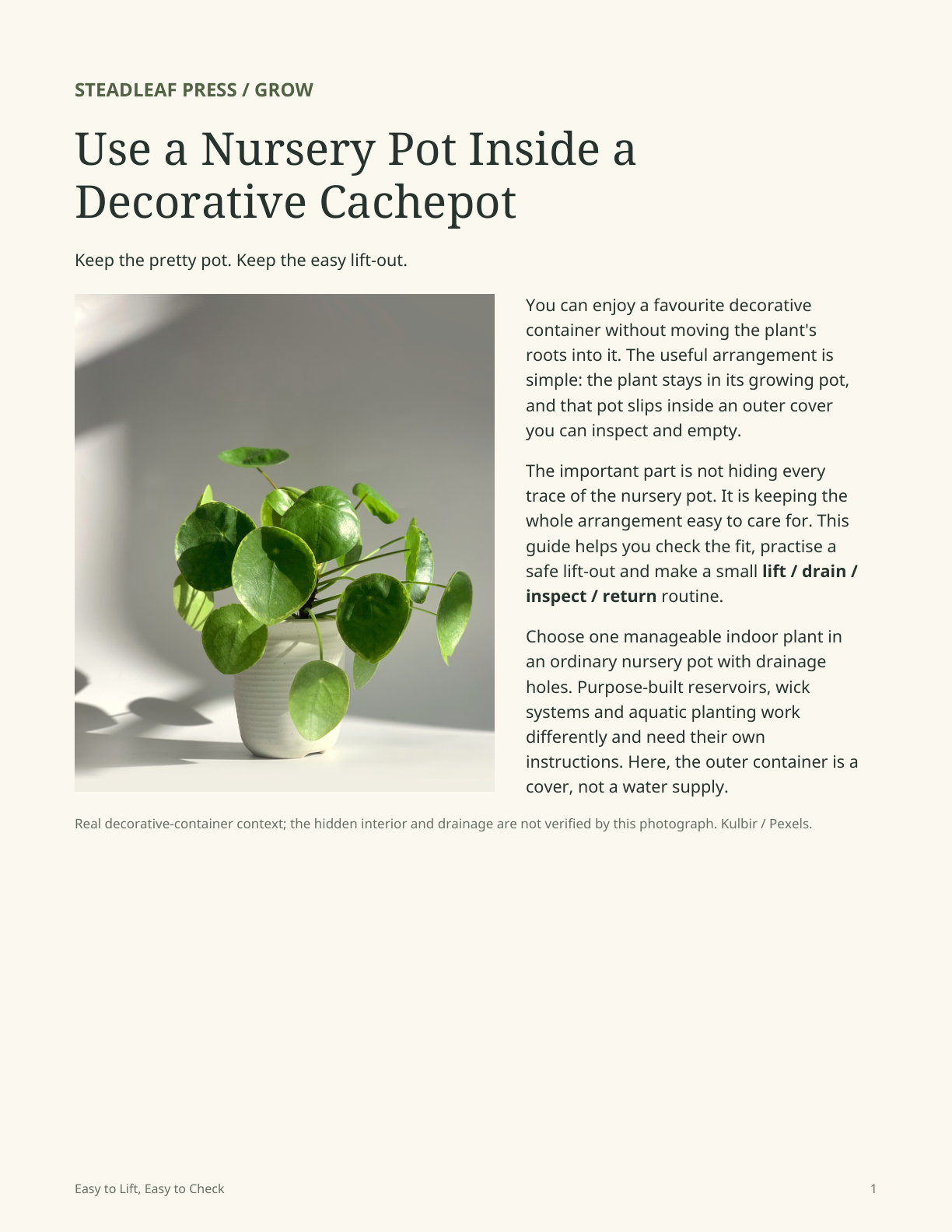
Real decorative-container context; the hidden interior and drainage are not verified by this photograph. Kulbir / Pexels.
Easy to Lift, Easy to Check 1
STEADLEAF PRESS / GROW Two pots, two jobs
The nursery pot holds the plant and growing medium. Its drainage openings let excess water leave. The cachepot is the decorative outer container, commonly without a drainage hole. Iowa State describes this double-pot arrangement as an outer sleeve around a smaller draining container. [1]
Keeping the growing pot separate lets you change the appearance without automatically changing the root space. A new decorative pot is not, by itself, a reason to disturb healthy roots or add more potting mix. Anoka County Extension Master Gardener guidance describes this as a useful way to display a plant while retaining its grow pot. [2]
Before you begin, identify which container you can actually lift out. If the plant is already planted directly into the decorative container, this routine does not apply until a suitable growing arrangement has been established.
What stays together
Lift the whole inner pot with the plant still in it. You are not pulling the plant out of its growing medium. [4] Hold the pot itself securely, supporting its base where practical; never use stems or leaves as handles.
A woven decorative cover on a wooden stand. This scene does not establish a watertight liner or easy lift-out access. Mathias Reding / Pexels.
Easy to Lift, Easy to Check 2
STEADLEAF PRESS / GROW Choose a fit you can undo
Try the fit on a stable, protected surface before watering. The outer pot should be large enough to accept the nursery pot without wedging it, and leave access for removal and inspection. Anoka's guidance favours a slightly larger cover for these practical reasons. [2]
Use these five checks rather than a universal centimetre gap:
Grip: Can you hold a sound part of the inner pot without pinching foliage or pulling the plant?
Release: Does the pot lift straight out without forcing it past a narrowed rim?
Rest: Does it sit securely without rocking, tipping or leaning on fragile leaves?
Outlet: Are the inner pot's drainage openings intact and unobstructed? A tight cover or liner must not seal them against its surface.
Access: Can you see and empty the bottom of the outer pot after the inner one is removed?
A visible nursery-pot rim is a useful trade-off if it makes removal easy. Do not bury it under decorations that have to be dismantled every time the plant needs checking.
If the combination is too heavy, awkward or tightly fitted for you to lift safely, choose a different cover or a more accessible arrangement. Do not compensate by lifting the whole assembly by the inner rim, leaving standing water hidden inside, or improvising an unstable stack of supports.
Easy to Lift, Easy to Check 3
STEADLEAF PRESS / GROW A cover is not a reservoir
The original cutaway shows a nursery pot resting inside an empty outer cover, with its rim accessible. A second view shows the inner pot removed and the outer bottom exposed for inspection. The plant stays in the inner pot throughout.
The drawings are schematic, not dimensions for a specific product. The inner pot is drawn with small feet and open outlets to explain the route; actual pot bases vary. Choose a combination that does not obstruct its intended drainage.
A cachepot can hide water as easily as it hides a plastic pot. Water collected in the outer container must be emptied rather than left around the growing pot. The drainage hole is only useful if the water can get away from the roots. [1]
Do not fill the space between the two pots with growing mix. For this simple lift-out arrangement, keep that space accessible instead of turning the cover into a larger planted container.
Inspect empty cover
1. Accessible inner rim 2. Lift the whole growing pot
Schematic only: feet/outlets vary by pot. No target gap, reservoir or water level.
Easy to Lift, Easy to Check 4
STEADLEAF PRESS / GROW The lift-out routine
1. Decide whether the plant needs water
Check the growing medium and the needs of this plant, not the appearance of the decorative pot. Watering frequency depends on the plant, mix, container and growing conditions; a fixed calendar does not settle it. [3]
2. Lift the inner pot
Move the manageable plant to a suitable water-safe work area, then remove the growing pot from its cover. Keep it upright and hold the pot, not the stems. Put the empty cover somewhere stable while you work.
3. Water appropriately and let excess leave
Follow the plant's watering needs with the growing pot outside the cachepot. Use a sink, draining surface or suitable catch tray that lets excess water leave the pot freely. Do not leave its base immersed in the collected runoff. Anoka specifically describes removing the growing pot for watering; Illinois explains allowing excess water to drain away. [2][3]
Wait until free drainage has subsided before returning it. There is no single drain time for every pot and mix. Observe the actual runoff rather than treating a timer as proof.
4. Inspect and empty the cover
Look into the bottom. Pour away any collected water while the plant remains safely separate. [4] Remove loose debris that prevents you seeing the bottom, following the container's care instructions. Check for cracks or damage before putting it back on furniture.
5. Return and recheck
Return the drained nursery pot upright into the empty cover. Confirm the easy grip and stable fit are still there. Check again after returning it if further drips could have collected, and empty any pooling you find. When you next check the plant, include a look inside the cover rather than assuming it stayed empty.
Easy to Lift, Easy to Check 5
STEADLEAF PRESS / GROW Keep the surface and the routine simple
A decorative finish does not establish that a container is watertight. Follow its material and care information, protect the surface beneath it appropriately and keep spills away from electrical items. A porous or damaged cover may need a different arrangement; an absorbent coaster is not a promise of waterproof protection.
If there is a liner, inspect the space inside it as well as the cover. It can hold water even when the decorative outer shell looks dry. Keep it removable and out of the way of the nursery pot's outlets. A liner changes where water collects, not whether you need to empty it.
Keep this routine indoors. Before moving the plant outdoors, reassess the arrangement: rain can collect in a cover without drainage. Anoka recommends removing such a cachepot for an outdoor stay. [2]
A small pause is a good choice
If you cannot lift the inner pot, cannot inspect the bottom or cannot empty the cover safely, stop using that combination for this routine. A plain growing pot with accessible drainage is more useful than a display that hides the task you need to do.
Easy to Lift, Easy to Check 6
STEADLEAF PRESS / GROW Your lift-out card
Plant / growing pot: ___________________________________________
Decorative cover / liner, if present: ____________________________
Water-safe place for the task: __________________________________
Check before using this pair Yes / change needed
I can hold and remove the inner pot without pulling the plant.
The inner pot sits securely and its outlets are not sealed.
I can inspect and empty the cover and any liner.
The assembly is manageable and the surface beneath is protected.
My decision: USE THIS PAIR / CHANGE THE FIT / USE A DIFFERENT ARRANGEMENT
One change before the next watering: ___________________________
One actual care check
Date: __________ Plant needed water? YES / NO / NOT SURE
Inner pot removed safely? ______ Free drainage observed? ______
Cover and liner checked and emptied? ___________________________
Returned upright, secure and still easy to lift? __________________
Later pooling found / action taken: _____________________________
This blank card records your observations. It is not a completed test or a watering schedule. If the plant does not need water, you can still check the fit and the outer container without watering it.
Easy to Lift, Easy to Check 7
STEADLEAF PRESS / GROW Sources
1. Iowa State University Extension and Outreach, How to Care for Houseplants, Containers section. Double-pot arrangement, drainage and avoiding collected water around the growing pot. https://yardandgarden.extension.iastate.edu/how-to/how-care-houseplants
2. Carol Hanson, Anoka County Extension Master Gardener, In Favor of the Cachepot. Removable fit, watering the grow pot separately and rain-collection caution. https://anokamastergardeners.org/gardening-articles/in-favor-of-the-cachepot
3. University of Illinois Extension, Houseplants: Watering. Plant-specific watering needs, condition-based timing and drainage of excess water. https://extension.illinois.edu/houseplants/watering
4. University of Illinois Extension, Container Drainage Options, Double potting and decorative wraps sections. Removable inner pots, emptying the outer container and allowing free drainage before replacement. https://extension.illinois.edu/container-gardens/container-drainage-options
Sources checked November 2, 2026. The lift-out sequence, original cutaway and care card are Steadleaf's practical synthesis. No physical drainage trial, measured clearance, universal drain time or waterproof certification is claimed. Gravel supports, decorative top-dressing, fixed soak times and treatment recipes in broader source material are not instructions in this guide.
Easy to Lift, Easy to Check 8
STEADLEAF PRESS / GROW Photograph credits
Cover: Kulbir, Green Plant on White Ceramic Pot, Pexels. Real light, foliage and a pale decorative container illustrate the appeal of a display pot. Its hidden interior, drainage and use of a separate nursery pot are not verified by the image. https://www.pexels.com/photo/green-plant-on-white-ceramic-pot-11336965/
Interior: Mathias Reding, Potted Plant on Wooden Stand, Pexels. A woven outer cover surrounds a partly visible dark container. Foliage obscures the inspection area; the picture does not establish drainage holes, watertightness, easy lift-out access or an approved support arrangement. https://www.pexels.com/photo/potted-plant-on-wooden-stand-5331915/
These are contextual photographs, not demonstrations of the illustrated procedure or species recommendations. The original cutaway, rather than the photographs, explains the two-pot routine.
Both photographs are under the Pexels License. https://www.pexels.com/license/
Full frames retained. Changes by Steadleaf: proportional resampling to print-resolution placement and JPEG/PDF encoding only. No retouching, relighting or generated imagery; original photographer processing is not excluded. Raw stock originals remain private production assets, not standalone customer downloads.