Pause Feeding When a Plant Is Stressed
A stress versus nutrient decision tree
Follow five yes/no questions to choose care correction, records verification, routine feeding, nutrient assessment or observation; record a condition-based next decision.
FREE · No email or checkout
Free practical guide. No email or payment required. Photos are contextual illustrations, not proof of measured conditions or physical trials.
Read the complete free guide online
Read the instructional text here, or download the complete free PDF above for original diagrams, tables, worksheets and page layout. The original publication is unchanged.
STEADLEAF PRESS / GROW Pause Feeding When a Plant Is Stressed
A stress versus nutrient decision tree
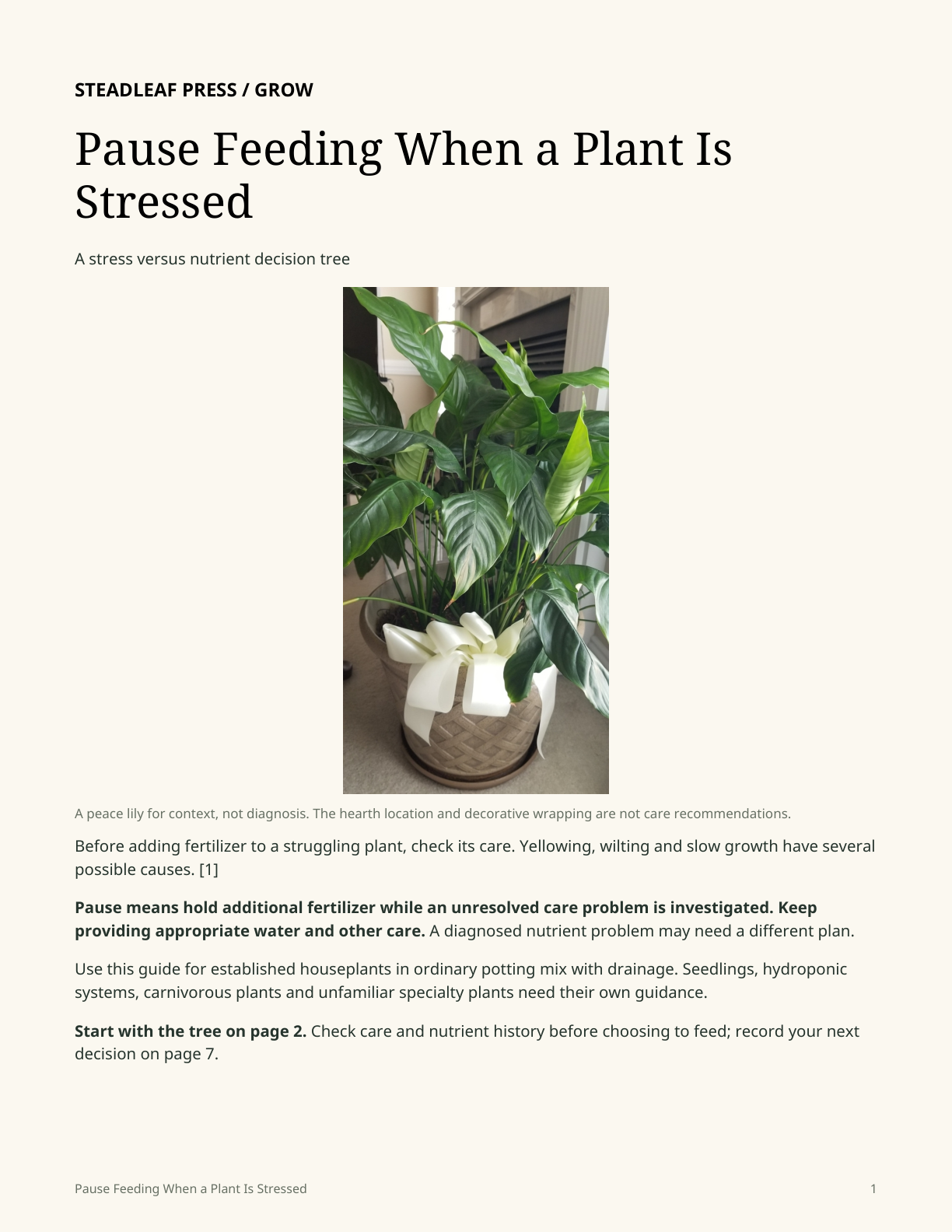
A peace lily for context, not diagnosis. The hearth location and decorative wrapping are not care recommendations.
Before adding fertilizer to a struggling plant, check its care. Yellowing, wilting and slow growth have several possible causes. [1]
Pause means hold additional fertilizer while an unresolved care problem is investigated. Keep providing appropriate water and other care. A diagnosed nutrient problem may need a different plan.
Use this guide for established houseplants in ordinary potting mix with drainage. Seedlings, hydroponic systems, carnivorous plants and unfamiliar specialty plants need their own guidance.
Start with the tree on page 2. Check care and nutrient history before choosing to feed; record your next decision on page 7.
Pause Feeding When a Plant Is Stressed 1
STEADLEAF PRESS / GROW Choose the next action
Answer in order. If a condition has not been checked, use the pause or verify route rather than guessing.
1 Is there rapid collapse, soft stem tissue, or YES -> A Pause and seek prompt help. Check worsening wilt while the mix stays wet? YES drainage and contact an extension service or qualified plant adviser. Do not try a rescue feed.
NO -> Question 2.
2 Is a water, light, temperature, pest or root YES -> B Pause and check care. Use page 3. concern present or still unchecked? YES Address the identified concern, then reassess from Question 1.
NO -> Question 3.
3 Are the mix and feeding records clear, with NO -> C Hold and verify. Use page 4. Unknown no known overapplication or conflicting NO history belongs here; an unconfirmed deficiency product directions? does not.
YES -> Question 4.
4 Is the plant growing normally, with routine YES -> D Feed according to those directions. feeding due under its species and product YES Use the restart checks on page 5. guidance?
NO -> Question 5.
5 Do persistent symptoms and a plausible gap YES -> E Investigate nutrition. Use the history in nutrient supply remain after the care YES and observations on page 4; seek assessment checks? before choosing a corrective treatment.
NO -> F Maintain suitable care and observe. Slow or resting growth is not, by itself, a reason to feed.
This is a care-priority tool, not a diagnostic test. Its branches are an editorial synthesis of the extension guidance in sources 1-9.
Pause Feeding When a Plant Is Stressed 2
STEADLEAF PRESS / GROW Check stress before nutrients
Look at the plant, pot and recent changes. Record observations: “mix still wet and two leaves drooping” is more useful than “needs food.”
What you notice What it can mean A useful next check
Wilt with unusually dry A water shortage is possible Check moisture and pot weight; water mix according to the plant's needs, without a rescue feed.
Wilt with persistently wet Excess moisture can damage roots Check standing water and drainage. mix Drooping alone does not justify watering. Escalate worsening wilt.
Pale or stretched growth Light may not suit the plant Check its position and species light after a move needs.
Leaf change after heat, Temperature exposure may be involved Move away from the problem into cold or a draft suitable conditions.
Webbing, sticky deposits A pest problem is possible Inspect leaf undersides and stems; or insects identify the pest before treatment.
Prompts, not proof. Water and roots: [4,9]. Light and temperature: [3,5]. Pests: [6].
Check below the decorative pot
If a nursery pot sits inside a cover pot, empty standing drainage water beneath it. A dry surface does not establish moisture deeper down. Use an appropriate moisture check and changes in pot weight, where lifting is safe. [4]
Keep the investigation gentle
Start with records and accessible checks. Routine unpotting, root cutting or replacing all the mix is not part of this tree. For collapse or suspected root trouble, seek help choosing the next inspection rather than repeatedly disturbing the plant.
An unknown answer gives you a next task, not a reason to fertilize.
Pause Feeding When a Plant Is Stressed 3
STEADLEAF PRESS / GROW Check the nutrient history
Before opening a fertilizer bottle, find out what is already supplying nutrients. Slow-release products work over time, and many fresh potting mixes contain fertilizer. Skipping liquid feed does not mean the pot is nutrient-free. [2,3]
Build a short supply record
Plant: What is it, and does its care guidance describe special feeding needs?
Mix: What product was used, when, and does its packaging list added fertilizer?
Past feeding: What product, amount, dilution and application date can you verify?
Other additions: Were pellets, spikes or nutrient-containing amendments used?
Current directions: Is this fertilizer intended for this plant and growing method? Does the label address an already fertilized mix?
If the record is incomplete, photograph the packaging and ask the seller or manufacturer. Do not infer that visible pellets are exhausted, or dig through roots to remove them without product-specific advice.
When nutrition deserves a closer look
A nutrient-supply gap becomes more plausible when the history shows little or no provision over the plant's growth period and care checks have not explained a continuing problem. That is a reason to investigate, not proof of a particular deficiency.
Pale growth, yellow leaves and slow growth are not enough on their own to choose a nutrient treatment. Similar signs can occur with environmental problems, pests or excess fertilizer. [1,7,9]
Ask an extension service or qualified adviser whether the species, mix and history justify feeding or whether further assessment is needed. Send whole-plant and close-up photographs plus the record above. A confirmed nutrient problem can warrant a specific correction; it need not be treated as a permanent “no fertilizer” case.
Read residue carefully
A white crust may come from fertilizer salts or minerals in the water. It does not, by itself, reveal the dose applied or prove the plant is overfed. [8]
If excess fertilizer is known or suspected, keep the product details. Seek advice suited to the plant, pot and drainage. Flushing or repotting can be appropriate in particular cases, but neither is this guide's automatic response to a yellow leaf or white deposit. [7,8]
Pause Feeding When a Plant Is Stressed 4
STEADLEAF PRESS / GROW Pause reassess and restart
During the pause
Keep care going. Match watering to the plant and moisture in its mix; provide suitable light and temperature. Do not keep wet mix wet to deliver a supplement. [3,4]
Record your action. For example: “Emptied standing water from the cover pot; will check moisture and drainage before watering again.” Avoid adding several new products at once; their effects become harder to distinguish.
At reassessment
Compare dated photos or notes. Has wilt eased or worsened? Is moisture changing appropriately? Are new symptoms appearing? Consider overall condition and new growth when it occurs, not one unchanged damaged leaf.
Worsening symptoms return you to Question 1; they do not call for more fertilizer.
Before routine feeding resumes
[ ] The original care concern is addressed; active decline is not ignored.
[ ] Light, temperature, watering and drainage suit the plant.
[ ] Growth state and species guidance support routine feeding.
[ ] Existing fertilizer and the mix have been accounted for.
[ ] Current product directions apply to this plant and situation.
Measure the specified amount and dilution, and use the stated application method. Do not make up missed doses or add another product for faster recovery. Products differ. [2,5]
For soluble fertilizer, do not apply to drought-wilted, dry roots. Restore appropriate moisture and allow recovery first; follow application-moisture directions. This does not mean adding water to already wet mix. [2]
There is no universal restart day. Use condition, species needs and product guidance. An assessed nutrient problem may need a different plan from routine feeding.
Pause Feeding When a Plant Is Stressed 5
STEADLEAF PRESS / GROW Practice with common situations
These examples show how to use the tree. They are not diagnoses of a particular plant.
A wilted plant after a missed watering
The mix feels much drier than usual and the pot is light. The plant has not recently been fed.
Route: Question 2 -> B. Check its water needs and restore appropriate moisture without adding fertilizer as the rescue. Then observe whether it recovers. If wilt persists or worsens despite an appropriate moisture correction, revisit Question 1 rather than repeatedly watering or feeding. [2,4]
Yellow leaves after moving to a darker room
Growth has become stretched. You cannot remember when the last fertilizer was applied.
Route: Question 2 -> B, then Question 3 -> C. First check whether light suits the species. Reconstruct the feeding record separately. The uncertain fertilizer date does not make nutrient shortage the best explanation. [1,3]
Brown tips with a recent feeding mistake
You discover that concentrate was mixed more strongly than its directions specify. The pot has poor drainage.
Route: Pause additional fertilizer and get advice. Share the product, concentration, amount applied, time since application and drainage details. Do not automatically run large volumes of water through a poorly draining pot. Brown tips alone would not prove fertilizer injury, but the known mixing error is important evidence. [7,8]
A well-kept plant with an unexplained slowdown
Light and watering appear appropriate. You find no pests. The mix and feeding records suggest a possible nutrient gap, but growth is not normal.
Route: Question 5 -> E, after completing the earlier checks. Seek assessment rather than switching among “deficiency cures.” If the plant is instead growing normally and feeding is due under verified guidance, Question 4 leads to routine feeding. [1,2,9]
The same symptom can lead to different actions. Context and history make the decision useful.
Pause Feeding When a Plant Is Stressed 6
STEADLEAF PRESS / GROW My next decision
Use one sheet for one plant. A photo taken from the same angle can make the next comparison easier. Plant and location __________________________________________________ Date and photo reference ____________________________________________ What I can observe
Main change and when it began _______________________________________________________________________ _______________________________________________________________________ Moisture and drainage observations _______________________________________________________________________ Recent light temperature or location change _______________________________________________________________________ Pest or root concerns checked and anything still unknown _______________________________________________________________________ What is already in the pot
Mix name and date used ______________________________________________ Fertilizer products dates amounts and any slow release product _______________________________________________________________________ Information I still need ______________________________________________ My plan
Tree outcome A / B / C / D / E / F The next action I will take _______________________________________________________________________ What I will compare or verify at reassessment _______________________________________________________________________ My next observation date or care checkpoint ___________________________ This is a reminder to inspect, not a scheduled feeding date. If the plant worsens I will ___________________________________________ At reassessment Improving / Unchanged / Worsening / Unclear What changed and my next decision _______________________________________________________________________
Pause Feeding When a Plant Is Stressed 7
STEADLEAF PRESS / GROW Sources and photo credit
The decision tree and worksheet are original Steadleaf Press tools. The numbered references support their horticultural principles; they are not a diagnostic validation of the tree. Primary extension guidance was checked on November 2, 2026.
1. Iowa State University Extension and Outreach. Diagnosing Houseplant Problems - https://yardandgarden.extension.iastate.edu/how-to/diagnosing-houseplant-problems. Checking species needs and considering several causes.
2. University of Connecticut Home and Garden Education Center. Houseplant Fertilization - https://homegarden.cahnr.uconn.edu/factsheets/houseplant-fertilization/. Nutrient products, active growth, label directions and application to moist mix.
3. Iowa State University Extension and Outreach. How to Care for Houseplants - https://yardandgarden.extension.iastate.edu/how-to/how-care-houseplants. Light, care conditions and fertilizer included in potting mixes.
4. University of Maryland Extension. Overwatered Indoor Plants - https://extension.umd.edu/resource/overwatered-indoor-plants. Moisture, root function, pot weight and drainage checks.
5. University of Illinois Extension. Houseplants Care - https://extension.illinois.edu/houseplants/care. Temperature changes, active growth and fertilizer directions.
6. University of Minnesota Extension. Managing insects on indoor plants - https://extension.umn.edu/garden-and-home/yard-and-garden/yard-and-garden-insects/insects-on-indoor-plants. Inspecting plant surfaces and recognizing pest clues.
7. University of Maryland Extension. Fertilizer Toxicity or High Soluble Salts in Indoor Plants - https://extension.umd.edu/resource/fertilizer-toxicity-or-high-soluble-salts-indoor-plants. Excess application and possible injury signs.
8. University of Maryland Extension. Mineral and Fertilizer Salt Deposits on Indoor Plants - https://extension.umd.edu/resource/mineral-and-fertilizer-salt-deposits-indoor-plants. Water minerals, fertilizer residues and case-specific management.
9. University of Maryland Extension. Diagnose Indoor Plant Problems - https://extension.umd.edu/resource/diagnose-indoor-plant-problems. Overlapping symptoms and possible root, pest and environmental causes.
Photo credit
Cindy Christian, “Spathiphyllum, Peace Lily, houseplant view,” image 40363, via NC State Extension Plant Toolbox - https://plants.ces.ncsu.edu/plants/spathiphyllum/. Licensed under Creative Commons Attribution 4.0 International - https://creativecommons.org/licenses/by/4.0/. Full frame proportionally resized and JPEG encoded; no crop, retouching or generated alteration.