Pick a Pot Diameter for a Small Root Ball
A little growing room, in the right place.
Compare actual inside width, taper and depth against root-ball information, distinguish diameter from per-side space, and choose keep, modest step up or pause.
FREE · No email or checkout
Free practical guide. No email or payment required. Photos are contextual illustrations, not proof of measured conditions or physical trials.
Read the complete free guide online
Read the instructional text here, or download the complete free PDF above for original diagrams, tables, worksheets and page layout. The original publication is unchanged.
STEADLEAF PRESS / GROW Pick a Pot Diameter for a Small Root Ball
A little growing room, in the right place.
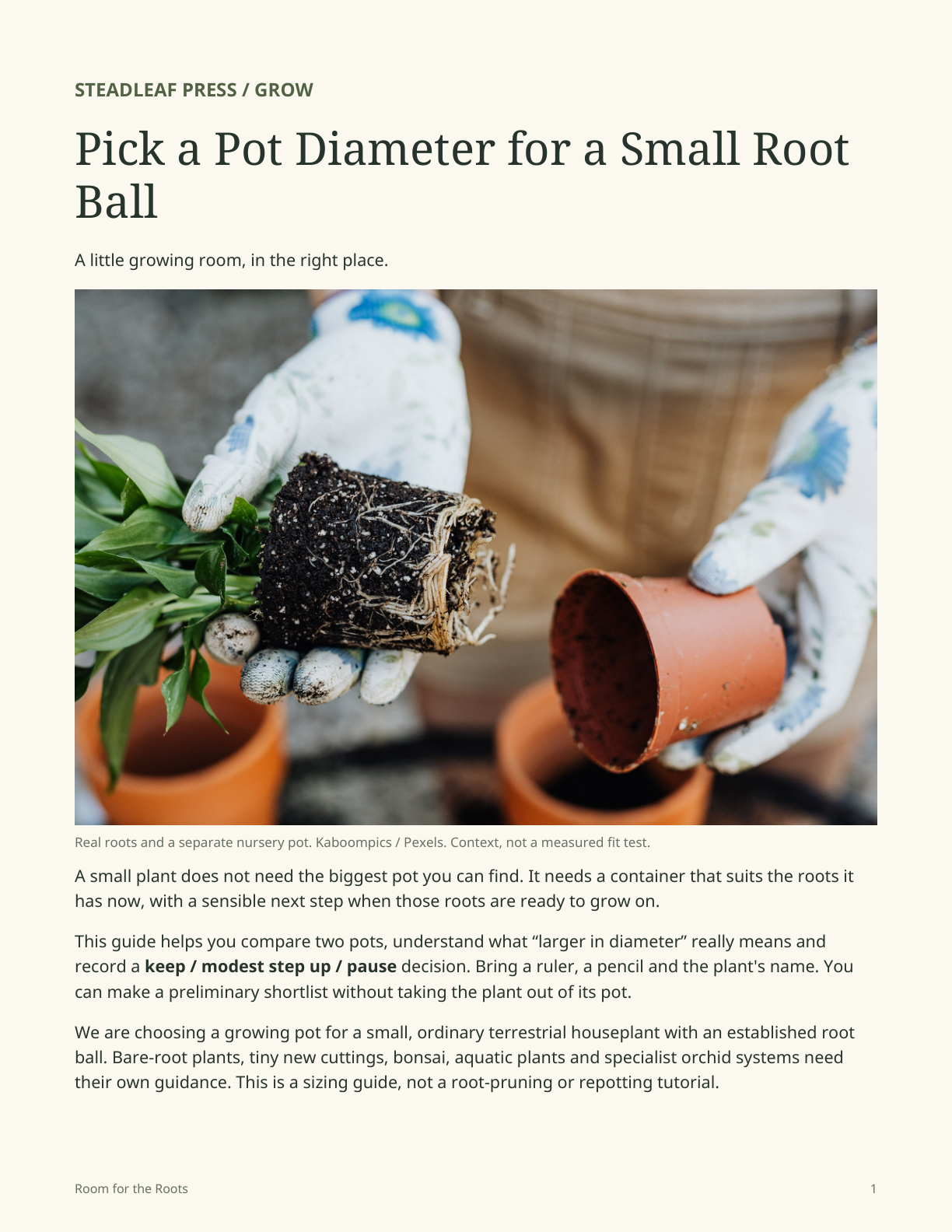
Real roots and a separate nursery pot. Kaboompics / Pexels. Context, not a measured fit test.
A small plant does not need the biggest pot you can find. It needs a container that suits the roots it has now, with a sensible next step when those roots are ready to grow on.
This guide helps you compare two pots, understand what “larger in diameter” really means and record a keep / modest step up / pause decision. Bring a ruler, a pencil and the plant's name. You can make a preliminary shortlist without taking the plant out of its pot.
We are choosing a growing pot for a small, ordinary terrestrial houseplant with an established root ball. Bare-root plants, tiny new cuttings, bonsai, aquatic plants and specialist orchid systems need their own guidance. This is a sizing guide, not a root-pruning or repotting tutorial.
Room for the Roots 1
STEADLEAF PRESS / GROW Start with the roots, not the leaves
The root ball is the roots together with the growing medium held around them. A leafy top does not tell you its width or how much of the current pot the roots occupy.
Before choosing a larger container, ask why you are changing it. An attractive new cover is a different reason from roots running out of room. You may be able to keep the current growing pot if the plant is doing well and does not need more root space.
Crowded roots circling the inside of a container are a useful reason to assess repotting. Fast drying or slow growth can prompt a closer look too, but neither observation measures the roots by itself. Iowa State advises modest container-size changes rather than frequent jumps into much larger pots. [1]
A gentle information check
Record the current pot's width and depth first. If you already have a recent view of the root ball from a necessary potting task, use it. Otherwise mark its dimensions not yet checked rather than repeatedly unpotting the plant just to complete this sheet.
During an appropriate, planned inspection, support a small plant and its root ball over a protected surface. A flexible nursery pot may release with gentle pressure on its sides. Stop if it does not release easily; do not tug the stems, cut roots or break a pot for this exercise. Keep the roots supported and avoid leaving them exposed while you compare containers. [1][2]
If the ball is fragile, falls apart or shows concerning damage, settle the plant-care question before choosing a bigger pot. Root colour alone is not a diagnosis.
Room for the Roots 2
STEADLEAF PRESS / GROW Read the size instruction correctly
RHS gives a usual step of about 2.5-5 cm (1-2 in) more in diameter than the previous pot, without a large increase in depth. Illinois Extension likewise recommends moving up modestly rather than placing a small plant in a large volume of mix. These are general starting points for potting on, not a rule for every species or every tiny root ball. [3][4]
Diameter is the whole distance across. A 3 cm increase across a centred round shape adds about 1.5 cm on each side, not 3 cm on each side.
The familiar step-up advice assumes the existing pot is a useful reference. If a small root ball occupies only part of an oversized container, adding another size to that container is the wrong starting comparison. Assess the actual root mass and the plant's requirements instead. [3]
A wider pot is not automatically harmful. The practical concern is an unnecessarily large volume of new mix that can stay wet while a small or slowly growing root system makes limited use of it. Plant growth, mix and watering conditions all matter. [3]
Room for the Roots 3
STEADLEAF PRESS / GROW The space around a root ball
Original sizing diagram
The top-view diagram uses two invented, perfectly round examples to explain geometry. It is not a recommended pot size or a record of a plant trial.
R is root-ball width. P is the pot's inside width at the same level. For a centred round ball, the approximate space on either side is (P - R) / 2.
Example A: R = 10 cm, P = 13 cm. Total difference = 3 cm; space on each side = 1.5 cm.
Example B: R = 10 cm, P = 20 cm. Total difference = 10 cm; space on each side = 5 cm.
Both examples contain the same root ball. B surrounds it with a much wider ring. The drawing helps you notice that difference; it does not calculate drying time or prescribe a universal acceptable gap.
1.5 cm each side 5 cm each side
R = 10 cm R = 10 cm
A: P = 13 cm B: P = 20 cm Invented top views. Same root-ball size; no measured plant or target gap.
Room for the Roots 4
STEADLEAF PRESS / GROW Check the inside, not just the label
Measure inside edge to inside edge, not across a thick outer rim. A pot label may describe an outside or nominal size. Record what you actually measured so your comparisons use the same basis.
Most pots taper, and real root balls are not perfect cylinders. Check the narrower lower portion as well as the opening. A ball that passes the rim may still be squeezed farther down. Do not compress or trim roots to make a preferred pot fit.
Pale roots are visible around the ball. Its dimensions and the plant’s identity are not established by this photograph. Kaboompics / Pexels.
Room for the Roots 5
STEADLEAF PRESS / GROW Give depth its own check
A reasonable top width can hide an excessively deep container. Compare the usable inside depth with the root ball's height as well as its width.
Keep the plant's existing planting level: do not bury the stem or crown simply to fill a tall pot. Allow the mix surface to sit below the rim so water can be applied without immediately spilling over. Colorado State describes retaining the original soil-ball level; Iowa State explains the purpose of space below the rim. The exact headspace should suit the plant and container, rather than an automatic number for every small pot. [1][2]
The side-view diagram separates three spaces: the root ball, the supporting mix below it, and the unfilled headspace above the mix surface. These are different measurements. It deliberately has no target depth or layer thickness.
If the candidate needs a deep column of extra mix just to raise a small root ball to the intended planting level, compare a shallower pot. Gravel is not a sizing correction or a substitute for a working drainage outlet. [1]
Headspace above mix
Root ball
Supporting mix below
Schematic section, not to scale. Existing planting level stays at mix surface.
Room for the Roots 6
STEADLEAF PRESS / GROW Try three everyday decisions
These situations are invented examples, not completed tests.
What you know A useful decision Why
The plant is doing Keep the growing pot for now. A decorative preference does not establish well, the growing pot a need for more root space. still suits it, and only the colour bothers you.
A planned inspection Compare a modestly wider pot of similar Check actual inside fit, planting level and shows an proportion. drainage before accepting it. established ball filling its small pot; the plant is ready for an appropriate potting-on step.
The current pot is Pause the automatic size increase. Get plant-specific guidance; the old large, but the root container is not a reliable sizing target. ball is small or its condition is uncertain.
If two pots have the same opening but one is much deeper or more sharply tapered, treat them as different candidates. A size printed on a shelf label cannot replace the fit check.
Room for the Roots 7
STEADLEAF PRESS / GROW Your small-pot sizing card
Plant / botanical name: ________________________________________
Reason for considering a change: _______________________________
Root information from: RECENT INSPECTION / PLANNED TASK / NOT YET CHECKED
Current growing pot, inside width / depth: _______________________
Root ball, approximate width / height, if known: __________________
Check Candidate A Candidate B
Inside width at the root-ball level
Narrower lower portion: enough room without squeezing?
Usable depth and existing planting level
Headspace below rim; no unnecessary deep fill
Working drainage; stable, manageable container
Plant-specific requirement or unanswered question
My decision: KEEP / MODEST STEP UP / PAUSE
Chosen pot or next question: ___________________________________
Why this is a fit for these roots: _______________________________
A useful finish is a clear choice, not necessarily a newly potted plant. Keep this card with your plant notes so the next comparison starts with what you actually know.
Room for the Roots 8
STEADLEAF PRESS / GROW Sources
1. Iowa State University Extension and Outreach, How to Care for Houseplants, container and repotting sections. Modest size changes, flexible-pot handling, headspace and gravel limitations. https://yardandgarden.extension.iastate.edu/how-to/how-care-houseplants
2. Colorado State University Extension / PlantTalk Colorado, 1316 - Houseplants: Repotting. Root inspection and preservation of original planting level. https://planttalk.colostate.edu/topics/houseplants/1316-houseplants-repotting/
3. Royal Horticultural Society, Overpotting. Qualified diameter-increase guidance, depth and the relationship between root mass and excess new mix. https://www.rhs.org.uk/prevention-protection/overpotting
4. University of Illinois Extension, Houseplants: Get Started, Choosing Your Container. Modest pot-size increase and drainage. https://extension.illinois.edu/houseplants/get-started
Sources checked November 2, 2026. Geometry, comparison sequence, invented situations and sizing card are original editorial synthesis. No physical potting trial, measured root growth or drying-time prediction is claimed. Root cutting, chemical cleaning, fertilizer recipes and species-specific repotting procedures in broader source material are outside this guide.
Room for the Roots 9
STEADLEAF PRESS / GROW Photograph credits
Cover: Kaboompics, Close Up Photo of a Person Holding Plant and a Pot, Pexels. A gloved hand supports a visible root ball beside a separate nursery pot. This is real potting context, not a measured comparison or a recommended new pot size. https://www.pexels.com/photo/close-up-photo-of-a-person-holding-plant-and-a-pot-4751968/
Interior: Kaboompics, Person Holding A Green Rooted Plant on Brown Pot, Pexels. Pale roots wrap around the dark root ball. The image illustrates visible features, not a prescribed grip, species identification or a diagnosis from root colour. https://www.pexels.com/photo/person-holding-a-green-rooted-plant-on-brown-pot-4751960/
Both photographs come from the same shoot. They are not a before-and-after sequence or a documented fit test, and the invented diagram dimensions do not describe them.
Both are licensed under the Pexels License. https://www.pexels.com/license/
Full frames retained. Changes by Steadleaf: proportional resampling to print-resolution placement and JPEG/PDF encoding only. No retouching, relighting or generated imagery; original photographer processing is not excluded. Raw stock originals remain private production assets, not standalone customer downloads.