Prevent Roots From Sitting in a Water-Filled Saucer
Empty, return, recheck.
Plan three safe places, finish one actual watering event and record the empty-return-recheck outcome.
FREE · No email or checkout
Free practical guide. No email or payment required. Photos are contextual illustrations, not proof of measured conditions or physical trials.
Read the complete free guide online
Read the instructional text here, or download the complete free PDF above for original diagrams, tables, worksheets and page layout. The original publication is unchanged.
STEADLEAF PRESS / GROW Prevent Roots From Sitting in a Water-Filled Saucer
Finish the watering, not just the pour.
A separate saucer is a useful little catchment. It protects the space beneath a pot while you water, then gives you somewhere easy to look for runoff. A small finishing routine keeps that collected water from becoming an unintended bath.
This guide is for one small indoor plant in an ordinary draining pot with a removable saucer. You will plan where the pot can rest, empty the saucer without dragging it under the plant, and check the result before putting the task away.
Choose a pot you can handle securely. A heavy, unstable or tightly fitted container needs a different arrangement or help, not a stronger tug. Purpose-built reservoirs, hydroponics, bog plants and deliberate bottom-watering sessions follow their own instructions.
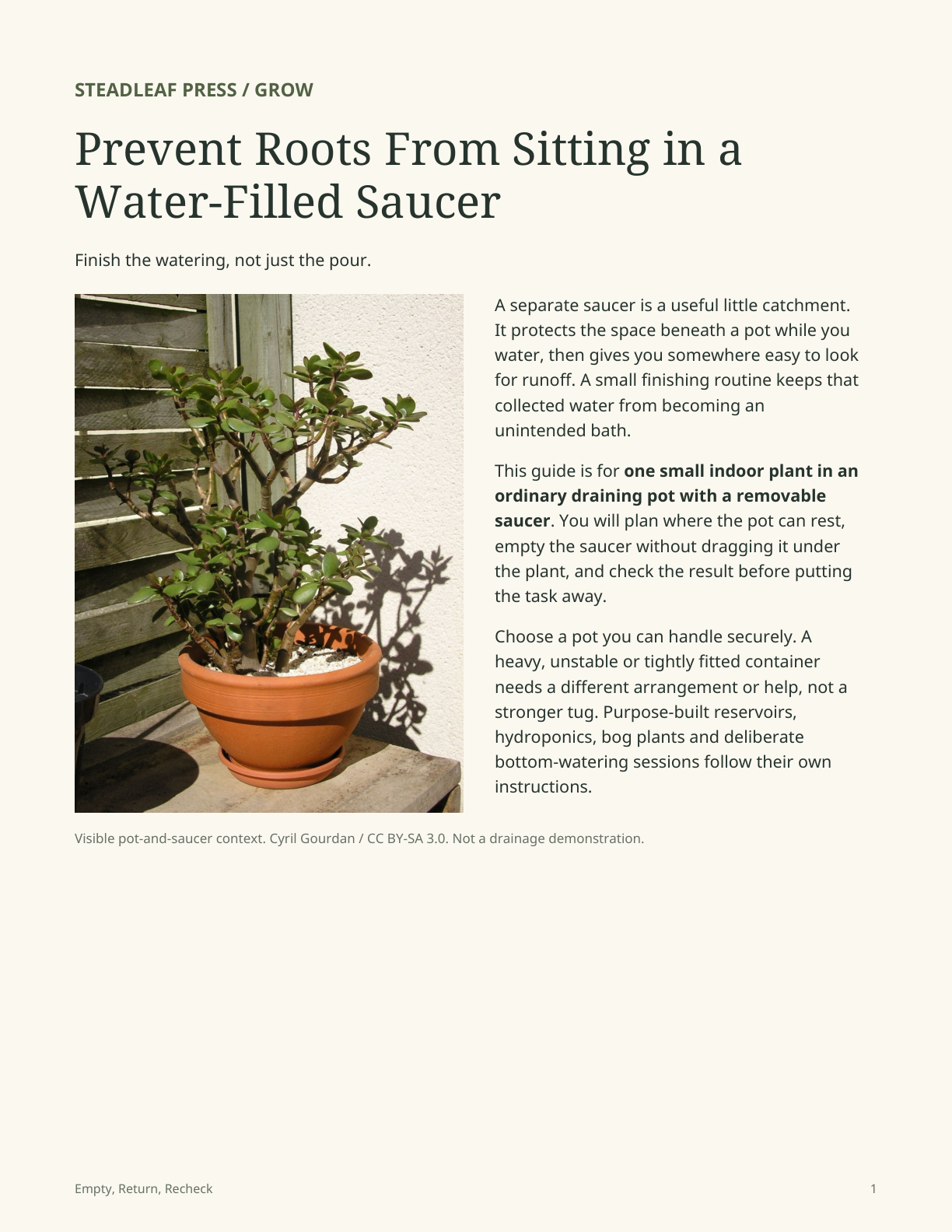
Visible pot-and-saucer context. Cyril Gourdan / CC BY-SA 3.0. Not a drainage demonstration.
Empty, Return, Recheck 1
STEADLEAF PRESS / GROW Make the finishing step easy
Before the next watering that your plant actually needs, look at its everyday setup. You should be able to see the saucer, reach it comfortably and move the pot without disturbing its roots.
Set up three places
The growing place: the pot sits securely in its saucer, away from electrical items and vulnerable edges. Check that the saucer is separate and can be removed. Illinois Extension specifically favours detachable saucers over attached designs that are difficult to empty. [1]
The temporary resting place: choose a stable, water-safe spot that will catch any continuing drips, such as a suitable clean sink or a sturdy waterproof tray. Clear it first. Keep the pot upright and its drainage openings unobstructed. Avoid balancing it on improvised stacks or the narrow edge of a basin.
The emptying place: choose where you can dispose of the collected water without spilling it onto flooring, furniture or another plant. If fertilizer or another treatment was used, follow its disposal directions and local rules. Keep plant-care water separate from food preparation.
Have a cloth for stray drips nearby. If there is no safe place to set the pot down while you handle the saucer, solve that access problem before watering in place. You can instead plan to water a manageable pot at a suitable draining station and return it afterwards. Maryland Extension describes draining small plants at a sink before returning them. [5]
A quick rehearsal: with the pot still settled, check your route and reach. You do not need to lift it or add water just to practise.
Empty, Return, Recheck 2
STEADLEAF PRESS / GROW One watering event, five finishing steps
Use this sequence after normal top-watering appropriate to your plant. Illinois Extension advises allowing excess water to drain and then emptying the saucer; RHS likewise says to drain thoroughly and empty water-filled saucers. [2,3]
1. Give runoff somewhere to go. Keep the pot stable while excess water emerges. Watch the saucer rather than adding another pour because water has appeared below. If it is approaching overflow, stop adding water and attend to the collection safely.
2. Move the pot, not the loaded saucer. When you can do so securely, support the container with both hands as needed and set it upright in the prepared water-safe resting place. Keep the plant in its pot. Do not pull stems, trap foliage or slide a full saucer out from beneath a precariously balanced pot.
3. Empty the separate saucer. Carry it level to the chosen disposal point, empty the pooled water and remove loose debris. Wipe its outside and the supporting surface as needed. Routine tidying is enough for this task; this is not a disinfecting or disease-treatment procedure.
4. Reunite the pair. Once the main runoff has finished, put the empty saucer back on its stable surface and return the pot carefully. Make sure the pot is seated securely, with no folded cloth or other object blocking the outlets.
5. Look once more before you leave. Fresh drips can collect after the first emptying. Check for a new pool and remove it using the same safe sequence. If active dripping continues, keep the pot in its suitable draining place and check again before returning it. Finish with no collected pool left under this ordinary pot. A damp trace is different from a pool; there is no need to dry the potting mix or polish the saucer dry.
This is an observed sequence, not a universal countdown. Different containers and media drain differently. Choose a care session when you can complete the return check; do not rely on a timer to prove that every pot has finished draining.
Empty, Return, Recheck 3
STEADLEAF PRESS / GROW Read the result without guessing at roots
An open hole allows water to leave the pot. When the base is sitting in collected water, that outlet is no longer simply draining into an empty catchment: moisture can also enter through contact with the water. Deliberate bottom-watering uses that principle temporarily, but is a different task from leaving runoff behind. [1,2,5]
Water contact Collected water removed
Pool reaches base and outlet Outlet clear; mix still holds moisture
Schematic only. Not to scale; no root condition, water depth or drying time is measured.
At the finishing check Your next action
No collected pool; pot is stable The saucer task is finished. Resume the plant's normal moisture checks.
A new pool appears while the pot is still dripping Empty it again, or allow further drainage in the prepared safe place before returning the pot.
Water is present but the saucer cannot be safely Pause the lifting attempt. Arrange help or a more removed accessible setup; do not force the pot or work around an unstable load.
Saucer is empty but the plant remains unwell or the mix Keep the issue separate from this task. Check species stays unusually wet care and seek horticultural advice if it persists.
Emptying a saucer removes the collected water; it does not diagnose or reverse root damage. Iowa State notes that wilting can arise from either too little water or damaged roots in overly wet conditions. A drooping leaf alone is not a reason to refill the saucer. [4]
Empty, Return, Recheck 4
STEADLEAF PRESS / GROW Your empty-and-recheck card
Use one card for one actual watering event. Blank entries are fine; there is no target amount of runoff to collect.
Plant / date: _______________________________________________
Separate saucer accessible? yes / no / unsure
Safe temporary resting place: ________________________________
Water disposal plan: ________________________________________
Checkpoint What I saw or did
Initial runoff and saucer condition __________________________________
Saucer emptied; outside and surface __________________________________ checked
Pot returned upright and secure __________________________________
Return check: no pool / fresh pool / still __________________________________ dripping
Final action or access issue to resolve __________________________________
Task finished / further drainage being watched / help needed
Next normal plant-care check: ________________________________
Invented example: the saucer is emptied, then a few more drips collect after the pot is returned. You empty the new pool, check the stable setup and finish. You do not infer a watering schedule or a root diagnosis from that one event.
Empty, Return, Recheck 5
STEADLEAF PRESS / GROW Sources
Primary guidance checked 2 November 2026. The three-place setup, five-step task sequence, comparison diagram and card are original editorial adaptations. No lifting trial, timed drainage test or plant-growth experiment was performed.
1. Illinois Extension. Container Drainage Options. Detachable saucers, open drainage and the distinction from designed reservoirs. Source drilling, sealed-pot tipping and gravel recommendations are not instructions in this guide. https://extension.illinois.edu/container-gardens/container-drainage-options
2. Illinois Extension. Watering: Houseplants. Let excess drain, empty the saucer and distinguish deliberate bottom-watering from retained runoff. https://extension.illinois.edu/houseplants/watering
3. Royal Horticultural Society. How to grow houseplants. Allow thorough drainage and empty water-filled saucers. https://www.rhs.org.uk/plants/types/houseplants/growing-guide
4. Iowa State University Extension and Outreach. Why is my houseplant wilting? The limits of diagnosing water needs from wilting alone. https://yardandgarden.extension.iastate.edu/faq/why-my-houseplant-wilting
5. University of Maryland Extension. Watering Indoor Plants. Small-plant sink drainage and the uptake path during bottom watering. Only these principles are used, not its salt-leaching or fixed-depth advice. https://extension.umd.edu/resource/watering-indoor-plants
Empty, Return, Recheck 6
STEADLEAF PRESS / GROW Photograph and diagram credits
Potted plant of Crassula ovata, Cyril Gourdan, via NC State Extension Plant Toolbox. A genuine photograph of a jade plant in a terracotta-coloured pot with a matching saucer, beside weathered wood and a pale wall. Plant identification is attributed to the source. The saucer is visible, but the photograph does not establish its removability, drainage holes, collected water or the plant's root condition. It is a container illustration, not a recommendation for this location, plant size or surface.
Source: https://plants.ces.ncsu.edu/plants/crassula-ovata/ License: Creative Commons Attribution-ShareAlike 3.0 Unported. https://creativecommons.org/licenses/by-sa/3.0/
Changes: the complete frame is retained and proportionally sized, with JPEG/PDF encoding. No crop, retouching, generated image or staged drainage result. This photograph and any technical adaptations remain available under CC BY-SA 3.0, without added restrictions. No endorsement is implied.
The two-panel water-contact diagram is an original Steadleaf illustration, not a photograph or measured test. It shows only the intended relationship of an ordinary pot outlet to collected water. The worksheet is blank and the example is explicitly invented.
Check your own plant's handling needs and keep plants and runoff away from children and pets. The pictured jade plant is context, not a pet-safe plant recommendation.