Read the Difference Between Bright and Direct Light
A small visual field guide for the place your plant will actually sit.
Separate direct-beam exposure from approximate light quantity, recognize four illustrated scenarios, and write a bounded leaf-position description with a next useful observation.
FREE · No email or checkout
Free practical guide. No email or payment required. Photos are contextual illustrations, not proof of measured conditions or physical trials.
Read the complete free guide online
Read the instructional text here, or download the complete free PDF above for original diagrams, tables, worksheets and page layout. The original publication is unchanged.
STEADLEAF PRESS / GROW Read the Difference Between Bright and Direct Light
A small visual field guide for the place your plant will actually sit.
A room can look bright while a plant is in shade. A closed window can let a direct sunbeam reach a leaf. And a spot can be sunny before lunch and indirect afterward. Those are not contradictions: brightness and direct exposure answer different questions.
This guide helps you name what you see without turning a pleasant-looking room into a promise about plant growth. You need a safe indoor viewpoint, a piece of plain paper and a pencil. No meter or new purchase is needed for this first description.
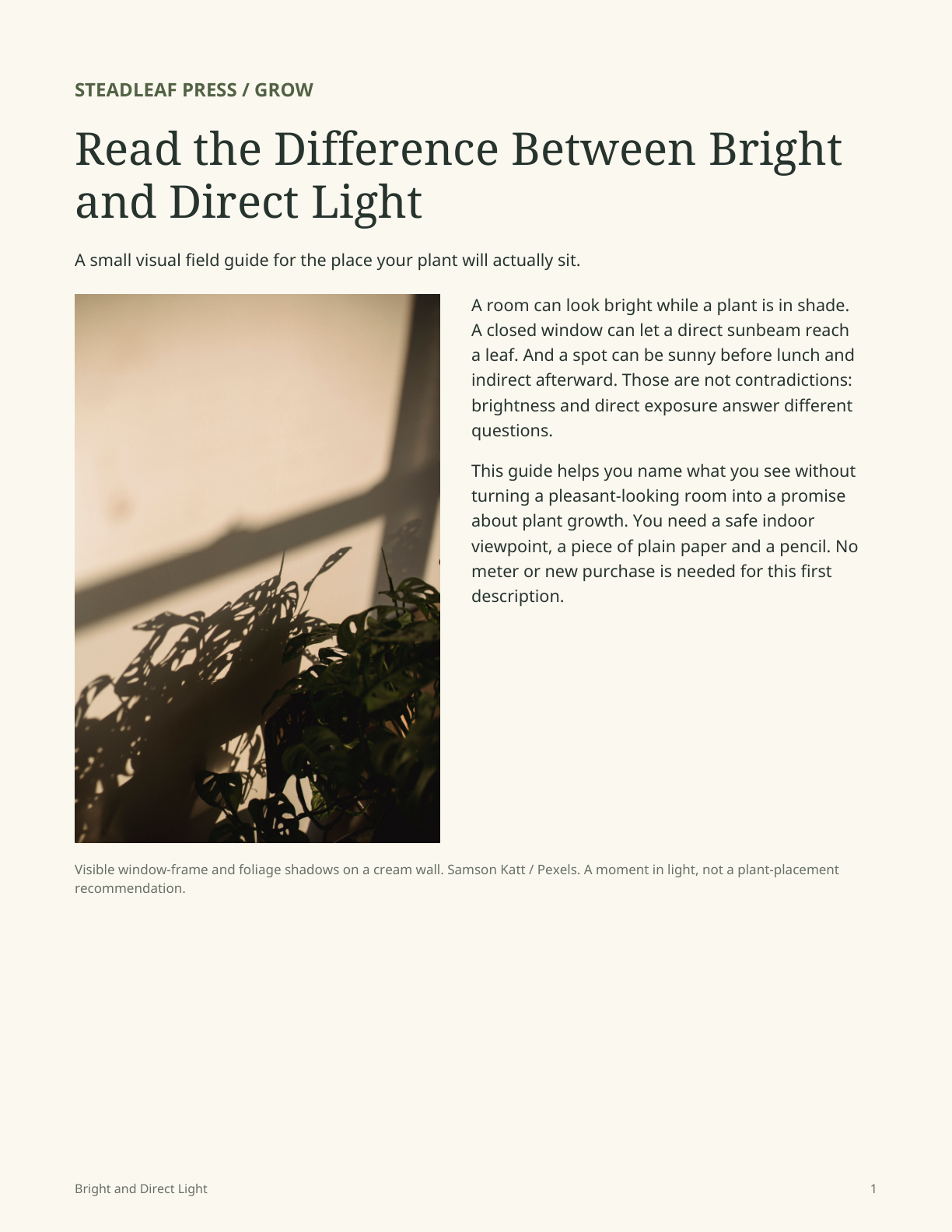
Visible window-frame and foliage shadows on a cream wall. Samson Katt / Pexels. A moment in light, not a plant-placement recommendation.
Bright and Direct Light 1
STEADLEAF PRESS / GROW Two questions, not one ladder
Direct or indirect? Ask whether sunlight is reaching the proposed leaf position as a direct beam. Clear window glass does not automatically make that beam indirect. A patch of sun can remain direct indoors. [1]
How much light? Bright, medium and low are broad descriptions of quantity, not standardized labels that a photograph can certify. Our eyes adapt to dimmer spaces, making brightness comparisons unreliable. A phone camera also changes exposure: a pale photograph is not a light reading. [1]
So “bright” is not the opposite of “direct.” A spot can be bright with direct sun, bright without a direct beam, or indirect and much too dim for the plant you had in mind.
A useful first vocabulary
Description What you are saying What you are not saying
Direct sun at this time A sunbeam reaches the leaf position It lasts all day, or every plant will now tolerate it
Bright indirect, provisionally Plenty of daylight appears to reach the You have measured a plant-specific spot, without a direct beam during light target your checks
Filtered or patchy sun A covering or foliage changes the Every curtain makes light indirect, or beam; some patches may still reach every leaf is shaded the leaves
Shaded or lower indirect light The spot is outside the beam and It is suitable for a “low-light” plant receives less daylight without further checking
These working descriptions can overlap. “Filtered morning sun, then indirect daylight” is often more honest than forcing a whole day into one box.
Bright and Direct Light 2
STEADLEAF PRESS / GROW Example 1: a sun patch is not the whole room
Imagine a narrow bright patch crossing a wooden floor. Put an imaginary pot inside the patch and another beyond its edge. The room is the same; the two plants do not receive the same exposure.
In the illustrated example, A is inside the beam and B is outside it. This is a hypothetical placement diagram, not a measurement of the photographed room. If A's leaves extend past the edge, different parts of the plant may receive different light.
Look at the leaf position, not only the pot base. Sun on the floor underneath a high shelf does not establish that the shelf receives sun. Conversely, a pot in shadow can hold leaves that reach into the beam.
A fairly crisp boundary or directional shadow is a useful clue to a concentrated light source. It is not a calibrated brightness test, and artificial lamps can make shadows too. Notice whether the patch is associated with the window and changing daylight; do not stare toward the sun to trace it.
Good description: “A direct beam reaches the upper-leaf position at 10:20 today.”
Too much certainty: “This is a full-sun room.” You have described one place at one moment, not the entire room or day.
HYPOTHETICAL TOP VIEW / not a measured room Window Shading marks the beam, not intensity.
A - beam reaches leaves B - outside beam
Bright and Direct Light 3
STEADLEAF PRESS / GROW Example 2: daylight without a direct beam
Imagine a plant near an open view of the sky, but outside any sunbeam during your observations. This is a candidate for indirect daylight. Whether it deserves the word bright remains a separate question.
A large, useful daylight opening and a nearby position are promising context. An overhang, neighboring building, tree canopy or small window can change that context. Moving deeper into the room or far to the side of a window often reduces available light more than it seems to our eyes. There is no universal “one metre from the window” boundary. [2]
Good description: “Near the window, no beam at leaf height during my checks; brightness not measured.” This gives you more to work with than “the room feels sunny.”
The photograph on this page illustrates a window-side setting, not a certified bright-indirect site. Exposure settings, season and the hours outside the frame are unknown. Do not compare its printed brightness with another photograph to rank real light levels.
A shadow can help, but cannot decide
You may hold plain paper at the proposed leaf position and briefly cast a hand shadow onto it. Keep your hand at about the same distance from the paper when comparing nearby spots. Notice the edge and direction rather than trying to grade how dark it looks.
A strong edge can support your observation of a beam. A soft or absent shadow does not distinguish bright diffuse daylight from inadequate light by itself. Bright indirect light can still cast a noticeable shadow. Use the window context and repeated observations, not a one-shadow rule. [2]
Window-side context, not certified bright-indirect light. Huy Phan / Pexels.
Bright and Direct Light 4
STEADLEAF PRESS / GROW Example 3: a curtain is a modifier, not a guarantee
A sheer curtain can soften sunlight; a heavy curtain can remove much of the useful daylight. Fabric, weave, folds, gaps and the angle of sunlight matter. A visible strip of sun through a gap still deserves a “direct beam here” note, even when most of the window is covered. [2,3]
Use the curtain as it normally will be used. If you observe with it open but keep it closed for privacy, you have assessed the wrong everyday condition. Record the layer rather than assuming a particular reduction: “behind a single sheer,” “blind partly closed,” or “patch through a gap.”
Good description: “Filtered daylight behind the sheer; a direct patch reaches the left side at this check.”
Too much certainty: “A sheer makes any sunny window safe for any houseplant.” It does not establish plant suitability or the amount of light left after filtering.
In the curtain photograph, the fabric appears between the camera and the plant. That is not evidence that it filters sunlight before the light reaches the leaves. Ask which side of the fabric the plant occupies.
Do not trap a plant against the glass to make room for a curtain. Choose a stable surface, leave foliage clear of cold panes, and keep it away from heating or cooling drafts. [4]
Foreground fabric is not proof of filtered light at the leaves. Sergei Bezborodov / Pexels.
Bright and Direct Light 5
STEADLEAF PRESS / GROW Example 4: no sun does not mean enough light
Consider a shelf well inside the room. You can comfortably read there with the room lights on. That tells you something about human vision, not whether the shelf has enough sustained light for a plant.
“Indirect” only rules out a direct beam in your observation. It is not an assurance of sufficient light. “Low-light tolerant” is not “no light required”: plants still need light, and a tolerated location may produce less dense growth or fewer flowers than a better-lit one. [5]
Good description: “Deep shelf, no beam observed, little obvious daylight; not yet a confirmed growing position.”
Next useful action: compare a safely accessible place closer to the daylight opening, or seek a light assessment for the exact species before buying. Do not buy a plant just to prove that a dark corner works.
A cloudy moment is not a permanent category
Clouds can soften or hide the sun patch. If you see no beam only while the sky is overcast, write that down. Revisit when the weather changes. Window direction is useful context, not a verdict: latitude, season, nearby buildings and obstructions all affect the light that reaches the spot. [1,2]
If you use artificial growing lights, record that separately. This guide describes daylight cues; the brightness of a lamp in a room is not a substitute for checking its plant-light specifications and placement.
NEAR THE OPENING DEEPER IN THE ROOM
Indirect describes the light path. Indirect describes the light path.
Quantity remains a separate question. Quantity remains a separate question.
No beam does not mean low light. No beam does not mean enough light.
Bright and Direct Light 6
STEADLEAF PRESS / GROW Your leaf-position description card
Choose one safely reachable location. Look at the space the leaves would occupy, keeping windows closed and both feet on the floor. Do not climb, lean out or look directly at the sun.
Location and proposed leaf height: __________________________________
Date / season / general location: ___________________________________
Window direction if known: ________________________________________
Normal curtain, blind, screen and outside obstructions: ________________
Check Time and weather Beam at leaf What I actually noticed position?
Earlier __________ Yes / No / Unsure __________________ daylight
Middle of day __________ Yes / No / Unsure __________________
Later __________ Yes / No / Unsure __________________ daylight
These are example checking periods, not a light-duration test. If a period is missed, write “not checked.” Three snapshots cannot establish hours of direct sun.
My most useful description: ________________________________________
Circle any that apply: direct at times / provisionally bright indirect / filtered or patchy / lower indirect / still uncertain.
One uncertainty to resolve: _________________________________________
My next observation or placement change: ___________________________
Bright and Direct Light 7
STEADLEAF PRESS / GROW Try the language
1. A bright room, but a beam reaches the leaves through closed clear glass. Answer: direct at that time; glass alone does not make it indirect.
2. No beam during a cloudy lunch break. Answer: no beam observed then; the clear-weather pattern remains unknown.
3. A sheer covers the window, with a sharp patch through a gap. Answer: filtered context plus a direct patch; check which leaves it reaches.
4. A deep shelf has no beam and looks attractive in a photo. Answer: the photograph does not establish enough light for a plant.
Turn the description into a plant decision
Now compare your description with reliable care information for the exact species or cultivar. Look for whether direct sun is recommended or discouraged, how much and when, and whether your observations cover those periods. “Bright indirect” on a label is a starting point for this conversation, not a precise specification.
If the plant needs protection from direct sun, identify a spot outside the beam and verify it stays that way during relevant hours. If it needs sun, do not count an unobserved period as supplied. If brightness remains uncertain, choose further observation or an appropriate assessment rather than an unsupported yes.
Light is only one part of a workable place. Before bringing a plant home, check its mature space needs, drainage, household pet/child suitability and the safety of the surface. The photographs are not species recommendations or evidence that the pictured plants thrive there.
The sentence to keep: “This is what reaches the leaves, at these times, under these conditions.” A specific, modest description is more useful than a confident label for the whole room.
Bright and Direct Light 8
STEADLEAF PRESS / GROW Sources and photograph notes
Original teaching examples, comparison language and description card by Steadleaf Press. No physical light measurements or plant-growth trials were performed. Source guidance checked 2 November 2026; numerical light bands are deliberately not treated as universal definitions.
1. University of Florida IFAS, Light for Houseplants. Human vision, general light labels, clear glass, weather and season. https://gardeningsolutions.ifas.ufl.edu/plants/houseplants/light-for-houseplants/
2. Iowa State University Extension, How to Care for Houseplants, Light section. Indirect-light shadows, distance, coverings and obstructions. https://yardandgarden.extension.iastate.edu/how-to/how-care-houseplants
3. Montana State University Extension, Houseplant Selection and Care. Bright but sunless and curtain-filtered light as practical descriptions. https://extension-store.montana.edu/montguides/houseplant-selection-and-care
4. University of Connecticut, Growing Houseplants. Leaf clearance from cold glass and avoidance of drafts and heat sources. https://homegarden.cahnr.uconn.edu/factsheets/growing-houseplants/
5. University of Minnesota Extension, Lighting for Indoor Plants and Starting Seeds. Light as a plant requirement; tolerance versus stronger growth and flowering. https://extension.umn.edu/garden-and-home/yard-and-garden/gardening-in-minnesota/lighting-for-indoor-plants
Photographs and diagram
Cover: Samson Katt, Green Plant in Room Under Sunlight. Visible wall and foliage shadows; not measured light or proof of ideal placement. https://www.pexels.com/photo/green-plant-in-room-under-sunlight-5257586/
Window-side example: Huy Phan, Potted Green Indoor Plants. No obvious beam is visible; intensity and later sun are unknown. https://www.pexels.com/photo/potted-green-indoor-plants-3076899/
Curtain example: Sergei Bezborodov, Potted Plant on Window. Foreground sheer illustrates why fabric position matters; no filtering claim for the leaves. https://www.pexels.com/photo/potted-plant-on-window-19045066/
All three are real photographs used under the Pexels License: https://www.pexels.com/license/ Full frames retained, proportionally resized for layout; no recoloring, retouching or generated content. Raw photographs remain private production assets, not standalone stock downloads. No photographer endorsement is implied.
The A/B beam diagram is original and hypothetical: the shaded wedge represents a beam through a window; A is inside it and B is outside. It is not a reconstruction of a photograph or a measured brightness gradient. The paired boxes distinguish indirect light near a window from indirect light deeper inside; neither box certifies sufficient light.