Read Seed Packet Depth and Spacing Directions
Sowing Translation Worksheet
Preserve the packet wording, distinguish each measurement, verify units and local timing, and fill a practical sowing-translation worksheet before sowing.
FREE · No email or checkout
Free practical guide. No email or payment required. The seed-packet photograph provides context, not the invented teaching example or an endorsement.
Read the complete free guide online
Read the instructional text here, or download the complete free PDF above for original diagrams, tables, worksheets and page layout. The original publication is unchanged.
STEADLEAF PRESS / GROW Read Seed Packet Depth and Spacing Directions
Sowing Translation Worksheet
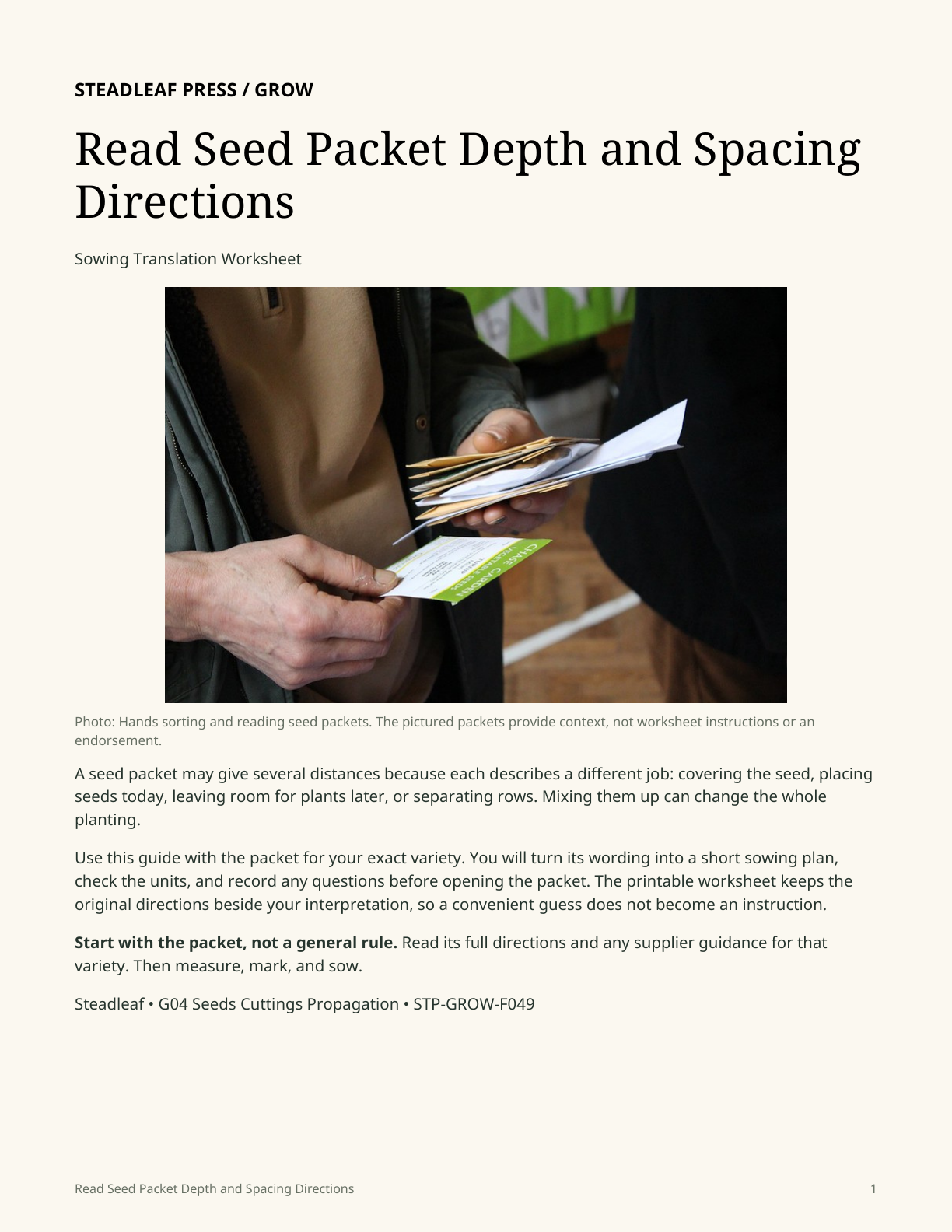
Photo: Hands sorting and reading seed packets. The pictured packets provide context, not worksheet instructions or an endorsement.
A seed packet may give several distances because each describes a different job: covering the seed, placing seeds today, leaving room for plants later, or separating rows. Mixing them up can change the whole planting.
Use this guide with the packet for your exact variety. You will turn its wording into a short sowing plan, check the units, and record any questions before opening the packet. The printable worksheet keeps the original directions beside your interpretation, so a convenient guess does not become an instruction.
Start with the packet, not a general rule. Read its full directions and any supplier guidance for that variety. Then measure, mark, and sow.
Steadleaf • G04 Seeds Cuttings Propagation • STP-GROW-F049
Read Seed Packet Depth and Spacing Directions 1
STEADLEAF PRESS / GROW Find the instructions that belong together
Read the front, back, flaps, and any instructions inside the packet. Layouts differ. Look for the variety name, sowing method, depth, seed spacing, row spacing, and thinning directions. Keep the packet for later reference. [1]
Choose the correct route
Direct sow means sowing where the plants will grow. Start indoors describes a nursery stage; transplant spacing describes the later garden arrangement. Do not use a final garden spacing as a seed-tray instruction. A packet may offer more than one route, each with its own timing and measurements.
Copy the relevant wording before shortening it. Keep words such as “thin,” “per,” “after,” and “when”: they change what a number means.
Read the unit before the number
A double mark (") commonly means inches; a single mark (') means feet. Write these out on your worksheet. Distinguish mm from cm: 10 mm equals 1 cm.
One inch equals exactly 25.4 mm. These are conversions, not recommended sowing depths. [2]
Packet measurement Metric equivalent
1/8 inch about 3.2 mm
1/4 inch 6.35 mm
1/2 inch 12.7 mm
1 inch 25.4 mm
Use one unit system for your working marks. Preserve the original alongside it. If two printed equivalents appear substantially inconsistent, ask the supplier; do not silently choose the larger number.
Read Seed Packet Depth and Spacing Directions 2
STEADLEAF PRESS / GROW Turn depth into a layer above the seed
For a buried seed, think of depth as the soil or growing mix above the seed, up to the settled surface directly over it. It is not the distance from the pot rim or the height of a ridge beside the planting furrow. [3]
Measure the finished covering
1. Prepare a reasonably level surface. In containers, moisten the mix before sowing so it can settle. [4]
2. Find the packet's depth and covering instruction. Mark that distance on a small ruler or label.
3. Place the seed and cover as directed. A deep hole plus an extra mound of covering can bury it farther than intended.
4. Check the layer above one sample placement before completing the whole row or tray. Settle gently rather than packing the surface hard. Do not add an extra mulch layer over newly sown seeds unless crop-specific directions call for it; extra covering changes conditions above the seed. [9]
Surface sow is a different instruction
“Surface sow” or “do not cover” means leaving the seed at the surface. If directed, press it gently into contact with the mix without burying it. “Lightly cover” allows a covering; it is not another way to say “leave uncovered.” Follow the stated material and amount. [5]
Some seeds need light during germination. A packet's full sun symbol describes the growing plant's site, not necessarily whether its seed should be buried. [5, 6]
Do not replace an exact depth or a light requirement with a “two or three times the seed width” rule. If depth is missing or instructions conflict, resolve that question before sowing.
Read Seed Packet Depth and Spacing Directions 3
STEADLEAF PRESS / GROW Keep the spacing measurements separate
Write a noun beside every spacing number. Are you measuring between seeds, between retained plants, between rows, or between groups?
Packet wording What you are arranging
Seeds a stated distance apart Initial positions along the row
Thin to a stated distance Spacing between plants you retain later
Rows a stated distance apart Separate row lines, not seeds within a row
A stated number per hill or mound Seeds or plants in each group
For individual plants, mark positions from one plant center to the next. For rows, measure from one row line to the next. A leaf edge is a moving reference as plants grow.
Thinning changes the population
Thinning means removing excess seedlings so the remaining plants have the intended room. The initial seed spacing and final plant spacing can therefore differ without contradicting each other. Follow the packet's stage for thinning, rather than treating every seedling as a plant that must stay. [6]
A seed count is not a promise of that many established plants. Equally, “thin to one” is a retained-plant instruction, not necessarily an instruction to sow only one seed.
Groups need two kinds of information
Record both the number within each group and the distance between groups. A “hill” can mean a group of seeds rather than a raised mound. [10] Follow any soil-shaping instructions given; do not assume the word alone supplies the shape or dimensions. Supplier directions can separately list seeds per mound and plants to retain per mound. [7]
For broadcasting or a bed-wide pattern, use that method only when specified for the variety and purpose. Do not invent a broadcast rate from row spacing, or discard row spacing simply because the bed is raised. Ask for the appropriate bed arrangement if it is not provided.
Read Seed Packet Depth and Spacing Directions 4
STEADLEAF PRESS / GROW Check timing and resolve missing information
A month printed on a packet is a starting clue, not proof that today's conditions fit. Match the instructions to your location, season, and sowing method.
Translate the timing trigger
Weeks before the local last frost: identify the local reference date, then count backward by the packet's interval for indoor sowing.
After frost risk has passed: check local guidance and the forecast, not just the calendar.
When soil reaches a stated temperature: check soil conditions using locally appropriate measurement guidance; a warm afternoon's air temperature is not the soil temperature.
Soil temperature, air temperature, crop type, and local frost risk all matter. Minnesota Extension's timing advice illustrates why calendar dates alone are insufficient; its regional dates are not a schedule for every garden. [8]
Stop when a key instruction is unclear
Mark not stated instead of filling a gap from memory. Contact the seed supplier or local Extension service if:
“Spacing” has no clear subject and no thinning explanation.
Surface-sowing text conflicts with a printed burial depth.
A group count is given but group spacing is missing.
The packet and current variety-specific instructions disagree.
Send the exact variety name, a photo of both sides, and the conflicting wording. Include whether you are sowing in a tray, container, row, or bed, plus your location. Ask a specific question, such as “Is this the initial seed spacing or the final spacing after thinning?”
Do not treat an estimated emergence window as a guarantee or sow more deeply merely because germination is slow.
Read Seed Packet Depth and Spacing Directions 5
STEADLEAF PRESS / GROW Work through an illustrative packet
Invented teaching example only. This wording and all its measurements are fictional. They are not instructions for any named crop. Direct sow after local frost risk has passed. Cover seeds with 1/4 inch of soil. Sow seeds 2 inches apart in rows 12 inches apart. When seedlings have two true leaves, thin to 6 inches apart.
Exact wording Interpretation Measurements or action
Cover seeds with 1/4 inch of soil Thickness of covering above seed Mark 1/4 inch, equivalent to 6.35 mm
Seeds 2 inches apart Initial seed positions within each Mark successive positions 2 inches row apart
Rows 12 inches apart Distance between row lines Set the next row line 12 inches away
Thin to 6 inches apart Final spacing between retained At the stated stage, keep plants plants roughly 6 inches apart
Check the translation with a short line
Imagine initial marks at 0, 2, 4, 6, 8, 10, and 12 inches. If every mark produced a suitable seedling, retaining those at 0, 6, and 12 inches would demonstrate the final spacing. Actual emergence may leave gaps; this arithmetic does not guarantee a stand or dictate which seedlings will be suitable. The 12-inch row distance never replaces the 2-inch seed distance. The 6-inch thinning distance is not the seed's covering depth. What remains unresolved? This fictional excerpt gives no soil-temperature guidance. Before applying a real packet with the same omission, check variety-specific supplier or local Extension advice. Do not borrow a universal temperature.
Read Seed Packet Depth and Spacing Directions 6
STEADLEAF PRESS / GROW Your sowing translation worksheet
Use one sheet for one variety and sowing method. Copy the wording first, then translate it. Write not stated wherever information is missing. Variety and supplier: ________________________________________ Packet year or lot: ______________ Location: __________________ Method and planting area: ___________________________________
Exact packet wording My interpretation Measurements or action
Depth and covering ____________________ ____________________ _____________________ ____________________ ____________________ _____________________
Initial seed spacing or count ____________________ ____________________ _____________________ ____________________ ____________________ _____________________
Final plants and thinning stage ____________________ ____________________ _____________________ ____________________ ____________________ _____________________
Rows or groups ____________________ ____________________ _____________________ ____________________ ____________________ _____________________
Timing and conditions ____________________ ____________________ _____________________ ____________________ ____________________ _____________________
Question to resolve: ________________________________________ Answer and source: _________________________________________ Final checks before sowing
[ ] I selected the instructions for this variety and method. [ ] Units and conversions are labeled; depth refers to covering. [ ] Surface-sowing or light instructions are preserved. [ ] Seed positions, retained plants, and rows or groups are distinct. [ ] Local timing conditions and unanswered questions are checked. Sown on: ______________ Thinning check due at: _______________
Read Seed Packet Depth and Spacing Directions 7
STEADLEAF PRESS / GROW Sources and further reading
These sources support the decoding principles. Use the current packet for your exact variety; regional or crop-specific examples are not universal planting prescriptions. Sources accessed 2 November 2026.
1. Illinois Extension - Grow confidence when choosing seed packets for your garden. Packet layout and the distinct depth, spacing, and thinning fields.
2. National Institute of Standards and Technology - SI Units Length. Exact inch-to-millimeter conversion.
3. NC State Extension - Tips for Successful Cotton Planting. Depth measurement directly above a seed; cotton-specific depth recommendations are not reproduced here.
4. University of Minnesota Extension - Starting seeds indoors. Settling moistened mix and following packet directions.
5. Iowa State University Extension and Outreach - Germination Requirements for Annuals and Vegetables. Light, darkness, surface pressing, and covering distinctions.
6. University of Nebraska Lincoln Extension - Understanding the Seed Packet. Seed counts, light, timing, plant spacing, and thinning.
7. Botanical Interests - Cinderella Pumpkin Seeds. Original supplier instructions demonstrating separate seed and retained-plant counts per mound.
8. University of Minnesota Extension - A Minnesota guide to garden timing. Local frost risk and soil conditions rather than calendar dates alone.
9. Virginia Cooperative Extension - Seed for the Garden. Variable covering depths and conditional moisture-conserving coverings.
10. UMass Extension - Planting a Vegetable Garden. Hill planting as grouped seeds, distinct from raised mounds.
Cover photograph
Local Food Initiative, Vegetable seed packets (2), CC BY 2.0. Full-frame proportional resizing and JPEG print encoding only. The photograph is not the fictional worked example. No additional restrictions are placed on this CC-licensed photograph.