Read Soil Moisture Before Watering
Get to know the mix beneath your fingertips.
Locate the actual mix surface, make a gentle plant-appropriate contact check and record location, actual depth, feel and uncertainty on a mapped pointcard.
FREE · No email or checkout
Free practical guide. No email or payment required. Photos are contextual illustrations, not proof of measured conditions or physical trials.
Read the complete free guide online
Read the instructional text here, or download the complete free PDF above for original diagrams, tables, worksheets and page layout. The original publication is unchanged.
STEADLEAF PRESS / GROW Read Soil Moisture Before Watering
Get to know the mix beneath your fingertips.
A useful moisture check is more specific than “the soil feels dry.” Where did you touch it? How far below the surface? Was that fine potting mix, a bark chip or a decorative pebble?
This small workshop helps you make one gentle, repeatable observation in an established houseplant's pot. You will finish with a check-point sketch and a short record you can understand next time.
Start with a safely reachable plant in loose, fine-textured potting mix and a conventional draining pot. Bring its care guidance, a pencil and, if helpful, a ruler to use beside your hand. Leave the watering can aside until you have read the observation.
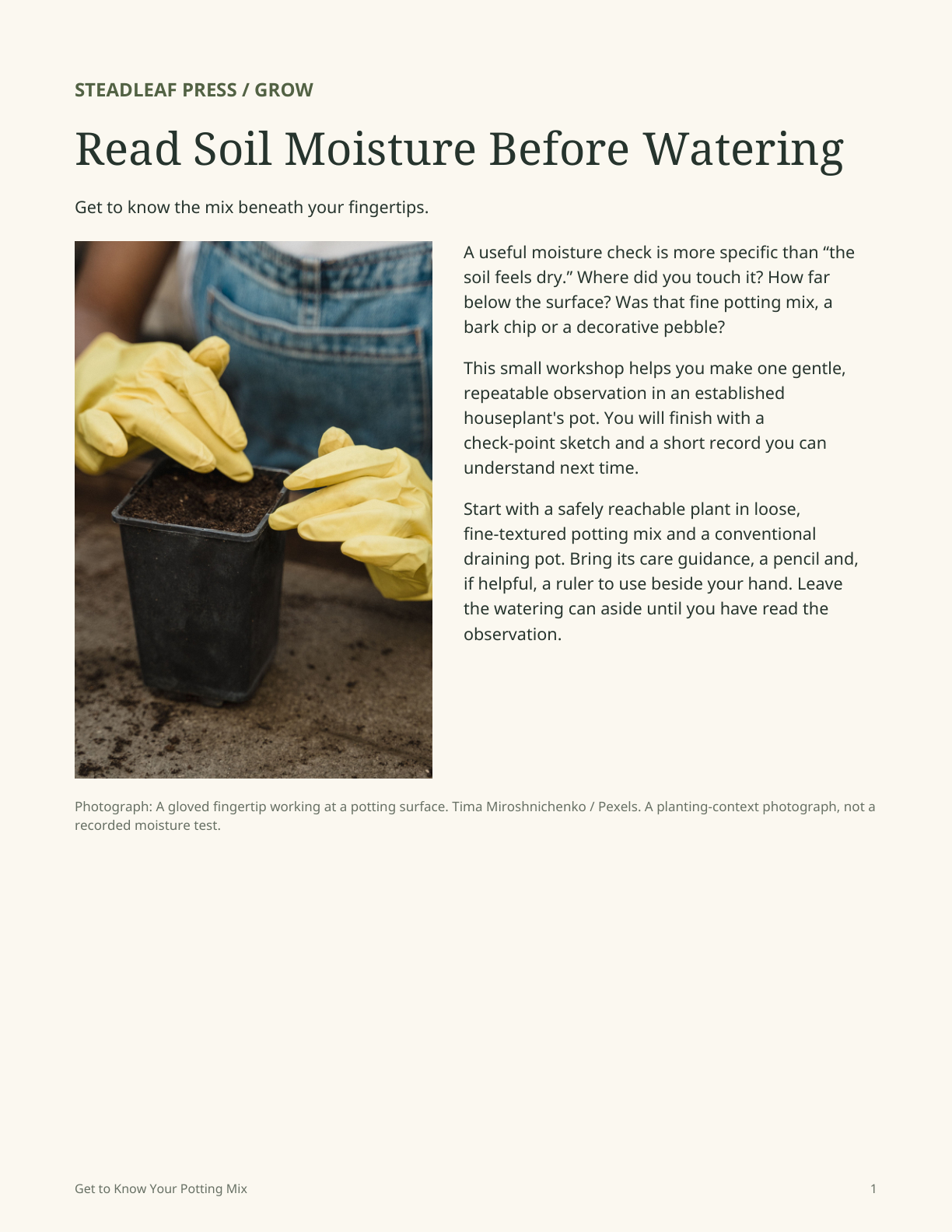
Photograph: A gloved fingertip working at a potting surface. Tima Miroshnichenko / Pexels. A planting-context photograph, not a recorded moisture test.
Get to Know Your Potting Mix 1
STEADLEAF PRESS / GROW Choose what you are checking
Give the plant a name and the mix a description
Find the plant's identity and its watering guidance. “Keep evenly moist” and “allow to dry between waterings” are different goals. A dry-feeling patch is an observation; the plant's needs tell you what to do with it. If those needs are unknown, complete the observation but leave the watering decision open. [1,2]
Describe the material from the bag label or your potting record where possible: ordinary fine-textured mix, coarse bark, a gritty specialist mix, or unknown. Do not identify ingredients from colour. This guide's touch method is easiest where a finger can make gentle contact with loose fine material. Coarse orchid media, reservoirs, seedlings and spiny plants need a different, plant-specific approach.
Choose a sensible depth before you begin
Published advice has different contexts. Wisconsin Extension describes a check about one inch below the surface; Maryland describes about two inches for many houseplants and explicitly notes exceptions. These are not interchangeable promises about every pot. Use guidance suited to your plant and container rather than averaging the numbers or pushing deeper to satisfy a rule. [1,2]
If you are learning with an ordinary established houseplant in a small pot of fine mix, a gentle check about one inch (2.5 cm) below the actual mix surface can be a starting observation, following Wisconsin's general method. It does not certify the moisture farther down or set a universal watering threshold.
Get to Know Your Potting Mix 2
STEADLEAF PRESS / GROW Make a gentle contact check
1. Keep the pot supported. Work where you can comfortably see and reach the mix without lifting the plant, moving a heavy container or bending stems aside. Wear suitable clean, dry gloves and follow the mix's handling advice. Thin gloves can help with delicate work; if you cannot distinguish the feel, record uncertain. Wash your hands afterwards. If touch is unsuitable for you, use an appropriate alternative with plant-specific guidance rather than forcing this method. [5]
2. Find the actual mix surface. The top of decorative stones, the pot rim and the mix surface may be at different heights. Choose an exposed area of mix away from the stem base and visible roots. If a covering prevents safe access, record “covered; not checked” rather than digging through it.
3. Know the depth you mean. Compare the chosen distance with your finger beside a ruler, outside the pot. Knuckles vary. Measure mentally from the mix surface, not from the rim. A ruler stays outside; it is not a probe.
4. Touch without digging. Gently ease a fingertip into loose mix at the chosen spot. Stop at resistance, a root or discomfort. Do not twist, excavate or substitute a sharp tool. Notice the feel at the depth you actually reached, even if it was shallower than planned. [1,2]
5. Describe, then withdraw. Record “feels damp,” “no dampness detected,” or “uncertain,” plus location and actual depth. Replace any lightly displaced loose surface material without pressing it down. If another easy, exposed spot is available and the first result seems doubtful, make one gentle comparison there. No need to pepper the pot with holes.
Keep the check small. No unpotting, root cutting, squeezing handfuls from a planted pot or probing through a drainage hole is needed. Resistance is a reason to stop, not proof of compaction or a root-bound plant.
Get to Know Your Potting Mix 3
STEADLEAF PRESS / GROW Keep location and depth together
A top view answers “where?” A side view answers “how far below the mix?” Both belong in a useful note. The whole root ball is larger than the small area you touched.
TOP VIEW SIDE VIEW
B actual mix surface
depth
stem A Not observed by this touch
Optional accessible spots; avoid visible roots. Illustrative positions and depth; not to scale.
A worked note, not a completed experiment
Hypothetical example: “Plant A, ordinary fine mix. Care reference says allow the upper mix to begin drying. A: front-left, about 2.5 cm below mix surface, feels damp. B: back-right, same depth, feels damp. Surface looks pale. No extra water now; check again as this plant approaches its usual drying point.”
The useful part is the combination of place, depth and feel. The example does not establish a 2.5 cm rule for your plant. If A had felt dry and B damp, retain both observations rather than averaging them into “half wet.”
Get to Know Your Potting Mix 4
STEADLEAF PRESS / GROW Learn the material's language
What you encounter What the observation can tell A useful next move you
Loose fine-textured mix with a Moisture is detectable at that Record the depth and compare with the clear damp feel contact point. plant's care requirement.
Material feels dry at the point No dampness was detected there Check whether this is the relevant depth reached by touch. for that plant before watering.
Fibres or particles cling to a Material has transferred; that Describe the feel as well as the residue. finger or glove alone is not a reliable wet/dry Record uncertain if you cannot tell. threshold.
A bark chunk, gravel or a gap A contact with one coarse piece or Use guidance for that medium; do not between large pieces an air space differs from contact force a deeper search for “soil.” with fine mix.
A hard layer, dense roots or an This touch method cannot reach Stop and record the limitation. Seek a inaccessible surface the intended point gently. suitable alternative.
Potting media differ in water retention and air space. Fine or fibrous ingredients often retain more water than coarse materials, but a photograph or a handful's appearance cannot tell you a mix's actual formulation. Very dry peat- or bark-based media can also resist rewetting, leaving different areas unevenly moist. [3]
One clear limit: Touch is a local, qualitative check, not a moisture percentage. Coolness, colour and crumbs alone do not establish a plant's water need. In a taller pot, upper mix can dry while lower areas remain wetter. A meter is another tool with its own instructions, not an automatic answer to conflicting observations. [3,4]
Get to Know Your Potting Mix 5
STEADLEAF PRESS / GROW Your check-point card
Use this page for one pot. Keep the same depth description and general locations for later comparisons, without repeatedly opening a deep hole. Update the card if the plant is repotted or the mix changes.
Plant / pot: ______________________________________________
Mix description and source of that information: __________________
Plant-specific watering guidance / source: ______________________
Planned check depth below mix surface: _________________________
Sketch: Draw the pot from above. Mark the stem, any covering, your reachable side and one or two possible contact areas. Leave unavailable areas unmarked.
YOUR TOP-VIEW SKETCH
Check point Actual depth / access limit What I felt
A: __________ __________________ __________________
B, only if useful: __________ __________________ __________________
My reading: consistent / conflicting / uncertain / not checked
Next action and reason: _____________________________________
If the result fits the plant's watering requirement, follow its normal watering method. If observations conflict or the plant is unwell despite damp mix, pause extra water and investigate. One gentle check can improve a decision without becoming a diagnosis.
Get to Know Your Potting Mix 6
STEADLEAF PRESS / GROW Sources and photograph credit
This is an original practical learning aid, not a report of physical trials. The contact routine and worksheet organize published guidance into a repeatable observation. Sources checked 2 November 2026.
1. University of Wisconsin-Madison Extension, Houseplant Care. General one-inch touch check and differing moisture preferences. https://hort.extension.wisc.edu/articles/houseplant-care/
2. University of Maryland Extension, Watering Indoor Plants. General two-inch check, exceptions and access limitations. https://extension.umd.edu/resource/watering-indoor-plants
3. Virginia Cooperative Extension, Properly Watering Container Houseplants, SPES-804P. Media texture, uneven rewetting and container-height effects. This guide does not adopt its unpotting demonstration or fixed watering times. https://www.pubs.ext.vt.edu/SPES/spes-804.html
4. Maryland HGIC, House Plant Moisture Meters. A practical advice response, not experimental validation of meter accuracy. https://ask.extension.org/kb/faq.php?id=799752
5. Royal Horticultural Society, Minimising Health Risks in the Garden. Gloves, hand hygiene and handling growing media. https://www.rhs.org.uk/advice/health-and-wellbeing/minimising-health-risks-in-the-garden
Cover photograph: Tima Miroshnichenko, Pexels photo 6509137. Used under the Pexels License. Full frame proportionally reduced and encoded for this guide; no retouching or generated alteration. The image illustrates contact with a potting surface, not plant identity, wetness, measured depth or endorsement by the person pictured.
Photo source: https://www.pexels.com/photo/person-putting-soil-on-a-black-pot-6509137/
License: https://www.pexels.com/license/
Original diagram and worksheet: Steadleaf Press. Photograph is real; no generated images. The accessible text companion includes the diagram description and linearized table content.