Recognize Overwatering Without Guesswork
Put the symptoms beside the pot's story.
Pair a five-symptom comparison with moisture/drainage/care-history evidence and select a proportionate next action or escalation.
FREE · No email or checkout
Free practical guide. No email or payment required. Photos are contextual illustrations, not proof of measured conditions or physical trials.
Read the complete free guide online
Read the instructional text here, or download the complete free PDF above for original diagrams, tables, worksheets and page layout. The original publication is unchanged.
STEADLEAF PRESS / GROW Recognize Overwatering Without Guesswork
Put the symptoms beside the pot's story.
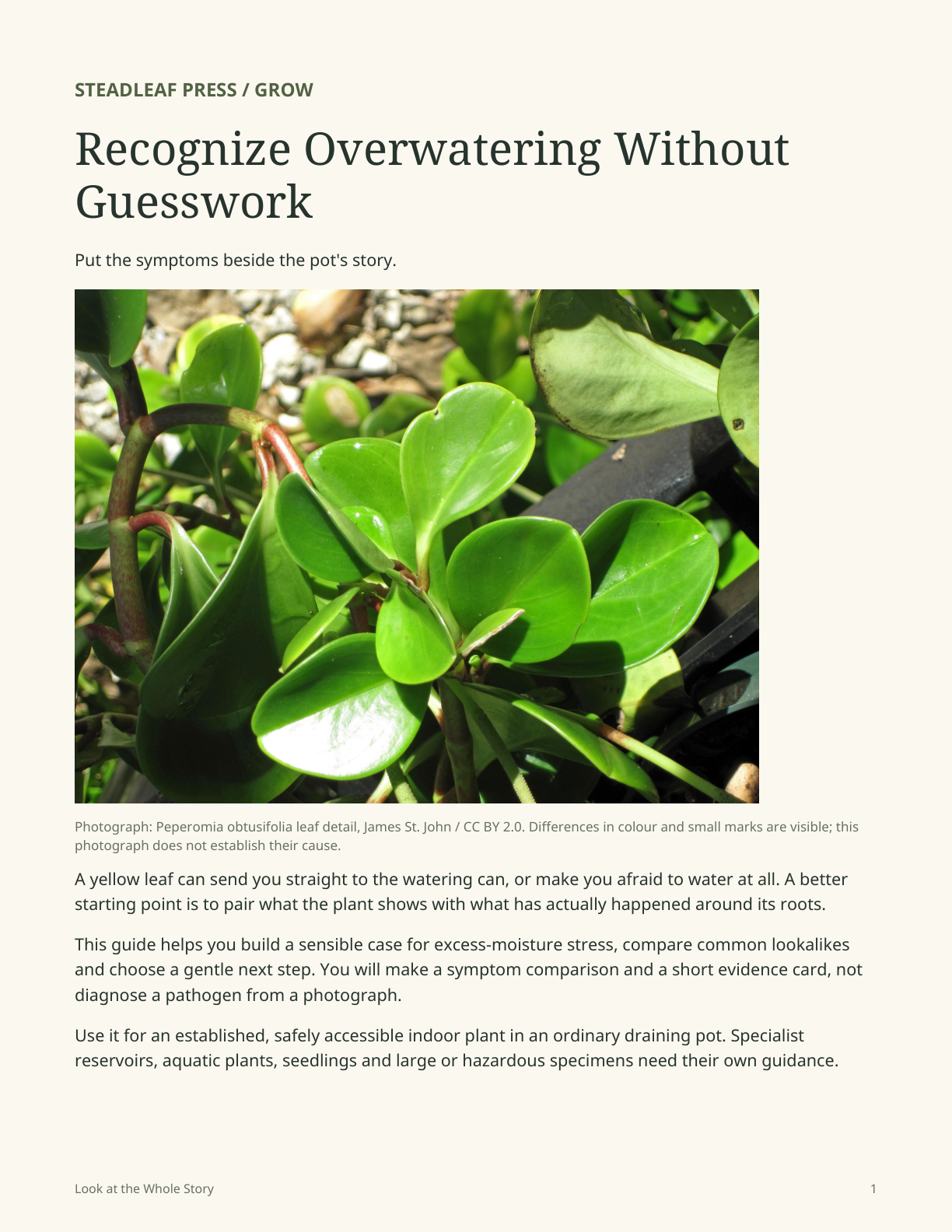
Photograph: Peperomia obtusifolia leaf detail, James St. John / CC BY 2.0. Differences in colour and small marks are visible; this photograph does not establish their cause.
A yellow leaf can send you straight to the watering can, or make you afraid to water at all. A better starting point is to pair what the plant shows with what has actually happened around its roots.
This guide helps you build a sensible case for excess-moisture stress, compare common lookalikes and choose a gentle next step. You will make a symptom comparison and a short evidence card, not diagnose a pathogen from a photograph.
Use it for an established, safely accessible indoor plant in an ordinary draining pot. Specialist reservoirs, aquatic plants, seedlings and large or hazardous specimens need their own guidance.
Look at the Whole Story 1
STEADLEAF PRESS / GROW Start with a pattern, not a verdict
A wet pot is not automatically an overwatered plant
Mix is normally wet after appropriate watering. The concern is an unsuitable excess of moisture that persists or repeatedly returns before this plant's roots have the conditions they need. Frequency, drainage, mix, pot and growing conditions all matter. There is no number of wet days that diagnoses every plant. [1]
Roots need oxygen as well as water. Excess water can reduce oxygen around roots, damage fine roots and interfere with water uptake. That is why a plant with a wet root environment may wilt as though thirsty. This explains a possibility; it does not prove that every damp, drooping plant has root rot. [1]
Keep three kinds of evidence separate
Plant: Which leaves changed first? Is the change spreading? Are leaves limp, dropping, spotted or becoming brown at the edges?
Pot: What is the moisture at a safely reachable, plant-appropriate check point? When was water last added? Is an ordinary inner pot sitting in collected water? What is actually known about its outlets?
Setting: Did the plant recently move, get repotted, receive fertilizer, meet a cold draft or spend time in stronger sun? Can you see insects, webbing or cottony patches without damaging the foliage?
Write observations before naming the cause. A newly watered pot plus one yellow leaf is a very different story from repeated wet checks, continued watering and spreading decline.
Look at the Whole Story 2
STEADLEAF PRESS / GROW Compare the symptom with its companions
Use this chart to choose the next observation. It is deliberately not an “overwatered versus underwatered” picture quiz. Several causes can occur together. [1,2,3]
What you notice Evidence that raises concern about Other explanations to check excess moisture
Limp or wilting leaves Relevant mix remains wet on repeated Too little water, excessive light or heat, checks; water is repeatedly added or root damage and disease can also cause retained around the inner pot. wilt.
Lower or inner leaves Yellowing spreads while an unsuitable Low light, cold exposure, pest feeding yellowing and dropping wet condition persists. and other root problems can produce a similar pattern.
Brown leaf tips or Wet-root history accompanies the Dry mix, low humidity, heat, drafts and margins damage; a new “drink” does not resolve excess salts or fertilizer can also damage the mismatch. edges.
Blisters or corky raised Conditions may favour water uptake Edema is a physiological imbalance, not patches faster than the leaves lose it. an automatic diagnosis of infection or too many watering-can trips. Similar marks need identification.
Slow growth or generally Poor growth occurs alongside the Light, nutrition, pests, season and other pale foliage wet-history evidence, not just a recently root problems also influence growth. watered pot.
A useful distinction: The first column describes an appearance. The second asks whether the root environment supports a particular explanation. The third keeps you from closing the case too early. No single row confirms root rot.
Look at the Whole Story 3
STEADLEAF PRESS / GROW Gather the missing evidence gently
1. Describe the change. Note where it began and whether it is new. Compare with an earlier photograph if you have one. Photograph the whole plant, then a representative leaf in ordinary light; keep the same leaf in later comparisons when practical.
2. Check the actual pot condition. Use a gentle, appropriate moisture check in accessible mix and record the location and depth reached. Do not decide from surface colour alone. Stop at roots or resistance rather than digging to find a preferred answer. A shallow observation leaves deeper areas unknown.
3. Reconstruct recent care. List watering dates you remember, who watered, repotting or feeding, and any location change. Mark missing history as unknown. Do not invent a pattern from one visit.
4. Look at the drainage arrangement. If it is safe to do so, inspect the collection space around a removable inner pot. Empty retained water from an ordinary saucer or cachepot after drainage. Support the pot, not its foliage. Do not tip a heavy pot, poke through roots or remove the plant solely to complete this card. [1]
5. Look for competing clues. Inspect accessible leaf surfaces for actual insects, webbing or cottony material. Consider drafts, changed light and recent fertilizer. Visible pests or spreading spots deserve a separate identification step rather than being relabelled overwatering. [2,3]
You can collect useful evidence without exposing the root ball. If a qualified adviser recommends root inspection, ask for a method suited to the plant and your ability to handle it safely. This guide does not teach root cutting, repotting rescue or chemical treatment.
Look at the Whole Story 4
STEADLEAF PRESS / GROW Choose a proportionate next step
Wet history plus worsening symptoms
Pause additional watering while the relevant mix is still wetter than this plant needs. Remove safely accessible retained water and correct an obvious, accessible collection problem. Keep conditions appropriate and stable; do not try to bake the pot dry with a heater or abrupt full sun. Resume watering according to the plant's needs and actual condition, not after an arbitrary week without water.
Seek plant-specific advice promptly if decline continues, the stem base collapses, tissue becomes soft and dark, or the pot remains unusually wet without further watering. These signs warrant assessment, not a guaranteed rescue recipe. Root damage and pathogens cannot be distinguished by a leaf chart alone. [1,3,4]
Dry evidence fits the plant's needs
If a relevant, safe check finds the mix drier than appropriate for that plant, use its normal watering guidance. An old yellow leaf is not a reason to keep withholding needed water. If the plant fails to improve or symptoms spread, investigate further rather than adding repeated extra drinks.
The evidence does not agree
Keep “unresolved” as a valid outcome. Ask a local extension or horticultural adviser for help with the plant identity, whole-plant and close-up photos, moisture observations and care history. Ask how to submit any sample before cutting or mailing material. No purchase or laboratory test is required to use this guide.
Edema deserves its own question. Moisture uptake and loss can become unbalanced under humid, low-light or poorly ventilated conditions. Review the whole setting rather than treating every blister as proof of infection. Diagnosis may require more than a photograph. [4,5]
Look at the Whole Story 5
STEADLEAF PRESS / GROW Three cases to practise with
These are invented learning examples, not plants tested by Steadleaf.
Case What supports the next step A sensible response
A: wet on repeated checks, watered Several observations support an Stop adding water for now, safely again yesterday, ordinary cachepot excess-moisture concern. They do empty retained water and check holds runoff, lower leaves continue not identify a pathogen. plant-specific care. Seek help if yellowing decline continues.
B: one older leaf is yellow, recent There is not enough evidence to Record the change and compare watering has drained, no prior wet blame overwatering. later; check light, temperature and history recorded other clues rather than impose a drought.
C: tips are brown, mix is dry at the The watering and feeding histories Follow plant-appropriate moisture appropriate point, recent fertilizer both matter; leaf tips cannot care and seek advice on possible was stronger than its label specified separate them alone. salt injury. Do not automatically flush a wet or poorly draining pot.
What improvement looks like
Use the next check to ask whether the root environment is becoming suitable and whether new damage is appearing. Already dead leaf tissue will not turn green again. New, unaffected growth can be a better longer-term sign, but growth speed varies by plant and season. [6]
For a rapidly declining plant, do not wait for new growth before asking for help. For a stable plant, avoid changing light, fertilizer, mix and watering all at once merely to chase a faster answer.
Look at the Whole Story 6
STEADLEAF PRESS / GROW My evidence card
Plant / pot / date: ___________________________________________
Normal moisture preference and trusted source: _________________
Evidence My observation
First change: leaf position, appearance, date __________________________________
Moisture: point, depth, feel, date __________________________________
Recent watering / feeding / repotting __________________________________
Drainage or retained water actually observed __________________________________
Light / temperature change / visible pest clues __________________________________
Working explanation: excess-moisture concern / another concern / unresolved
What is still unknown? ______________________________________
One next action and why: ____________________________________
When to recheck or ask for help: ______________________________
Choose a recheck based on the plant's condition and care needs, not a universal watering interval. Record urgent deterioration as a reason for prompt help. Keep the photo and this card together so the next decision starts with better information.
Look at the Whole Story 7
STEADLEAF PRESS / GROW Sources and photograph credit
Independent guidance checked 2 November 2026. The chart, cases and evidence card are original editorial tools; no physical trial or diagnostic accuracy rate is claimed.
1. University of Maryland Extension, Overwatered Indoor Plants. Oxygen limitation, drought-like symptoms and watering context. https://extension.umd.edu/resource/overwatered-indoor-plants
2. University of California Statewide IPM, Houseplant Problems. Multiple causes of yellowing, wilt, poor growth and brown margins. https://ipm.ucanr.edu/home-and-landscape/houseplant-problems/
3. University of Maryland Extension, Diagnose Indoor Plant Problems. Symptom overlap, pests and root disorders. This guide does not adopt its pruning or chemical-treatment instructions. https://www.extension.umd.edu/resource/diagnose-indoor-plant-problems
4. University of Wisconsin-Madison Extension, Edema. Water-balance disorder, environmental contributors and limits of visual diagnosis. https://hort.extension.wisc.edu/articles/edema/
5. University of Maryland Extension, Edema of Indoor Plants. Blister-like or corky marks and water uptake/loss imbalance. https://extension.umd.edu/resource/edema-indoor-plants
6. Maryland HGIC, Diagnose My House Plant Problem. Existing damaged tissue and later unaffected growth. https://ask.extension.org/kb/faq.php?id=872039
Photograph: James St. John, Peperomia obtusifolia (baby rubber plant) 1, photographed 15 December 2012 at the Sanibel-Captiva Conservation Foundation's Native Plant Nursery. CC BY 2.0. Full frame proportionally reduced and encoded for print; no crop, retouch or generated alteration. No measured moisture or disease diagnosis is attributed to this specimen.
Source: https://commons.wikimedia.org/wiki/File:Peperomia_obtusifolia_(baby_rubber_plant)_1.jpg

License: https://creativecommons.org/licenses/by/2.0/
Steadleaf Press: Original comparison chart, hypothetical cases and evidence card. Real photograph; no generated images. The text companion presents tables in a linear reading order.