Plan Around Reflected Light on a Balcony
Look beyond the sunny patch to the surfaces around your plants.
Draw observed and uncertain light paths, flag potential surface-heat concerns, compare leaf and pot positions, then choose a reversible placement change or defer an unclear site.
FREE · No email or checkout
Free practical guide. No email or payment required. Photos are contextual illustrations, not proof of measured conditions or physical trials.
Read the complete free guide online
Read the instructional text here, or download the complete free PDF above for original diagrams, tables, worksheets and page layout. The original publication is unchanged.
STEADLEAF PRESS / GROW Plan Around Reflected Light on a Balcony
Look beyond the sunny patch to the surfaces around your plants.
A balcony can feel like a tiny garden and behave like several different places. One pot sits beside a pale wall; another catches a moving patch from nearby glass; a third stands over paving that has spent the afternoon in sun. The compass direction alone does not tell the whole story.
This guide helps you sketch those relationships and choose a provisional plant position-or decide what you need to observe before choosing. You will make a reflection and heat-risk map, not calculate temperatures or certify a balcony installation. No meter, app or new equipment is required.
Start with an empty proposed position if you can. A plant does not need to be exposed to a suspected problem just to find out whether the spot is suitable.
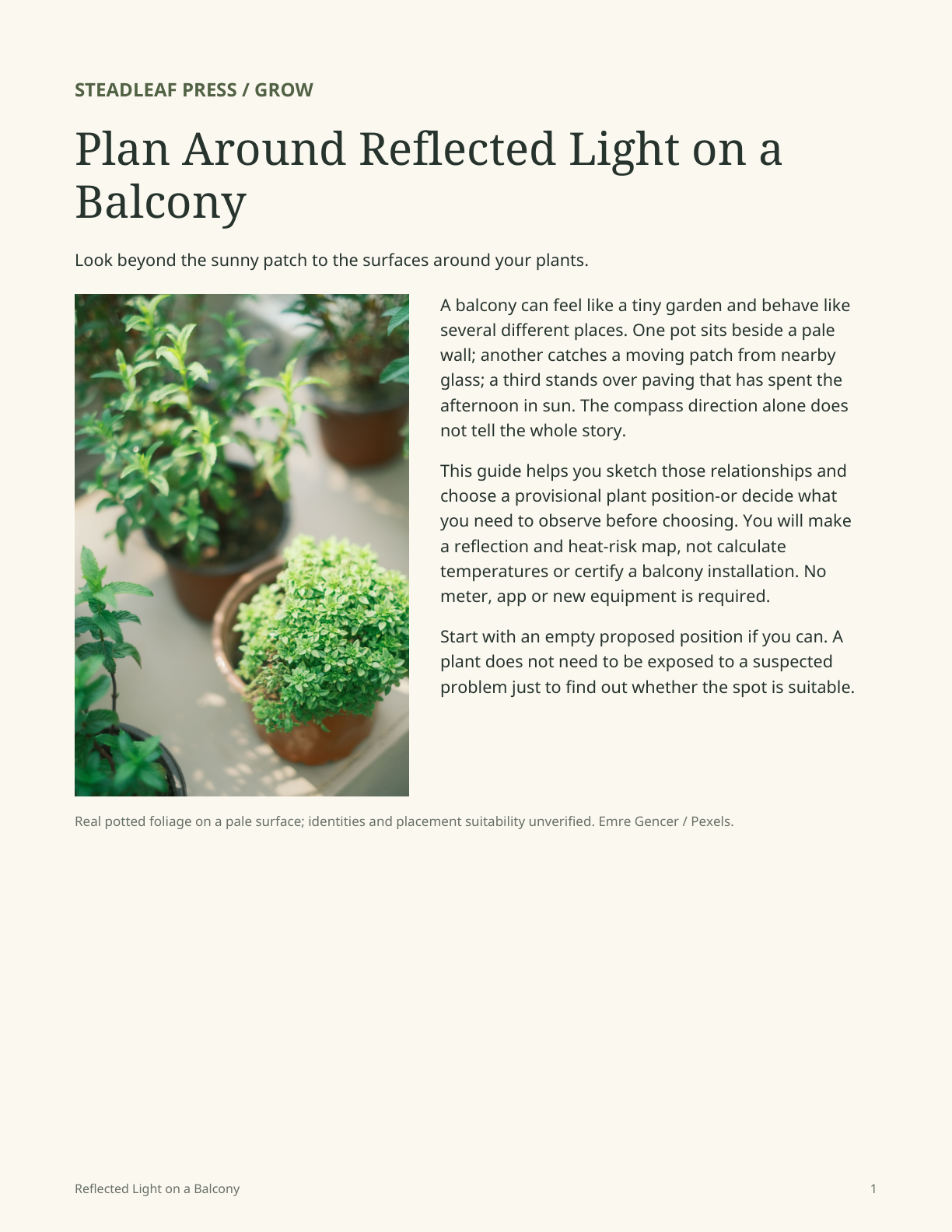
Real potted foliage on a pale surface; identities and placement suitability unverified. Emre Gencer / Pexels.
Reflected Light on a Balcony 1
STEADLEAF PRESS / GROW Separate light from heat
Direct sunlight reaches a place from the sun without first bouncing off another surface. Reflected sunlight reaches it after bouncing from a surface. A rough, pale wall can scatter light in many directions; a smoother reflective surface can send a more directional patch. Real surfaces may combine both behaviours. A bright-looking wall is not a measurement of the light reaching a leaf. [1]
Absorbed energy is different. A wall or paving surface can absorb sunlight, warm up and release heat to its surroundings. Materials with thermal mass can store heat as well. That warmth is not the same thing as a visible reflected patch, and it need not disappear the instant the patch moves away. [2,3]
A surface can reflect some sunlight and absorb some at the same time. Colour alone does not establish its temperature, reflectance across the solar spectrum or ability to release heat. A light-coloured wall may remain cooler than a less-reflective one while still sending light toward nearby foliage. Do not label all pale walls “hot” or all shaded pots “safe.” [2]
Sunlight and shadows on paving and a balustrade. Warm colour is not a heat reading. Jayce Q / Pexels.
Reflected Light on a Balcony 2
STEADLEAF PRESS / GROW Read the reflection and heat-risk diagram
The three original diagrams on the following page separate processes that are often bundled together as “reflected heat.” They are conceptual-not a measured balcony, a ray-tracing calculation or a temperature map.
A. Scattered reflection: sunlight reaches a rough wall; several arrows leave the wall in different directions. Some may reach a nearby leaf position. The fan of arrows means scattering, not a measured distribution or guaranteed increase in plant growth.
B. Directional reflection: sunlight reaches a smooth reflective surface and changes direction. The outgoing patch can cross a plant position as the sun moves. A plain flat reflection is not automatically a focused hot spot; the surface's shape, finish and geometry matter.
C. Surface heating: sunlight is absorbed by a solid surface. Separate curved arrows represent heat leaving the warmed surface. These arrows do not represent visible reflected sunlight. No temperature or safe clearance is implied.
Use the diagrams to ask better questions, not to install reflectors. Do not add mirrors, foil or improvised reflective panels to test or increase exposure.
Reflected Light on a Balcony 3
STEADLEAF PRESS / GROW Three different processes
Conceptual diagrams only. Arrows show relationships, not measured intensity, temperature, duration or safe spacing.
A Scattered reflection
Incoming sunlight
Rough Reflected light spreads wall in several directions.
B Directional reflection
Incoming sunlight
Smooth A redirected path—not surface automatic focusing.
C Absorption and heat release
Sunlight absorbed
Curved arrows: heat leaving the warmed surface, not visible reflected rays.
Solid sun-exposed surface
Gold solid = incoming sunlight. Olive dashed = reflected sunlight. Rust curved = heat release. No plant, balcony or material was physically tested for this guide.
Reflected Light on a Balcony 4
STEADLEAF PRESS / GROW Look from a normal, comfortable place
Choose two realistic positions, A and B, inside the usable balcony area. Mark where the leaves would be and where the pot would stand. The foliage and root container can face different conditions: shading the pot does not necessarily shade the leaves, and the reverse is also true.
From an ordinary safe viewpoint, look at patches on the floor, walls and proposed positions. Never stare at the sun or a dazzling reflection. Do not lean over a railing, climb, reach into a neighbour's space or touch a surface to test whether it is hot. If glare makes observation uncomfortable, stop and mark the path uncertain.
Notice nearby glass, pale or glossy walls, metal panels, paving and dark containers. Record what is visible without assuming every shiny object sends light toward the plant. If you cannot follow a suspected path safely, draw a question mark rather than a confident arrow.
Check at several convenient times when the balcony can receive sun. Include a time when you have previously noticed a reflection, if known. Write the actual date, time, weather and covering positions. Return on another comparable day if a single visit leaves the pattern unclear. Cloud, season and changes in screens or furniture can all alter what you see.
These checks are snapshots, not total daily sun hours. A photo can help you remember the arrangement; its exposure and apparent brightness are not light or temperature readings.
Reflected Light on a Balcony 5
STEADLEAF PRESS / GROW Draw your own balcony map
Use a simple plan view. Add a small side-view note if the source is above or below the leaves. Include the door, railing, fixed walls, overhang, existing shade, drainage route and the two positions. Leave the normal route in and out clear.
Use solid arrows for observed direct sunlight and dashed arrows for an observed reflected path. Label a suspected path with ?. Use H? beside a sun-exposed wall, floor or container that deserves a heat check; it means a potential concern, not a measured hot surface. Record missing observations as unknown.
My site details
Date / town or region / local season: ____________________________
Window or balcony direction, if known: __________________________
A: leaf position and pot position: _______________________________
B: leaf position and pot position: _______________________________
Surfaces, existing shade and overhangs: _________________________
Things I cannot observe safely or do not know: ___________________
Reflected Light on a Balcony 6
STEADLEAF PRESS / GROW My reflection and heat-risk map
Draw the accessible balcony area here. Mark A, B, leaf height, the door route and relevant surfaces. The blank area is for your own observations, not a supplied measurement.
Solid = observed direct path · Dashed = observed reflected path · ? = uncertain · H? = potential surface-heat concern, not measured heat.
Reflected Light on a Balcony 7
STEADLEAF PRESS / GROW Keep a short evidence record
One line per check is enough. Distinguish what you saw from what you suspect. If the source of a patch is unknown, that is useful information too.
Date / actual Weather / shade A: leaf and pot B: leaf and pot Unknown / next time setting observations observations check
Check 1: ______ ______ ______ ______ ______
Check 2: ______ ______ ______ ______ ______
Check 3: ______ ______ ______ ______ ______
Follow-up: ______ ______ ______ ______ ______
Invented example, not a photo description: “Clear afternoon; a bright patch crosses A's proposed leaf position. Nearby glazing is a possible source, but I cannot verify the path safely. B is outside the patch during this check; both pots would stand on sun-exposed paving.”
A useful conclusion is “A needs more investigation; B avoids this observed patch but still has a possible container-heat concern.” It is not “B is cool,” “A gets twice the light,” or “the glazing caused leaf damage.”
Reflected Light on a Balcony 8
STEADLEAF PRESS / GROW Turn the map into a practical choice
A plant's tolerance of ordinary full sun does not necessarily mean it tolerates the added reflected light and heat of a particular site. University of Arizona Extension makes that distinction for its regional landscape conditions; do not convert its compass examples into a worldwide balcony rule. Check the actual species and your local climate. [4]
What your map shows A sensible next step What still needs checking
A repeated bright reflected Consider a position outside that The new position still needs enough patch crosses the proposed observed path, then re-observe it appropriate light; one check does not leaves cover the day
A dark pot would sit in Consider existing shade for the Leaf exposure, drainage, stability and prolonged direct sun container or a different feasible species needs still matter position
A wall or paving receives Keep the potential surface-heat Shade alone does not establish leaf, strong sun, but the nearby concern on the map root or air temperature plant position looks shaded
Only diffuse reflected light is Treat it as part of the site's light, not Appearance alone cannot establish apparent an automatic hazard adequate light or absence of heat stress
Glare, inaccessible surfaces or Defer that position or ask for Do not create a risky experiment to mixed observations leave the local/site-specific help force an answer path unclear
Dark containers can absorb enough heat in summer sun to affect roots and dry the growing medium quickly. Illinois Extension suggests changing placement or shading the container. That is a prompt to assess your pot, not a claim that every dark pot overheats or every terracotta pot stays cool. [5]
Reflected Light on a Balcony 9
STEADLEAF PRESS / GROW Make the change modest and reversible
Prefer using an existing sheltered position over adding a screen or reflector. Move only a container you can handle safely; if it is heavy, get suitable help. Keep drainage and the access route clear. Do not place pots on a railing or change structural loads, fixings or building surfaces as part of this exercise.
Before adding any shade structure, hanging item or heavier container, check the building's rules and the appropriate support requirements. Balconies can be windy, and improvised loose screens can create a new problem. This guide does not approve a fastening method, load or fire-escape arrangement. [6]
Check moisture in the growing medium according to the plant's needs rather than watering automatically because the balcony feels hot. Wind and heat can speed drying; an overhang may keep rain out. More water does not resolve every exposure problem, and leaf scorch can occur even in a watered plant. [6]
If a plant is deteriorating, do not wait for a complete map before seeking help or moving it to a more suitable protected position. Wilting or damaged leaves do not, by themselves, identify reflected light as the cause. Record what changed and reassess; avoid a sudden move into stronger sun merely because that spot is convenient.
My provisional decision
Position: keep A / consider B / defer both / another option: __________
Evidence supporting that choice: _______________________________
Unresolved light or surface-heat concern: ________________________
Plant identity and local care guidance to check: ___________________
One safe, reversible change: ___________________________________
When I will look again, and what I will compare: ___________________
A good balcony plan leaves room for uncertainty-and room for a comfortable garden.
Reflected Light on a Balcony 10
STEADLEAF PRESS / GROW Sources
Primary references checked 2 November 2026. The diagrams, map, record and invented example are original editorial tools. No physical balcony trial, temperature measurement or plant-growth test was performed.
1. OpenStax, University Physics Volume 3, 1.2 The Law of Reflection. Rough and smooth surface reflection; no source figure reproduced. https://openstax.org/books/university-physics-volume-3/pages/1-2-the-law-of-reflection
2. Pacific Northwest National Laboratory, Building America Solution Center: Cool Roofs and Walls to Reduce Heat Gain. Solar reflectance versus thermal emittance and limits of visible colour. Principles only, not a retrofit recommendation. https://basc.pnnl.gov/resource-guides/cool-roofs-and-walls-reduce-heat-gain
3. U.S. Department of Energy, Consumer Guide to Passive Solar Home Design. Absorption and thermal storage; regional building-design prescriptions not adopted. https://www.energy.gov/sites/default/files/2021-08/ES-Passive%20Solar%20design_081321.pdf
4. University of Arizona Cooperative Extension, Choosing the Right Plants, az1153. Site microclimates and reflected-exposure tolerance; Arizona compass examples not universal. https://extension.arizona.edu/publication/choosing-right-plants
5. University of Illinois Extension, Container Gardens: Containers. Dark-container heat absorption and location choices. https://extension.illinois.edu/container-gardens/containers-0
6. Royal Horticultural Society, Roof gardens and balconies. Wind, sun, container drying, overhang rain exclusion and building considerations. No universal watering schedule or structural instruction adopted. https://www.rhs.org.uk/garden-design/roof-gardens-balconies
Reflected Light on a Balcony 11
STEADLEAF PRESS / GROW Photograph credits
Cover: Emre Gencer, “Sunlit Potted Herbs on a Balcony,” Pexels. Green potted foliage and terracotta on a pale surface. The source calls the setting a balcony; the close-up does not establish its mounting, plant identities or growing conditions. No edible-plant or suitable-placement recommendation is implied. https://www.pexels.com/photo/sunlit-potted-herbs-on-a-balcony-32240563/
Interior: Jayce Q, “Leaves over Wall and Pavers,” Pexels. Foliage, pale-yellow balustrade and terracotta paving with sunlight and shadows. The original photograph has a warm, grainy appearance; that colour is not evidence of heat. It shows surfaces to notice, not a verified reflected-ray path or measured temperature. https://www.pexels.com/photo/leaves-over-wall-and-pavers-13378509/
Both are real photographs used under the Pexels License. Full frames retained with proportional layout resizing and PDF encoding; no retouching or generation by Steadleaf. Original photographer processing is not excluded. Raw files are private production assets, not standalone stock downloads. https://www.pexels.com/license/