Refresh Only the Top Layer of Potting Mix
A small, careful refresh. The roots stay where they are.
Choose refresh/leave/investigate, replace only accessible loose surface mix, preserve planting depth and record root-safe stopping limits.
FREE · No email or checkout
Free practical guide. No email or payment required. Photos are contextual illustrations, not proof of measured conditions or physical trials.
Read the complete free guide online
Read the instructional text here, or download the complete free PDF above for original diagrams, tables, worksheets and page layout. The original publication is unchanged.
STEADLEAF PRESS / GROW Refresh Only the Top Layer of Potting Mix
A small, careful refresh. The roots stay where they are.
Sometimes a plant can stay in its present pot while a little old material at the surface is replaced. This is a modest maintenance task, not a miniature repotting session: keep the plant upright, work only where loose mix comes away easily, and finish at the same planting level.
This guide helps you choose a suitable pot, prepare fresh mix and follow a gentle remove / replace / check sequence. Use the work card to record what you actually did, including a perfectly sensible decision to leave the surface alone.
Start with one established indoor foliage plant in ordinary potting mix and a draining container. Specialist orchid media, cacti, bulbs with exposed necks, carnivorous plants, seedlings and self-watering systems need their own instructions. No plant needs a refresh merely because a date has arrived.
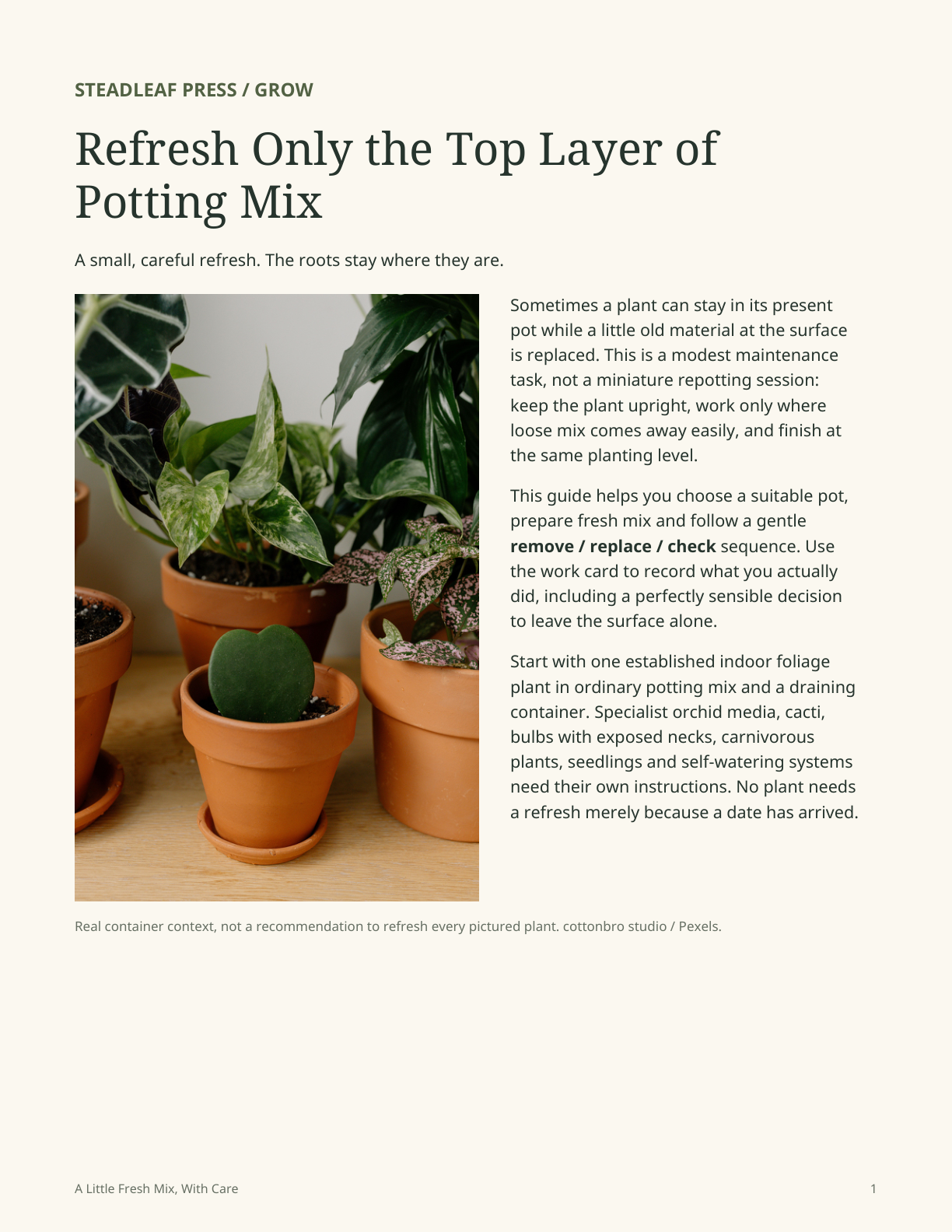
Real container context, not a recommendation to refresh every pictured plant. cottonbro studio / Pexels.
A Little Fresh Mix, With Care 1
STEADLEAF PRESS / GROW Choose a good candidate
Surface replacement is an option for some established houseplants, particularly when a full repot is difficult or more growing space is not currently wanted. Purdue and the New York Botanical Garden describe replacing some surface mix with fresh material. It does not create more room for crowded roots. [1,2]
Your pot today Best next step
Plant is stable; watering and drainage work; a little loose A gentle refresh may suit it. Identify the original soil surface mix is accessible line before starting.
Surface is sound and the plant is doing well Leave it alone. A tidier-looking surface is not a requirement for healthy growth.
Roots form a mat at the surface, or every small scoop Stop. There is no safe loose layer to replace with this catches roots method.
Mix stays persistently wet, water bypasses a dry root Investigate the cause. A fresh cap will not repair the ball, plant declines or roots crowd the pot entire root environment.
Crust returns repeatedly, or pests/disease are suspected Identify the problem before covering it. A surface refresh is not treatment for every residue or pest.
A white crust can be mineral or fertilizer salts. Its source may need attention; severe accumulation can require broader treatment or repotting. Do not assume every pale surface patch is the same thing. [3]
A Little Fresh Mix, With Care 2
STEADLEAF PRESS / GROW Set out a small working tray
Have a clean shallow tray, a clean small blunt spoon or scoop, gloves, a container for removed material and a little suitable fresh potting mix ready. Work at a comfortable height. Leave a heavy pot safely in place if its surface is accessible; do not drag or lift it by the plant.
Choose compatible fresh mix. Use a prepared medium appropriate for the plant and similar in intended use to the existing mix. Check its label for preparation and included fertilizer. If the old medium is unknown or visibly very different, pause and ask before making a strongly contrasting layer. This is not the moment to add garden soil, manure, food scraps or a homemade ingredient recipe. [4]
Prepare only a small amount. If the label calls for premoistening, do it in the tray, not by flooding the pot. Aim for workable material rather than airborne dust or dripping wet mix. Keep the unused bag closed. [4,5]
One handling habit worth keeping
Use good ventilation; keep your face away from a newly opened bag. Wear gloves, minimize dust and follow the label and local health guidance on protective equipment, including respiratory protection where advised. Keep food and drinks away, tidy spills without raising dust, and wash your hands afterwards. Keep children and pets away from the work area. [5]
Material-handling context only, not a mix test or a demonstrated refresh step. Sasha Kim / Pexels.
A Little Fresh Mix, With Care 3
STEADLEAF PRESS / GROW The gentle surface-refresh sequence
1. Save the level
Before removing anything, look at where the mix meets the stem base or crown and how much space remains below the rim. A quick side photograph helps. The aim is to preserve that planting depth, not to fill the pot to the top. If the plant has already sunk too deeply, this method will not lift it back into position. [4]
2. Clear only loose debris
Lift away detached fallen leaves you can reach easily. Leave attached roots, stems and living growth in place. If an existing decorative layer hides the surface and cannot be removed gently, postpone the task rather than digging through it blindly.
3. Take a little, then look
Use the blunt spoon nearly flat to lift a small amount of loose surface mix into the waste container. Work in accessible open areas, away from the crown. Recheck after each small scoop. Stop at visible roots, resistance or movement of the plant. Do not comb, scrape or pull mix out of a root mat.
There is no depth target to reach. Published examples differ with plant and container size; this beginner sequence deliberately lets accessible loose mix set the limit. If only a tiny amount is removable, that is the whole job. [1,2]
4. Replace, rather than build a mound
Add compatible fresh mix in small spoonfuls where material was removed. Ease it into place without pressing hard. Restore the previous surface level around the plant while keeping the crown or stem base at its original soil line. Preserve room below the rim for watering. Do not cover deliberately exposed plant parts or pile mix up the stem. [4]
5. Check before clearing up
The plant should still be steady, with no new roots left bare by your work and no raised collar of mix around the stem. If you accidentally uncover a root that was previously covered, replace the loose cover gently at the original level and stop further removal there. Bag the removed material for disposal under local rules; keep it out of your fresh-mix bag.
A Little Fresh Mix, With Care 4
STEADLEAF PRESS / GROW Finish with ordinary care
Return the pot to its usual suitable position and clear loose mix from its rim and surrounding surface. Keep outlets unobstructed. Record the fresh mix used, especially whether it contains fertilizer.
A fresh surface does not tell you how wet the old root zone is. Continue checking moisture for the actual plant rather than watering because you have just worked on it. When watering is needed, apply it gently, allow runoff to escape and empty the saucer or outer cover. Do not leave an ordinary draining pot standing in collected water. [6]
Do not add an automatic fertilizer dose as a finishing touch. Follow the plant's needs and the mix/fertilizer labels, accounting for any fertilizer already included. Replacing a thin surface layer is neither a guaranteed nutrient programme nor a cure for a depleted or damaged root system. [3,4]
A small result is still a result
Invented example: you remove a few spoonfuls from open areas, then meet fine roots near the crown. You leave those areas alone, replace only what came away safely and record the limit. The goal is a careful refresh, not a uniformly excavated ring.
At the next normal care check, look for washout, exposed roots, persistent crust or changed wetting behaviour. If the plant deteriorates or a problem returns, assess the cause rather than repeating the scrape-and-cover routine. Stop sooner whenever roots or plant stability are at risk.
A Little Fresh Mix, With Care 5
STEADLEAF PRESS / GROW Your surface-refresh card
Plant / identity: ____________________________________________
Date / reason for considering a refresh: _______________________
Decision: refresh a loose layer / leave alone / investigate first
Fresh mix and any included fertilizer: _________________________
Checkpoint What I actually observed or did
Original planting line and headspace __________________________________
Accessible loose areas / roots to avoid __________________________________
Material removed / reason I stopped __________________________________
Replacement level / crown left clear __________________________________
Moisture check and next care action __________________________________
Next normal check: __________ Watch for: _____________________
Question or unresolved issue: ________________________________
Keep the card with your plant notes. A blank, skipped or "stopped at roots" entry is more useful than a made-up measurement. This record is for your own work, not a completed Steadleaf trial.
A Little Fresh Mix, With Care 6
STEADLEAF PRESS / GROW Sources
Primary references checked 2 November 2026. The sequence and card are original, conservative editorial adaptations; no physical plant trial is claimed.
1. B. Rosie Lerner, Purdue University Cooperative Extension, Indoor Plant Care, HO-39-W, p.3. Surface replacement as an alternative to continued upsizing. Only this principle is used; no old sterilizing recipe or fixed watering/feeding schedule. https://www.purdue.edu/hla/sites/yardandgarden/wp-content/uploads/sites/2/2016/10/HO-39.pdf
2. New York Botanical Garden, Houseplants: Tips and Troubleshooting. Careful spoon removal and replacement for plants difficult to repot. Its example depth is not a universal target. https://libguides.nybg.org/houseplantcare
3. University of Maryland Extension, Mineral and Fertilizer Salt Deposits on Indoor Plants. Causes, prevention and limits of cosmetic surface work. https://extension.umd.edu/resource/mineral-and-fertilizer-salt-deposits-indoor-plants
4. NC State Extension, Extension Gardener Handbook, chapter18: Plants Grown in Containers. Planting depth, medium preparation, surface exposure and plant-specific medium needs. https://content.ces.ncsu.edu/extension-gardener-handbook/18-plants-grown-in-containers
5. Royal Horticultural Society, Minimising health risks in the garden. Potting-media handling, dust reduction and hygiene. https://www.rhs.org.uk/advice/health-and-wellbeing/minimising-health-risks-in-the-garden
6. Illinois Extension, Watering. Plant- and condition-led moisture checks and free drainage. https://extension.illinois.edu/houseplants/watering
A Little Fresh Mix, With Care 7
STEADLEAF PRESS / GROW Photograph credits
Cover: cottonbro studio, Indoor Plants on Clay Pots. Real foliage and terracotta-coloured containers on wood, with some mix surfaces visible. This is contextual photography, not evidence that these plants need the same care or a surface refresh. Source: https://www.pexels.com/photo/indoor-plants-on-clay-pots-9707258/
Interior: Sasha Kim, Person Holding Clear Glass Jar With Soil. Gloved hands hold a jar of material in a plant-filled indoor setting. It illustrates material handling, not a compaction test, verified mix composition or a demonstrated step in this guide. Source: https://www.pexels.com/photo/person-holding-clear-glass-jar-with-soil-9413692/
Both photographs: Pexels License, https://www.pexels.com/license/
Changes: full frames retained; proportional print-resolution reduction and PDF image encoding only. No retouching, recolouring or generative changes. Original photographer processing is not excluded. No endorsement or Steadleaf physical trial is implied. The private stock originals are not separate customer downloads.