Replant a Top-Heavy Houseplant Without Overpotting
Give the plant a steadier home, not simply a bigger one.
Separate base and support concerns from root-space need, compare suitable containers and choose a modest replanting, undisturbed-root option or help-first plan.
FREE · No email or checkout
Free practical guide. No email or payment required. Photos are contextual illustrations, not proof of measured conditions or physical trials.
Read the complete free guide online
Read the instructional text here, or download the complete free PDF above for original diagrams, tables, worksheets and page layout. The original publication is unchanged.
STEADLEAF PRESS / GROW Replant a Top-Heavy Houseplant Without Overpotting
Give the plant a steadier home, not simply a bigger one.
A tall crown of leaves can outgrow the balance of a light pot long before it needs a great deal more potting mix. The useful question is not just “Which pot is larger?” It is “What needs to change: the base, the root space, or the plant's support?”
Use this guide to make a stabilization and pot-selection plan for one manageable, established indoor foliage plant. You may finish with a modest replanting, a container change that preserves root space, or a decision to get help first.
Large floor specimens, spiny plants, brittle stems, damaged roots and attached climbing structures need more specific handling. If you cannot control the whole plant and container comfortably, stop before unpotting. A safer plan is a useful result.
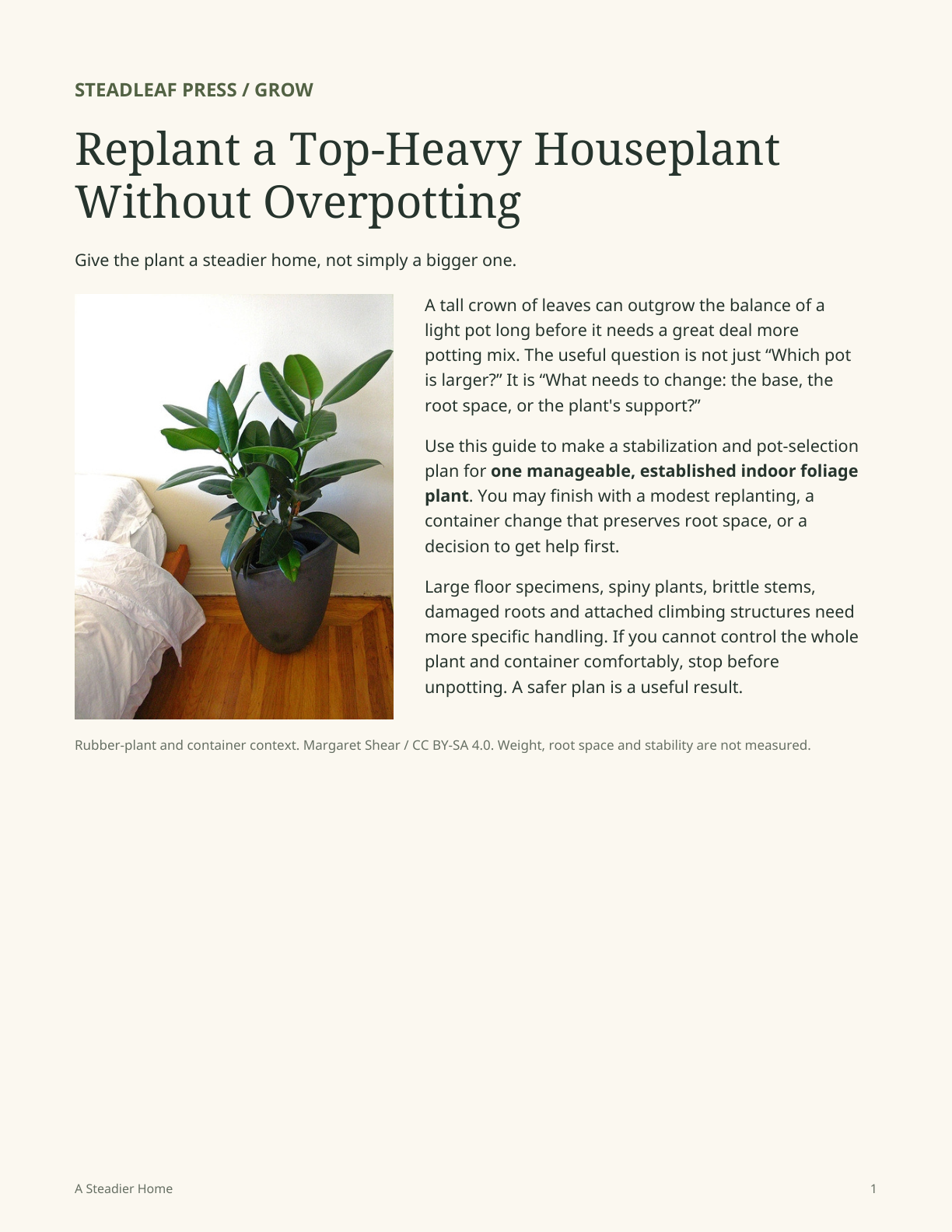
Rubber-plant and container context. Margaret Shear / CC BY-SA 4.0. Weight, root space and stability are not measured.
A Steadier Home 1
STEADLEAF PRESS / GROW Separate the two decisions
Look at the plant where it stands, without pushing it to see whether it will fall. Keep people and pets clear of an already unstable plant. Check the supporting surface and clear the route before any necessary move.
First: what looks unstable? Note a narrow base, a rocking or cracked container, an uneven stand, or foliage that extends far to one side. A leaning stem is not the same as a tipping pot: it may reflect the plant's natural habit or need for a suitable support. Increasing soil volume does not answer every one of these problems.
Second: do the roots need more room? Use what you already know from routine care and any recent root inspection. A dense root mass occupying the container is relevant evidence; height alone does not reveal the root ball. Do not unpot solely to fill in this worksheet. If replanting is justified and safe, assess the roots as part of that job. [1,4]
Tall foliage and an ordinary pot: Cindy Christian / CC BY 4.0. Appearance does not establish top-heaviness.
What you know A useful direction
Root space is adequate; the light or narrow pot is the Look for a more substantial, broad-based draining pot concern with comparable usable root space. Consider whether a secure, accessible outer container could solve the problem without disturbing roots.
Roots have filled the pot and the whole plant is Plan a modest increase in root space together with a manageable more suitable base.
The stem or climbing structure needs support Resolve the plant-specific support plan first; do not bury the stem more deeply to make it stand up.
The plant is unsafe to handle, stuck, or its condition is Arrange knowledgeable help before removal or uncertain purchase.
These are planning branches, not a diagnosis from appearance. Choose the smallest intervention that addresses the actual problem.
A Steadier Home 2
STEADLEAF PRESS / GROW Compare pots on four useful features
Iowa State recommends broad, wide-based pots for taller plants. Montana State notes that heavier ceramic can be useful for a plant prone to tipping. Neither feature makes every arrangement safe: consider the plant, support surface and your ability to move the finished pot together. [1,2]
Feature What to compare before choosing
Base and contact A sound, flat base that sits securely on the intended level surface; avoid a narrow pedestal or an unstable stand.
Material and handling More substantial construction may help, but added weight must remain manageable during watering, drainage and future care.
Usable root space Compare inside width and depth, not just the outside rim or decorative silhouette. Allow only the growth space the plant actually needs.
Drainage and access A clear outlet and a collection arrangement you can inspect and empty. If using an outer pot, the inner pot must remain removable and free of standing runoff.
More pot is not always more help. RHS explains that a large amount of fresh mix around a small root system can remain wet too long, particularly with slow growth or excessive watering. A larger container does not inevitably cause harm, but choosing one only for its visual bulk can create an avoidable care problem. [3]
No single diameter increase or pot-to-plant height ratio fits every plant. Compare the actual root ball, growth habit and inside dimensions. A broad outer profile can hide a smaller cavity; a tall narrow pot can add unwanted depth. Keep these measurements separate on your card.
Skip a layer of stones as a drainage or stability shortcut inside the growing pot. Iowa State warns that a gravel layer does not improve the root-zone drainage arrangement. Choose the container itself for the job rather than using extra soil or buried ballast to compensate. [1]
A Steadier Home 3
STEADLEAF PRESS / GROW Replant only when your plan is ready
For a sound, manageable foliage plant whose roots can be handled without force, this is the basic sequence. Check its own care guidance for timing, mix and aftercare; active growth is generally a better opportunity than slow seasonal growth. [3]
1. Prepare the destination. Have the clean, sound draining pot, appropriate prepared mix, collection tray and clear working area ready. Plan where the plant will rest while you work. Read the mix label, wear suitable gloves and work in a ventilated space. Keep your face away from the bag opening, limit dust and wash hands afterwards. Keep the job separate from food preparation. [5]
2. Release without a tug-of-war. Support the root ball as you gently ease the old container away. Protect the foliage and do not use stems as carrying handles. If roots or the container are stuck, stop for help rather than pulling harder, breaking the pot or cutting blindly.
3. Confirm the fit. Compare the exposed root ball with the planned cavity. If roots are damaged, unusually soft, or densely tangled beyond a straightforward transfer, pause for plant-specific advice. Do not trim roots merely to make your chosen pot fit.
4. Keep the planting level. Add enough suitable mix below the root ball to hold its previous planting depth, then fill around it gently. Leave watering space below the rim. Do not heap mix over the stem base or ram it down to hold a leaning plant upright. Texas A&M describes retaining the original planting depth and lightly firming the surrounding medium. [4]
5. Finish the care arrangement. Water and settle the plant according to its species and mix instructions; allow excess to drain and empty collected runoff. Confirm that the pot sits securely in its final place without a push or tilt test. [1]
6. Recheck during normal care. Notice settling, a developing lean, loose support or water that is awkward to remove. Reassess rather than adding more mix over the stem or keeping the pot wet for extra weight.
A Steadier Home 4
STEADLEAF PRESS / GROW Make your stabilization plan
Record observations, not a test load. There is no need to provoke a wobble, weigh a large specimen or remove a healthy plant just to complete this card.
Plant / date: _______________________________________________
The problem I actually observed: ______________________________
Current inside pot width / depth, if safely known: _________________
Root-space evidence, or “not yet known”: _______________________
Decision My plan
Base and supporting surface __________________________________
New inside width / depth and reason __________________________________
Material and manageable handling __________________________________
Drainage, collection and emptying access __________________________________
Plant support or help needed before starting __________________________________
Chosen route: keep roots undisturbed / replant modestly / get help first
Mix and plant-specific care reference: __________________________
First normal-care recheck: ____________________________________
Invented example: a gardener has recently seen that a small foliage plant's roots still have space. Its lightweight pot is the concern. They compare a broad-based, heavier draining pot with similar internal dimensions rather than doubling the volume of mix. If the new pot would make emptying runoff difficult, they keep looking or revise the arrangement. No stability measurement is implied.
A Steadier Home 5
STEADLEAF PRESS / GROW Sources
Primary guidance checked 2 November 2026. The two-decision framework, four-feature comparison and planning card are original editorial adaptations. No lifting trial, tipping test or plant-growth experiment was performed.
1. Iowa State University Extension and Outreach. How to Care for Houseplants. Broad-based pots, modest changes of container size, drainage and the limits of gravel layers. https://yardandgarden.extension.iastate.edu/how-to/how-care-houseplants
2. Montana State University Extension. Ask Steward: How do I repot a houseplant? Heavier ceramic as one option for taller plants prone to tipping. This guide does not adopt its universal size, bleach, root-cutting or mix-reuse recipes. https://www.montana.edu/extension/lila_extn/askstewardrepothouseplant.html
3. Royal Horticultural Society. Overpotting. Conditional risks from excessive fresh medium, growth rate and watering; modest potting-on rather than a large jump. https://www.rhs.org.uk/prevention-protection/overpotting
4. Texas A&M Aggie Horticulture. Media, Repotting & Containers. Root-space assessment, drainage, original planting depth and gentle filling. Its bleach, detergent and forceful removal suggestions are not instructions in this guide. https://a ggie-horticulture.tamu.edu/ornamental/a-reference-guide-to-plant-care-handling-and-merchandising/media-repotting-co ntainers/
5. Royal Horticultural Society. Minimising health risks in the garden. Potting-media dust precautions, label instructions and hand hygiene. https://www.rhs.org.uk/advice/health-and-wellbeing/minimising-health-risks-in-the-garden
A Steadier Home 6
STEADLEAF PRESS / GROW Photograph credits
Cover: Houseplant (Ficus elastica), Margaret Shear, via NC State Extension Plant Toolbox. A rubber plant in a dark outer container beside cream upholstery and a wooden floor. The visible inner rim and outer profile do not establish root space, material, weight, drainage or stability.
Source: https://plants.ces.ncsu.edu/plants/ficus-elastica/ License: CC BY-SA 4.0. https://creativecommons.org/licenses/by-sa/4.0/
Interior: Dracaena fragrans, Corn Plant, houseplant view, Cindy Christian, via NC State Extension Plant Toolbox. Tall strap-like foliage above an ordinary pot and clear saucer beside a wooden cabinet. This illustrates the relationship of foliage and container, not a top-heaviness diagnosis or an approved placement.
Source: https://plants.ces.ncsu.edu/plants/dracaena-fragrans/ License: CC BY 4.0. https://creativecommons.org/licenses/by/4.0/
Both photographs are genuine, with plant identities attributed to the source. Whole frames are retained and proportionally sized, with JPEG/PDF encoding; no crop, retouching, generated alteration or staged stability test. The cover photograph and its technical adaptations remain CC BY-SA 4.0; the interior photograph remains CC BY 4.0. No additional restrictions or endorsement are implied.
Check the identity and handling precautions of your own plant, including sap and household access. The pictured species are not pet-safe recommendations. Keep plants, loose mix and runoff away from children and pets.