Rescue a Leggy Seedling
Check the stem before changing the growing setup
Separate stretching from collapse, correct growing conditions, choose stage-appropriate handling, distinguish tomato burial from other crops and make a rescue or replacement plan.
FREE · No email or checkout
Free practical guide. No email or payment required. Photo is contextual, not a diagnosed leggy seedling, spacing template or rescue result.
Read the complete free guide online
Read the instructional text here, or download the complete free PDF above for original diagrams, tables, worksheets and page layout. The original publication is unchanged.
STEADLEAF PRESS / GROW Rescue a Leggy Seedling
Check the stem before changing the growing setup
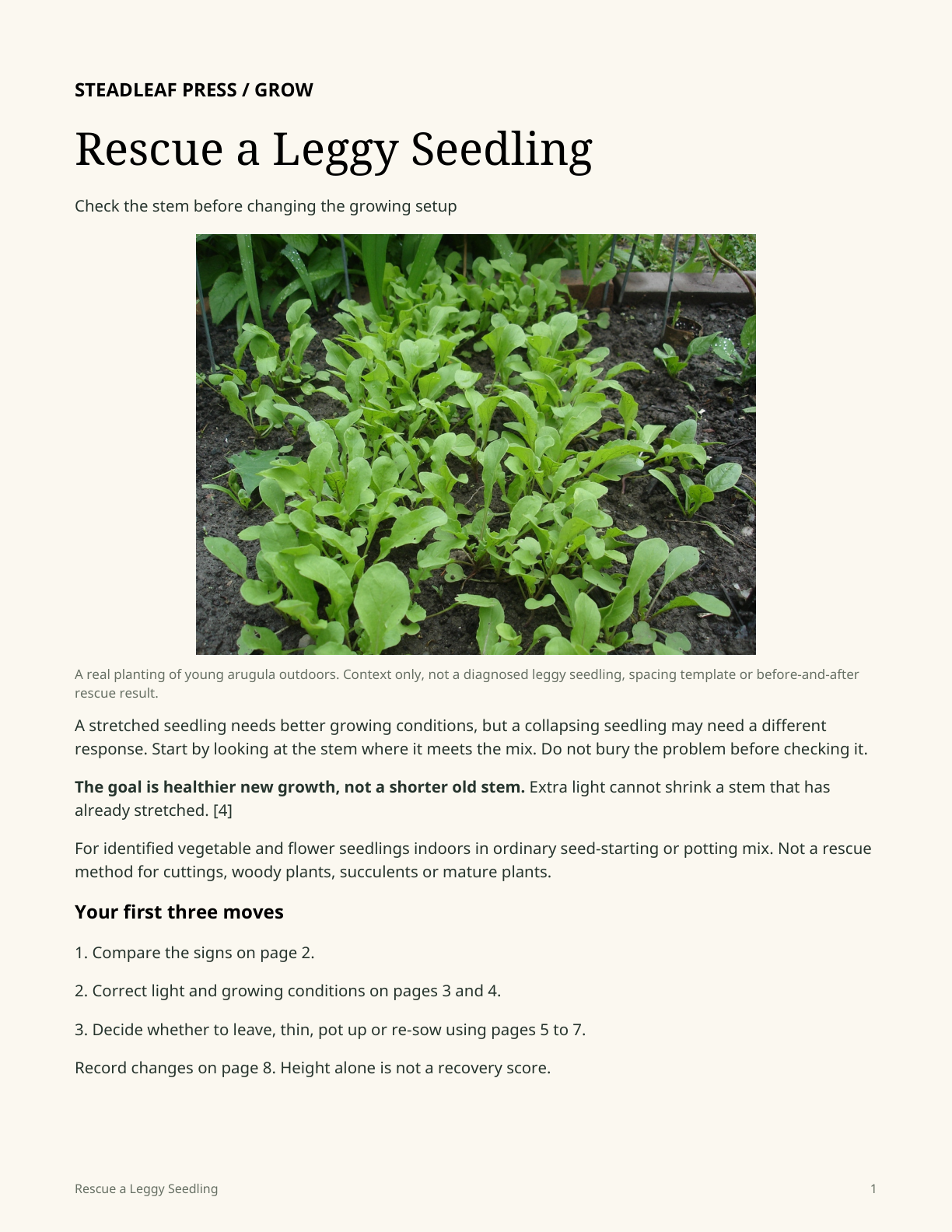
A real planting of young arugula outdoors. Context only, not a diagnosed leggy seedling, spacing template or before-and-after rescue result.
A stretched seedling needs better growing conditions, but a collapsing seedling may need a different response. Start by looking at the stem where it meets the mix. Do not bury the problem before checking it.
The goal is healthier new growth, not a shorter old stem. Extra light cannot shrink a stem that has already stretched. [4]
For identified vegetable and flower seedlings indoors in ordinary seed-starting or potting mix. Not a rescue method for cuttings, woody plants, succulents or mature plants.
Your first three moves
1. Compare the signs on page 2.
2. Correct light and growing conditions on pages 3 and 4.
3. Decide whether to leave, thin, pot up or re-sow using pages 5 to 7.
Record changes on page 8. Height alone is not a recovery score.
Rescue a Leggy Seedling 1
STEADLEAF PRESS / GROW Separate stretching from collapse
Inspect without squeezing or bending the stem. Look closely at the mix line, then compare several seedlings in the tray.
What you see What it suggests Your next move
Long, slender growth or leaning Insufficient light is a possibility; Improve the setup, then watch the toward a window, with an intact warmth and crowding can new growth. stem base contribute
Soft, water-soaked, discolored or Damping off is a concern Stop treating this as ordinary threadlike stem tissue near the mix stretching. Remove affected line, followed by collapse seedlings and their mix; watch neighbors.
Wilt with dry, light-feeling cells but Water shortage may be involved Check moisture and water gently if no obvious stem lesion needed; do not diagnose by height.
Wilt or collapse while the mix stays Root trouble, disease or injury Do not add a stake, more water or wet, or a damaged stem needs investigation deeper mix as an automatic cure.
Stretching: [4,6]. Damping-off signs: [1]. Moisture clues: [7]. These are observations, not a diagnostic test.
Damping off can resemble damage from unsuitable moisture, temperatures or chemicals. A photograph alone may not settle the cause. If the base is unclear, take close-up photographs and ask your local extension service before repotting. [2]
Protect the rest of the tray
Seedlings with damping off seldom become vigorous plants. Discard affected plants with their growing mix rather than moving them into a fresh pot. Use clean water, avoid sharing runoff with other trays, and monitor adjacent seedlings. Start replacements in clean containers and fresh seed-starting mix. [1,3]
Rescue a Leggy Seedling 2
STEADLEAF PRESS / GROW Improve the light that reaches the leaves
Do this promptly for seedlings with intact stems. A window that looks bright to you may still supply too little usable light. Turning a tray can reduce leaning, but cannot make weak light strong. [4,12]
Check the whole growing area
Put seedlings beneath the useful coverage of an appropriate plant-growing fixture, not beside its edge.
Check the lamp model, its seedling instructions, mounting height and any dimmer setting.
Follow the manufacturer's height guidance. There is no single safe distance for every LED panel, shop light and fluorescent fixture.
Adjust the fixture as plants grow. Keep leaves from touching lamps. Browning near the light can signal excessive exposure or heat; do not respond to every long stem by lowering a powerful lamp. [5]
Use a timer and a suitable schedule
For many common seedlings, extension guidance uses roughly 12 to 16 hours of light daily. Check crop-specific needs and leave a dark period; continuous lighting is not the default rescue. [5,12]
Hours and intensity work together. Running a weak lamp longer does not necessarily supply enough light. If stretching continues, review coverage, output and distance rather than automatically extending the day. [4]
Record the change
Record the lamp model, hours and leaf-to-lamp distance. Photograph from the same angle and compare new growth with earlier growth.
Do not use sudden all-day outdoor sun as a shortcut. Indoor seedlings need gradual acclimation before permanent outdoor planting. [9]
Rescue a Leggy Seedling 3
STEADLEAF PRESS / GROW Reset warmth water and feeding
Match temperature to the growing stage
Warmth used for germination is not automatically right after emergence. Remove the humidity cover once seedlings emerge, and review whether a heat mat is still needed. Do not keep every emerged crop in a hot, enclosed germination setup. [12]
As an example, UMass recommends about 70 to 75°F by day and 60°F at night for tomato, pepper, eggplant, cucumber, melon and squash seedlings. This is not a temperature prescription for every flower or vegetable. Use the seed supplier's or local extension's crop guidance, and measure near the seedlings rather than guessing from the room thermostat. Avoid heat vents and cold windows. [6,8]
Water the root zone without keeping it saturated
Check daily, but do not water automatically each day. Compare the cell's weight and the mix's appearance with its just-watered condition. Let the mix dry moderately between waterings without allowing seedlings to wilt. Small cells can change quickly. [7]
Use a gentle flow that does not flatten stems or displace mix. Whether watering from above or below, let excess water drain and empty the catch tray. Do not leave cells soaking indefinitely. [7]
Do not feed for height
Extra fertilizer is not a support for a weak stem. Too much can produce soft, weak growth. Check whether the mix already contains nutrients; use fertilizer directions intended for seedlings rather than guessing a stronger dose. [7]
Allow air circulation around the plants rather than enclosing emerged seedlings beneath a cover. [12]
Rescue a Leggy Seedling 4
STEADLEAF PRESS / GROW Give seedlings room without damaging them
Choose the least disruptive useful action
Only seed leaves so far: The first leaves are cotyledons; true leaves develop afterward. Correct the setup, but do not force a fragile plant through repotting simply because it is tall. First true leaves are a common stage for separating seedlings grown together. [8,11]
Several seedlings in one cell: Keep the healthiest suitable seedling and snip unwanted ones near the mix surface with clean scissors. Pulling extras can disturb the roots of the one you want. Use the crop's spacing guidance. [9]
Individual pots crowded together: Spread pots so leaves receive light instead of shading one another. Pot up when root space is needed, not as a routine height correction. [6]
A gentle potting up sequence
1. Prepare a clean draining container and moisten suitable fresh mix before lifting the plant.
2. Make a planting hole that will accept its roots without forcing them into place.
3. Lift from beneath with a plant label or small spoon. Keep roots supported by their surrounding mix where possible.
4. If you must steady a small seedling, hold a leaf gently, not its delicate stem. Ease crowded roots apart; do not yank.
5. Replant at the previous growing depth unless you have verified a crop-specific exception. Firm lightly and water gently. [8,11]
Beans, peas, carrots and cucurbits such as squash need particular care with root disturbance or alternative starting methods. Identify the crop before separating it. [8]
Rescue a Leggy Seedling 5
STEADLEAF PRESS / GROW Bury stems only with a verified reason
Tomatoes have a useful exception
Tomatoes can form roots along buried stems and may be set deeper when potting up. Wait until they can be handled safely; the Oregon handout uses the second set of true leaves for its first repotting. [10]
For a healthy, identified tomato with an intact stem:
Prepare a draining pot with moistened mix and room for the root ball.
Support the roots and handle by a leaf, not the stem.
Set it somewhat deeper without folding the stem. Remove lower leaves that would touch or sit beneath the mix; keep healthy upper foliage and the growing tip above it.
Firm gently, water in and return to suitable light and warmth. Still correct the conditions that caused stretching. [10]
Do not bury a softened, constricted or rotting tomato stem. The rooting exception is not a treatment for damping off. [1,10]
Other species are not automatically tomatoes
For other crops, keep the previous depth unless reliable crop-specific guidance supports something different. Family resemblance is not enough. Do not assume peppers, eggplants, brassicas or flowers can be buried like tomatoes. [11]
If unidentified, preserve its depth while seeking identification. Do not heap mix around an unclear stem base; it also makes observation harder.
A potting change can improve the growing arrangement. It cannot guarantee that an already damaged seedling will recover.
Rescue a Leggy Seedling 6
STEADLEAF PRESS / GROW Choose rescue re sow or replacement
Use the plant's condition and your planting window, not the time already invested. This planning aid does not predict survival.
Choice When it makes sense What to do
Keep and observe Stem base intact; leaves alive; Correct the setup and assess new improved conditions available growth without repeated disturbance.
Thin or pot up Crowding or container space is the Use page 5; apply page 6 only practical limit; crop tolerates where appropriate. handling
Re-sow alongside a trial Current seedlings are doubtful but Label the new batch and correct the not visibly diseased; enough season original setup first. remains
Replace rather than rescue Stem is crushed, rotting or Discard affected seedlings collapsing; suitable conditions appropriately; consider new seed or cannot be supplied healthy purchased starts.
Make the calendar part of the decision
Look up the crop's indoor starting period and local planting window. A fresh sowing may fit a fast-growing crop but leave a slow-growing crop too late; purchased transplants may be more practical. Starting earlier is not automatically better. [11]
Watch new growth and the base
Check moisture and stability daily. As true leaves develop, look for less stretching in new growth, usable leaves and an intact base. The old stem will not shorten. No fixed recovery deadline fits every crop. [4]
If decline continues, review the setup and disease clues; seek help with the plant name, photographs and record. Before outdoor planting, harden survivors off gradually and follow crop-specific weather limits. [9,11]
Rescue a Leggy Seedling 7
STEADLEAF PRESS / GROW My seedling observation sheet
Use one sheet per crop and batch. Record observations before assigning a cause. Crop variety and sowing date _________________________________________ Today and photo reference ___________________________________________ Stage Seed leaves only / First true leaves / Several true leaves Stem base Intact / Soft or narrowed / Discolored / Broken / Unclear What I see including neighbors _______________________________________ _______________________________________________________________________ My growing setup
Lamp model hours and distance above leaves ___________________________ Day and night temperature near seedlings _____________________________ Cover or heat mat still in use _______________________________________ Mix moisture drainage and water left in tray __________________________ Crowding container size and mix fertilizer content ____________________ My decision and next observation
Choice Keep / Thin / Pot up / Re-sow / Replace / Seek advice Change made and date _______________________________________________ Next check date or growth stage _____________________________________
Check date New leaves and stretch Stem base and moisture Next action
__________ __________________ __________________ ______________
__________ __________________ __________________ ______________
__________ __________________ __________________ ______________
Local planting window and backup plan ________________________________ This sheet records changes. It does not diagnose disease or prove recovery.
Rescue a Leggy Seedling 8
STEADLEAF PRESS / GROW Sources and photo credit
Primary extension guidance checked November 2, 2026. The triage table, decision aid and worksheet are original Steadleaf Press tools, not validated diagnostic tests. Crop requirements and lamp specifications take precedence over generic examples.
1. University of Minnesota Extension. How to Prevent Seedling Damping Off. Symptoms and survival limits.
2. Iowa State University Extension and Outreach. Damping Off. Look-alike causes.
3. Utah State University Extension. Damping-off. Disposal, sanitation and irrigation spread.
4. University of New Hampshire Extension. Growing Seedlings Under Lights. Light quantity and irreversible stretching.
5. University of Vermont Extension. Tips for Choosing Grow Lights. Fixture height, coverage and heat.
6. UMass Extension. Starting Seeds Indoors Caring for Your Seedlings. Temperature and spacing.
7. Utah State University Extension. Starting Vegetable Seeds Indoors IV Seedling Culture and Transplanting. Water, nutrients and airflow.
8. University of Maine Cooperative Extension. Plant Propagation in Maine. Bulletin 2410. Handling, depth and transplant-sensitive crops.
9. University of Georgia Center for Urban Agriculture. Get Growing Early A Guide to Seed Starting. Thinning and acclimation.
10. Oregon Master Gardener Association in cooperation with OSU Extension. Growing Tomatoes in the Home Garden. Indoor tomato repotting.
11. Rutgers Cooperative Extension. Starting Vegetable Seeds Indoors. FS787. Timing and planting depth.
12. Iowa State University Extension and Outreach. How to Successfully Start Seed Indoors. Emergence, covers and light schedules.
Photo credit
soommen, “Young plants,” image 19678, Eruca vesicaria, via NC State Extension Gardener Plant Toolbox. Creative Commons Attribution 2.0 Generic. Full frame proportionally resized and JPEG encoded; no crop, retouching or generated alteration.