Reuse a Clean Plant Pot Responsibly
A second life starts with a closer look.
Inspect and clean an empty pot, match a suitable disinfection process and record washed-only, process-complete, hold or retirement status before reuse.
FREE · No email or checkout
Free practical guide. No email or payment required. Photos are contextual illustrations, not proof of measured conditions or physical trials.
Read the complete free guide online
Read the instructional text here, or download the complete free PDF above for original diagrams, tables, worksheets and page layout. The original publication is unchanged.
STEADLEAF PRESS / GROW Reuse a Clean Plant Pot Responsibly
A second life starts with a closer look.
An empty pot can be the beginning of another good growing season. Before filling it again, give it a simple route through inspection, cleaning and a suitable disinfection process. A tidy-looking surface is only one part of the decision.
This guide helps you sort ordinary, manageable plastic, glazed ceramic and terracotta plant pots into ready, not yet ready, or retire from planting use. You will finish with a short reuse record rather than a guess based on appearance.
Work with empty pots only. Containers with unknown chemical use, sharp damage, a difficult disease history or uncertain material need advice or retirement, not a more aggressive home treatment. Large planters, wood, metal, fabric and self-watering mechanisms need their own care instructions.
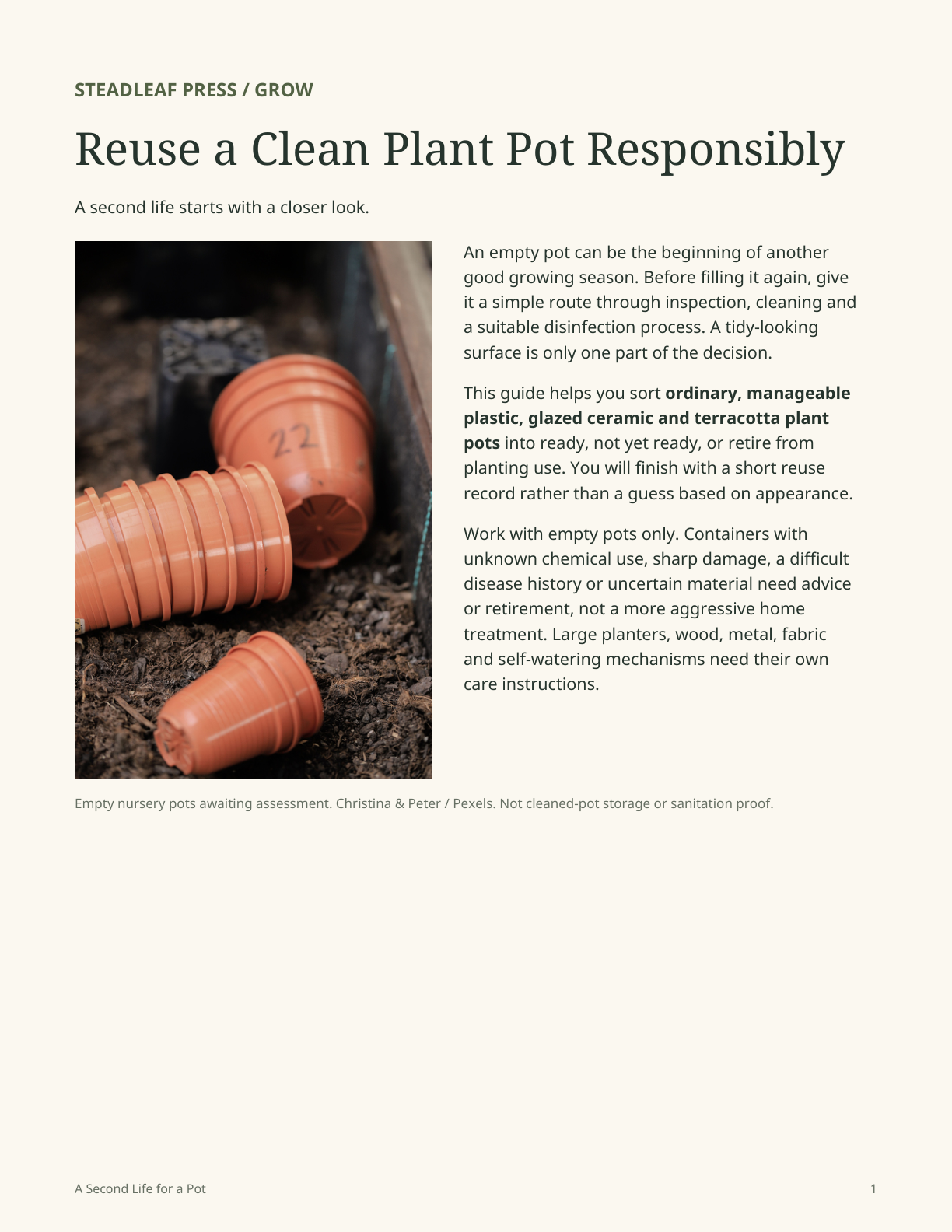
Empty nursery pots awaiting assessment. Christina & Peter / Pexels. Not cleaned-pot storage or sanitation proof.
A Second Life for a Pot 1
STEADLEAF PRESS / GROW Start with the pot's story
Look over the dry, empty container without flexing a brittle wall or running a finger along a sharp rim. Separate any saucer or removable insert that can be detached normally. Keep used items apart from pots already prepared for planting.
What you find What to do next
Known plant-pot use; sound walls and base Continue with cleaning and a suitable disinfection plan.
Cracks, sharp chips, a crumbling rim or a badly distorted Retire it from planting use rather than relying on a base repair to carry a wet root ball.
Former use is unknown, or it held chemicals rather than Do not assume washing makes it suitable for planting. plants Seek appropriate advice or use another pot.
The previous plant had disease or a persistent pest Keep the pot separate. Ask for guidance for that problem problem and material before deciding to reuse it.
A finish, coating or material cannot be identified Check maker's guidance before soaking, scrubbing or applying chemicals.
Check the drainage openings while the pot is empty. Notice blocked holes and areas under a rolled rim where debris could remain. This is an inspection, not a drilling or repair project. Sound construction and suitable drainage remain basic container requirements. [5]
Why the history matters: soil and root fragments can carry plant pathogens between uses. University of Minnesota Extension notes that these organisms can remain even when a pot looks clean. Iowa State recommends both cleaning and disinfection before reused pots receive another plant. [1,2]
A Second Life for a Pot 2
STEADLEAF PRESS / GROW Clean first, inside and out
Set up a washable work area with a separate container for debris, a pot-cleaning brush or cloth, water and a suitable mild detergent. Keep the work away from food preparation and protect nearby surfaces from dirty water. Wear appropriate gloves; handle damaged pots separately rather than reaching into them.
1. Empty the hiding places. Remove loose old mix, roots and labels that trap dirt. Collect debris rather than washing chunks of medium into a drain. Do not transfer the old material into the next pot as part of this task.
2. Wash the whole container. Use soapy water and a brush or cloth suited to the material. Work around the inner wall, rim, base, outside and drainage openings. Clean the saucer and any compatible removable insert too. Iowa State and UMN both put removal of soil and grime before disinfection. [1,2]
3. Rinse away the wash. Remove loosened debris and detergent thoroughly before a separate disinfection step. Do not add disinfectant to the dirty wash water. Cleaning and disinfection are separate stages, not ingredients to combine. [1,3]
4. Look again. Washing may reveal a crack, rough edge or blocked outlet that was hidden by soil. If stubborn deposits remain, use the pot maker's material-compatible advice rather than a knife, harsh abrasive or improvised chemical mixture. A white crust can be mineral buildup; colour alone does not establish what a deposit is. [1]
Material note: plastic and glazed ceramic are generally easier to wash than porous terracotta. A method intended for a hard, non-porous surface should not automatically be assumed suitable for unglazed clay. [1,4]
At this point the pot is washed, not certified free of plant disease. Keep it in the “not yet ready” group until the next step is resolved.
A Second Life for a Pot 3
STEADLEAF PRESS / GROW Match the disinfection method to the job
Use a current product label and reliable horticultural guidance that fit the pot material and intended plant-container use. A household product's claim against a human pathogen does not establish that it treats the plant problem you are concerned about. Iowa State notes uncertainty about the effectiveness of many household cleaners against plant pathogens; EPA explains that a disinfectant's supported uses depend on its label. [1,4]
Before opening or preparing anything, find these answers:
Label or guidance check What you need to know
Intended use and material Is this use appropriate for plant containers and this surface, including porous clay if relevant?
Product preparation Is it ready to use, or does this exact product require a specified dilution?
Application and contact time Which surfaces must be treated, how, and for how long? Follow any requirement to keep them wet throughout.
Finishing Is rinsing required? What drying or waiting instructions apply before planting or storage?
Protection and disposal What gloves, eye protection, ventilation, storage and disposal directions apply?
If an answer is missing or conflicts with the pot maker's instructions, pause and ask the manufacturer or a horticultural adviser. Do not substitute a remembered bleach ratio, extend a tool-only instruction to a pot, or make a stronger solution “to be sure.” This guide deliberately provides no all-purpose concentration or soaking time.
One clear safety rule: never mix bleach or another disinfectant with other cleaners or disinfectants, including vinegar, ammonia products or detergent. Use the specified protection and ventilation, keep products away from children and pets, and follow disposal directions and local rules. CDC supports the no-mixing and ventilation precautions; its household-surface recipes are not plant-pot protocols. [3]
Complete the appropriate directions exactly, including the finishing steps. Record what you used and when. The record describes a completed process, not laboratory proof of sterility.
A Second Life for a Pot 4
STEADLEAF PRESS / GROW Inspect, store, then match to a plant
Place the prepared pot on a clean surface. Inspect the inside, rim, base and outlets once more. Set aside any pot whose condition, remaining residue or treatment is still uncertain.
For storage, let it dry as directed before putting it away. Keep prepared pots separate from dirty ones; avoid forcing them into tight stacks or leaving loose debris inside. A simple paper tag makes it easier to remember which stage is complete.
Before planting, check that the container still suits the intended plant's root space and drainage needs. Follow any material-specific preparation instructions: a dry pot taken from storage is not automatically ready to fill in every situation. Cleaning does not fix an oversized cavity, a cracked base or a missing drainage outlet.
Use four honest status labels
WASHED ONLY: visible soil and detergent removed; disinfection method unresolved or not yet completed.
PROCESS COMPLETE: suitable cleaning and disinfection directions completed, finishing steps followed, and condition checked. Reassess fit for the next plant before use.
HOLD: an unanswered question about history, material, residue, disease or treatment needs resolving.
RETIRE FROM PLANTING: the pot cannot be responsibly prepared or safely used. Check local disposal or take-back options; do not assume every plastic plant pot belongs in household recycling. [1]
Invented example: two second-hand pots look equally tidy. One has a known history and compatible care instructions; the other has a split rim and an unknown coating. The gardener prepares the first through the full process and retires the second from planting. Matching colour is not a reason to treat them as equivalent.
A Second Life for a Pot 5
STEADLEAF PRESS / GROW Your reuse checklist
Pot description / date: _______________________________________
Previous use and any plant-health concern: _____________________
Material and maker's instructions, if available: ___________________
Checkpoint Done / question to resolve
Sound rim, walls, base and accessible __________________________________ drainage
Old mix and debris removed; inside and __________________________________ outside washed
Detergent and loosened debris rinsed away __________________________________
Suitable disinfection directions identified __________________________________ and completed
Required rinse, drying or waiting steps __________________________________ completed
Final condition, storage and next-plant fit __________________________________ checked
Product / exact directions used: _______________________________
Completion date and remaining question: ________________________
Status: washed only / process complete / hold / retire from planting
Next intended plant, if known: _________________________________
A blank or uncertain answer means “not yet ready,” not failure. Reusing fewer suitable pots is better than rushing every empty container back into service.
A Second Life for a Pot 6
STEADLEAF PRESS / GROW Sources
Primary guidance checked 2 November 2026. The history triage, four status labels and reuse checklist are original editorial tools. No disinfection experiment, microbial test or material-compatibility trial was performed.
1. Iowa State University Extension and Outreach. How to Clean and Disinfect Plant Containers. Cleaning before disinfection, material differences, mineral deposits and limits of household-cleaner claims. Its generic chemical ratios and sharp scraping methods are not reproduced here. https://yardandgarden.extension.iastate.edu/how-to/how-clean-and-disinfect-plant-containers
2. University of Minnesota Extension. Clean and disinfect gardening tools and containers. Debris removal and disease-transfer prevention. For chemical mixing, this guide follows CDC's stricter no-mixing advice and does not adopt the page's detergent exception. https://extension.umn.edu/garden-and-home/yard-and-garden/gardening-in-minnesota/ how-to-clean-and-disinfect-gardening-tools-and-containers
3. Centers for Disease Control and Prevention. Cleaning and Disinfecting with Bleach. Chemical-safety precautions only, not validation of a plant-pot recipe. https://www.cdc.gov/hygiene/about/cleaning-and-disinfecting-with-bleach.html
4. United States Environmental Protection Agency. Selected EPA-Registered Disinfectants. Product-specific intended use, surface, pathogen and label directions. This US guidance explains label reading; use the applicable label and local requirements where you live. https://www.epa.gov/pesticide-registration/selected-epa-registered-disinfectants
5. Iowa State University Extension and Outreach. How to Select Quality Plant Containers. Sound containers and drainage. No striking, drilling or repair method is prescribed here. https://yardandgarden.extension.iastate.edu/how-to/how-select-quality-plant-containers
A Second Life for a Pot 7
STEADLEAF PRESS / GROW Photograph credits
Stack of Empty Plant Pots in a Garden, Christina & Peter, Pexels. A genuine photograph of empty orange nursery pots lying among loose growing material, with rims and molded bases visible. It illustrates pots awaiting assessment, not a completed cleaning process, a recommended storage arrangement or proof of sanitation. The image does not establish prior use or contamination.
Source: https://www.pexels.com/photo/stack-of-empty-plant-pots-in-a-garden-37397141/ License: Pexels License. https://www.pexels.com/license/
The full frame is retained and proportionally reduced for print, with JPEG/PDF encoding. No crop, retouching, generated alteration or staged before-and-after result. No endorsement is implied. The original photograph is retained privately as production evidence; the customer guide uses it within original educational content, not as a standalone stock-photo download.
The source platform describes the pots as terracotta. This guide uses the neutral description “nursery pots” rather than treating colour or a platform label as a verified material analysis. The cleaning decision still depends on the reader's own pot and its care instructions.