Save Dry Seeds From an Open-Pollinated Flower
Labelling, Drying and Storage Guide
Choose a documented healthy parent, collect mature heads, clean and dry a labelled batch, pack only dry seed and preserve identity and crossing uncertainty through storage.
FREE · No email or checkout
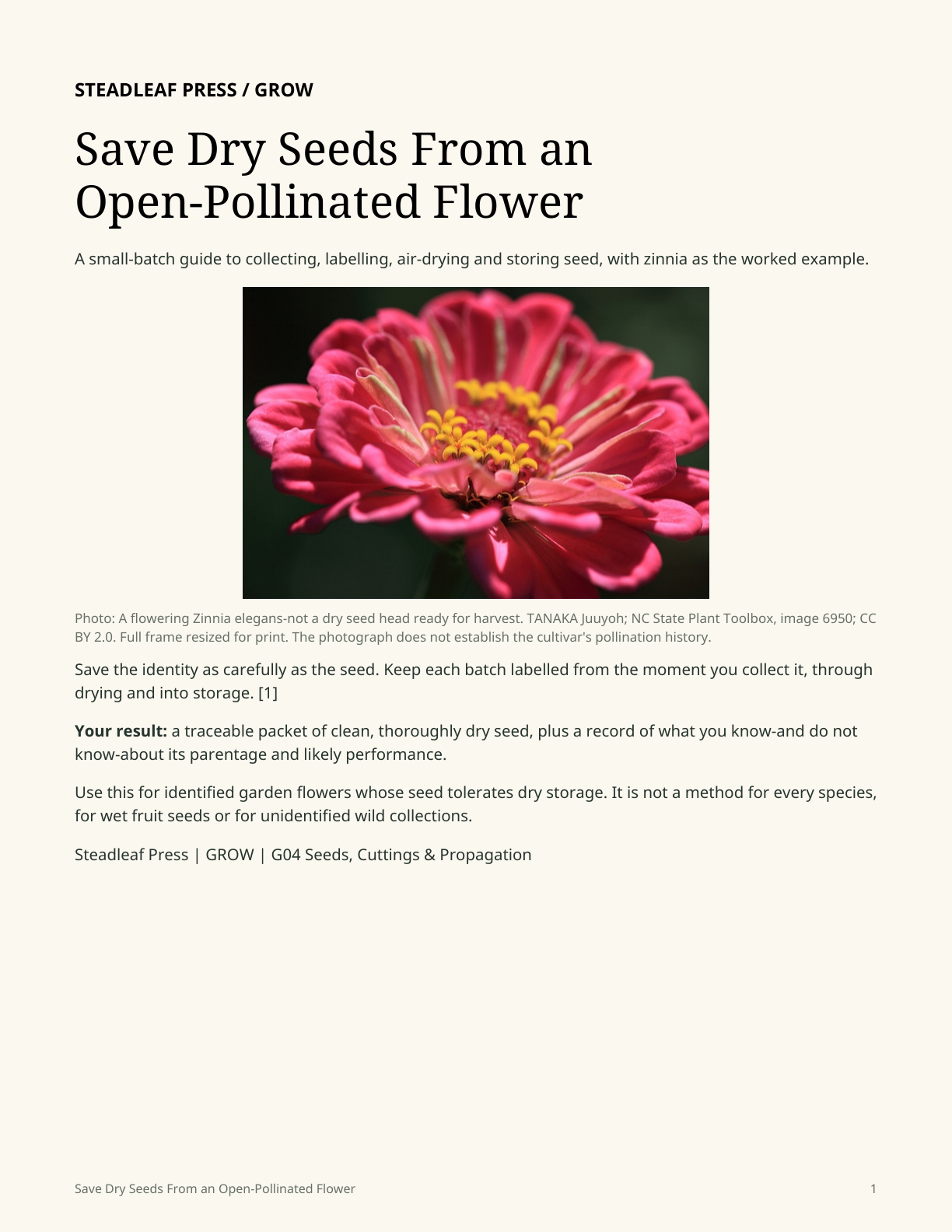
Free practical guide. No email or payment required. The photograph shows a flowering zinnia, not a dry seed head ready for harvest or evidence of cultivar purity; no endorsement.
Read the complete free guide online
Read the instructional text here, or download the complete free PDF above for original diagrams, tables, worksheets and page layout. The original publication is unchanged.
STEADLEAF PRESS / GROW Save Dry Seeds From an Open-Pollinated Flower
A small-batch guide to collecting, labelling, air-drying and storing seed, with zinnia as the worked example.
Photo: A flowering Zinnia elegans-not a dry seed head ready for harvest. TANAKA Juuyoh; NC State Plant Toolbox, image 6950; CC BY 2.0. Full frame resized for print. The photograph does not establish the cultivar's pollination history.
Save the identity as carefully as the seed. Keep each batch labelled from the moment you collect it, through drying and into storage. [1]
Your result: a traceable packet of clean, thoroughly dry seed, plus a record of what you know-and do not know-about its parentage and likely performance.
Use this for identified garden flowers whose seed tolerates dry storage. It is not a method for every species, for wet fruit seeds or for unidentified wild collections.
Steadleaf Press | GROW | G04 Seeds, Cuttings & Propagation
Save Dry Seeds From an Open-Pollinated Flower 1
STEADLEAF PRESS / GROW Choose a suitable parent plant
Confirm the name and seed type
Start with a healthy, identified flower in your own garden, or one you have permission to collect from. Check the original packet or supplier description for an open-pollinated variety. Record the species and cultivar, not only the flower colour. [1, 2]
Open-pollinated varieties are generally better candidates for saving recognisable characteristics than F1 hybrids. Seed from a hybrid may grow, but the next generation can differ. “Open-pollinated” does not mean that crossing cannot happen. [2]
Zinnia example: compatible varieties can exchange pollen and produce different colours or forms next season. Unless you used a suitable isolation method before flowering, record the batch as potentially crossed. This guide is a home seed-saving exercise, not a varietal-purity programme. [3]
What you know What to do
Named open-pollinated variety; healthy plant Keep its original identity and note any possible crossing.
Parent variety known, isolation not controlled Save as an experiment; do not promise identical offspring.
Hybrid, unknown identity or suspect disease Choose a better-documented healthy plant for this exercise.
Mark a few chosen blooms and allow them to finish naturally instead of deadheading them. Seed maturity comes after the attractive flowering stage. A dried bouquet is not automatically a source of mature seed. [1, 3, 4]
Save Dry Seeds From an Open-Pollinated Flower 2
STEADLEAF PRESS / GROW Collect mature heads, one batch at a time
For the zinnia example
Wait until the head is dry on the plant and the short stem beneath it has turned brown. A fading bloom with a green, soft base is not the same stage. Different heads mature at different times; collect the ready ones rather than stripping the whole plant. [3, 4]
Choose a dry day after surface moisture has gone. Prepare a labelled paper bag or an open container, a tray and clean, sharp snips. Keep fingers away from the cutting path. Hold the container beneath the head, snip it off and place it directly into its own batch. [1, 3, 5]
Label immediately: species; cultivar if known; collection date; a simple batch code; and the parent plant or garden location. A phone photo can supplement the label, not replace it. [1, 2]
Do not collect heads that are mouldy, rotting or obviously pest-damaged for this beginner batch. Do not mix questionable material with sound seed. [2, 5]
Other flowers need their own maturity cues
Some pods split or scatter seed suddenly; some flowers require a different harvest stage. Use a species-specific guide before substituting another flower. Drying cannot reliably rescue seed collected before it was fully formed. [1, 4]
At the work surface: process one labelled batch, then clear the tray and tools before opening the next. Keep seeds and snips away from children and pets; these are planting materials, not snacks.
Save Dry Seeds From an Open-Pollinated Flower 3
STEADLEAF PRESS / GROW Clean gently, then finish air-drying
1. Release the seed. Over a clean tray, gently crumble a dry zinnia head. Separate recognisable, filled seeds from the loose petals and other debris, called chaff. Use fingers or tweezers; do not crush the seeds. [1, 3]
2. Remove obvious debris. Pick out large stem pieces, damaged material and obvious empty remnants. Perfect cleaning is not necessary for a small home batch, but excess chaff can hold moisture or pests. Do not blow dusty material toward your face. [1, 3]
3. Spread, do not heap. Put the cleaned seed in a thin layer on clean paper or a shallow tray in a dry, ventilated room, out of direct sun. Keep the batch label with it. Protect it from spills, pets and gusts that could mix or scatter it. [1, 3]
4. Allow enough time. Seed Savers Exchange recommends at least three weeks of final drying for zinnia after cleaning, moving the seeds gently each day for airflow. This is zinnia-specific guidance, not a guarantee that every room or species will be dry on day 21. [3]
5. Check before packing. Seed should be dry and firm, with no dampness, clumping, musty smell or visible mould. If dryness is uncertain, continue ventilated drying; do not seal it for storage yet. Appearance alone cannot certify moisture content or viability. [1, 2, 6]
No heat shortcut: do not use an oven, microwave or food dehydrator for this method. Excess heat can damage seed. In persistently humid conditions, seek species-appropriate drying advice rather than guessing that more days are enough. [6]
Save Dry Seeds From an Open-Pollinated Flower 4
STEADLEAF PRESS / GROW Pack only dry seed
Make the packet traceable
Use a clean paper envelope with seams small enough to retain the seeds. Transfer the batch label and add the year collected, drying start and finish dates, and the date packed. Keep potentially crossed batches separate from any batch whose isolation is documented. [1-3]
Paper alone is not a moisture-proof storage system. Once the seed is thoroughly dry, put the labelled envelope inside a clean, dry, tightly closing jar or other moisture-resistant container. Do not seal freshly collected, damp heads. [1, 6]
Choose a stable storage place
Store cool, dry and away from light. Avoid hot windowsills and sheds or garages with large heat or humidity changes. A refrigerator is an option only when dry seed is protected in a well-sealed container. [6, 7]
When taking a container from the refrigerator, let it reach room temperature while still closed, then open it. This helps avoid moisture condensing on cold seed. Take out what you need and reseal promptly. [7]
Warning sign Action
Condensation or damp seed Stop storage; return sound material to suitable drying conditions and investigate moisture entry.
Visible mould, decay or musty material Keep the batch separate; do not share it or treat it as a sound seed lot. Seek advice or discard it.
Lost label Mark identity as unknown; do not invent a cultivar or distribute it as named seed.
Plan to use the batch next season. Storage life varies; dry appearance and a sealed jar do not guarantee germination. Test a sample before relying on an older or uncertain batch. [5-7]
Save Dry Seeds From an Open-Pollinated Flower 5
STEADLEAF PRESS / GROW Write the label before you need it
Copy these fields onto an envelope or use this page as the batch's companion record. Keep the same code on the drying tray, packet and storage container.
Decision to record Packet / batch label
Species and common name
Parent cultivar; original source; open-pollinated status confirmed how?
Batch code; collection date; parent location
Pollination note: isolated, potentially crossed or unknown
Drying start / finish; packed date; storage location
Example wording-not a real batch: “Zinnia elegans; parent cultivar as named on original packet; home garden; collected 2026-09-18; batch Z1; open-pollinated parent, possible crossing; offspring may vary; packed only after thorough drying.” For sharing, carry the uncertainty forward. “Seed collected from a pink parent plant” describes an observation; “will produce the same pink flowers” makes a promise the record may not support. [2, 3]
Save Dry Seeds From an Open-Pollinated Flower 6
STEADLEAF PRESS / GROW Close the loop on one batch
Batch code: ____________________ Species: ______________________________
Decision to record Observation / next action
Harvest: what showed that these heads were mature?
Drying: where, how long and what conditions?
Packing: why am I satisfied the seed is dry?
Storage check: date, container condition and any moisture or pests
Next season: test / sow date, germination and flower variation
Before putting it away: identity recorded; mature seed collected; suspect material excluded; seed cleaned and thoroughly dried; label retained; container dry and suitable; storage place chosen. If one of those checks fails, record the gap and resolve it before treating the packet as ready. A small, well-documented batch is more useful than several bags whose identity or condition has been lost.
Save Dry Seeds From an Open-Pollinated Flower 7
STEADLEAF PRESS / GROW Sources and photo credit
Checked 2 November 2026. Instructions and worksheets are an original synthesis for a small home batch, not a seed-certification or long-term conservation protocol.
1. New York Botanical Garden: Collecting and Storing Seeds. Mature collection, immediate labels, cleaning, drying and moisture protection.
2. NC Cooperative Extension: Can I Save Seeds from This Year's Garden?. Open-pollinated versus hybrid seed, healthy parents and dry storage.
3. Seed Savers Exchange: How to Save Zinnia Seeds. Zinnia maturity, possible crossing, gentle cleaning and at least three weeks of final drying.
4. Iowa State University: When and how do I harvest seeds?. Species-specific maturity and staged harvest.
5. University of Illinois Extension: Flower seed-saving. Healthy flowers, harvest, cleaning and next-season use.
6. Iowa State University: How do I store collected seeds?. Drying before storage, avoiding excess heat and sealed containers.
7. South Dakota State University: How to Store Leftover Garden Seeds. Humidity, temperature, condensation prevention and testing.
Photo: “Zinnia elegans,” TANAKA Juuyoh, image 6950 in the NC State Plant Toolbox. CC BY 2.0. Resized and JPEG-encoded for print; no crop or AI alteration. Flowering-stage context only, not a mature-seed or variety-purity reference. No endorsement implied.