Start Herbs on a Sunny Windowsill
A First Herb Starter Plan
Assess actual light, choose one suitable herb, arrange a genuinely draining pot and record moisture and growth before a small first harvest.
FREE · No email or checkout
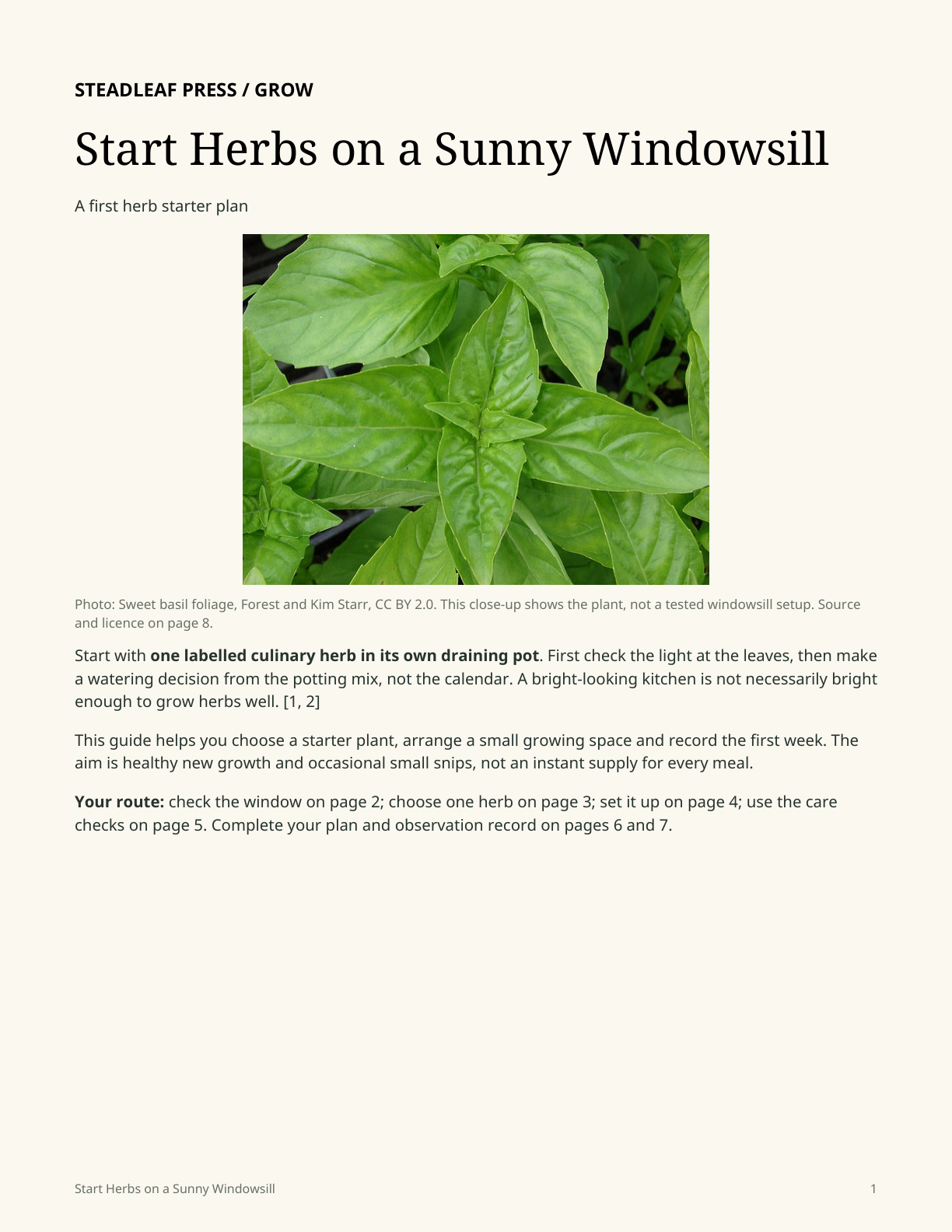
Free practical guide. No email or payment required. The photograph shows sweet basil foliage, not a tested windowsill setup or plant-identification guarantee; no endorsement.
Read the complete free guide online
Read the instructional text here, or download the complete free PDF above for original diagrams, tables, worksheets and page layout. The original publication is unchanged.
STEADLEAF PRESS / GROW Start Herbs on a Sunny Windowsill
A first herb starter plan
Photo: Sweet basil foliage, Forest and Kim Starr, CC BY 2.0. This close-up shows the plant, not a tested windowsill setup. Source and licence on page 8.
Start with one labelled culinary herb in its own draining pot. First check the light at the leaves, then make a watering decision from the potting mix, not the calendar. A bright-looking kitchen is not necessarily bright enough to grow herbs well. [1, 2]
This guide helps you choose a starter plant, arrange a small growing space and record the first week. The aim is healthy new growth and occasional small snips, not an instant supply for every meal.
Your route: check the window on page 2; choose one herb on page 3; set it up on page 4; use the care checks on page 5. Complete your plan and observation record on pages 6 and 7.
Start Herbs on a Sunny Windowsill 1
STEADLEAF PRESS / GROW Check the light before buying
Watch the exact spot where the leaves will sit on a reasonably sunny day. Note when direct sun reaches it and when it leaves. Curtains, screens, buildings and nearby trees can reduce the useful light. Repeat when the season changes; one sunny day does not describe a winter week.
For a first trial, look for about 6 to 8 hours of direct sun. University of Vermont uses that range; Iowa State notes that many indoor herbs need about eight hours. These are planning guides, not a promise that every herb will thrive. [1, 2]
If the window falls short
A south-facing window is often useful in the Northern Hemisphere, but observed sunlight matters more than the compass label. A west or east window may work if enough light reaches the plant. If stems stretch toward the glass or new growth is weak, reassess light rather than automatically adding fertilizer. [1, 3]
A suitable grow light can supplement a short or shaded day. Iowa State suggests a timer giving 12 to 16 hours of light daily. Follow the fixture's distance and safety instructions; one bulb-to-leaf distance does not fit every LED. Keep water away from electrical parts. [1]
Check the physical spot too
Use a stable surface that holds the pot and saucer without overhang. Keep foliage from touching cold glass and avoid hot radiators, heating vents and cold drafts. Turn the pot every few days for more even growth. Basil needs particular protection from cold. [2, 4, 8]
If useful light and a safe position are not available: change the position, add suitable light or postpone the project. Do not buy a large collection to test an unsuitable sill.
Start Herbs on a Sunny Windowsill 2
STEADLEAF PRESS / GROW Choose one herb you will use
A small, healthy nursery plant gives a simpler first trial than a tray of seeds. Buy a clearly labelled culinary plant, keep its label and check both sides of the leaves for pests or damage. Choose compact growth rather than a tightly crowded display pot. [2, 5, 6]
First option Why consider it Main care distinction
Sweet basil Familiar leaves; compact cultivars Warm, bright position. Keep mix Ocimum basilicum are available. lightly moist but draining, not saturated. [7, 8]
Chives A small established clump can suit Needs good light; check moisture Allium schoenoprasum an indoor collection. rather than letting the clump wilt. [5]
Common thyme Small leaves and compact types suit Let the mix dry more between Thymus vulgaris limited space. waterings than basil. Never leave it standing in water. [2, 4]
These are choices, not a three-pot shopping list. Grow different herbs in separate pots so you can water each according to its needs. Small pots may dry rapidly; a much larger pot is not automatically better. [1, 5]
If you prefer seeds
Start one labelled batch. Follow its packet for depth, temperature, germination time and eventual spacing. Use clean containers and a seed-starting mix. Keep the surface appropriately moist during germination; remove a humidity cover once seedlings emerge. Seedlings need strong light and are not ready for routine harvesting just because they have sprouted. [2, 3]
Do not identify food plants from this photograph alone. Keep unknown plants out of the kitchen harvest. Ask the seller about intended culinary use and any treatments before buying.
Start Herbs on a Sunny Windowsill 3
STEADLEAF PRESS / GROW Set up a draining pot
Gather: your labelled starter, a pot with open drainage holes, a saucer, commercial potting mix, water, a label and clean scissors for later. A decorative outer pot is optional; it must not trap water around the growing pot. [4, 5, 6]
1. Keep a suitable nursery pot. If the plant has space for growth and drains freely, there is no need to repot on arrival. Choose a wider stable stand if the sill is too narrow. If repotting is needed, use a modestly larger pot that suits the plant rather than a large reservoir of wet mix. [1, 8]
2. Check the mix. Use loose, well-drained potting mix rather than dense garden soil. If the starter needs repotting, ask the nursery for a suitable pot size and planting depth before disturbing it. [6, 8]
3. Water when needed, then let it drain. Check the existing root ball first. When watering is due, wet the mix evenly until water exits the holes. Empty the saucer or outer pot after drainage; do not leave the base soaking. [5, 6]
4. Position and label. Put the plant in the light you assessed, away from temperature extremes. Write the herb name, starting date and its moisture preference on the plan. [4]
A simple first setup
One established basil plant in its own draining nursery pot, a removable saucer and a genuinely sunny, warm position is enough to begin. If the window cannot provide adequate light, solve that before adding more pots. This is an example, not a required pot size or cultivar.
No-hole jars are not the starter setup in this guide. Drainage must be real, not inferred from a layer of stones in the bottom.
Start Herbs on a Sunny Windowsill 4
STEADLEAF PRESS / GROW Care for growth before harvesting
Check the mix and plant each day at first. A check is not an instruction to water. Feel about 1/2 inch (1 cm) below the surface as an initial check, then consider the herb's preference on page 3. Moist mix is a reason to wait, not add more water. Learn the difference between the freshly drained pot and the lighter, drying pot. Adjust to the herb, pot and conditions; do not impose a fixed daily amount. [3, 5]
What you notice What to check next
Mix still wet; plant drooping or yellowing Check drainage and standing water. More water may worsen the problem. Persistent decline needs diagnosis, not repeated soaking. [3, 5]
Mix dry; pot lighter; plant beginning to wilt Water evenly and drain. Do not deliberately wait for severe wilting. [3, 9]
Long weak stems leaning toward the window Recheck light at leaf level and turn the pot. Consider supplemental light; extra feeding is not a substitute. [1, 2, 3]
Insects, sticky patches or damaged leaves Separate the suspect plant from others and identify the problem before treatment. Check leaf undersides as well as stems. [6, 10]
Feed lightly only when appropriate
Check whether the potting mix already contains fertilizer. Follow the plant and product directions for edible container herbs; do not combine several feeds or treat every yellow leaf as a deficiency. Low-light, stalled or stressed plants need their conditions checked first. [1, 6]
Begin with a small harvest
Wait until the plant is settled and making healthy new growth. Take only a few leaves or tender tips, leaving most of the plant to grow. For basil, pinch or snip a tip just above a leaf pair; do not strip the stem bare. Pause if regrowth slows. [7, 9]
Use clean tools and wash hands and harvested herbs before cooking. Do not harvest unknown, diseased or potentially contaminated material. If a treatment was used, follow its edible-crop directions and harvest interval. [10, 11]
Start Herbs on a Sunny Windowsill 5
STEADLEAF PRESS / GROW Make your first herb plan
Complete this before buying or sowing. Start with one pot; expand only after you understand its drying pattern and see healthy growth. This is a planning sheet, not a promise of a harvest date.
Decision to record My starter plan
Herb and cultivar Labelled culinary source; starter or seeds
Window and space Observed direct sun times; date checked
Light decision Window only, extra light or postpone
Pot and water Drainage, saucer, mix and herb's moisture preference
Review date and next step What would make me change the setup?
Example: “Sweet basil starter; direct sun from 9 am to 4 pm on today's clear day; draining nursery pot; check moisture daily, water only when needed; review new growth and night-time chill in one week.” This is an example record, not a universal schedule. Before first harvest: I can confirm the plant's identity and treatment history, it is growing well, and I can remove a small amount without leaving it bare.
Start Herbs on a Sunny Windowsill 6
STEADLEAF PRESS / GROW Observe the first week
Use one row per check; copy this sheet if you want daily records. Include both watering and no-water decisions. This log is for learning conditions, not forcing progress by day seven.
Date and time Sun or light Mix and plant observations Action and next check hours
At your review date
Is new growth compact and healthy? Does the pot drain? Is the mix staying wet too long or drying unexpectedly fast? Has the light pattern changed? Record one adjustment and compare the next few checks rather than changing water, light and feed all at once. My next decision: keep this setup / change light / change watering checks / seek help / postpone. Adjustment and reason: __________________________________________________________________ __________________________________________________________________ A week may be too soon to judge a seed-grown batch or a slow-growing herb. Use the packet and the plant's response, not this page, to decide when harvesting can start.
Start Herbs on a Sunny Windowsill 7
STEADLEAF PRESS / GROW Sources and photograph
Primary guidance checked 2 November 2026. Bracketed numbers refer to these sources. The planning sheets and example record are original editorial tools, not controlled growing trials.
1. Iowa State Extension - Growing Herbs Indoors. Indoor light, individual pots and restrained feeding.
2. University of Vermont - Indoor Herb Gardening. Six to eight hours, rotation and starter or seed choices.
3. University of Minnesota - Growing herbs in home gardens. Seedling light, crowding and moisture checks.
4. University of Maryland - Growing Herbs in Containers and Indoors. Drainage, herb-specific watering and temperature extremes.
5. UC Master Gardeners of Sonoma County - Winter Herbs Indoors. Small nursery starts, separate pots and no standing water.
6. Illinois Extension - Growing Herbs in Containers. Potting mix, watering through drainage holes and pest checks.
7. NC State Plant Toolbox - Ocimum basilicum. Basil needs, pinching and the credited photograph.
8. Royal Horticultural Society - Herbs in containers. Warm bright basil position and overpotting cautions.
9. Iowa State Extension - Growing Herbs in Containers. Watering before severe wilt and leafy-tip harvesting.
10. University of Minnesota - Managing insects on indoor plants. Inspect, separate and identify suspect plants; treatment labels.
11. University of Maryland - Harvesting and Preserving Herbs. Clean harvesting and rinsing.
Photo: “Ocimum basilicum” by Forest and Kim Starr, NC State image 7076, CC BY 2.0. Source: item 7. Full frame, resized and JPEG re-encoded for layout; no AI editing. The image is not a plant-identification guarantee or evidence of indoor light levels. No endorsement implied.