Take a Clean Stem Cutting from an Easy Houseplant
Cutting Placement and Hygiene Checklist
Identify a healthy pothos stem, retain its lower node, prepare clean tools and jar, set a leaf-free waterline and record follow-up observations.
FREE · No email or checkout
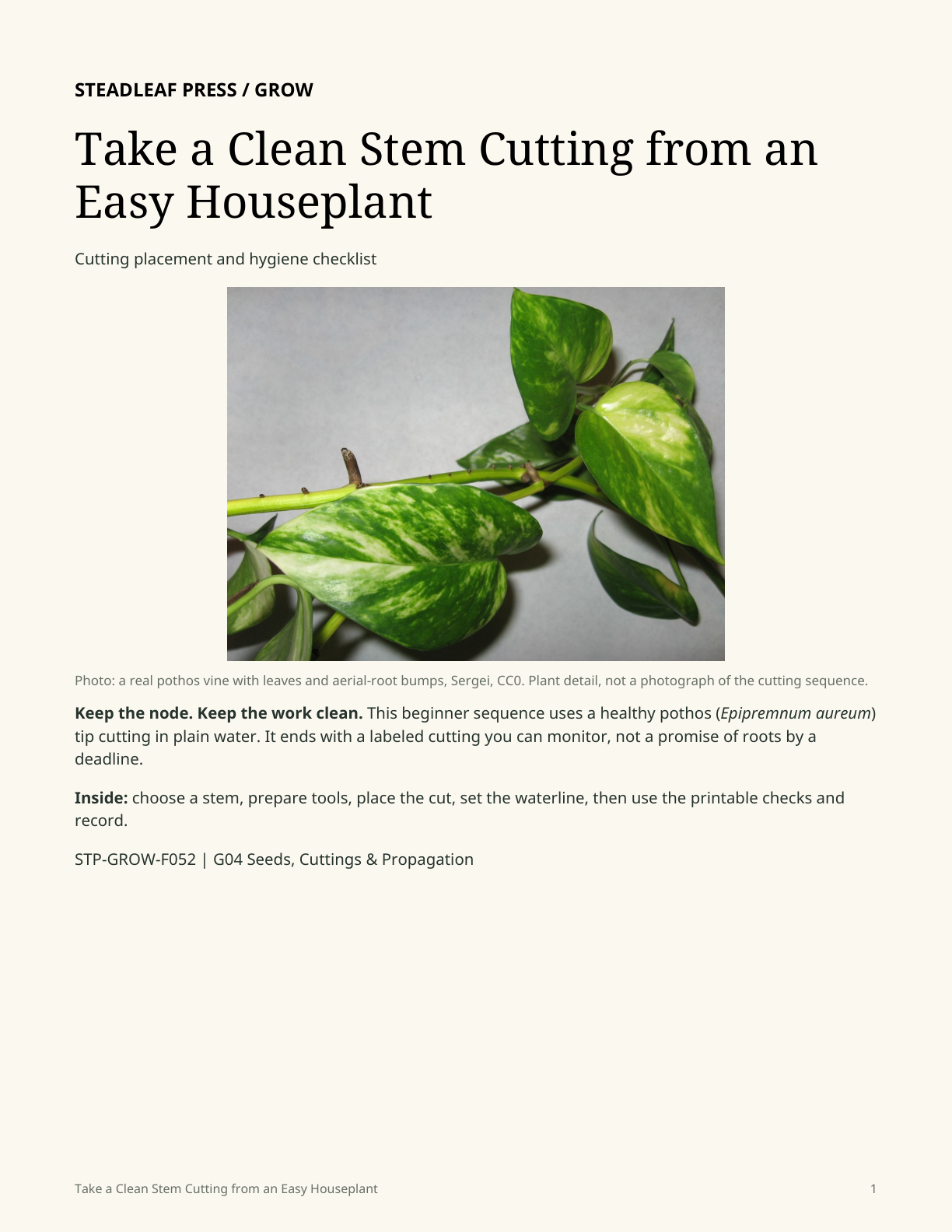
Free practical guide. No email or payment required. The photograph shows a real pothos vine; plant detail, not a cutting-operation demonstration or endorsement.
Read the complete free guide online
Read the instructional text here, or download the complete free PDF above for original diagrams, tables, worksheets and page layout. The original publication is unchanged.
STEADLEAF PRESS / GROW Take a Clean Stem Cutting from an Easy Houseplant
Cutting placement and hygiene checklist
Photo: a real pothos vine with leaves and aerial-root bumps, Sergei, CC0. Plant detail, not a photograph of the cutting sequence.
Keep the node. Keep the work clean. This beginner sequence uses a healthy pothos (Epipremnum aureum) tip cutting in plain water. It ends with a labeled cutting you can monitor, not a promise of roots by a deadline.
Inside: choose a stem, prepare tools, place the cut, set the waterline, then use the printable checks and record.
STP-GROW-F052 | G04 Seeds, Cuttings & Propagation
Take a Clean Stem Cutting from an Easy Houseplant 1
STEADLEAF PRESS / GROW Choose one suitable stem
Confirm the plant before cutting
Pothos is a familiar vining houseplant that can root in water. Identify your plant rather than assuming every heart-shaped leaf is pothos. This sequence is not for cactus segments, succulent leaves, woody branches or an unidentified plant. [1]
Choose a healthy, hydrated stem with firm tissue and normal leaves. Skip material with pests, spreading spots, soft black areas or unexplained collapse. Taking a cutting is not a way to make diseased material clean. [2]
Find the parts you need
Node: the joint on the main vine where a leaf attaches. A small aerial-root bump may be nearby. Leaf stalk: the short connection from leaf to vine; it is not the main stem. A loose leaf and its stalk are not the stem cutting described here.
For this tip-cutting exercise, choose about 3-6 inches (8-15 cm) of stem with at least two nodes and some healthy upper leaves. Follow the nodes, not the ruler alone; do not sacrifice the needed joint to meet a length. [2, 3]
Safe place: pothos is not edible and can irritate skin. Wear gloves when handling sap, wash hands afterward, and keep the plant, discarded pieces and water away from children and pets. [1]
Take a Clean Stem Cutting from an Easy Houseplant 2
STEADLEAF PRESS / GROW Prepare before making the cut
Set out a small clean station
Use sharp scissors or small pruners suited to the stem, a clean work surface, a clean stable jar, room-temperature water, a label and a container for trimmings. Keep fingers clear of the blade path. Close and put away the tool when finished.
Clean is a process not a promise
Remove sap, dirt and plant debris from the cutting tool before disinfecting it. Wash as appropriate for the tool. Use a disinfectant suitable for that tool and follow its label for contact time, protective equipment and any rinsing or drying steps. Never mix disinfectants. Keep chemicals out of the propagation jar. [4]
Clean and disinfect reused containers too. A clear-looking tool or jar is not evidence that pathogens are absent. Repeat tool cleaning and disinfection between parent plants, especially after suspect material; do not resume cutting a healthy plant with the same dirty blade. [4]
Ready check: jar and label prepared; plant identity confirmed; lower node selected; cutting path unobstructed. Work promptly so the detached cutting does not sit drying on the table. [3]
Take a Clean Stem Cutting from an Easy Houseplant 3
STEADLEAF PRESS / GROW Place the cut below a node
Trace first then snip
1. Follow the vine from its growing tip back to the lower node you want to keep on the cutting. Check that upper leaves and another node will remain on that piece.
2. Support the vine without squeezing it. Make a clean cut in the stem just below the selected lower node, on the parent-plant side of that node. Do not cut through the joint. [2]
3. Remove the lower leaf or leaves that would sit underwater. Avoid tearing the main stem or damaging the node. Keep healthy upper leaves attached and above the future waterline. [5]
4. Keep the original orientation: the cut base goes down; the growing tip stays up. Leave the parent with healthy foliage and nodes rather than stripping it for this one trial. [3]
Part to check Correct placement for this exercise
Selected lower node Still attached to the cutting, above its fresh cut end
Bare lower stem Goes into the water with that node submerged
Upper leaves and growing tip Remain above water; not wedged into the jar
Parent plant Remains in its pot; inspect the cut and resume appropriate care
Pause if uncertain: put the tool down and identify the node again. A leaf stalk is not a substitute for the section of main vine.
Take a Clean Stem Cutting from an Easy Houseplant 4
STEADLEAF PRESS / GROW Set the waterline and watch
Place the cutting in the prepared jar so the lower node and cut end are under water and all leaves remain above it. Use a jar that supports the stem without crushing it. Keep it in bright, indirect light, away from direct hot sun. [1, 5]
Check the water level and cutting daily at first. Top up enough to keep the node and developing roots submerged. Replace water one or two times a week, and sooner if it turns cloudy; use fresh room-temperature water and a clean jar. Do not leave dropped leaves in the water. [3, 5]
What you notice Useful response
Node exposed as water falls Restore the level without submerging leaves.
Soft, dark, collapsing stem or foul water Remove the failing cutting; clean the jar and tools before a fresh attempt. Do not share its water with other cuttings.
Firm cutting but no roots yet Check light, warmth and water condition. Keep observing rather than repeatedly recutting it.
Rooting speed varies. New leaves alone do not prove a useful root system. Plan a separate potting step once roots have developed; water roots may need adjustment to potting mix. This guide does not treat water rooting as permanent complete plant nutrition. [3, 5]
Take a Clean Stem Cutting from an Easy Houseplant 5
STEADLEAF PRESS / GROW Cutting placement and hygiene checklist
Mark each item only after checking it. If a key check fails, pause and correct the setup rather than taking more cuttings. Before cutting
[ ] I identified pothos and selected healthy material. [ ] I can point to the main vine, lower node and upper leaves. [ ] The blade is sharp, cleaned and disinfected according to the product label. [ ] My jar and work surface are clean; water and label are ready. [ ] Fingers, children and pets are clear of the work area. Before leaving the jar
[ ] The cutting still contains its lower node and upper foliage. [ ] The cut base points down; the node is underwater. [ ] No leaf blade is submerged and the stem is not crushed. [ ] The label names the plant, date and parent plant. [ ] The jar is stable in bright indirect light and out of reach. [ ] Trimmings are collected; tools and hands are cleaned. My next check: date __________ time __________ One thing to correct before proceeding: ________________________________________________________ ________________________________________________________
Take a Clean Stem Cutting from an Easy Houseplant 6
STEADLEAF PRESS / GROW Record this cutting
Use one sheet per cutting or clearly labeled jar. Observations are evidence, not a guarantee that a particular method will work for every plant.
Decision to record My notes
Plant identity and parent label __________________________ __________________________
Date and cutting description __________________________ __________________________
Node position and waterline checked __________________________ __________________________
Tool and jar cleaning completed __________________________ __________________________
Follow-up date, stem condition and roots seen __________________________ __________________________
Next action: continue observing / replace water / discard failing cutting / plan potting What I will change next time: ________________________________________________________ ________________________________________________________
Take a Clean Stem Cutting from an Easy Houseplant 7
STEADLEAF PRESS / GROW Sources and photo credit
Primary horticultural guidance checked 2 November 2026. This guide deliberately chooses a pothos water-rooting exercise; it does not generalize that method to every houseplant.
1. NC State Plant Toolbox - Pothos identity, water rooting and toxicity.
2. University of New Hampshire Extension - Selecting and preparing houseplant cuttings.
3. Iowa State University Extension - Stem tip cuttings, orientation and water care.
4. University of Minnesota Extension - Cleaning and disinfecting tools and containers.
5. University of Vermont Extension - Water rooting and observation.
Photo: Sergei, Epipremnum aureum. leaves, exact NC State Plant Toolbox gallery image, designated CC0 public-domain dedication. Full frame proportionally resized and JPEG encoded. No endorsement implied. Other photographs on that page have different licenses and are not included.
Scope: an original practical checklist and record by Steadleaf Press, not a sterile-laboratory protocol or a disease diagnosis. Follow disinfectant labels and plant-specific guidance. A successful cut is only the beginning of propagation.